
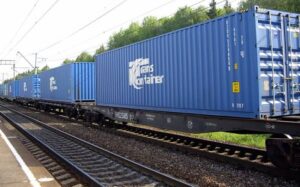
The volume of containerized freight transported by rail in January–August of this year totaled 202.73 thousand DFE (TEU), which is 33% higher than the figures for the same period in 2025, according to Valery Tkachov, deputy director of the Department of Transportation Technology and Commercial Operations at JSC “Ukrzaliznytsia,” on Facebook.
According to him, the business community considers the shortage of fitting platforms (FTPs) in Ukraine to be the main obstacle to further growth in container transportation volumes.
According to data provided by Tkachov, 27% of container traffic during the reporting period consisted of grain (26% for the first 8 months of 2025), 15% (21%) to ferrous metals, 12% (10%) to oilcake and meal, and 6% each to synthetic resins and oil (5% and 7%, respectively, last year).
The expert noted that, against the backdrop of an overall decline in shipments, the share of container traffic in the total cargo volume rose to a record high of 4.4% over the past year.
Tkachov added that the “Liski” branch of the Central Transport Service (CTS) presented a strategy for selling its own rolling stock, under which 60–80% of the FTL fleet is planned to be sold under long-term USTO contracts, and 20–40% through auctions or on general terms.
Currently, the operational fleet of the “Liski” branch of the Central Transport Service consists of 1,500 FTG units, of which 1,200 are 40-foot units, 265 are 60-foot units, and 48 are 80-foot units.
A representative of “Ukrzaliznytsia” noted that due to increased demand for fitting platforms, the branch has begun selling its scarce fleet through “Prozorro.Sales” auctions.
According to the post, business representatives raised concerns regarding the mechanisms for allocating the railcar fleet between long-term USTO contracts and auctions, suggesting that these mechanisms be revised to account for the specific nature of container transportation. To resolve the issue, meeting participants agreed to transition to long-term cooperation regarding the provision of container railcars under USTO contracts. Company representatives were asked to submit requests within a week detailing their FTT needs for 2026–2027, while “Ukrzaliznytsia” plans to conclude the relevant contracts with all interested companies as soon as possible.
“Having signed USTO contracts will allow us to plan the repair of Ukrzaliznytsia’s freight train fleet, taking into account existing repair capacities,” explained the director of Ukrzaliznytsia’s Department of Transportation Technology and Commercial Operations.
In addition, business representatives proposed considering the possibility of leasing FPTs from the non-operational fleet, assuming the costs of their repairs.
Among other issues, the business community cited incorrect preparation of accompanying documents and charges during export and import shipments at western border crossings, as well as congestion at the “Yagodin-Dorohusk” and “Mostyska-2-Medika” crossings, Tkachov reported.
CONTAINER, LOGISTICS, TRANSPORTATION, UKRAINE, UKRZALIZNYTSIA
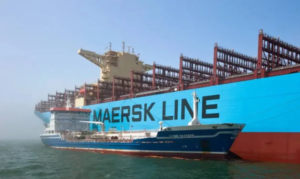
The international transportation and logistics group A.P. Moller—Maersk has temporarily suspended maritime container shipping through the terminal of Chornomorsk Fish Port LLC in the Odesa region.
The decision was made amid a deteriorating security situation and intensified Russian attacks on Ukrainian port infrastructure. However, this does not mean a complete suspension of Maersk’s operations in Ukraine.
“Due to the current situation affecting our operations, the feeder operator is unable to continue providing services to Ukraine via the Black Sea Fishing Port,” Maersk’s Ukrainian division reported.
The service has been suspended until further notice. The company did not explicitly cite the Russian attacks as the reason for this decision; however, the announcement came after a series of strikes on ports and civilian vessels in the Odesa region.
The vessel MEDKON MIRA V.629S, which was scheduled to deliver imported containers to Chornomorsk, will be redirected to the Romanian port of Constanta for unloading.
It is also planned to reroute shipments destined for Chornomorsk that are already in Port Said, Egypt, or en route there, to Constanta. Customers for whom unloading in Romania is not suitable are advised to submit a request to change the destination.
“Chornomorsk Fish Port” is not a term referring to a fishing harbor in the everyday sense, but rather the official name of a separate enterprise and a multifunctional cargo terminal in the village of Burlachya Balka near Chornomorsk.
The company was previously known as “Illichivsk Sea Fishing Port,” and in 2018 it adopted its current legal name—LLC “Black Sea Fishing Port.”
Despite its historical name, the enterprise operates a full-fledged container terminal. It has deep-water berths, Liebherr container handlers, mobile cranes, storage yards, and truck and rail weighing facilities.
The Black Sea Fishing Port is an independent operator and should not be confused with the state-owned seaport of Chornomorsk. The main deep-water port of Chornomorsk and other ports in the Greater Odesa region continue to operate, according to Ukrainian authorities.
The company has suspended only maritime shipments through this specific terminal. Maersk continues to offer cargo delivery to Ukraine via land and multimodal routes, including through Romania and Poland.
Rerouting containers through Constanța may increase transit times and shipping costs. After unloading in Romania, cargo will need to be transported to Ukraine by road or rail.
For Ukrainian importers, this means additional costs for land logistics, changes to documentation, and a possible delay in receiving goods.
At the same time, this decision enhances Constanta’s role as a regional transshipment hub for Ukrainian cargo.
Prior to Maersk, Kernel, a major Ukrainian producer and exporter of agricultural products, had suspended operations at one of its facilities in Chornomorsk following a series of attacks.
However, Ukrainian authorities have not imposed a general ban on ships calling at ports in the Greater Odesa area. Decisions to change routes are made by individual carriers and shipowners with the safety of crews, vessels, and cargo in mind.
A.P. Moller — Maersk is a Danish transportation and logistics group founded in 1904. The company provides maritime container shipping services and manages port terminals, warehouses, and land-based logistics infrastructure.
Maersk operates in approximately 130 countries, serves over 100,000 customers, and has a fleet of more than 700 container ships and a network of 67 terminals in 42 countries. The group employs more than 100,000 people. Thanks to its scale, Maersk is one of the key players in global container trade, and changes to its routes can significantly affect the timing, cost, and availability of international shipments.
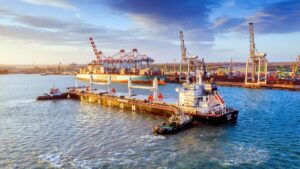
The Mediterranean Shipping Company (MSC) shipping group, headquartered in Geneva and one of the world’s largest, has acquired a 51% stake in the TIS container terminal at the Port of Pivdennyi, according to a report by Latifundist citing data from YouControl.
According to YouControl data, the largest beneficial owners of TIS are MSC owners Diego and Alexa Aponte, each holding 25.5%.
In March of this year, it was reported that global container operator DP World sold its stake in the TIS container terminal nearly six years after acquiring it; the TIS Group bought it back.
According to DP World’s annual report, it owned a 51% stake in TIS Container Terminal Limited, listed as a multipurpose terminal.
According to YouControl, other owners and beneficiaries of the TIS container terminal include Alexey Fedorichev and his “Fedkom Invest SAM” – 18.375%, Oleg Kutateladze – 9.19%, and brothers Yegor Grebennikov and Andrey Stavnitser – 11.72% and 9.72%, respectively.
Viktor Berestenko, President of the Association of International Freight Forwarders of Ukraine, confirmed this information in a comment to Latifundist and noted that MSC’s arrival could, to some extent, intensify competition among container terminals and provide a boost to the development of port infrastructure in Ukraine.
As reported in May 2025, Medlog, a subsidiary of MSC, acquired from Grebennikov a 50% stake in the intermodal logistics operator N’UNIT and a 25% stake in the cross-border terminal “Mostiska.”
In 2024, MSC announced the completion of a deal to acquire a 49.9% stake in the German logistics group Hamburger Hafen und Logistik AG (HHLA), which operates the Odessa Container Terminal (OCT).
The TIS Terminal Group is the largest stevedoring operator in Ukraine. The group comprises five terminals: “TIS-Container Terminal,” “TIS-Coal,” “TIS-Ore,” “TIS-Grain,” and “TIS-Mineral Fertilizers.” The group also owns and operates the largest infrastructure network, which includes a railway station.
According to information on the TIS Group website, the container terminal is the longest (600 m) and deepest (15 m) container terminal in the country. Its container handling capacity is 8 million tons/400,000 TEU per year. In 2021, Maersk consolidated all of its port calls in Ukraine at this terminal.
According to data from the YouControl system, the revenue of Pivdennyi Container Terminal LLC in 2025 decreased by 24.8% to 840.78 million UAH, while net profit fell by 2.8 times to 208.35 million UAH.

According to the company’s press service, Mostyska Dry Port (Mostyska container terminal) handled over 47,000 TEU of containerized cargo in 2025.
According to the report, the consolidated volume of transshipped general, bulk, and liquid cargo for the reporting period reached 395,000 tons. In the structure of cargo traffic, liquid cargo accounted for 200,000 tons, bulk cargo — 115,000 tons, general cargo — 45,000 tons, and grain — 35,000 tons.
“The dynamics of the container market in 2025 were uneven. In such conditions, the ability to adapt to changes becomes crucial. That is why we have consistently invested in storage facilities, modern equipment, and the development of areas that enable us to work effectively with different types of cargo,” said Dmitry Kobzar, CEO of the terminal, whose words are quoted in the report.
The company’s total capital investment in 2025 exceeded UAH 65 million (excluding VAT). In particular, the terminal opened a new covered warehouse with an area of over 4,000 square meters, thanks to which it can ship up to 10,000 tons of grain and meal in containers for export every month.
In addition, the company expanded its fleet of special equipment, in particular, it purchased a Kalmar reach stacker, a JCB telescopic loader, and an AWard container tipper for working at an angle of up to 90 degrees, which accelerated cargo handling processes.
In terms of tax deductions, the terminal transferred UAH 104.4 million to budgets of all levels and funds in the 12 months of 2025. Of this amount, UAH 81.9 million was taxes and fees to the state and local budgets, and UAH 22.5 million was a single social contribution (SSC).
Mostyska Drive Port (Container Terminal Mostyska) is a logistics hub located in the Lviv region near the Shehyni-Medyka checkpoint on the border between Ukraine and Poland. The terminal is a strategic hub that provides a direct connection between the Ukrainian railway network (1520 mm gauge) and the European railway network (1435 mm gauge).
The facility’s infrastructure allows for the transshipment of containers, as well as bulk, loose, and general cargo. The terminal’s technical capabilities ensure a full cycle of cargo handling between Ukraine and EU countries, including transshipment from one type of gauge to another and packing of cargo into containers.
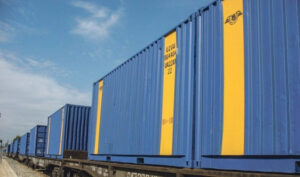
The subsidiary of Ukrzaliznytsia, TsTS Liski, has announced a tender for the purchase of 1,520 20-foot containers, including 1,020 Open Top containers and 500 Pallet Wide containers, according to a statement on Prozorro.
The open tender will be held according to the Dutch auction principle (price reduction – IF-U), with a starting price of UAH 469,088,082 (excluding VAT). The minimum price reduction step is 0.5% or UAH 2,345,440.
The auction is scheduled for June 27. The deadline for delivery of the containers is December 31, 2025.
According to the technical specifications, the Open Top container is designed for transporting a wide range of bulk cargo, hot pellets, and metal products. The container must have a steel all-welded frame.
The Pallet Wide container is designed for the transportation of a wide range of bulk cargoes that are explosion-proof, granular, and non-caking by rail, water, and road transport in domestic and international traffic. It must transport a wide range of piece goods on Euro pallets in width (two rows).
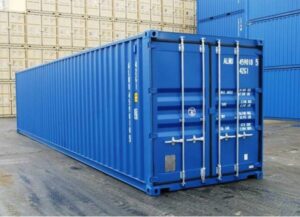
The first container of Serbian goods was shipped to China on Friday as part of the Free Trade Agreement between the two countries, according to the Serbian government website. The container contains products from local companies such as Pionir, Akov, Fruskogorski Vinograd, Vinarija Aleksić, Nutrino, Nash Med, Zarić Rakija, Budimka, and Damar. The transportation was organized by the Milšped company from Krnoševac, near Stara Pazova.
The Minister of Economy Adriana Mesarović noted that this is the result of the hard work of Serbian entrepreneurs, government agencies and Chinese partners, as well as confirmation of the “steel friendship” between China and Serbia. She emphasized that Chinese retailers, importers and distributors have expressed their willingness to accept Serbian products in a market of 1.4 billion consumers.
Chinese Ambassador to Serbia Li Ming said that thanks to the Free Trade Agreement, which entered into force on July 1, 2024, Serbia became China’s first partner in Central and Eastern Europe with such an agreement. He noted that since the agreement came into force, Serbia’s exports to China have increased by 53.7%, and more and more Serbian wines and dairy products are appearing on Chinese tables.
The free trade agreement covers 10,412 Serbian and 8,930 Chinese products. From the first day of application, 60% of the goods were exempted from duties, and over the next five to ten years, another 30% of products will be exempted from customs duties.
Source: https://t.me/relocationrs/633



