The Experts Club analytical center assesses the situation in Ukraine’s warehouse real estate market in 2026 as a transition phase from post-shock recovery to a new growth cycle, in which the main constraints are not demand but a shortage of high-quality space, high construction costs, and security risks.
Following a sharp decline in 2022, when a significant portion of the Kyiv region’s warehouse infrastructure was damaged or destroyed, the market gradually resumed activity in 2023–2025. The most notable recovery occurred in the Kyiv region and in western Ukraine, primarily in the Lviv region.
By the end of 2025, the Kyiv warehouse market had shown the highest level of activity in the past decade. Gross absorption of warehouse space reached approximately 217,000 sq. m, which is 30% more than the previous year. New supply amounted to approximately 216,000 sq. m, and total supply effectively returned to pre-war levels—about 1.57 million sq. m.
Vacancy rates in the Kyiv market remained very low—around 3.5%. This means that despite the introduction of a significant volume of new space, the market is quickly absorbing it. For tenants, this creates a challenge in finding large, high-quality spaces, especially those exceeding 5,000–10,000 sq. m. For developers and property owners, however, this creates conditions for a gradual increase in rental rates and the launch of new projects.
In 2026, Experts Club expects more balanced dynamics. Following a record-breaking 2025, the volume of new supply in the Kyiv region may decline to approximately 90,000 sq. m. This means that the increase in supply will be significantly lower than last year, while demand from key tenant groups will remain steady.
The main drivers of demand remain retail, e-commerce, 3PL operators, the pharmaceutical sector, distributors, FMCG companies, and businesses that are restructuring their logistics to adapt to wartime conditions. Within the demand structure, the role of companies requiring not just “bare-bones warehouses” but modern Class A and B facilities with energy efficiency, autonomy, enhanced security, docking infrastructure, temperature control capabilities, and adaptation to pharmaceutical or food standards is growing.
Rental rates remain stable. In the Kyiv region, the prime rate in 2025 was approximately $5.3 per square meter per month, excluding VAT and operating costs, which corresponds to the pre-war peak level. In hryvnia terms, rates for dry warehouses have risen by approximately 9% since the start of the year and ranged between 200–250 UAH per sq. m per month. In 2026, a further moderate increase in rates is likely, particularly in the segment of high-quality properties with scarce characteristics.
The Lviv region remains the second key center for warehouse real estate development. Its advantages include relative security, proximity to the EU border, its role as a western logistics hub, and demand from relocated businesses, e-commerce, retail, and international operators. Average rates in the Lviv region for Class A and B warehouses in 2025 were approximately $5–5.5 per sq. m per month, and according to some estimates, $6–6.5 in high-quality properties.
At the same time, a local increase in vacancy rates is already noticeable in the Lviv region due to the introduction of new phases of warehouse complexes. This does not indicate oversupply, but signals a gradual transition of the market to a more competitive phase. The most promising areas remain those near the Polish border, routes toward Kyiv, and zones of future industrial parks.
In the central regions, particularly the Vinnytsia, Khmelnytskyi, and Ternopil regions, demand is driven primarily by agricultural companies, local manufacturers, distributors, and businesses seeking to locate warehouses closer to domestic consumers. These regions lag behind Kyiv and Lviv in terms of liquidity but have potential for the development of Class B warehouses, agri-logistics, production-and-warehouse complexes, and regional distribution.
The eastern and frontline regions remain the highest-risk areas. There, demand is largely concentrated on temporary or lower-grade warehouse space, but investment activity is constrained by security concerns. Dnipro retains its status as a major industrial and logistics hub, but investors apply a higher risk premium to projects there.
A key trend for 2026 is the growing demand for specialized formats. This includes multi-temperature warehouses, pharmaceutical warehouses, food logistics facilities, e-commerce facilities, last-mile logistics near major cities, as well as build-to-suit projects tailored to specific tenants. The supply shortage is most acute in these formats.
A separate factor is energy resilience. Following attacks on the power grid, tenants are increasingly evaluating warehouses not only based on location and rent, but also on the presence of generators, alternative energy sources, high-quality engineering, backup power capabilities, fire safety, and stable operation during outages.
Investor interest in warehouse real estate is recovering but remains selective. The most attractive assets are ready-to-use or nearly ready Class A warehouses in the Kyiv and Lviv regions, as well as projects with reliable tenants and long-term leases. For investors, the key considerations are not only yield but also asset liquidity, tenant quality, location security, and the cost of completion.
Current market yields on high-quality warehouse assets in Ukraine may remain higher than in most EU countries due to a war risk premium. However, it is precisely this premium that is the main constraint on the widespread influx of institutional capital. Foreign investors are interested in the segment but are mostly adopting a wait-and-see approach or considering partnerships with local players.
For developers, 2026 will be challenging due to high construction costs. Rising costs of materials, energy, logistics, insurance, financing, and construction work are limiting the launch of new projects, especially without a prior lease agreement. Therefore, the share of speculative construction will remain limited, while build-to-suit and phased development will be more popular models.
Key market risks in 2026:
security threats and the risk of infrastructure damage;
a shortage of high-quality land plots near key transportation corridors;
high construction and financing costs;
currency risks associated with hryvnia-denominated rent payments;
a shortage of large ready-to-use lots;
limited access to long-term capital;
instability in energy supply;
caution among foreign investors.
At the same time, fundamental demand for warehouse real estate remains strong. The Ukrainian market is still structurally underserved with high-quality logistics space compared to Central European countries. The war has accelerated changes in logistics: businesses need more flexible warehouses, closer to consumers, with better engineering, autonomy, and the ability to quickly adjust supply chains.
According to Experts Club’s base scenario, in 2026, Ukraine’s warehouse real estate market will see moderate growth in rental rates, low vacancy rates in the Kyiv region, activity in the Lviv region, and a gradual expansion of high-quality supply in central regions. The greatest demand will be for Class A properties, multi-temperature warehouses, pharmaceutical logistics, last-mile warehouses, and build-to-suit projects.
The optimistic scenario anticipates a more active return of foreign capital, the launch of new industrial parks, and accelerated construction in western and central Ukraine. The negative scenario is linked to heightened security risks, further damage to logistics infrastructure, rising financing costs, and a decline in investment activity.
Experts Club Conclusion: warehouse real estate remains one of the most resilient segments of Ukraine’s commercial real estate market. By 2026, this market will no longer appear to be in crisis, but it will not yet be fully normalized. Its main characteristic is a shortage of quality supply while real demand from retail, logistics, e-commerce, pharmaceuticals, and distribution remains steady.
For developers, this means an opportunity to launch new projects provided they work closely with tenants. For investors, it is a chance to enter a segment with higher returns but increased risk. For tenants, it is a necessity to plan warehouse needs in advance, as finding a high-quality large warehouse “here and now” in Ukraine is becoming increasingly difficult.
The office real estate market of Kyiv and Ukraine’s largest cities by May 2026 is demonstrating cautious stabilization after several years of shocks caused by the pandemic, the full-scale war, business relocation and the transition of some companies to a hybrid work format. The main demand factors remain building safety, completed renovation, autonomous infrastructure, the availability of shelters and the ability to move in quickly without significant capital expenditures.
Kyiv still remains the country’s largest office market. According to InVenture estimates, the total competitive supply of office real estate in Kyiv in 2025 decreased to 2.10 million sq. m, while the vacancy rate fell to 18.5%. The annual volume of gross take-up amounted to about 160 thousand sq. m, which is 26% more than a year earlier. At the same time, about 40% of take-up was related not to the organic expansion of business, but to the forced relocation of companies from damaged properties.
According to the Confederation of Builders of Ukraine, citing a CBRE Ukraine presentation, in the first half of 2025 demand for offices in Kyiv grew by 16%, to 82 thousand sq. m, while supply decreased by 3%, to 2.1 million sq. m, due to damage to office buildings. Vacancy in the market stood at about 21%, while 20% of demand was formed by tenants forced to relocate from properties affected by strikes.

“The office market in Kyiv can no longer be assessed according to pre-war logic. Today, a tenant chooses not simply an address or a building class, but the ability of a property to ensure business continuity. A shelter, generators, engineering systems, the safety of the district and the readiness of the premises for quick move-in have become parameters as important as the rental rate,” says the founder of the Experts Club analytical center, Candidate of Economic Sciences Maksym Urakin.
Rental rates in Kyiv remain relatively stable, but the market retains pronounced differentiation. According to InVenture, effective rates for class A offices without renovation at the end of 2025 amounted to $14-18 per sq. m per month excluding VAT and operating expenses, while for offices with renovation they amounted to $19-25 per sq. m. Asking rates for class A were in the range of $16-27 per sq. m, and for class B — $8-18 per sq. m.
In 2026, Kyiv’s office market remains a tenant’s market: property owners are forced to offer flexible terms, divide large areas into smaller blocks, invest in ready-made finishing and increase the autonomy of buildings. At the same time, the best class A and B+ properties with shelters, stable power supply and high-quality operation are holding demand better than outdated buildings and premises without renovation.
CBRE Ukraine senior office real estate consultant Anastasiia Kachan noted that in Kyiv the connection between the rate and the specific location of a business center has strengthened: now not only proximity to the metro matters, but also the location relative to infrastructure or military facilities. According to her, each business center can effectively operate outside the typical rules of its submarket or district.
IT companies remain the key tenants in Kyiv, but the structure of demand has become broader. Activity is also being formed by the defense sector, medical companies, professional services, consulting, logistics, representative offices of international organizations and part of the business related to reconstruction. According to CBU/CBRE Ukraine, in 2025 demand from the military sector increased noticeably, and the market began adapting offers to such needs.
“The office has ceased to be a place of daily presence for all employees, but it has not lost its significance for management, communication and corporate culture. Companies are optimizing space, but they are not abandoning a quality office. Therefore, demand is shifting from large monofunctional spaces to more flexible, safe and technological formats,” Experts Club notes.
Development activity remains minimal. In 2025, not a single new business center was commissioned in Kyiv, and by the end of 2026, according to InVenture’s estimate, about 27 thousand sq. m may enter the market, but commissioning deadlines may be postponed due to security risks, limited financing and a weak level of pre-leasing.
The situation in Ukraine’s major cities is heterogeneous. Lviv remains one of the most active regional office markets thanks to business relocation, the presence of the IT sector, proximity to the EU border and a relatively higher level of safety compared with the eastern and southern regions. According to Forbes Ukraine, by the end of 2025 vacancy in Lviv business centers decreased to 25%, while rental rates remained at $7-15 per sq. m.
In 2026, the Lviv market can be considered the second most important after Kyiv in terms of office demand, but its scale is limited. For tenants, ready-made premises, transport accessibility, energy resilience and the possibility of accommodating small or medium-sized teams are important. Large deals remain rare, while some companies prefer hybrid formats or coworking spaces.
Dnipro retains the role of an industrial, logistics and service center, but the city’s office market remains more local and less institutionalized than in Kyiv or Lviv. Demand is formed by regional companies, service businesses, retail operators, logistics, medical services and part of production structures. Due to proximity to an area of increased risks, tenants are especially sensitive to the safety, cost and autonomy of premises.
Odesa remains an important southern business center, but the city’s office market is strongly dependent on the overall security situation, port and logistics activity, tourism, trade and service business. The market includes both classic offices in central districts and premises in new multifunctional complexes. Demand in 2026 remains selective: tenants choose ready-made small premises, while large corporate deals are limited.
Kharkiv remains the most difficult of the large office markets due to the high level of security risks and proximity to the frontline zone. A significant part of business operates in a reduced, distributed or remote format. Nevertheless, the market has not stopped completely: demand remains for small offices, service premises, spaces for local business and properties with minimal operating costs.
“In regional cities, office real estate has ceased to be a single segment. Lviv operates as a market of relocation and IT, Dnipro as a market of industrial and service business, Odesa as a southern trade and logistics hub, and Kharkiv as a market of survival and adaptation. Therefore, comparing them only by rental rate is no longer correct: it is more important to look at safety, the tenant profile and the resilience of the local economy,” Maksym Urakin believes.
A common trend for all major cities has been the reassessment of office space. Companies more often choose smaller areas, completed renovation, flexible lease terms and buildings where the owner assumes part of the capital expenditures. Premises without renovation and large blocks in outdated properties remain less liquid, since tenants are not ready to invest in expensive fit-out amid high uncertainty.
Another factor is autonomy. After energy crises and attacks on infrastructure, offices with generators, stable internet, backup systems, shelters and high-quality management gained a competitive advantage. In some cases, such characteristics allow properties to maintain their rate even with overall high market vacancy.
According to InVenture’s assessment, the investment logic of office real estate in 2026 has become more cautious: before the pandemic and the war, the typical payback period for office premises was estimated at about 7-8 years, whereas in 2026, 10-12 years is already becoming the norm for most assets. At the same time, the best properties with a strong tenant and a successful location may show more attractive results, but this is rather an exception.
According to Experts Club’s forecast, by the end of 2026 Ukraine’s office market will move according to a scenario of slow recovery without a sharp increase in rates. Kyiv will retain the status of the main market, Lviv the status of the main regional center of demand, while Dnipro, Odesa and Kharkiv will develop mainly at the expense of local tenants and selective deals.
“The main risk for the market is not the absence of demand, but its quality. Demand exists, but it has become cautious, rational and demanding. Tenants want to pay not for meters, but for a guaranteed ability to work. This means that office real estate in Ukraine is gradually moving from a space model to a service and resilience model,” Experts Club summarizes.
Thus, by May 2026, the office real estate market of Kyiv and major Ukrainian cities remains in a transitional phase. It has already passed through the period of a shock decline, but has not yet returned to a full-fledged investment cycle. The most sought-after offices are becoming safe, ready-to-use, energy-resilient and flexible ones. Outdated properties without renovation, autonomy and a clear operational model will continue to lose competitiveness.

Global stainless steel production in January–March of this year increased by 2.5% compared to the same period last year—rising to 15.774 million tons from 15.387 million tons. Production increased in the U.S., Asia, and China specifically, while it declined in Europe.
These figures are cited in a press release from The World Stainless Association (formerly the International Stainless Steel Forum, ISSF).
According to the information, stainless steel production in Europe decreased by 4.6% in the first quarter of 2026, to 1.468 million tons. In the U.S., production increased by 2.3%, to 566,000 tons.
In Asia, stainless steel production rose by 3.3% to 13.435 million tons, while in China it increased by 4.3% to 9.842 million tons.
In other regions (Brazil, Russia, South Africa, Ukraine, and the UK), production increased by 6.7% to 305,000 tons.
As reported, global stainless steel production in 2025 increased by 2.1% compared to the previous year—to 64.157 million tons from 62.821 million tons. At the same time, stainless steel production in Europe in 2025 decreased by 1.9% to 5.659 million tons. In the U.S., production increased by 7.6% to 2.099 million tons. In Asia (excluding China and South Korea), stainless steel production last year rose by 2.7% to 55.313 million tons, while in China it increased by 3.6% to 40.868 million tons. In other regions (Brazil, Russia, South Africa, the UK, and Ukraine), production fell by 11.3% to 1.086 million tons.
Global stainless steel production in 2024 increased by 7% compared to 2023—to 62.621 million tons from 58.539 million tons, with production rising in all major regions. In 2023, production of this type of steel increased by 4.6% compared to 2022—to 58.444 million tons; in 2022, it decreased by 5.2% compared to 2021—to 55.255 million tons.
Earlier, the information and analytical center Experts Club released a video dedicated to global steel production and leading producing countries – https://www.youtube.com/shorts/VgUU9MEMosE

Spain ranked first among European countries in terms of the number of tourist overnight stays in 2025, confirming its status as one of the world’s leading tourist destinations. According to data from the Experts Club information and analysis centre, tourists spent 329.7 million nights in hotels and other accommodation facilities in Spain last year.
Italy took second place with 264.7 million overnight stays, and Turkey came third with 154.8 million. Next came France with 150.8 million overnight stays and the United Kingdom with 149.8 million, although the figures for the UK are for 2024.
The top ten also included Greece with 130.9 million overnight stays, Austria with 97 million, Croatia with 85.6 million, Germany with 83.6 million and the Netherlands with 64.3 million. Thus, the European tourism market continues to be shaped not only by the largest EU countries but also by medium-sized destinations with a strong focus on resorts and culture.
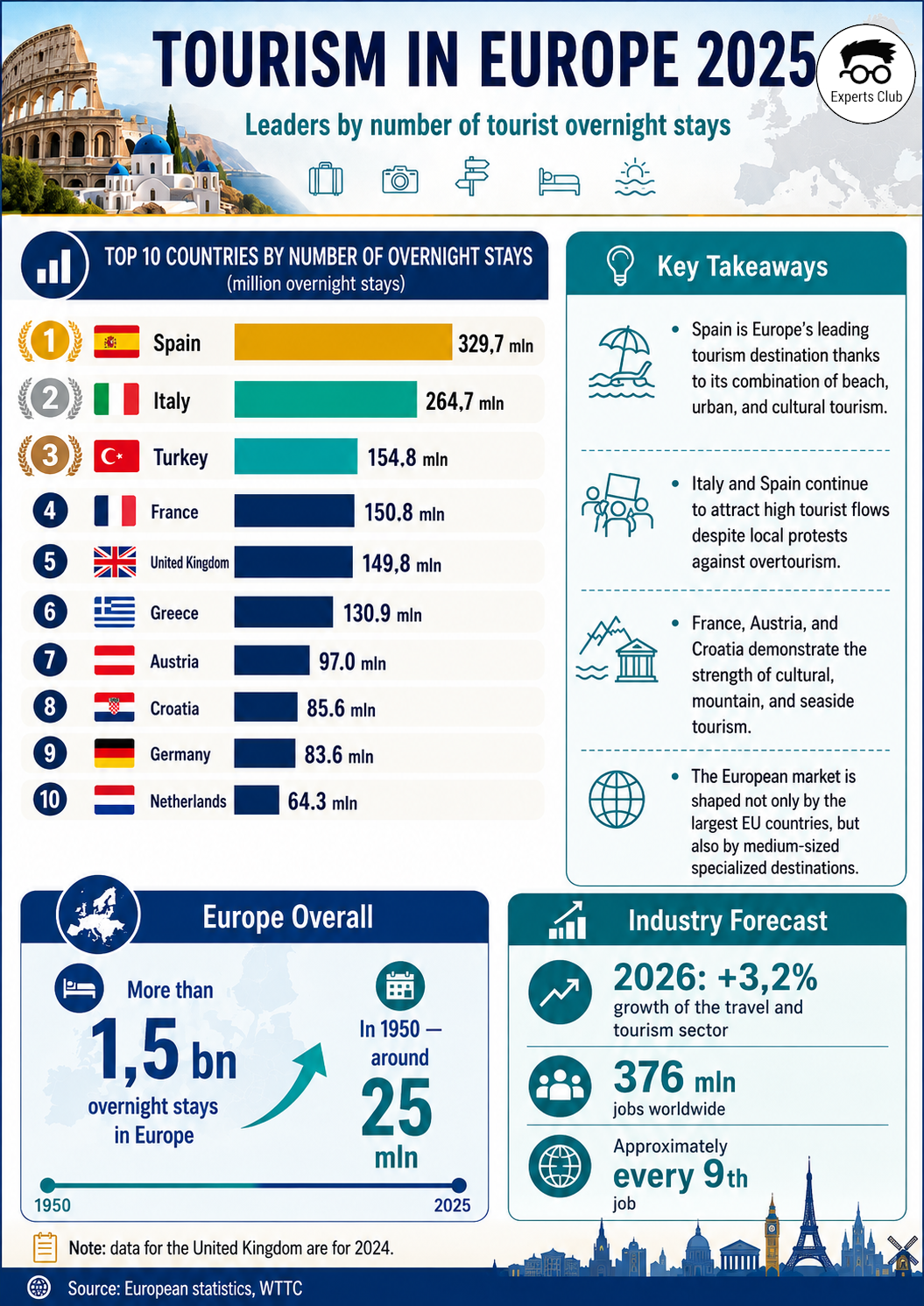
Spain remains the leader thanks to a combination of beach tourism, major city destinations, a well-developed hotel infrastructure and high demand from travellers from Europe and other regions. Despite protests against overtourism in certain regions of Spain and Italy, tourist flows to these countries remain high.
France maintains a strong position not only thanks to Paris. In summer, tourists are drawn to the Côte d’Azur and Provence, and in winter to the Alpine resorts. Austria and Croatia also demonstrate that countries with smaller populations can rank among the leaders by specialising in mountain, cultural and seaside tourism.
Europe as a whole remains the most visited region in the world. According to the data cited in the article, travellers spent over 1.5 billion nights in European accommodation, whereas in 1950 this figure stood at just around 25 million.
For the travel market, this confirms the steady recovery and growth of the tourism industry following the pandemic. According to estimates by the World Travel and Tourism Council, the travel and tourism sector could grow by 3.2% in 2026, and the industry will support 376 million jobs worldwide, or roughly one in nine jobs.