
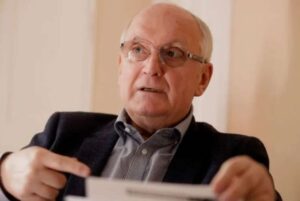
András Baku has become Hungary’s new president, according to Hungarian media reports.
“On Tuesday, the Hungarian Parliament elected 73-year-old lawyer and former Chief Justice of the Supreme Court András Baku as the country’s new president,” the reports state.
It is noted that 140 lawmakers voted in favor of his candidacy, while six voted against it. Representatives of the former ruling coalition, Fidesz—the Christian Democratic People’s Party—had announced in advance that they would not participate in the vote.
Hungary’s new Prime Minister, Péter Magyar, has repeatedly stated since his election in May that he intends to reform the Hungarian government; in particular, he has sought the resignation of President Tamás Szujók. Magyar believes that Szujók was not fulfilling his role and was serving the interests of former Prime Minister Viktor Orbán and his government.
Szujok refused to step down voluntarily, stating that he saw neither constitutional nor legal grounds for doing so. Later, in July, the Hungarian parliament approved a package of constitutional reforms that, among other things, provided for the president’s resignation. As a result, last week Szujok signed the constitutional amendments and stepped down from his post.
Magyar nominated renowned Hungarian chess grandmaster Judit Polgár for the position of the country’s new president, but she declined the offer.
The president in Hungary performs mainly ceremonial functions. The government is headed by the prime minister.

According to “Serbian Economist”, the Hungarian government plans to allocate 3.55 trillion forints, or about 9.8 billion euros, by 2035 for the modernization of the national railway network.
Hungarian Prime Minister Péter Magyar and Minister of Transport and Investment Dávid Vitézi presented the program on July 22 at the Rakospalota-Újpest station in Budapest. Authorities are calling it one of the largest railway projects in the country’s history.
The program is designed to be implemented in several phases. Its main objectives will be to improve the reliability of transportation, reduce travel times, reconstruct tracks and stations, modernize the rolling stock, and develop international rail routes.
The government intends to ensure competitive rail service to all administrative centers in Hungary, modernize regional lines, and expand commuter service around Budapest and other major cities. Specific areas of focus will include the development of freight transport, the establishment of a rail link to Budapest Airport, and the integration of national and urban transportation systems.
It is planned to allocate 1.1 trillion forints from EU Cohesion Funds and 700 billion forints from the European Recovery and Resilience Facility (RRF) to implement the program. An additional 400 billion forints is planned to be raised through loans from the European Investment Bank, with a similar amount to be secured through concession projects. Approximately 950 billion forints will be allocated to projects under the next EU budget cycle for 2028–2034.
The government plans to purchase at least 35 new InterCity trains and 42 commuter electric trains, as well as begin renovating the country’s ten busiest train stations. The average age of MÁV trains and HÉV commuter trains is currently about 43 years, and 42% of the rail network is subject to significant speed restrictions.
On major routes, the government aims to increase the average speed to 100 km/h. Certain sections are planned to be upgraded to accommodate trains traveling at speeds of 160–200 km/h.

According to Serbian Economist, passenger service on the high-speed rail line between Belgrade and Budapest is scheduled to begin within the next one to two months, Hungarian Prime Minister Péter Magyar announced at a press conference on July 16. Thus, provided the new deadlines are met, the first trains could begin running in August or September. However, Hungarian authorities have not yet specified an exact launch date.
In the coming days, Hungarian Minister of Transport and Investment David Vitézi is scheduled to visit Serbia. During talks with representatives of the Serbian government, the parties plan to coordinate the operation of signaling systems and equipment that ensure traffic safety on the cross-border section.
The launch of passenger trains has already been postponed several times. The main issue has been the certification of the European Train Control System (ETCS) installed on the Hungarian section of the line. Inspections conducted in the spring revealed malfunctions that could have compromised train safety at speeds of up to 160 km/h.
The reconstruction of the railway line has already been completed, and on February 27, 2026, freight traffic began on the Hungarian section. The first cross-border freight train traveled from Budapest through Kelebia and Subotica toward Novi Sad. Passenger service has been postponed until the testing and certification of the signaling systems are completed.
The Belgrade–Budapest high-speed rail line is one of the largest joint infrastructure projects between Serbia, Hungary, and China. Once fully operational, it is expected to significantly reduce travel time between the two capitals and strengthen Serbia’s transport links with Central Europe.
https://t.me/relocationrs/3252

The Hungarian government has launched an investigation into former Foreign Minister Péter Szijjártó’s contacts with Russian authorities, Prime Minister Péter Magyar announced on July 16.
According to him, the case file contains classified documents from the Ministry of Foreign Affairs and other agencies. However, it is not yet known which agency is conducting the investigation, whether a criminal case has been opened, or whether Szijjártó is considered a suspect.
The investigation was prompted by reports that the former minister may have briefed Russian Foreign Minister Sergey Lavrov on the progress of negotiations within the EU. Szijjártó denied the allegations and stated that he had not passed on classified information to Moscow.
The investigation coincided with his departure from politics. On July 15, Szijjártó announced that he was resigning his parliamentary seat to take a leadership position at the Chinese company BYD. The prime minister called this a conflict of interest, since while serving as minister, Szijjártó had been involved in providing state support to the company.

Hungary has lifted the ban on Ukrainian media previously imposed by the Fidesz party after coordinating this matter with the Ukrainian Ministry of Foreign Affairs and representatives of the Ukrainian national minority, who participated in the decision-making process.
“Together with the Ministry of Foreign Affairs, we have lifted the ban on Ukrainian media that was previously imposed by the Fidesz party.” In 2025, Fidesz unilaterally banned Ukrainian publications in Hungary in response to Ukraine’s blocking of those Hungarian publications that failed to adhere to journalistic ethics and instead spread Russian propaganda and stoked panic about a third world war,” said Zoltán Tarr, Hungary’s Minister of Social Affairs and Culture, in a post on Facebook.
The post also notes that “media outlets spreading Russian propaganda should not be confused with the genuine, independent press, either in Hungary or internationally.”
“The ousted government constantly worked to sow discord, and the blocking of these publications served no other purpose. Our task—to foster good-neighborly relations, which will help improve the situation of Hungarians abroad—is a common national cause. By following this path, thanks to our previous historic agreement, we have achieved more in a few weeks than the ousted government did in 16 years,” he noted.
It is also reported that the decision to lift the block was coordinated with Liliana Greksa, a representative of the Ukrainian national minority. After the decision was made, she stated that it is important for the Ukrainian community and refugees in Hungary to have access to news about their country in their native language.
HUNGARY, Hungary Has Lifted the Ban on Ukrainian Media, UKRAINIAN MEDIA

According to Serbian Economist, Hungarian law enforcement agencies seized a record 522 kg of cocaine, the Hungarian police reported following a press conference.
According to police, the shipment was discovered at the Csepel port in Budapest among a cargo of bananas. Investigators inspected approximately 7,000 boxes and found 438 blocks of cocaine weighing a total of 522 kg. The estimated black market value of the shipment is approximately 43 million euros. Hungarian authorities called this the largest cocaine seizure in the country’s history.
The operation involved the Hungarian National Bureau of Investigation, the Hungarian Tax and Customs Administration, German law enforcement agencies, as well as partners in the Czech Republic and Slovakia.
Police also reported the arrest of several suspects. Hungarian law enforcement officials believe the country is becoming one of the logistics hubs through which large shipments of drugs from South America are distributed further across the region.
International container shipments of cocaine have surged in recent years. While major flows previously passed through major ports in the Netherlands and Spain, shipments are now increasingly being routed to Southern and Central Europe as well, including ports in Montenegro. From there, shipments can be redirected to other countries in the region.
Hungary has no seaports, but it is actively used as a transit country thanks to its rail and road connections with Germany, Romania, Slovakia, the Czech Republic, and the Balkans. Montenegro, which has access to the Adriatic Sea, is also regularly cited in European investigations as one of the most frequent transit points for illicit shipments into the region.
https://t.me/relocationrs/2944



