

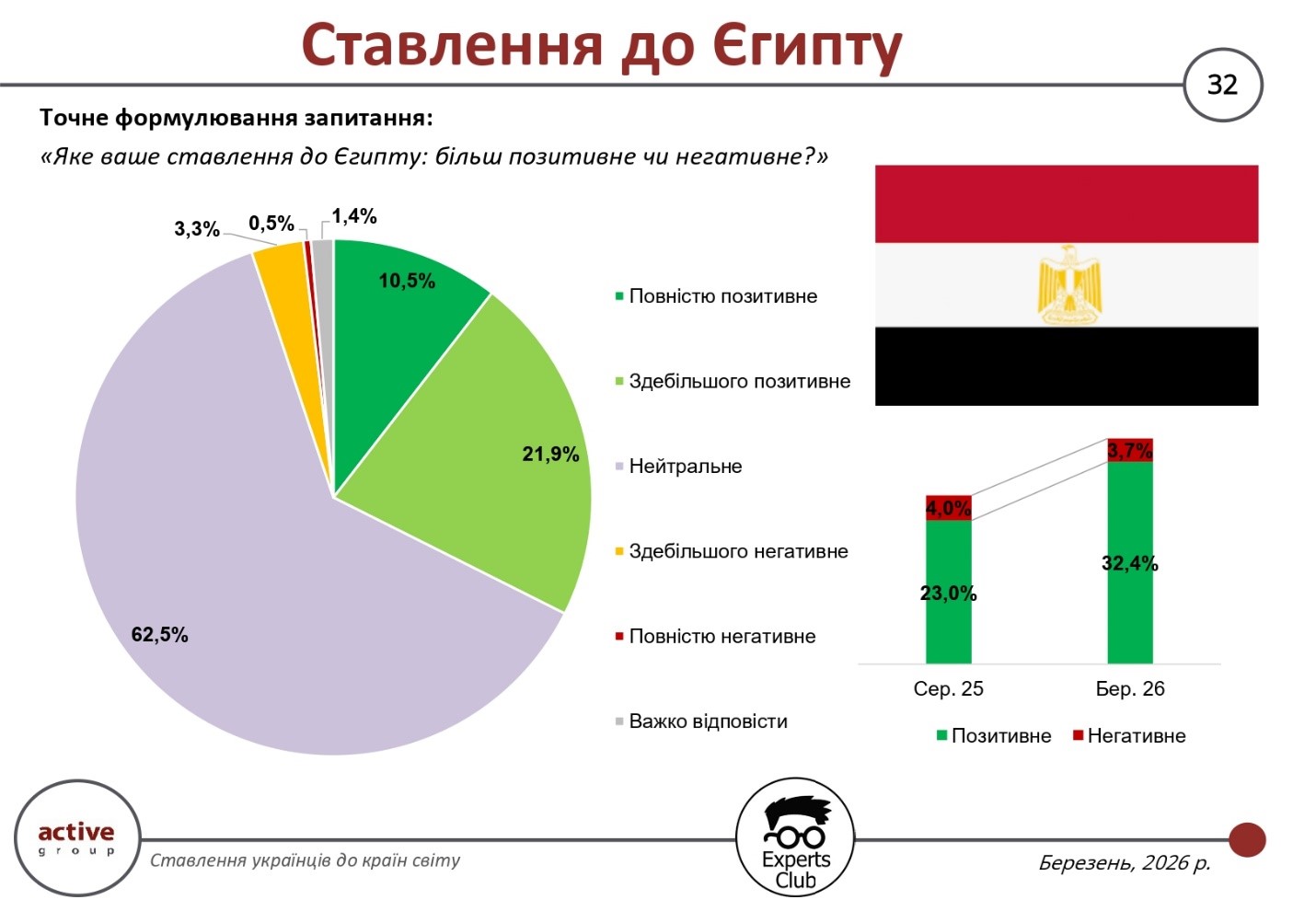
Ukrainians’ attitude toward Egypt remains largely neutral, but trends over the past few months indicate a noticeable improvement in perceptions of the country. According to the results of a sociological survey conducted in March 2026 by the research company Active Group in collaboration with the Experts Club information and analytical center, 32.4% of respondents view Egypt positively, whereas in August 2025 this figure stood at 23.0%. At the same time, the share of negative assessments has decreased slightly—from 4.0% to 3.7%.
The breakdown of responses shows that the largest group remains respondents with a neutral stance—62.5%. This means that for most Ukrainians, Egypt does not belong to the category of countries with a clearly defined emotional image. The positive attitude consists of 10.5% “completely positive” and 21.9% “mostly positive” assessments. The negative segment remains minimal: 3.3% of respondents chose “mostly negative,” 0.5% chose “completely negative,” and another 1.4% were undecided.
Thus, the main feature of attitudes toward Egypt is a combination of very high neutrality with a gradual increase in positive sentiment. This indicates that the country does not yet occupy a prominent place in the Ukrainian information space, yet its image is not negative and has the potential for further improvement. It is also important that the increase in positive assessments is occurring without a rise in critical perception.
“Egypt is a very interesting example of the gap between economic statistics and public perception. Egypt ranks first among Ukraine’s trading partners in terms of trade surplus—over $1.224 billion—meaning it is one of the most profitable markets for us. But in public opinion, we see a predominantly neutral attitude, which means: the country’s economic weight has not yet translated into an equally strong reputational presence,” noted Maksim Urakin, founder of the Experts Club information and analytical center.
From an analytical perspective, this means that Egypt is already an important economic partner for Ukraine, but has not yet become a country with a clearly established positive image in the public consciousness. Given such a significant positive trade balance, the potential for strengthening the bilateral image remains quite high. If economic cooperation is complemented by greater public visibility, humanitarian contacts, and an information presence, some of the current neutrality may eventually shift toward a more pronounced positive perception.
According to a study conducted by the Experts Club information and analytical center based on data from the State Customs Service, Egypt ranks 19th in total trade volume with Ukraine, with a figure of $1.82 billion. At the same time, Ukraine has a significant trade surplus with Egypt, as exports of Ukrainian goods exceed imports by more than five times.
The study was presented at the Interfax-Ukraine press center; the video can be viewed on the agency’s YouTube channel. The full version of the study can be found at this link on the Experts Club analytical center’s website.
ACTIVE GROUP, EGYPT, EXPERTS CLUB, Pozniy, SOCIOLOGY, SURVEY, UKRAINE, URAKIN
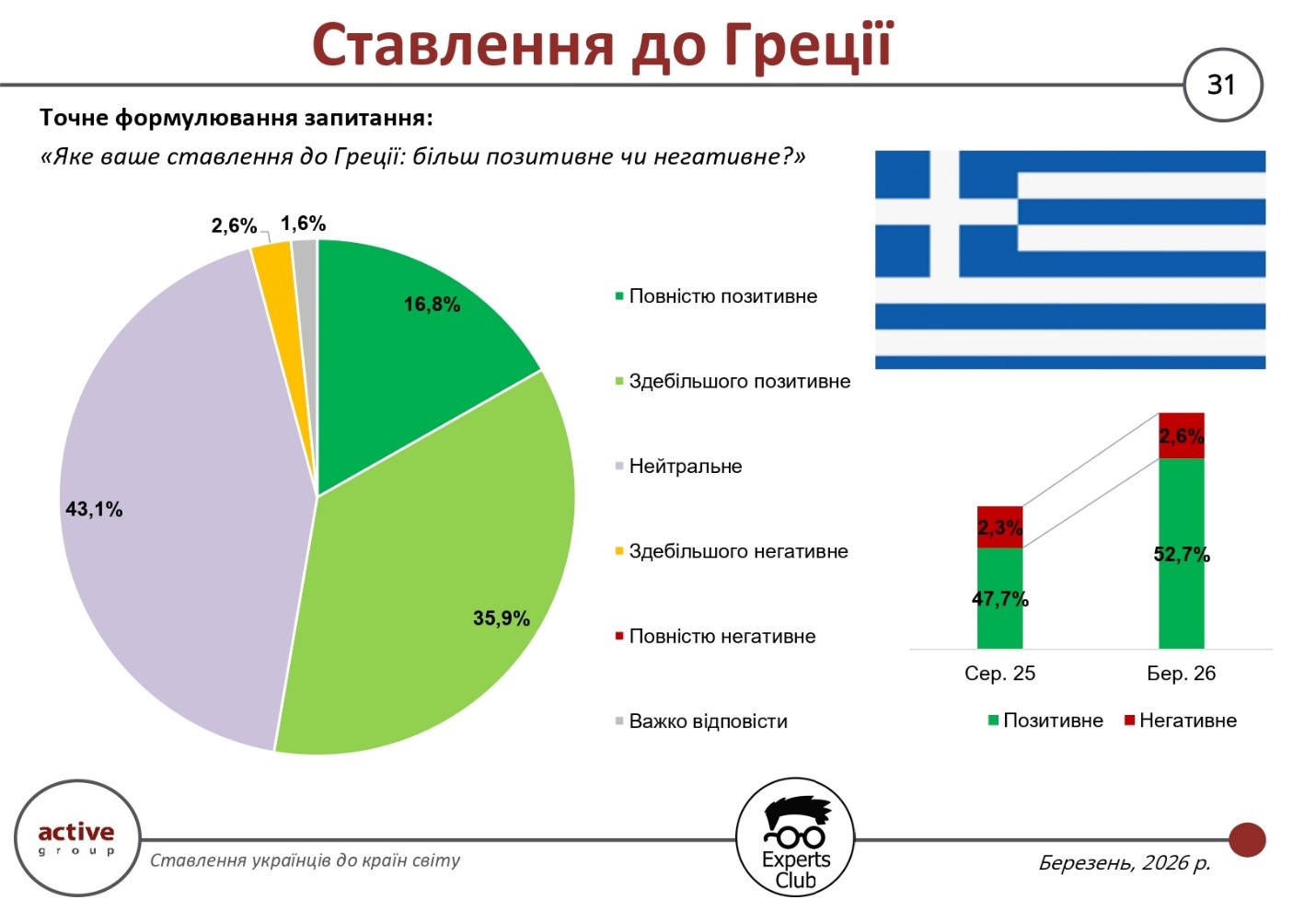
Ukrainians’ attitudes toward Greece are showing a moderately positive trend. According to the results of a public opinion poll conducted in March 2026 by the research company Active Group in collaboration with the Experts Club information and analytical center, the share of positive assessments stands at 52.7%, which is higher than the August 2025 figure (47.7%). At the same time, the level of negative perception remains low and fluctuates around 2.6% (compared to 2.3% previously).
The breakdown of responses indicates a predominance of moderately positive attitudes. 16.8% of respondents chose the option “completely positive,” while another 35.9% selected “mostly positive.” Thus, more than half of Ukrainians generally view Greece positively, although the intensity of this attitude remains less pronounced than in the case of leading European partners.
At the same time, a key feature is the significant share of neutral assessments—43.1%. This indicates that for a significant portion of Ukrainian society, Greece does not fall into the category of countries with a clearly formed emotional image. Negative assessments remain marginal: 2.6% of respondents indicated a “mostly negative” attitude, while the share of “completely negative” assessments is virtually nonexistent. Another 1.6% of respondents were undecided.
Comparative trends show that over the past six months, attitudes toward Greece have become more positive, though the changes are gradual. The increase in positive assessments occurred without a significant rise in negative ones, indicating a gradual strengthening of the overall perception of the country without sharp fluctuations in public opinion.
The high proportion of neutral responses indicates limited intensity of contact or informational influence. In such cases, positive dynamics develop more slowly than in countries that have a more noticeable presence in the political, economic, or humanitarian spheres for Ukraine.
“The results regarding Greece show that Ukrainians do not form strong opinions where interaction is less intense. In such cases, we see a combination of a moderately positive attitude with a large proportion of neutral responses. This means that the country’s image is still in the process of formation,” noted Oleksandr Pozniy, director of the research company Active Group.
Overall, the survey data indicate that Greece is gradually strengthening its position in Ukrainian public opinion, though the country’s level of engagement and influence on perceptions remains moderate. The primary potential for further improvement lies in shifting from a neutral to a more clearly positive perception.
According to a study conducted by the Experts Club information and analytical center based on data from the State Customs Service, Greece ranks 18th in total trade volume with Ukraine, amounting to $1.92 billion. Imports from Greece significantly exceed exports from Ukraine, resulting in a trade deficit of over $1.13 billion.
The study was presented at the Interfax-Ukraine press center; the video can be viewed on the agency’s YouTube channel. The full version of the study can be found at this link on the Experts Club analytical center’s website.
ACTIVE GROUP, EXPERTS CLUB, GREECE, Pozniy, SOCIOLOGY, SURVEY, UKRAINE, URAKIN
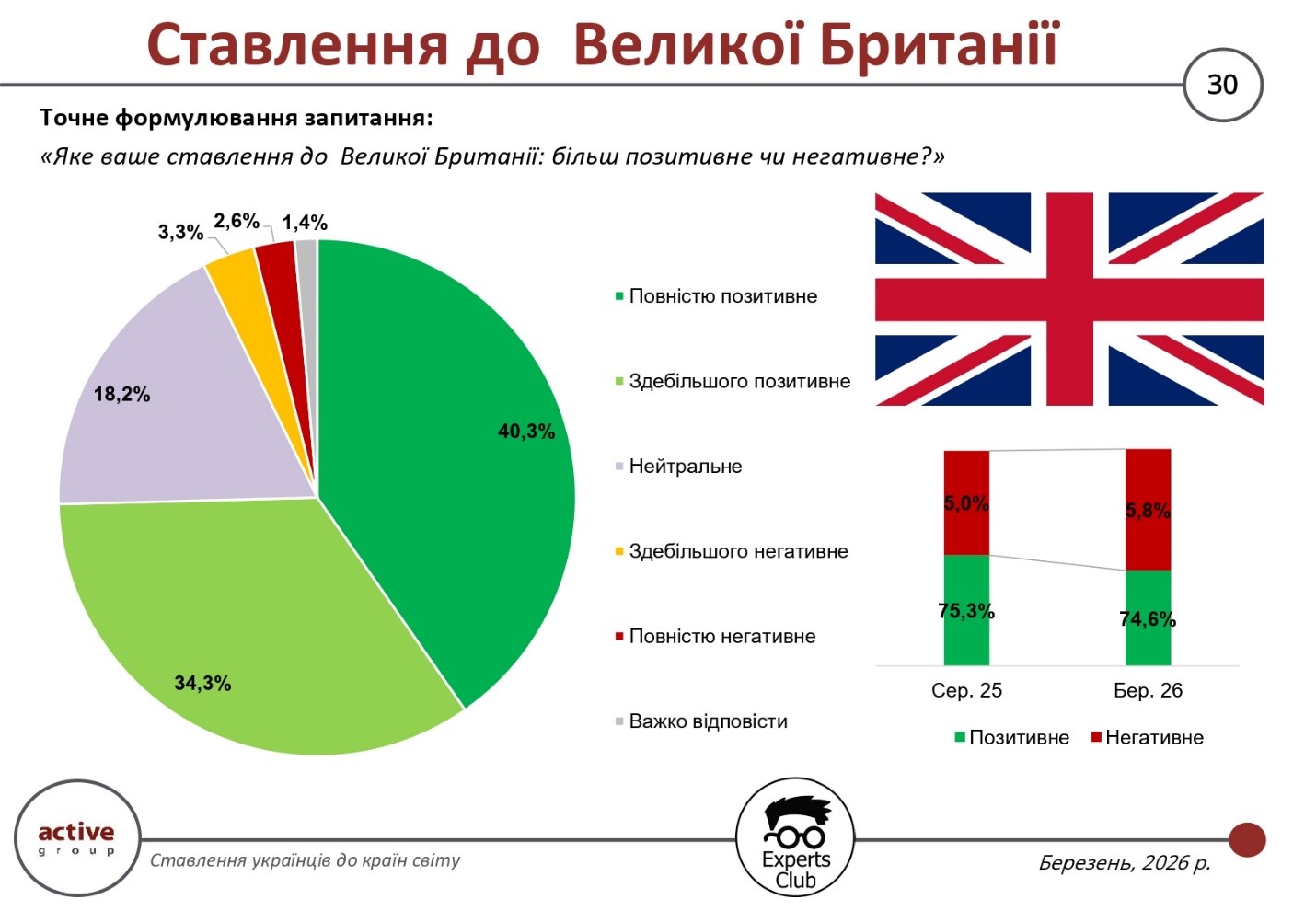
Ukrainians’ attitude toward the United Kingdom remains one of the most positive among all countries covered by a public opinion poll conducted in March 2026 by the research firm Active Group in collaboration with the Experts Club information and analytical center. The share of positive assessments stands at 74.6%, which is only slightly lower than the August 2025 figure (75.3%). At the same time, the share of negative assessments has risen slightly—from 5.0% to 5.8%.
Positive assessments dominate the response structure: 40.3% of respondents expressed a “completely positive” attitude, while another 34.3% expressed a “mostly positive” attitude. This distribution indicates a high level of trust and a clearly established positive perception of the country among Ukrainians.
The share of neutral assessments stands at 18.2%, which is a relatively low figure and confirms that the majority of respondents have a definite attitude toward the United Kingdom. Negative assessments remain limited: 3.3% chose “mostly negative,” and 2.6% chose “completely negative.” Another 1.4% of respondents were unable to answer.
A comparison with the previous period shows that the overall level of positive perception of the United Kingdom remains consistently high, although there has been a slight increase in critical assessments. At the same time, these changes are not systematic in nature and do not affect the overall picture, in which the United Kingdom retains its position among Ukraine’s most positively perceived partners.
A distinctive feature of attitudes toward this country is the high proportion of “fully positive” assessments, indicating an emotionally strong perception. This means that the image of the UK in Ukrainian society is shaped not only on a rational level but also has a significant value-based and symbolic component.
“Attitudes toward the UK demonstrate that Ukrainians quite clearly distinguish the roles of different countries in the international context. Where there is a consistent position and clear signals of support, a stable positive image is formed. Even slight fluctuations in the indicators do not change the overall level of trust in such partners,” noted Oleksandr Pozniy, director of the research company Active Group.
Thus, the survey results indicate that the United Kingdom maintains one of the highest levels of positive perception among Ukrainians. Minor changes in the dynamics do not affect the overall trend: the country remains a stable and positively viewed partner in Ukrainian public opinion.
According to a study conducted by the Experts Club information and analytical center based on data from the State Customs Service, the United Kingdom ranks 17th in total trade volume with Ukraine, with a figure of $2.08 billion. At the same time, imports of British goods exceed Ukrainian exports, resulting in a negative bilateral trade balance of over $785 million.
The study was presented at the Interfax-Ukraine press center; the video can be viewed on the agency’s YouTube channel. The full version of the study can be found at this link on the Experts Club analytical center’s website.
ACTIVE GROUP, EXPERTS CLUB, Pozniy, SOCIOLOGY, SURVEY, UKRAINE, UNITED KINGDOM, URAKIN
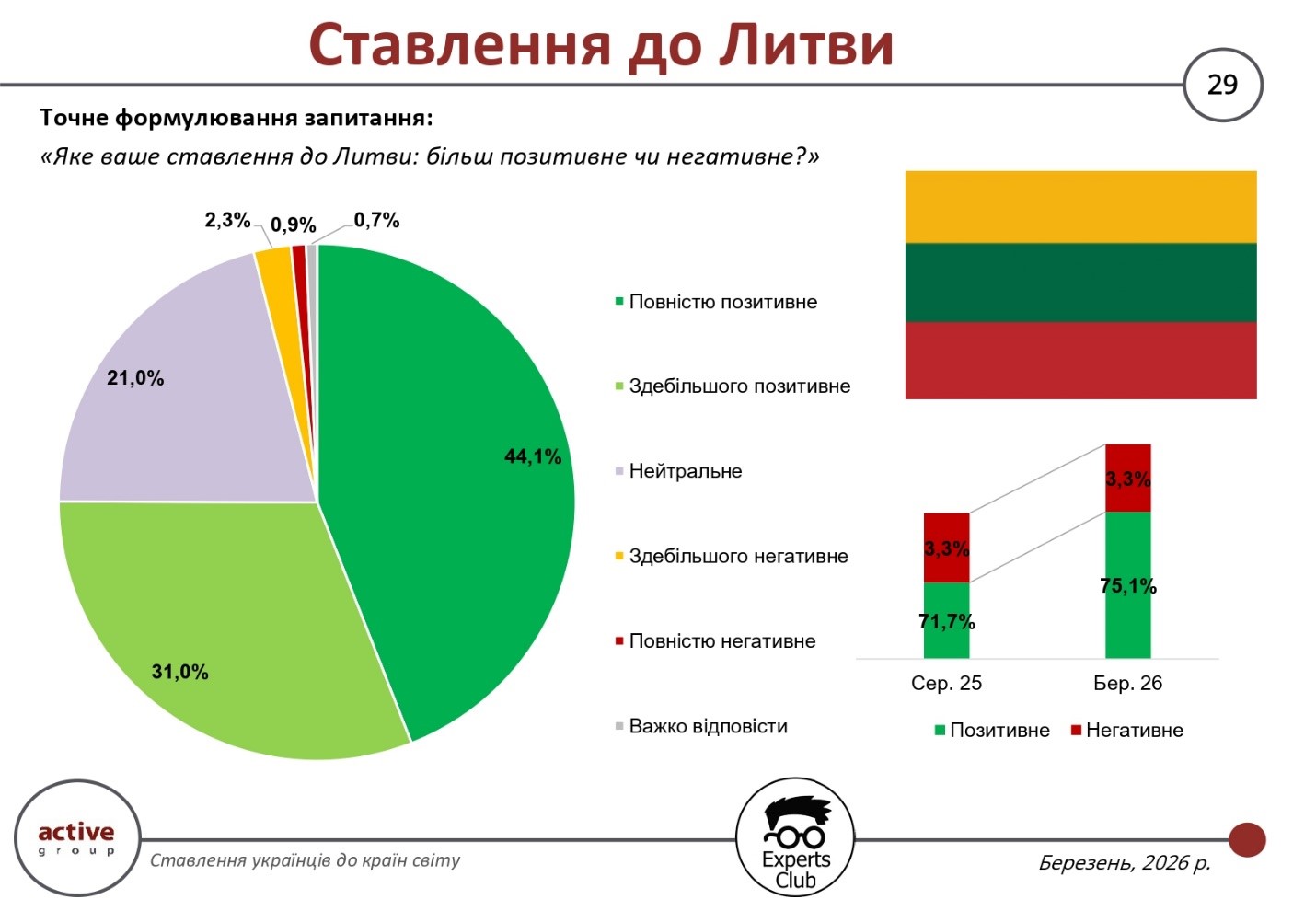
Ukrainians’ attitudes toward Lithuania remain among the most stable and positive of all countries covered by the sociological survey conducted in March 2026 by the research company Active Group in collaboration with the Experts Club information and analytical center. The share of positive assessments rose to 75.1% compared to 71.7% in August 2025, indicating a further strengthening of this country’s positive image in Ukrainian society. At the same time, the level of negative attitudes remained unchanged at 3.3%.
“Completely positive” attitudes dominate the response structure—44.1% of respondents chose this option. Another 31.0% described their attitude as “mostly positive.” Thus, Lithuania ranks among the countries with the highest share of unconditional support among Ukrainians.
A neutral stance is held by 21.0% of respondents, which is a relatively low figure compared to many other countries. This indicates a fairly clear and well-established attitude among Ukrainians toward Lithuania. Negative assessments remain minimal: 2.3% of respondents chose the “mostly negative” option, and only 0.9% selected “completely negative.” Another 0.7% were undecided.
The trend between August 2025 and March 2026 demonstrates not just stability, but a gradual strengthening of positive perceptions. The increase in positive assessments is occurring without a rise in negative ones, which is quite rare in sociological research and indicates the systemic nature of this support.
A distinctive feature of attitudes toward Lithuania is also the high proportion of “fully positive” assessments, which signifies not only general goodwill but also an emotionally strong perception of this country as a close partner. This pattern of responses is characteristic of countries that Ukrainians associate with consistent political support, solidarity, and active participation in international processes related to Ukraine.
“Attitudes toward Lithuania are an example of how a stable, positive image of a country is formed in the public consciousness. Where there is consistent support, a clear position, and a tangible presence on issues important to Ukraine, public opinion responds accordingly. In the case of Lithuania, we see not situational sympathy, but long-term trust,” noted Oleksandr Pozniy, director of the research company Active Group.
Thus, the survey results indicate that Lithuania remains one of Ukraine’s most positively perceived partners. Maintaining and even strengthening this level of trust points to stable relations and a high level of public support that is not dependent on short-term factors.
According to a study conducted by the Experts Club information and analytical center based on data from the State Customs Service, Lithuania ranks 16th in total trade volume with Ukraine, with a figure of $2.17 billion. At the same time, imports from Lithuania exceed exports of Ukrainian goods, resulting in a trade deficit of over $752 million.
The study was presented at the Interfax-Ukraine press center; the video can be viewed on the agency’s YouTube channel. The full version of the study can be found at this link on the Experts Club analytical center’s website.
ACTIVE GROUP, EXPERTS CLUB, LITHUANIA, Pozniy, SOCIOLOGY, SURVEY, UKRAINE, URAKIN

Ukrainians’ attitudes toward India are characterized by a predominance of neutral assessments and a relatively low level of clearly defined positive or negative views. According to the results of a sociological survey conducted in March 2026 by the research company Active Group in collaboration with the Experts Club information and analytical center, 55.5% of respondents described their attitude as neutral, making India one of the countries with the least defined emotional perception among Ukrainians.
The share of positive assessments stands at 17.9%, which is slightly higher than the 16.0% recorded in August 2025. At the same time, negative attitudes have decreased from 26.3% to 23.5%, indicating a certain softening of critical assessments.
In the detailed breakdown of responses, 4.2% of respondents chose the “completely positive” option regarding India, while another 13.8% selected “mostly positive.” In contrast, 19.6% of respondents indicated a “mostly negative” attitude, and 4.0% — “completely negative.” Another 3.0% of respondents were undecided.
The high proportion of neutral assessments indicates India’s limited presence in the Ukrainian information and public sphere. For a significant portion of respondents, this country is not the subject of constant attention or active engagement, which makes it difficult to form a clear position. At the same time, the noticeable decline in negative assessments may indicate a gradual reduction in critical perceptions.
The dynamics of change between August 2025 and March 2026 are relatively moderate. The increase in positive assessments and the simultaneous decrease in negative ones signal a certain balancing of attitudes, but do not alter the overall picture: India remains a country that Ukrainians perceive more neutrally than emotionally.
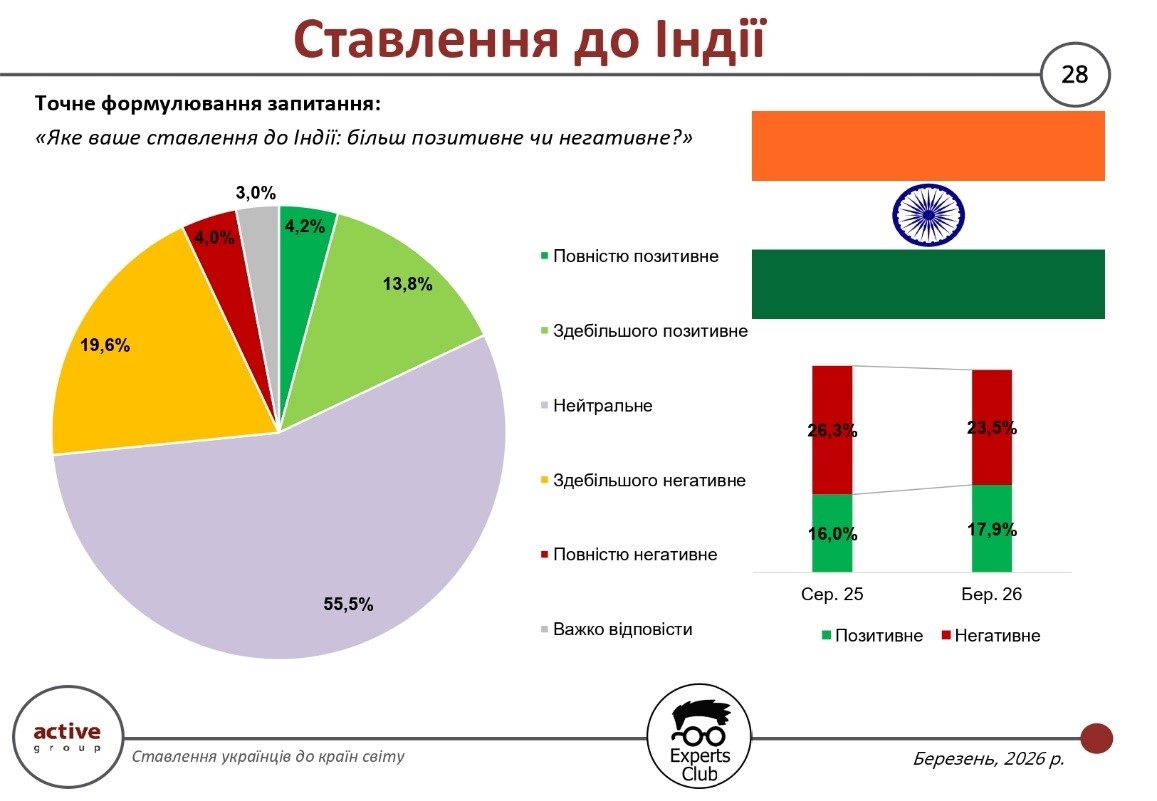
It is also important to note that the ratio of positive to negative assessments remains close, albeit with a slight preponderance of the negative. This means that in the absence of active informational or economic interaction, public opinion forms slowly and lacks a clearly defined direction.
“Attitudes toward India are a telling example of how a neutral perception forms in cases of limited interaction. When a country lacks a constant presence in the information sphere or practical cooperation projects, public opinion remains vague. “That is why, to strengthen a positive perception, it is important to develop economic and humanitarian ties that create a sense of genuine partnership,” noted Maksym Urakin, founder of the Experts Club information and analytical center.
Thus, the survey results indicate that India does not yet belong to the group of countries with a clearly established positive image in Ukraine. At the same time, current trends open up opportunities for a gradual improvement in perception, provided there is more active interaction between the countries.
According to a study conducted by the Experts Club information and analytical center based on data from the State Customs Service, India ranks fifteenth in terms of total trade in goods with Ukraine, amounting to $2.62 billion. At the same time, imports of Indian goods are more than double exports from Ukraine, resulting in a negative bilateral trade balance.
The study was presented at the Interfax-Ukraine press center; the video can be viewed on the agency’s YouTube channel. The full version of the study can be found at this link on the Experts Club analytical center’s website.
ACTIVE GROUP, EXPERTS CLUB, INDIA, Pozniy, SOCIOLOGY, SURVEY, UKRAINE, URAKIN

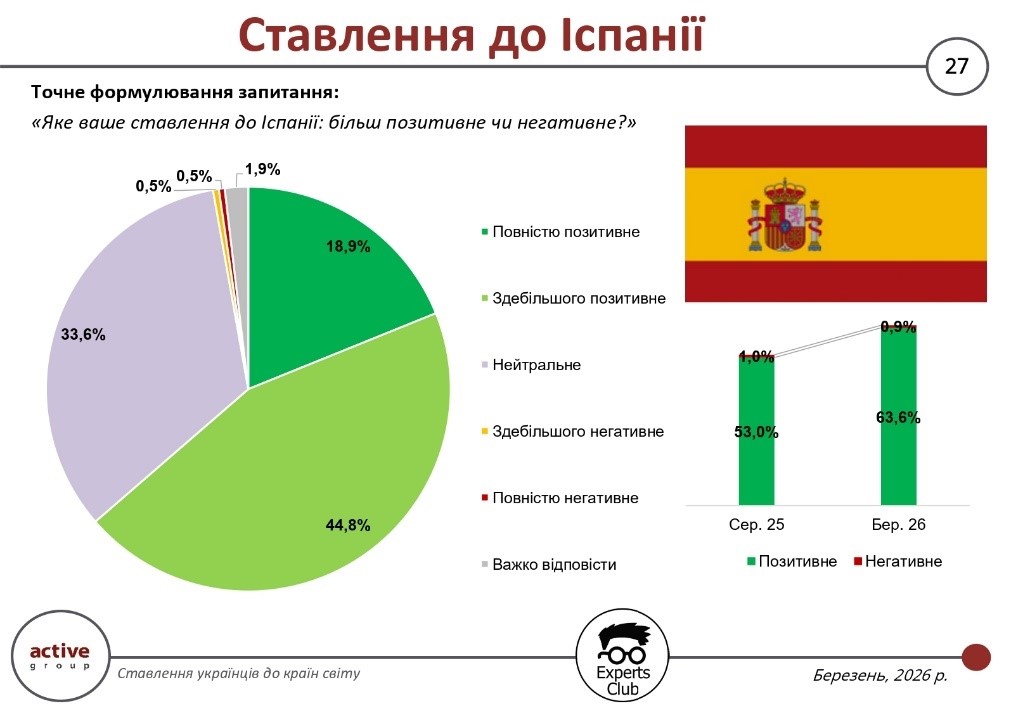
Spain is among the group of countries that Ukrainians consistently view positively, and recent trends indicate a further strengthening of this image. According to a survey conducted in March 2026 by the research firm Active Group in collaboration with the Experts Club information and analytical center, 63.6% of respondents rated their attitude toward Spain as positive, a significant increase from 53.0% in August 2025.
The breakdown of positive perceptions appears quite balanced: 18.9% of respondents reported a completely positive attitude, while another 44.8% described their attitude as mostly positive. This indicates that positive sentiment is not only growing in quantity but also has a fairly deep foundation, as a significant portion of respondents demonstrate a clearly formed positive view of the country.
At the same time, the share of neutral assessments remains relatively high—33.6%. This indicates that for a significant portion of Ukrainians, Spain is not a country that features in their daily news, yet even in this case, its image does not evoke negative associations.
Negative attitudes toward Spain are practically nonexistent: only 0.9% of respondents view it negatively (of these, 0.5% view it mostly negatively and 0.5% view it completely negatively). This figure is one of the lowest among all countries surveyed, underscoring a consistently high level of trust and goodwill.
A comparison with August 2025 also shows not only an increase in positive assessments but also a further decline in negative ones (from 1.0% to 0.9%). This indicates the gradual formation of a stable positive image of Spain in Ukrainian society.
Overall, the data show that Spain is perceived as a friendly and neutral-positive country without significant controversial factors. It is not a central political or security player in the perception of Ukrainians, but at the same time, it is among the countries with a high level of trust.
“In the case of Spain, we see a classic example of a stable positive image that does not depend on situational factors. It is not the most prominent political actor for Ukrainians, but at the same time, it has no negative media coverage. That is precisely why its perception is gradually strengthening and moving into a stable positive zone,” noted Maksym Urakin, founder of the Experts Club information and analytical center.
Thus, Spain occupies an important place in the group of countries with a high level of positive perception, where the key factor is not the intensity of political interaction, but the absence of negative signals and an overall positive image in the public consciousness.
According to a study conducted by the Experts Club Information and Analytical Center based on data from the State Customs Service, Spain ranks fourteenth in total trade volume of goods with Ukraine, with a figure of $2.80 billion. At the same time, Ukraine has a trade surplus with Spain, as exports of Ukrainian goods exceed imports.
The study was presented at the Interfax-Ukraine press center; the video can be viewed on the agency’s YouTube channel. The full version of the study can be found at this link on the Experts Club analytical center’s website.
ACTIVE GROUP, EXPERTS CLUB, Pozniy, SOCIOLOGY, SPAIN, SURVEY, UKRAINE, URAKIN



