
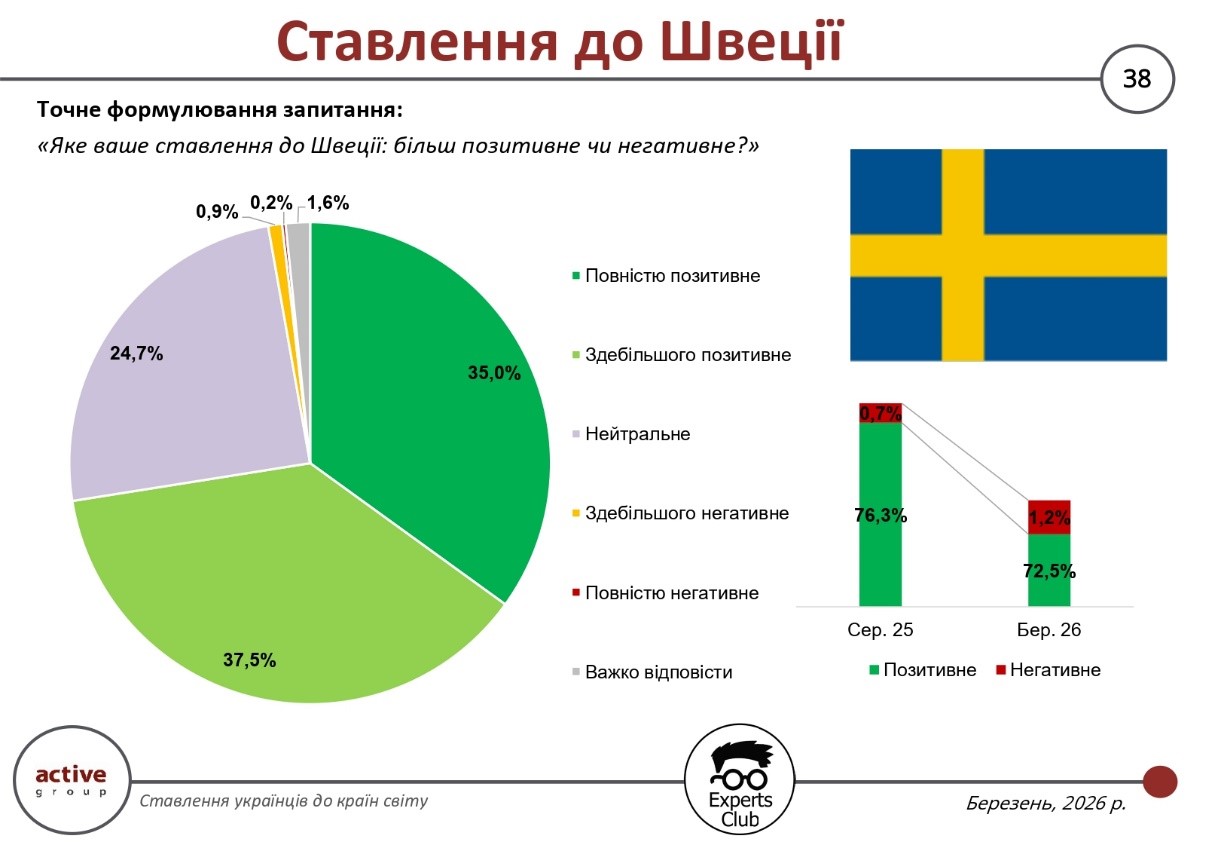
The results of a public opinion poll conducted in March 2026 by the research firm Active Group in collaboration with the Experts Club information and analytical center show a consistently high level of positive attitudes among Ukrainians toward Sweden. The overall share of positive assessments stands at 72.5%, which is, however, slightly lower than the August 2025 figure (76.3%). At the same time, the level of negative attitudes remains minimal—only 1.2% compared to 0.7% previously.
The breakdown of responses indicates a deeply positive foundation for perceptions of this country. The share of those who view Sweden “entirely positively” stands at 35.0%, while another 37.5% selected the “mostly positive” option. Together, these figures represent one of the highest levels of positive perception among the countries surveyed.
At the same time, 24.7% of respondents hold a neutral position, which may indicate a limited level of personal or informational contact with the country. Negative assessments remain marginal: 0.9% rated it “mostly negative” and only 0.2% rated it “completely negative.” Another 1.6% of respondents were undecided.
The slight decrease in the share of positive assessments likely resulted from a shift of some respondents into the neutral category, rather than an increase in criticism. This indicates that Sweden’s image remains consistently positive, albeit less emotionally charged compared to the previous period.
“Sweden remains a country with a very high level of trust among Ukrainians, and this is evident in the structure of the responses. At the same time, we observe a certain increase in the share of neutral assessments, which indicates not a change in attitude but a decrease in its intensity. This is a typical effect for countries that are not constantly in the center of media attention,” noted Oleksandr Pozniy, director of the research company Active Group.
Overall, the survey results confirm that Sweden is among the countries with the highest level of positive perception in Ukrainian society. At the same time, the dynamics of change indicate a gradual normalization of assessments, as the emotional component gives way to a more restrained and rational perception.
According to a study conducted by the Experts Club information and analytical center based on data from the State Customs Service, Sweden ranks 25th in total trade volume with Ukraine, with a figure of $1.13 billion. At the same time, imports from Sweden exceed Ukrainian exports many times over, resulting in a significant trade deficit of over $962 million.
The study was presented at the Interfax-Ukraine press center; the video can be viewed on the agency’s YouTube channel. The full version of the study can be found at this link on the Experts Club analytical center’s website.
ACTIVE GROUP, EXPERTS CLUB, Pozniy, SOCIOLOGY, SURVEY, SWEDEN, UKRAINE, URAKIN
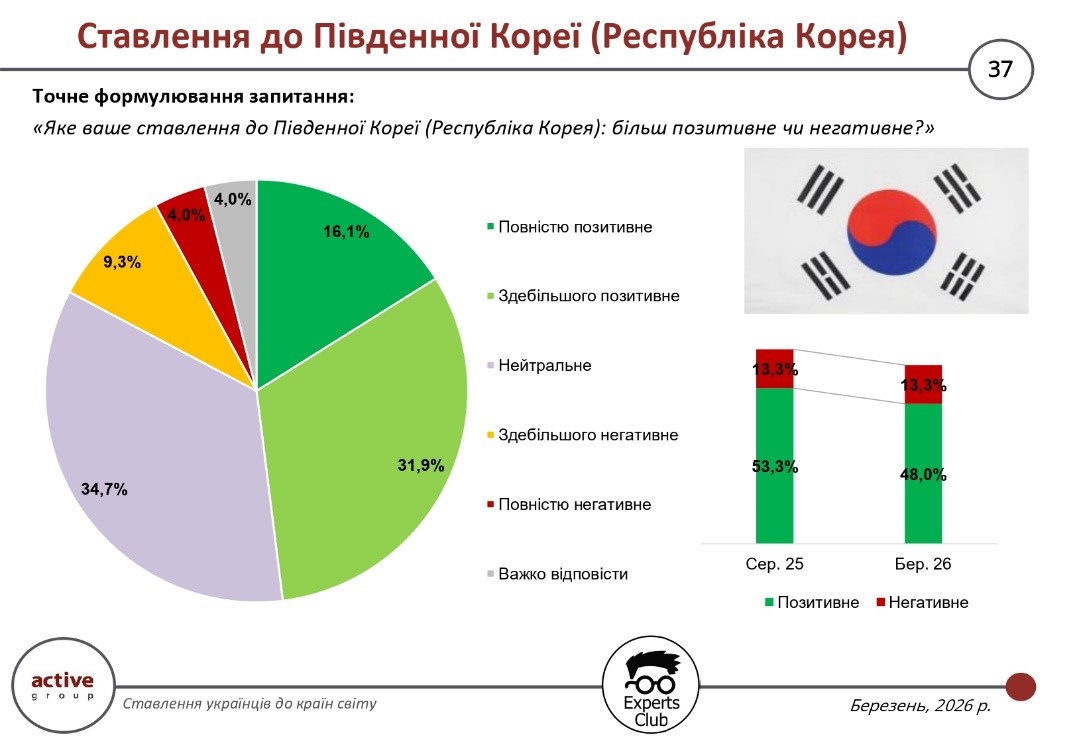
The results of a survey conducted in March 2026 by the research firm Active Group in collaboration with the Experts Club Information and Analytical Center indicate a slight cooling of Ukrainians’ attitudes toward South Korea. The share of positive assessments dropped to 48.0% compared to 53.3% in August 2025, while the level of negative attitudes remained unchanged at 13.3%.
In the breakdown of responses, 16.1% of respondents chose the option “completely positive,” and another 31.9% chose “mostly positive.” At the same time, the share of neutral assessments remains significant—34.7%—which indicates a relatively reserved and not fully formed perception of the country.
Negative assessments are represented by 9.3% of responses as “mostly negative” and 4.0% as “completely negative.” Another 4.0% of respondents were unable to determine their position. Thus, despite the decline in positive perception, the level of criticism has not increased, and the overall picture has shifted due to a portion of positive assessments moving into the neutral category.
This trend may indicate a decrease in the intensity of South Korea’s media presence in Ukraine or a reduction in the number of factors shaping a clearly positive attitude. Unlike EU countries or certain strategic partners, South Korea remains an important but not a top-priority element of the international context for a significant portion of Ukrainians.
“The data show that attitudes toward South Korea remain generally positive, but less defined than toward Ukraine’s key partners. A significant proportion of neutral responses indicates that for many Ukrainians, this country is outside the daily news cycle. In such cases, even minor changes in the external context can influence the balance of assessments,” noted Oleksandr Pozniy, director of the research firm Active Group.
Overall, South Korea maintains a positive image in Ukraine; however, the downward trend in the share of positive assessments underscores the need for the country to be more actively engaged in economic, technological, and humanitarian cooperation if it seeks to strengthen its position in Ukrainian society.
According to a study conducted by the Experts Club information and analytical center based on data from the State Customs Service, the Republic of Korea ranks 24th in total trade volume with Ukraine, which amounts to $1.14 billion. Imports of Korean products significantly exceed Ukrainian exports, resulting in a negative trade balance of over $769 million.
The study was presented at the Interfax-Ukraine press center; the video can be viewed on the agency’s YouTube channel. The full version of the study can be found at this link on the Experts Club analytical center’s website.
ACTIVE GROUP, EXPERTS CLUB, Pozniy, SOCIOLOGY, SOUTH KOREA, SURVEY, UKRAINE, URAKIN

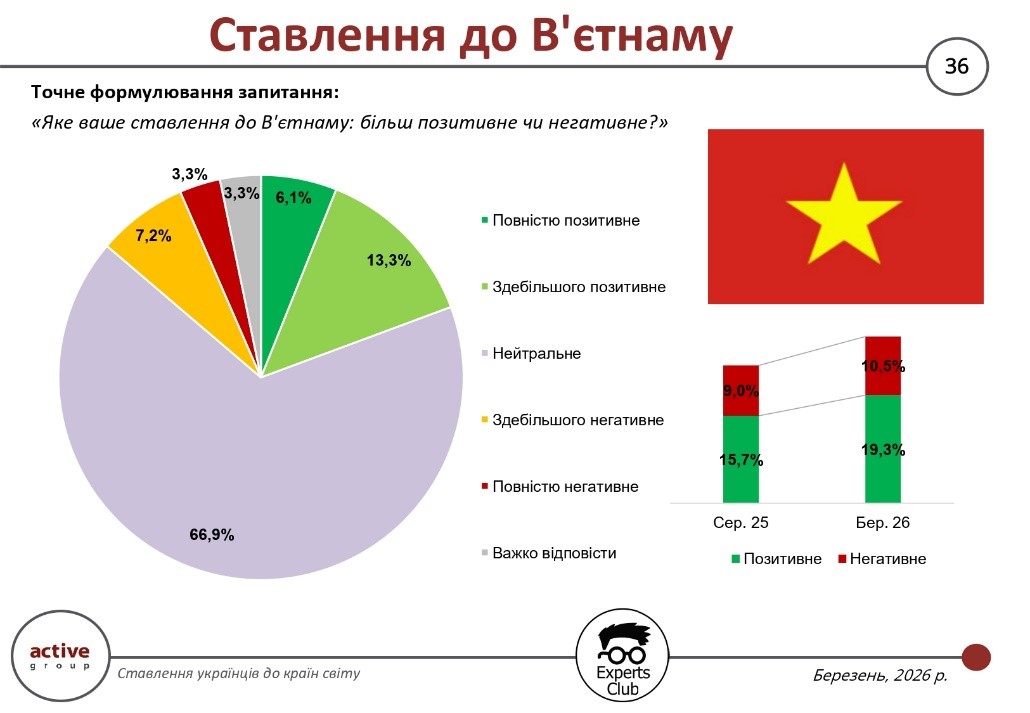
The results of a public opinion poll conducted in March 2026 by the research firm Active Group in collaboration with the Experts Club information and analytical center indicate that, for most Ukrainians, Vietnam remains a country with an undefined or neutral image. The largest share of respondents—66.9%—expressed a neutral attitude, which significantly distinguishes Vietnam from countries with a clearly formed positive or negative perception.
At the same time, the share of positive assessments has increased—to 19.3% compared to 15.7% in August 2025. Of these, 6.1% of respondents indicated a completely positive attitude, while another 13.3% described it as mostly positive. This indicates the gradual formation of a more defined positive image of the country, although this process is proceeding slowly.
Negative attitudes also increased slightly—from 9.0% to 10.5%. Specifically, 7.2% of respondents chose “mostly negative,” and 3.3% chose “completely negative.” The share of those who could not decide on an answer is 3.3%. Overall, these figures demonstrate a slight increase in the polarization of assessments while maintaining a high proportion of neutrality.
The dynamics of change indicate a gradual decrease in uncertainty: some respondents who previously had no formed opinion are beginning to lean toward either a positive or a negative assessment. At the same time, the absence of sharp changes in the structure of responses indicates that Vietnam does not yet occupy a prominent place in the focus of public opinion in Ukraine.
“When we see such a high level of neutral responses, it means that the country is effectively outside the active informational and social sphere. Ukrainians simply do not have enough contacts, experience, or cues to form a clear attitude. That is why any systematic presence—economic, cultural, or diplomatic—could quite quickly shift the balance of assessments in one direction or another,” noted Maksym Urakin, founder of the Experts Club information and analytical center.
Thus, Vietnam is currently characterized as a country with high potential for building a positive image in Ukraine; however, this potential largely depends on the intensity of interaction and the level of presence in the Ukrainian information space.
According to a study conducted by the Experts Club information and analytical center based on data from the State Customs Service, Vietnam ranks 23rd in total trade volume with Ukraine, with a figure of $1.16 billion. At the same time, imports of Vietnamese goods exceed exports from Ukraine by several times, resulting in a trade deficit of over $706 million.
The study was presented at the Interfax-Ukraine press center; the video can be viewed on the agency’s YouTube channel. The full version of the study can be found at this link on the Experts Club analytical center’s website.
ACTIVE GROUP, EXPERTS CLUB, Pozniy, SOCIOLOGY, SURVEY, UKRAINE, URAKIN, VIETNAM
Moldova ranks among the countries closest to Ukraine not only geographically but also in terms of public perception. According to a survey conducted in March 2026 by the research company Active Group in collaboration with the Experts Club information and analytical center, 60.1% of Ukrainians describe their attitude toward Moldova as positive, a significant increase from 51.3% in August 2025. Thus, over the course of six months, positive perception has increased by nearly 9 percentage points.
The distribution of positive attitudes is fairly even: 22.8% of respondents chose the option “completely positive,” while another 37.3% selected “mostly positive.” This indicates not only a general level of favorability but also that a significant portion of Ukrainians have a well-formed and stable positive perception of Moldova.
At the same time, the share of neutral assessments remains relatively high—32.9%. This is a typical figure for countries that, despite their proximity, are not at the center of the constant information flow. However, even with such a proportion of neutral responses, the overall balance of perception is clearly tilted toward the positive side.
Negative attitudes toward Moldova remain minimal—5.4% in March 2026 (compared to 4.7% in August 2025). Although this figure has risen slightly, it remains at a low level, confirming the absence of significant sources of tension in bilateral perceptions.
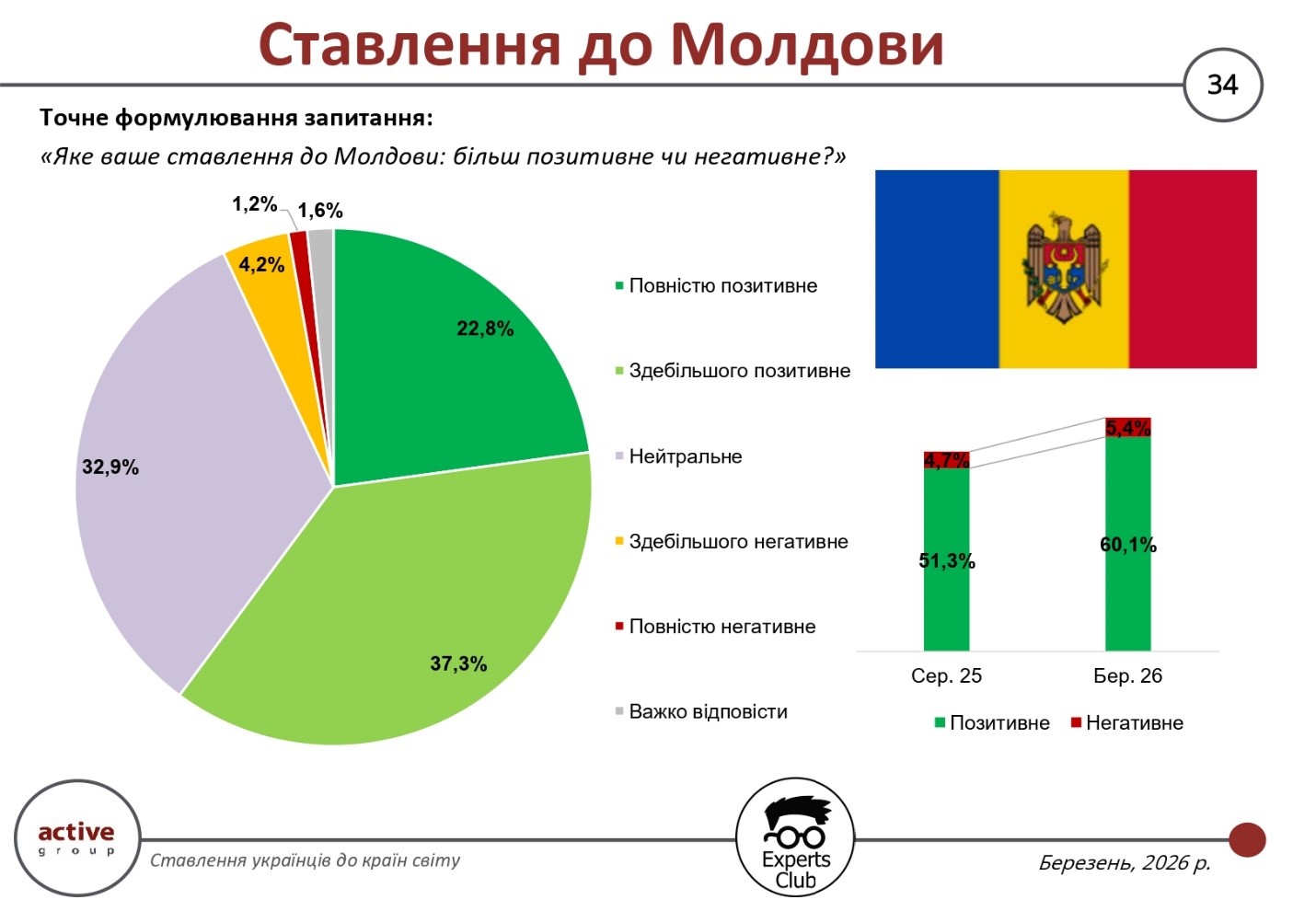
The trend indicates a gradual strengthening of Moldova’s positive image in Ukrainian society. The increase in positive sentiment occurred both due to a shift of some neutral assessments toward positive ones and through a general rise in the level of trust in the country.
In a broader context, these results can be explained by the proximity of Ukraine’s and Moldova’s interests, shared security challenges, as well as similar European integration trajectories. In the minds of Ukrainians, Moldova is increasingly perceived as a partner with a similar political and values-based context.
“Attitudes toward Moldova are a telling example of how a stable, positive image of a neighboring country is formed. Here, not only geographical proximity plays an important role, but also a sense of shared interests and a similar strategic course. It is precisely these factors that ensure the long-term strengthening of trust in society,” noted Maksym Urakin, founder of the Experts Club information and analytical center.
Thus, Moldova holds a firm position among countries with a high level of positive perception in Ukraine. Its image is characterized by stability, a low level of negativity, and a gradual increase in trust, making this country one of the most predictable and understandable partners in the region.
According to a study conducted by the Experts Club Information and Analytical Center based on data from the State Customs Service, the Republic of Moldova ranks 21st in total trade volume of goods with Ukraine, with a figure of $1.32 billion. At the same time, Ukraine has a clear trade surplus, as exports to Moldova exceed imports by more than seven times.
The study was presented at the Interfax-Ukraine press center; the video can be viewed on the agency’s YouTube channel. The full version of the study can be found at this link on the Experts Club analytical center’s website.
ACTIVE GROUP, EXPERTS CLUB, MOLDOVA, Pozniy, SOCIOLOGY, SURVEY, UKRAINE, URAKIN
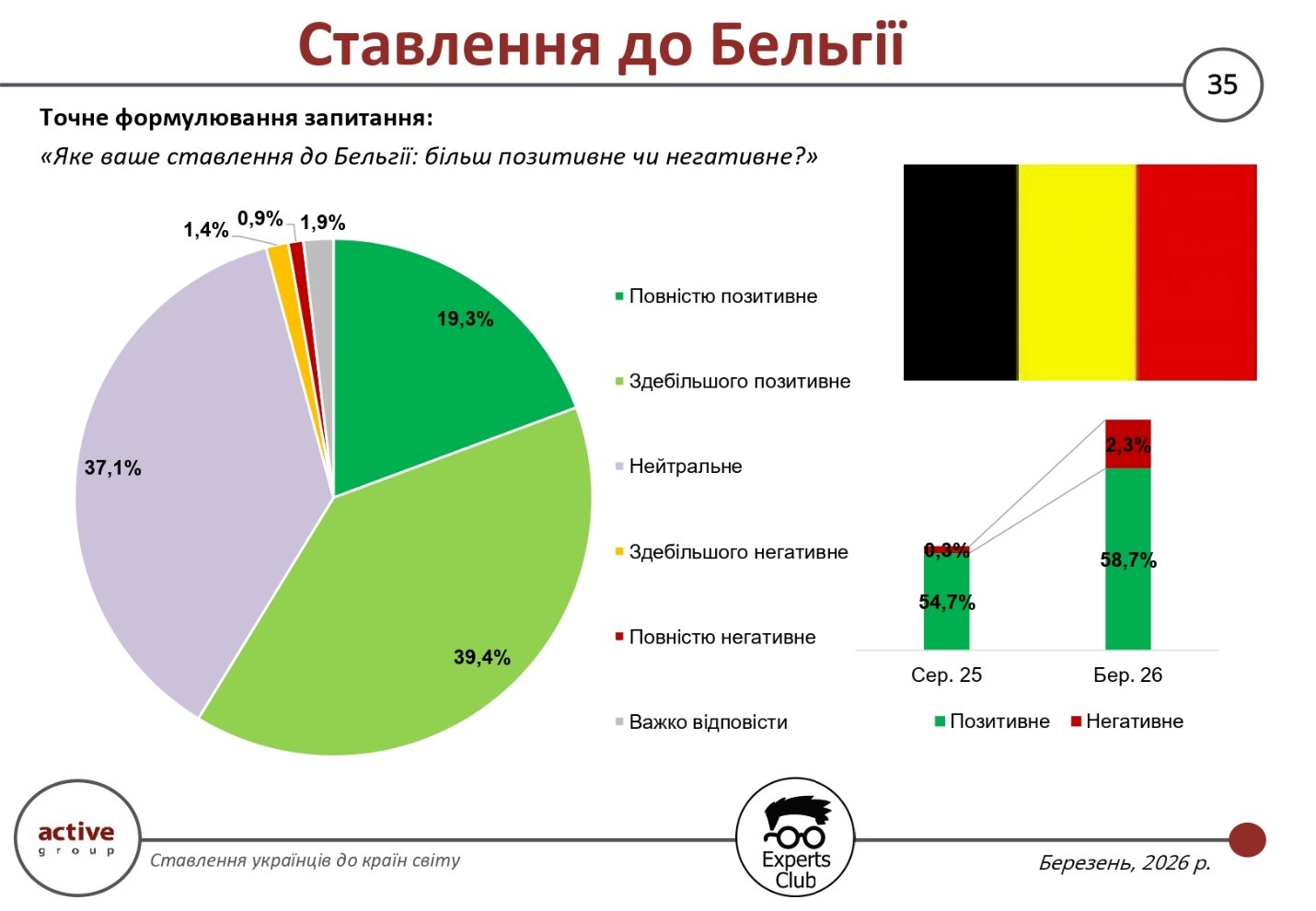
A sociological survey conducted in March 2026 by the research firm Active Group in collaboration with the Experts Club information and analytical center shows a consistently positive attitude among Ukrainians toward Belgium, with a noticeable upward trend. The share of positive assessments rose to 58.7% compared to 54.7% in August 2025. At the same time, the level of negative perception also increased slightly—from 0.3% to 2.3%—though it remains low overall.
The breakdown of responses indicates a predominance of moderately positive perceptions. 19.3% of respondents view Belgium entirely positively, while 39.4% selected the “mostly positive” option. At the same time, the share of neutral assessments remains significant—37.1%—indicating a limited level of formed perception of the country among Ukrainians.
Negative assessments are marginal: 1.4% of respondents indicated a mostly negative attitude, and another 0.9%—a completely negative one. The share of those who could not decide on an answer is 1.9%. This pattern of indicators suggests the absence of systemic negativity, but at the same time—insufficient intensity of informational or emotional interaction with this country.
In terms of trends, it is worth noting not only the growth in positive assessments but also a slight increase in negative ones. This may be linked to the general polarization of public opinion, where neutral positions are partially shifting toward more defined ones—both positive and negative. At the same time, the key trend remains the gradual strengthening of positive perceptions.
“Attitudes toward countries such as Belgium are shaped not so much by direct experience of interaction as by the broader European context and associations with the EU’s institutional role. When a country is associated with support for Ukraine at the level of politics, the economy, or humanitarian initiatives, this gradually translates into a rise in positive perception. At the same time, the high proportion of neutral responses indicates that the potential for strengthening this image is far from exhausted,” noted Maksym Urakin, founder of the Experts Club information and analytical center.
Thus, for Ukrainians, Belgium remains a country with a predominantly positive but not fully formed image. Further growth in positive attitudes will largely depend on the visibility of its role in supporting Ukraine, as well as on practical contacts in the spheres of the economy, education, and humanitarian cooperation.
According to a study conducted by the Experts Club Information and Analytical Center based on data from the State Customs Service, Belgium ranks 22nd in total trade volume with Ukraine, amounting to $1.29 billion. Imports of Belgian goods slightly exceed Ukrainian exports, so the bilateral trade balance remains negative.
The study was presented at the Interfax-Ukraine press center; the video can be viewed on the agency’s YouTube channel. The full version of the study can be found at this link on the Experts Club analytical center’s website.
ACTIVE GROUP, BELGIUM, EXPERTS CLUB, Pozniy, SOCIOLOGY, SURVEY, UKRAINE, URAKIN
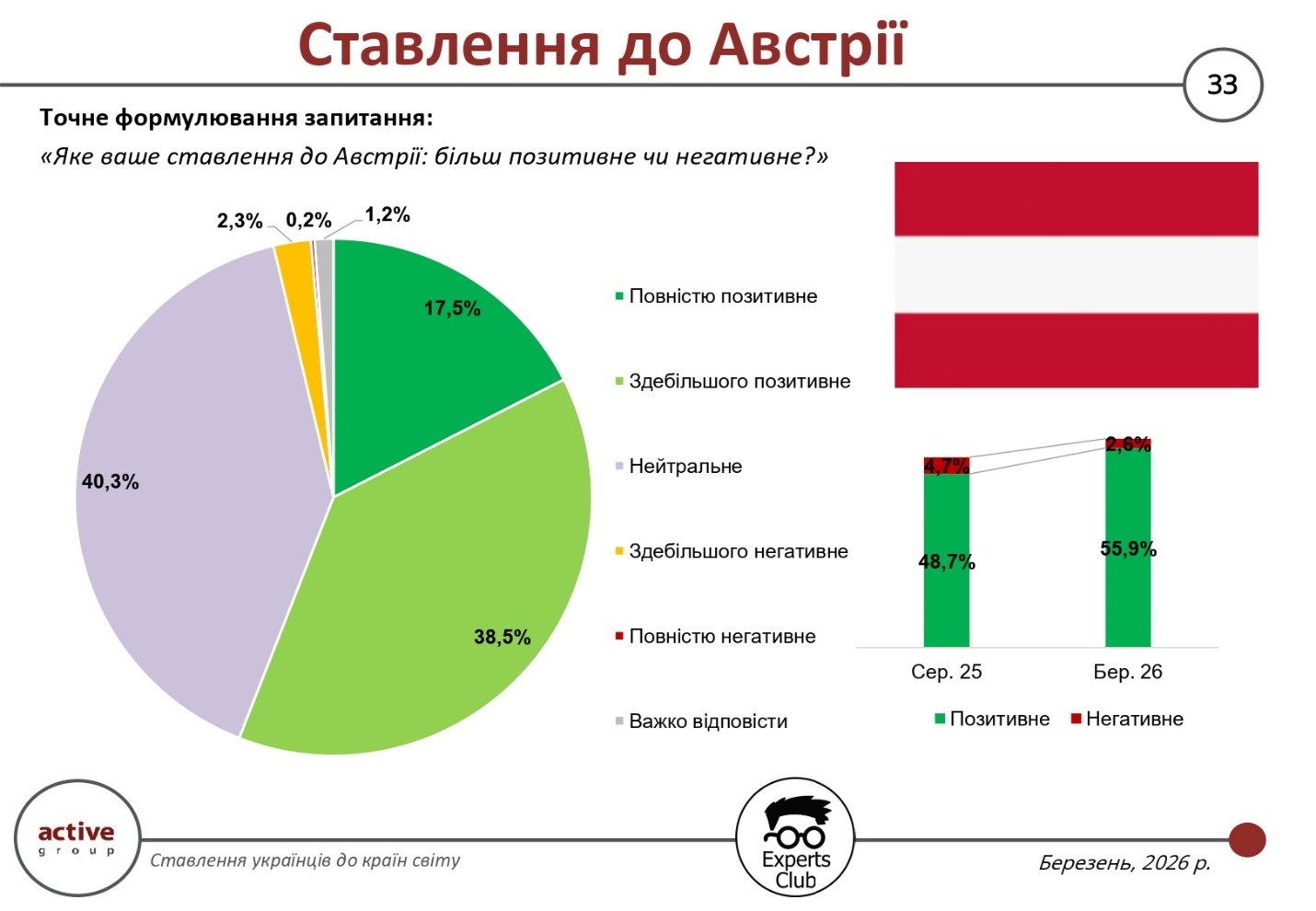
A sociological survey conducted in March 2026 by the research firm Active Group in collaboration with the Experts Club information and analytical center shows an overall positive trend in Ukrainians’ attitudes toward Austria. The share of positive assessments rose to 55.9% compared to 48.7% in August 2025. At the same time, the level of negative perception nearly halved—from 4.7% to 2.6%.
Despite this, a significant portion of respondents—40.3%—adopt a neutral stance. This distribution of responses indicates that for many Ukrainians, Austria remains a country without a clearly defined emotional image. At the same time, the positive segment is quite stable: 17.5% of respondents expressed a completely positive attitude, and another 38.5%—a mostly positive one.
Negative assessments remain minimal. The share of those who view Austria mostly negatively is 2.3%, and those who view it entirely negatively is only 0.2%. Another 1.2% of respondents were unable to decide on their position. This configuration of indicators suggests the absence of systematic negativity and, at the same time, a limited depth of positive perception.
The key factor in the dynamics of change is precisely the increase in positive sentiment. This may indicate a gradual strengthening of Austria’s presence in the Ukrainian information space or a clearer understanding of its role in the European context. At the same time, the persistence of a large share of neutral responses suggests that this process is not yet complete.
“The results regarding Austria clearly demonstrate how attitudes toward countries that are not at the center of Ukrainians’ daily attention are formed. We see a rise in positive sentiment, but at the same time, a significant proportion of neutral assessments remains, which indicates a lack of knowledge or experience in interaction. In such cases, the key factor becomes the country’s informational presence and clear signals regarding its role for Ukraine,” noted Oleksandr Pozniy, director of the research company Active Group.
Thus, Austria is currently perceived by Ukrainians more positively than negatively, though this perception has not yet taken on a clearly defined character. Further growth in positive assessments will largely depend on the extent to which the country is present in the Ukrainian public sphere and how clearly its role in the broader European context becomes understood.
According to a study conducted by the Experts Club information and analytical center based on data from the State Customs Service, Austria ranks 20th in total trade volume with Ukraine, which amounts to $1.33 billion. At the same time, imports from Austria exceed Ukrainian exports, resulting in a moderate trade deficit of over $200 million.
The study was presented at the Interfax-Ukraine press center; the video can be viewed on the agency’s YouTube channel. The full version of the study can be found at this link on the Experts Club analytical center’s website.
ACTIVE GROUP, AUSTRIA, EXPERTS CLUB, Pozniy, SOCIOLOGY, SURVEY, UKRAINE, URAKIN



