
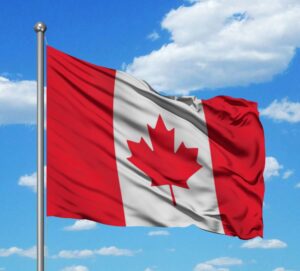
Canada is among the group of countries that consistently enjoy a high level of positive perception within Ukrainian society. According to the survey results, 76.2% of respondents describe their attitude toward Canada as positive. Specifically, 39.4% of Ukrainians indicated a “completely positive” attitude, while another 36.8% described it as “mostly positive.” This distribution of responses indicates not only broad support but also a deeply entrenched positive image of the country.
At the same time, the level of negative perception of Canada is minimal—only 2.3% (1.4% “mostly negative” and 0.9% “completely negative”). This is one of the lowest figures among all countries included in the study. This result confirms that negative assessments are isolated and do not significantly influence overall perception.
The share of neutral responses is 20.3%, which is a moderate figure. This means that while most Ukrainians have already formed a positive attitude toward Canada, a certain portion of respondents lack sufficient personal experience or information to make a clear assessment. At the same time, only 1.2% of respondents were unable to decide on an answer, which further underscores the high level of certainty in public opinion regarding this country.
Overall, Canada demonstrates one of the most balanced and positive perception profiles: the combination of a high share of “fully positive” assessments with virtually no negativity forms a solid reputation capital. This indicates that the country’s image in Ukraine is based not only on general perceptions but also on a systematic view of Canada as a reliable partner.
“Canada is among those countries toward which Ukrainians have formed not just a positive, but a consistently positive attitude. This is the result of long-term interaction, support, and presence in the Ukrainian information space. In such cases, even neutral responses do not blur the overall picture, but only underscore its consistency,” noted Oleksandr Pozniy, director of the research company Active Group.
Thus, Canada ranks among the top countries with the highest level of trust in Ukrainian society. The combination of high positive perception and minimal negativity creates a foundation for further strengthening bilateral relations, particularly in the areas of politics, the economy, and humanitarian cooperation.
According to a study conducted by the Experts Club information and analytical center based on data from the State Customs Service, Canada ranks 41st in total trade volume of goods with Ukraine, with a figure of $416.2 million.
Imports of Canadian goods are twice as high as Ukrainian exports, resulting in a trade deficit of $139.9 million.
The study was presented at the Interfax-Ukraine press center; the video can be viewed on the agency’s YouTube channel. The full version of the study can be found at this link on the Experts Club analytical center’s website.
ACTIVE GROUP, CANADA, EXPERTS CLUB, Pozniy, SOCIOLOGY, SURVEY, UKRAINE, URAKIN
According to the results of a public opinion poll conducted in March 2026 by the research company Active Group in collaboration with the Experts Club information and analytical center, perceptions of Brazil in Ukrainian society show moderately positive trends, although a high level of neutrality remains the key characteristic. Most Ukrainians do not have a clearly formed attitude toward this country, but the share of positive assessments is gradually increasing.
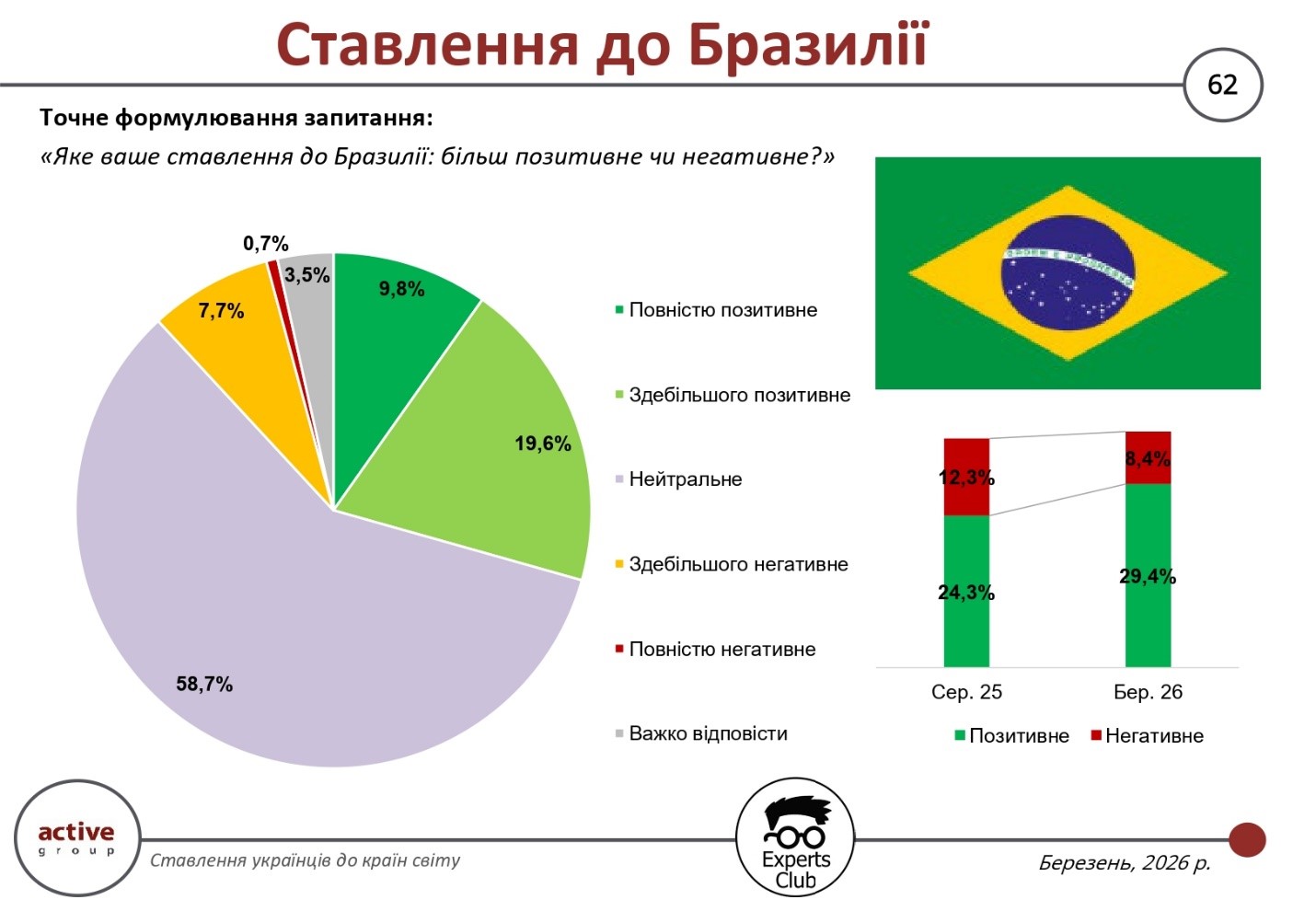
Overall, the positive attitude toward Brazil stands at 29.4%, which is a noticeable increase compared to August 2025 (24.3%). At the same time, 9.8% of respondents chose the “completely positive” option, and another 19.6% selected “mostly positive.” This trend indicates a gradual strengthening of the country’s positive image, although it remains relatively moderate.
At the same time, negative assessments have decreased—from 12.3% to 8.4%. Within the structure of negative perceptions, 7.7% fall under the “mostly negative” category and only 0.7% under “completely negative.” This means that critical perceptions of Brazil in Ukraine are diminishing and are not systemic in nature.
Most telling is the high level of neutrality—58.7% of respondents. This indicates that for most Ukrainians, Brazil remains a country that does not occupy a significant place on the informational or political agenda. The absence of active interaction or regular information flows shapes precisely this model of perception.
Additionally, 3.5% of respondents were unable to determine their position. Combined with neutral assessments, this creates a significant segment of “undecided attitudes,” which could potentially change depending on the development of bilateral relations or the country’s media presence.
From a dynamic perspective, Brazil shows a positive trend: an increase in the share of positive assessments is accompanied by a simultaneous decrease in negative ones. This indicates a gradual improvement in the country’s image in Ukraine, although it is occurring against a backdrop of general inertia in neutral perception.
Overall, Brazil remains a “peripheral” country for Ukrainians in terms of emotional perception, yet with potential for further improvement of its image. The high proportion of neutral assessments means that future changes in perception will largely depend on the level of economic, diplomatic, and informational interaction between the two countries.
According to a study conducted by the Experts Club information and analytical center based on data from the State Customs Service, Brazil ranks 50th in total trade volume of goods with Ukraine, with a figure of $335.6 million. At the same time, imports from Brazil are nearly four times higher than Ukrainian exports, resulting in a bilateral trade deficit of $193.5 million.
The study was presented at the Interfax-Ukraine press center; the video can be viewed on the agency’s YouTube channel. The full version of the study can be found at this link on the Experts Club analytical center’s website.
ACTIVE GROUP, BRAZIL, EXPERTS CLUB, Pozniy, SOCIOLOGY, SURVEY, UKRAINE, URAKIN
According to the results of a sociological survey conducted in March 2026 by the research company Active Group in collaboration with the Experts Club information and analytical center, perceptions of Mexico in Ukrainian society are characterized by a high level of neutrality and a relatively moderate share of both positive and negative assessments. At the same time, the trend shows a gradual increase in positive attitudes and a simultaneous decrease in negative ones, indicating a cautious normalization of the country’s image.
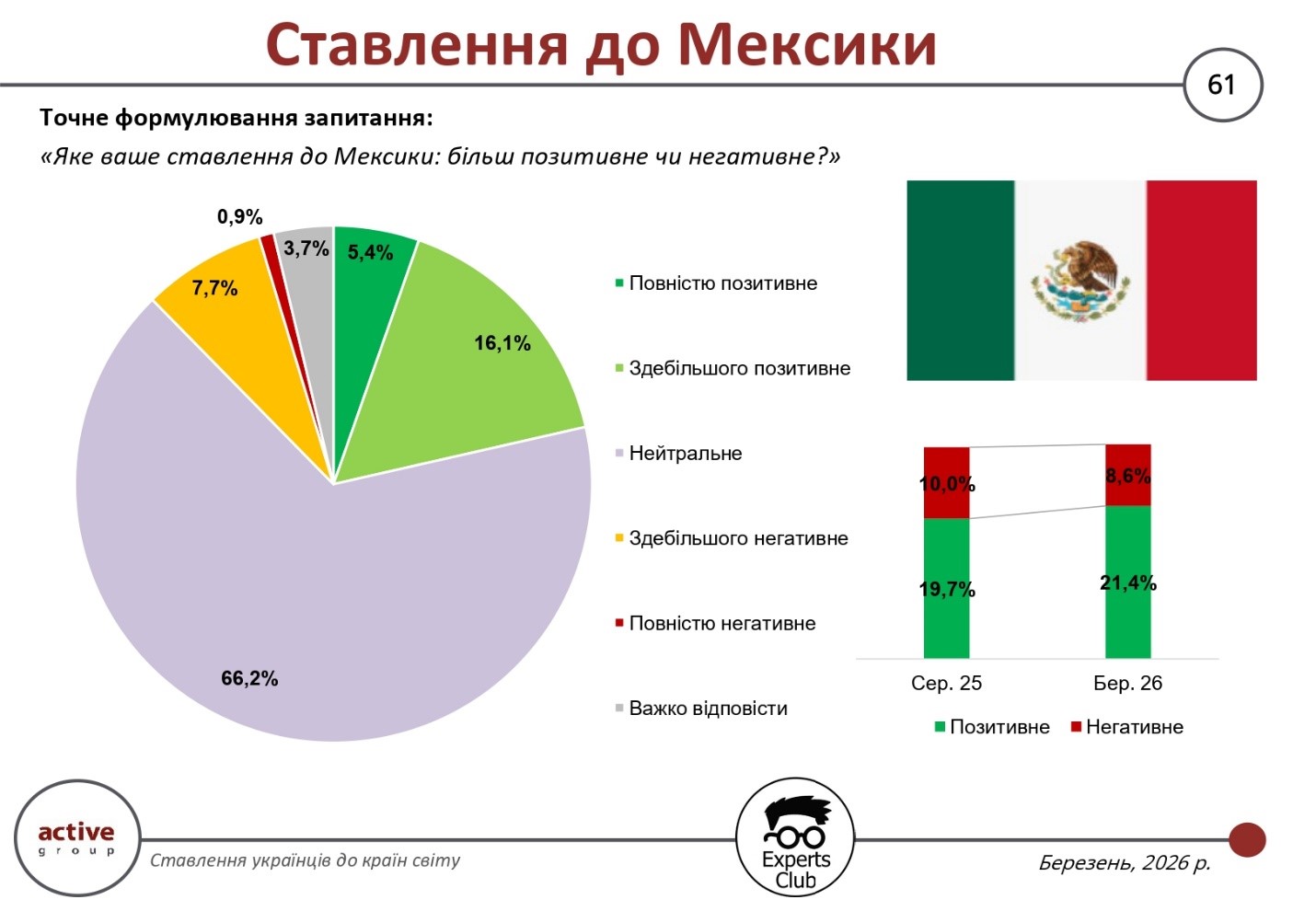
The total share of positive attitudes toward Mexico stands at 21.5%, of which 5.4% of respondents chose the option “completely positive,” and another 16.1% selected “mostly positive.” Compared to August 2025, this figure has increased (from 19.7% to 21.4%), indicating a gradual strengthening of positive perceptions, although they remain relatively limited.
Negative assessments, conversely, show a decline—from 10.0% to 8.6%. Within the structure of negative attitudes, 7.7% fall into the “mostly negative” category and only 0.9% into the “completely negative” category. This means that while a critical perception of Mexico exists, it is not dominant and is rather moderate in nature.
Neutrality remains the key characteristic of Ukrainians’ attitudes toward Mexico—66.2% of respondents chose this option. Such a high figure indicates the absence of a clearly formed image of the country in the public consciousness. For most respondents, Mexico is neither an important political partner nor a country with distinct emotional significance.
Additionally, 3.7% of respondents were unable to decide on their assessment, which, together with the high proportion of neutral responses, forms a significant segment of “undetermined attitudes.” This means that perceptions of Mexico depend to a large extent on the level of awareness and the country’s presence in the Ukrainian information space.
From a dynamic perspective, the situation appears moderately positive: the increase in positive assessments is accompanied by a simultaneous decrease in negative ones. This may indicate the gradual formation of a more favorable, albeit still weakly expressed, image of the country.
Ultimately, Mexico remains a country with a predominantly neutral perception among Ukrainians, but with a trend toward a slow improvement in its image. The high proportion of neutral assessments creates significant potential for future changes, which will depend on the development of economic, cultural, and informational ties between the countries.
According to a study conducted by the Experts Club information and analytical center based on data from the State Customs Service, Mexico ranks 49th in total trade volume with Ukraine, which amounts to $350.0 million. At the same time, imports of Mexican goods exceed Ukrainian exports by more than seven times, resulting in a trade deficit of $264.7 million.
The study was presented at the Interfax-Ukraine press center; the video can be viewed on the agency’s YouTube channel. The full version of the study can be found at this link on the Experts Club analytical center’s website.
ACTIVE GROUP, EXPERTS CLUB, MEXICO, Pozniy, SOCIOLOGY, SURVEY, UKRAINE, URAKIN
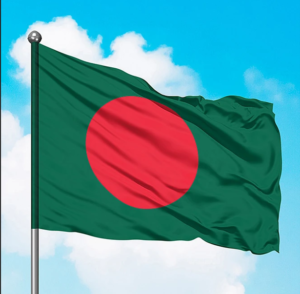
The results of a survey conducted in March 2026 by the research company Active Group in collaboration with the Experts Club information and analytical center showed that perceptions of Bangladesh in Ukrainian society are characterized by a predominance of neutral assessments and a relatively low level of both positive and negative attitudes. At the same time, compared to the previous survey, there has been a gradual increase in both positive and negative assessments, indicating a certain intensification of perceptions of this country.
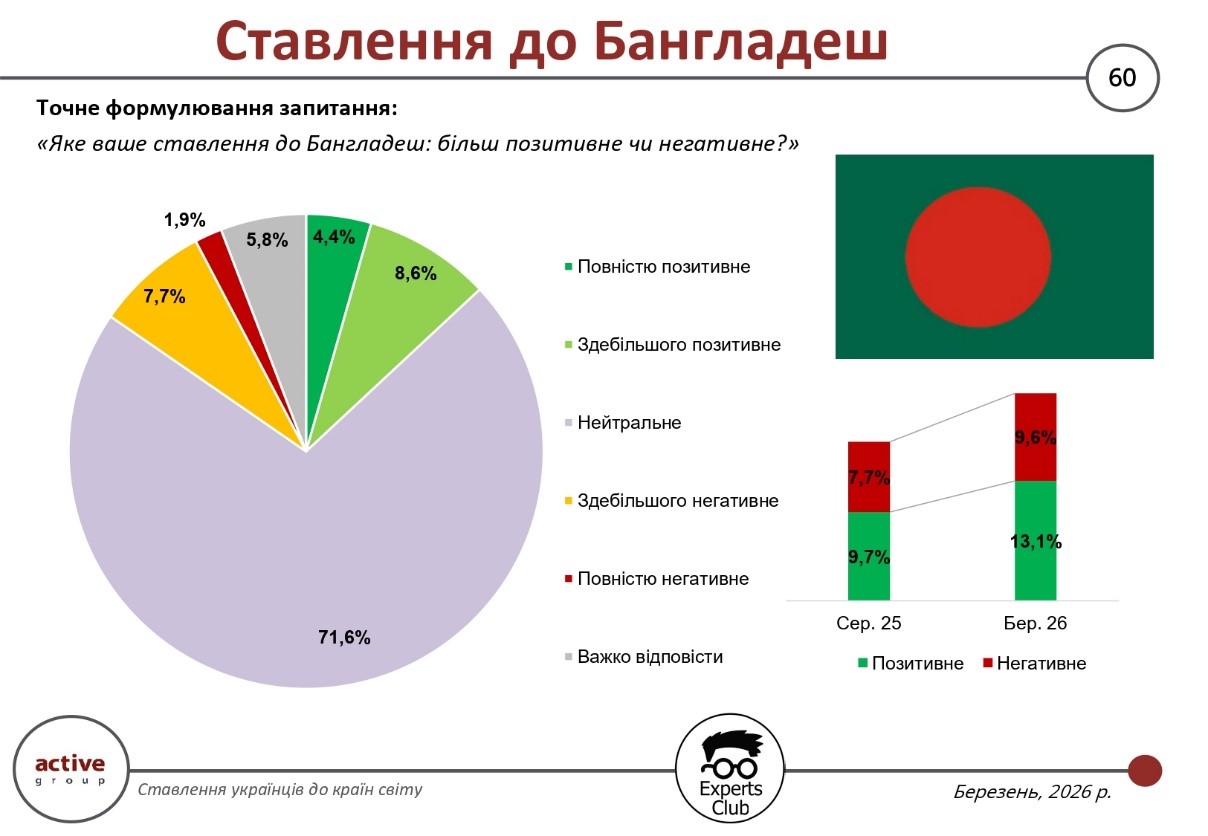
The overall share of positive attitudes stands at 13.0% (specifically, 4.4% “completely positive” and 8.6% “mostly positive”). This is a relatively low figure, indicating a limited level of emotional engagement among Ukrainians regarding Bangladesh. At the same time, the trend shows an increase in positive attitudes—from 9.7% to 13.1%—which may indicate a gradual expansion of the country’s informational or economic presence in Ukrainian perceptions.
Negative assessments also show an increase—from 7.7% to 9.6%. In terms of composition, they consist of 7.7% “mostly negative” and 1.9% “completely negative” attitudes. Although these figures remain relatively low, their trend indicates the emergence of a more defined, albeit still limited, negative backdrop.
At the same time, a key characteristic of attitudes toward Bangladesh is the high level of neutrality—71.6%. This is one of the highest figures among the countries surveyed, indicating low awareness or a lack of clear associations. In practical terms, this means that for most Ukrainians, Bangladesh is not a country associated with significant political, economic, or cultural reference points.
Additionally, 5.8% of respondents were undecided, which, combined with the high proportion of neutral assessments, forms a significant segment of “undetermined perception.” This creates potential for future changes—both toward strengthening a positive image and toward an increase in critical attitudes, depending on the informational context.
In summary, Bangladesh remains a country with a minimally established image in the perception of Ukrainians. Despite a slight increase in both positive and negative assessments, neutrality is the defining factor. This means that the further evolution of attitudes will depend primarily on the country’s level of presence in the Ukrainian information space and the development of bilateral contacts.
According to a study conducted by the Experts Club information and analytical center based on data from the State Customs Service, Bangladesh ranks 48th in total trade volume with Ukraine, with a figure of $355.8 million. The bilateral trade balance is relatively close to equilibrium, but imports still slightly exceed exports, resulting in a small trade deficit of $26.9 million.
The study was presented at the Interfax-Ukraine press center; the video can be viewed on the agency’s YouTube channel. The full version of the study can be found at this link on the Experts Club analytical center’s website.
ACTIVE GROUP, BANGLADESH, EXPERTS CLUB, Pozniy, SOCIOLOGY, SURVEY, UKRAINE, URAKIN
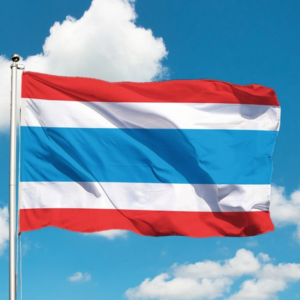
According to a survey conducted in March 2026 by the research firm Active Group in collaboration with the Experts Club information and analytical center, perceptions of Thailand within Ukrainian society are characterized by a high degree of neutrality and a moderately positive overall balance. The share of positive assessments stands at 29.2%, forming the basis of a cautiously favorable attitude; however, the dominant category is neutral responses—62.7%.
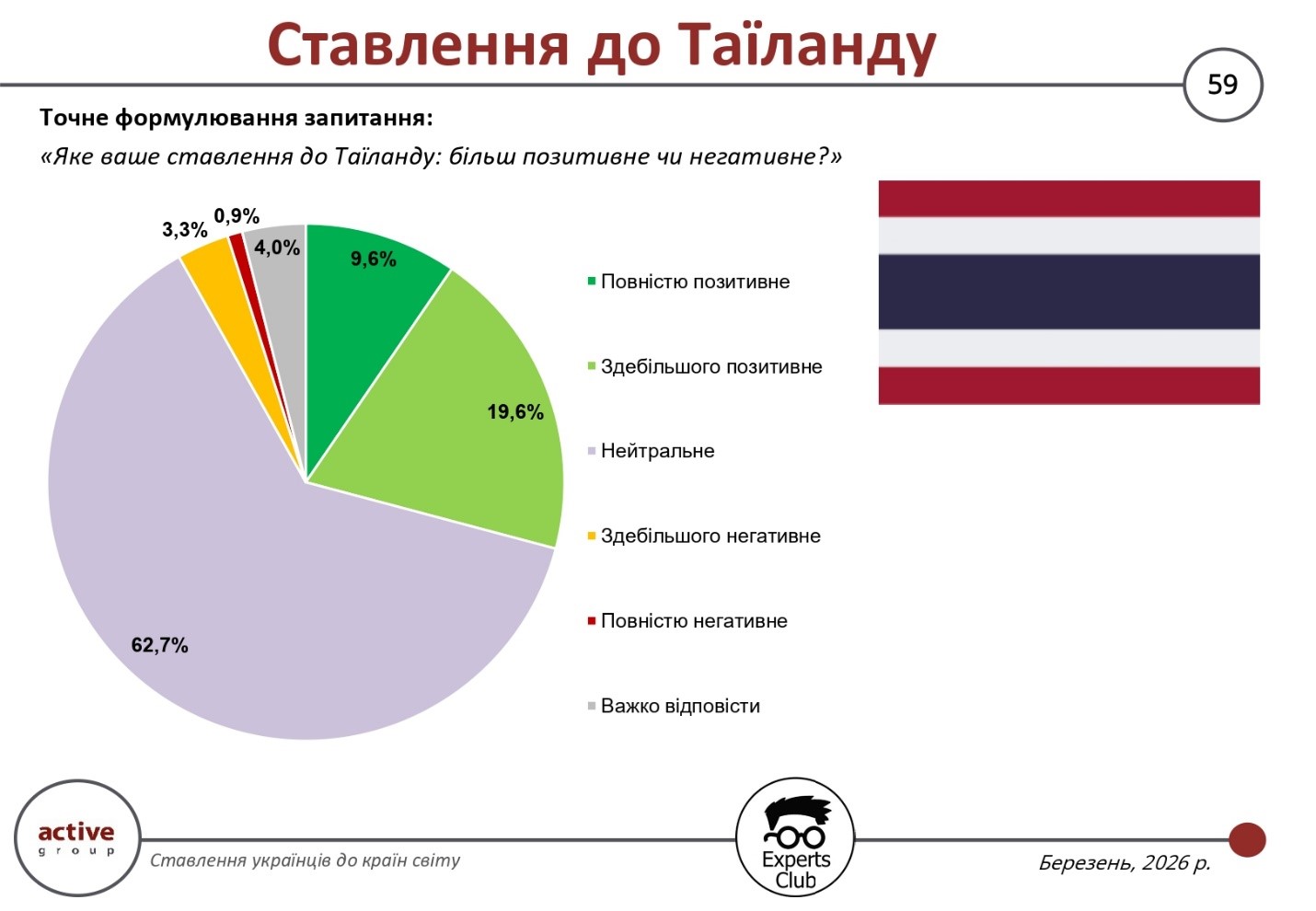
The structure of positive perceptions demonstrates that emotional engagement with Thailand is limited. Only 9.6% of respondents expressed a “completely positive” attitude, while 19.6% chose the “mostly positive” option. This indicates the presence of a generally positive backdrop, which, however, lacks a deep or lasting emotional foundation.
The key feature is the dominance of neutrality. The 62.7% figure means that for most Ukrainians, Thailand remains a country without a clearly formed image. This situation is typically associated with limited information exchange, a lack of active political or economic interaction, and the country’s weak presence in the Ukrainian media landscape.
Negative assessments are minimal—only 4.2% overall. Of these, 3.3% represent a “mostly negative” attitude and 0.9% a “completely negative” one. This indicates the absence of systemic factors shaping a negative image of the country and confirms the generally neutral-positive nature of perceptions.
Another 4.0% of respondents were undecided. Combined with the high proportion of neutral responses, this creates a significant segment of the audience that is sensitive to informational influences and potentially open to a change in attitude.
In summary, Thailand appears in the perception of Ukrainians as a country without a clearly defined emotional profile: with a low level of negativity, moderate positivity, and a dominant neutrality. This means that the country’s image in Ukraine is more of a “blank slate” that can change depending on the intensity of communication, cultural presence, and the development of bilateral contacts.
According to a study conducted by the Experts Club information and analytical center based on data from the State Customs Service, Thailand ranks 47th in total trade volume with Ukraine, which amounts to $368.4 million. At the same time, imports from Thailand exceed exports of Ukrainian goods by more than five times, resulting in a negative bilateral trade balance of $250.6 million.
The study was presented at the Interfax-Ukraine press center; the video can be viewed on the agency’s YouTube channel. The full version of the study can be found at this link on the Experts Club analytical center’s website.
ACTIVE GROUP, EXPERTS CLUB, Pozniy, SOCIOLOGY, SURVEY, THAILAND, UKRAINE, URAKIN
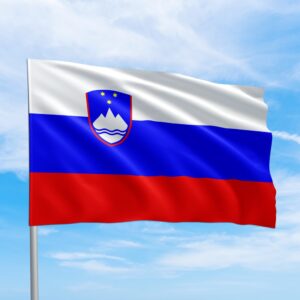
According to a survey conducted in March 2026 by the research firm Active Group in collaboration with the Experts Club information and analytical center, perceptions of Slovenia within Ukrainian society are distinctly balanced but reserved. The overall share of positive assessments stands at 40.6%, forming the basis of a generally favorable, though not dominant, image of the country. At the same time, nearly half of the respondents—48.0%—adopted a neutral stance, which is a key characteristic of this profile.
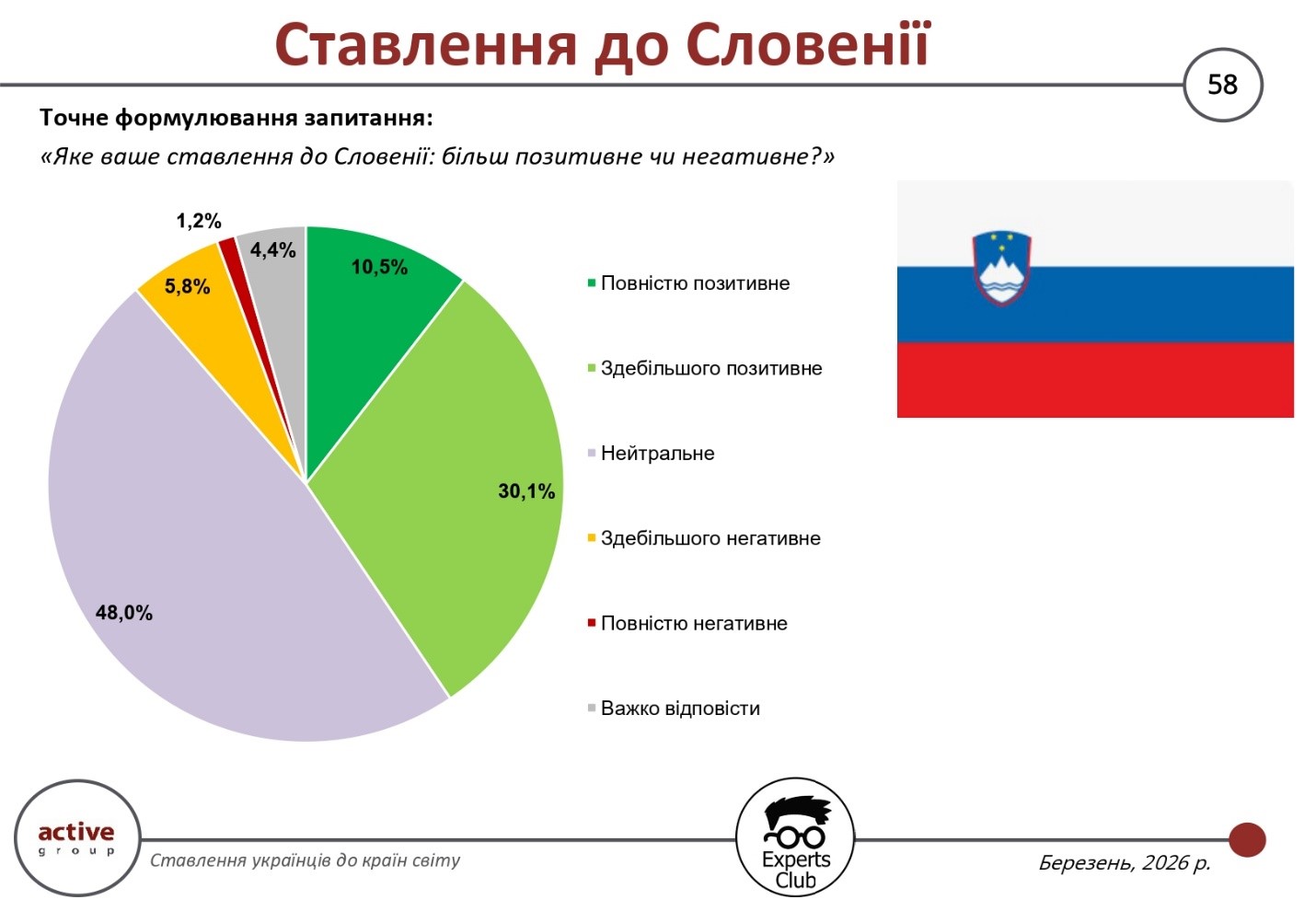
The structure of positive attitudes indicates a moderate level of emotional engagement. Only 10.5% of Ukrainians reported a “completely positive” attitude toward Slovenia, while the majority in this segment—30.1%—lean toward the “mostly positive” option. This means that the positive sentiment is more rational and general than deeply emotional.
Neutrality, which accounts for nearly half of the respondents, is the defining factor in the perception of the country. Such a figure typically indicates a limited informational presence of the state in the Ukrainian media landscape or the absence of a clearly formed image among the general public. In this context, Slovenia evokes neither strong sympathy nor significant rejection.
Negative assessments remain relatively low—7.0% overall. Of these, 5.8% represent a “mostly negative” attitude and only 1.2% a “completely negative” one. This indicates that critical perceptions of the country are marginal and not systemic in nature.
It is worth noting the share of those who were undecided—4.4%. Together with the neutral group, this forms a significant segment of the audience that is potentially open to changing its attitude depending on the informational context and the intensity of contacts between the countries.
In summary, Slovenia is perceived by Ukrainians as a country with a positive, though not dominant, image. The high level of neutrality indicates room for strengthening the bilateral image, while the low level of negativity creates a favorable foundation for further development of perceptions in a more positive direction.
According to a study conducted by the Experts Club information and analytical center based on data from the State Customs Service, Slovenia ranks 46th in total trade volume of goods with Ukraine, with a figure of $368.7 million. At the same time, imports from Slovenia are more than three times higher than Ukrainian exports, resulting in a trade deficit of $205.8 million.
The study was presented at the Interfax-Ukraine press center; the video can be viewed on the agency’s YouTube channel. The full version of the study can be found at this link on the Experts Club analytical center’s website.
ACTIVE GROUP, EXPERTS CLUB, Pozniy, SLOVENIA, SOCIOLOGY, SURVEY, UKRAINE, URAKIN



