
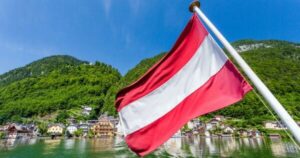
Austria continues to be viewed predominantly positively by Ukrainians: in August 2026, about 52.7% of respondents expressed a positive attitude toward the country, while only 2.7% expressed a negative one. At the same time, 41.7% of those surveyed hold a neutral position, which remains a distinctive feature of perceptions of Austria, according to the Experts Club Information and Analytical Center.
According to the results of the August survey, 15.3% of Ukrainians have a completely positive attitude toward Austria, and 37.4% have a mostly positive attitude. A neutral response was chosen by 41.7% of respondents. 2.3% view the country mostly negatively, only 0.4% view it entirely negatively, and another 2.9% were undecided.
Thus, the balance of positive and negative assessments, when rounded, stands at approximately plus 50 percentage points. There are nearly 20 times as many positive responses as negative ones; however, Austria differs from a number of other Western European countries in having a significantly higher proportion of neutral attitudes.
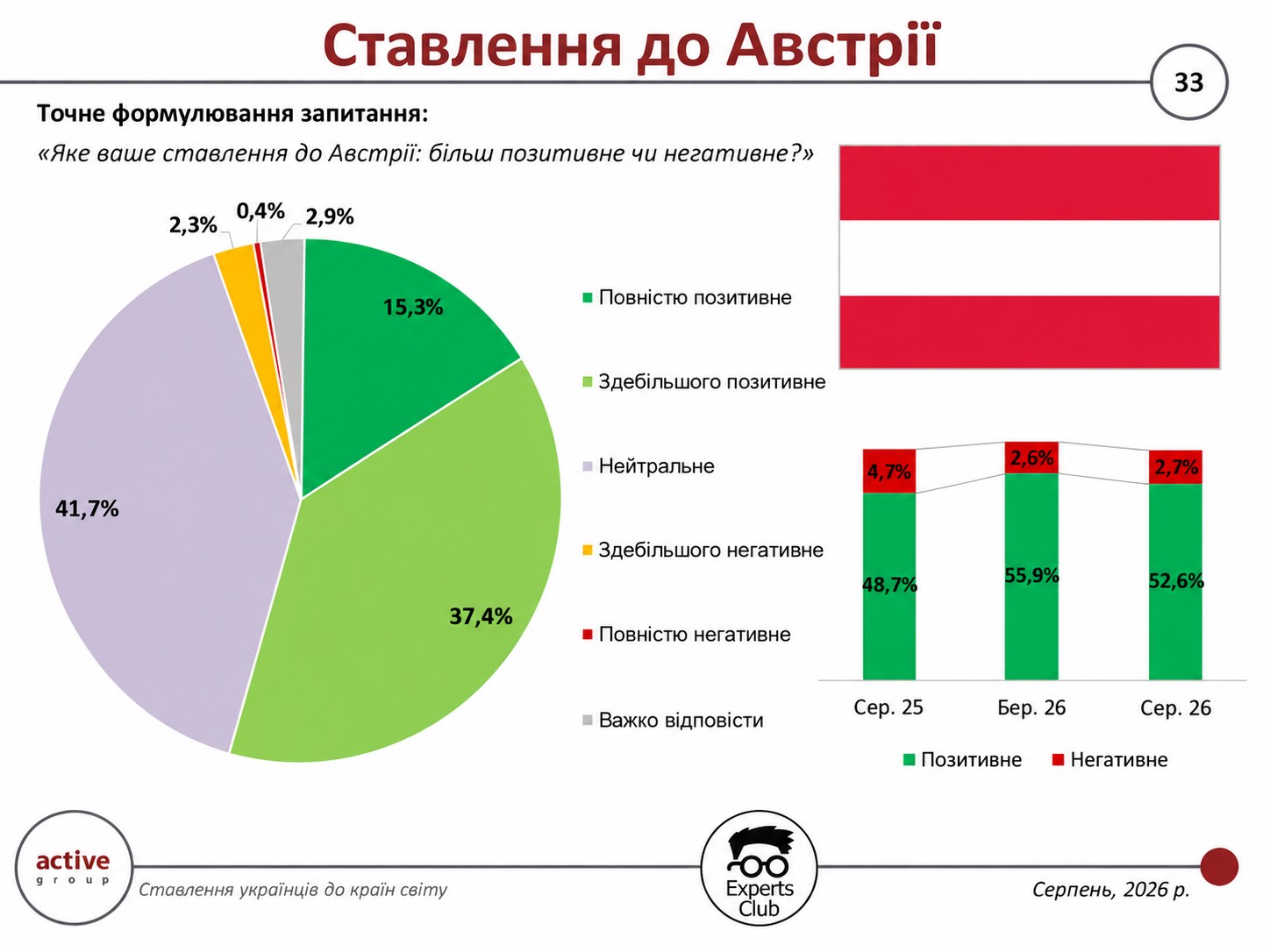
Compared to March 2026, the proportion of positive assessments has decreased slightly. In the previous survey wave, 17.5% of respondents had a completely positive attitude toward Austria, and 38.5% had a mostly positive attitude, meaning the combined positive rating was about 55.9%. A neutral stance was held by 40.3% of respondents, while about 2.6% expressed a negative attitude.
Thus, over the course of five months, the share of positive assessments decreased by approximately 3.2 percentage points—to 52.7%. The share of negative assessments remained virtually unchanged—about 2.6% in March compared to 2.7% in August—while the neutral segment increased by 1.4 percentage points. The most notable decline was in the share of entirely positive responses—from 17.5% to 15.3%.
This pattern indicates that the slight weakening of the positive rating is not accompanied by a shift toward a negative attitude among a significant portion of respondents. A neutral stance remains the primary alternative to a positive assessment of Austria.
Oleksandr Pozniy, director of the research company Active Group, when commenting on Ukrainians’ attitudes toward Austria, previously highlighted precisely this combination of a positive image of the country with a large neutral group.
“Austria is traditionally perceived by Ukrainians as a European country with high social standards, a rich cultural heritage, and a stable political system. Although Austria is not Ukraine’s main partner in foreign policy, the overall level of favorability remains positive,” Pozniy noted.
The current wave of the survey generally confirms this assessment: the negative segment remains very small, and changes are occurring primarily among positive and neutral responses. More than nine out of ten respondents view Austria positively or neutrally.
The survey was conducted in August 2026 using self-administered online questionnaires in the SunFlowerSociology panel among 800 Ukrainian citizens aged 18 and older. The previous survey wave in March also included 800 respondents; the sample was representative by age, gender, and region, with a maximum theoretical margin of error of ±3.5 percentage points for indicators at the 50% confidence level.
ACTIVE GROUP, AUSTRIA, EUROPEAN UNION, EXPERTS CLUB, international relations, Pozniy, PUBLIC OPINION, SOCIOLOGY, UKRAINE, WESTERN EUROPE
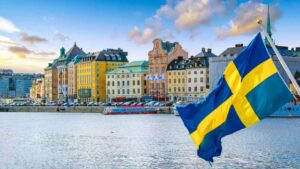
Sweden remains among the countries with the highest level of positive perception among Ukrainians: in August 2026, 71.4% of respondents expressed a positive attitude toward it, while only 0.8% expressed a negative one. Compared to March, the share of positive assessments decreased slightly, but negative attitudes also declined, according to the Experts Club Information and Analytical Center.
According to the results of the August survey, 31.9% of Ukrainians have a completely positive attitude toward Sweden, and 39.5% have a mostly positive attitude. A neutral stance is held by 26.2% of respondents. Only 0.8% view the country mostly negatively; no entirely negative assessments were recorded in the survey, and another 1.6% were undecided.
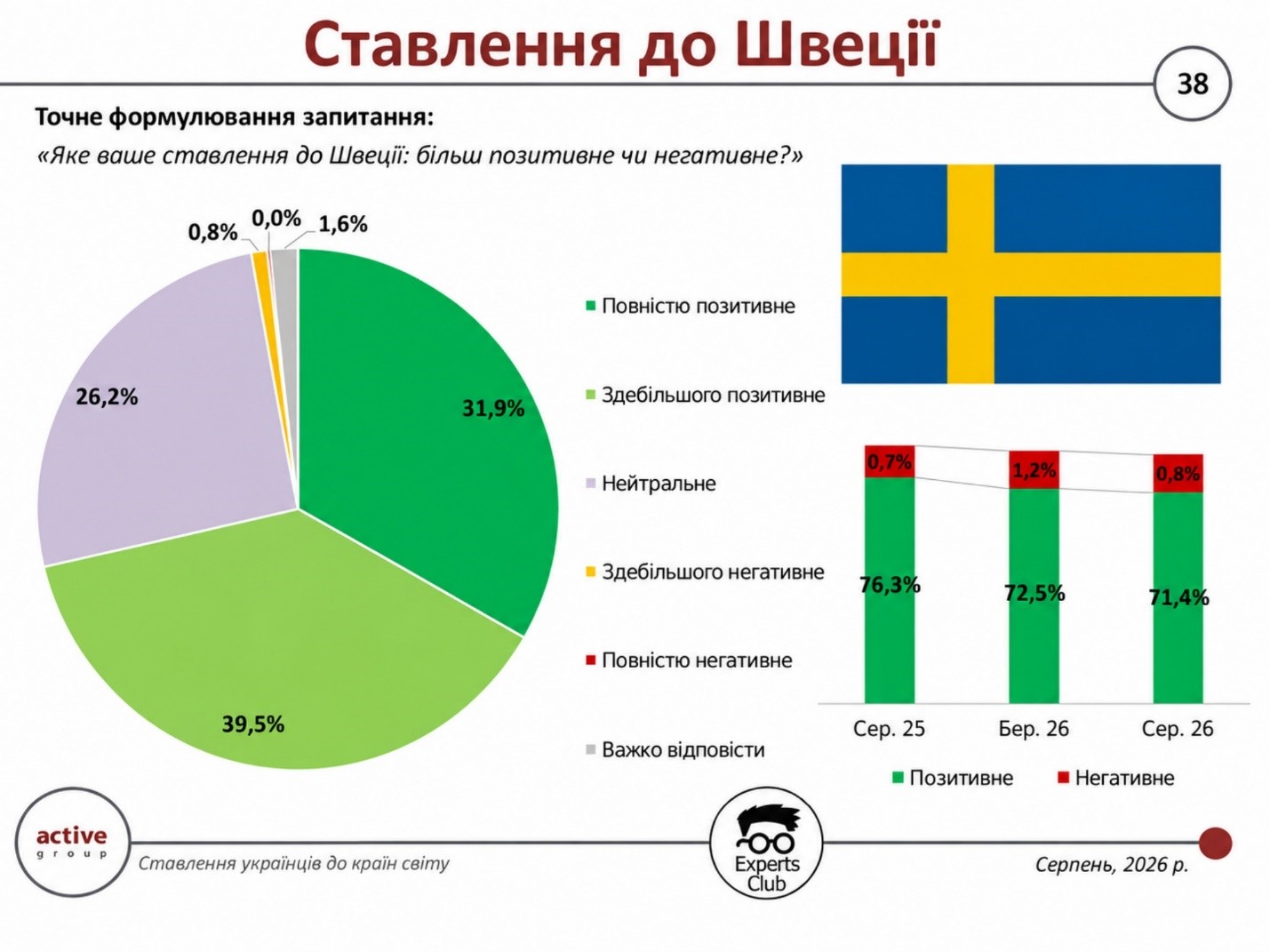
The balance between positive and negative assessments stands at plus 70.6 percentage points. By this measure, Sweden ranks among the highest of all countries included in the study. Positive attitudes outnumber negative ones by nearly 90 to 1.
In March 2026, 72.5% of respondents viewed Sweden positively: 35% viewed it entirely positively and 37.5% viewed it mostly positively. At that time, 24.7% of respondents held a neutral stance, while negative attitudes accounted for about 1.2%.
Thus, over the course of five months, the share of positive assessments decreased by only 1.1 percentage points—from 72.5% to 71.4%. Negative responses decreased by 0.4 percentage points, while the neutral segment increased by 1.5 percentage points—from 24.7% to 26.2%. The balance between positive and negative attitudes remained virtually unchanged—from approximately plus 71.3 to plus 70.6 percentage points.
At the same time, there was a certain redistribution within the positive segment. The share of fully positive assessments decreased from 35% to 31.9%, while the share of mostly positive assessments rose from 37.5% to 39.5%. This indicates a moderate decline in the intensity of positive attitudes rather than a deterioration in the country’s overall image.
Oleksandr Pozniy, director of the research firm Active Group, commented on the previous wave of the survey by highlighting the stability of Ukrainians’ attitudes toward Sweden.
“Sweden remains a country with a very high level of trust among Ukrainians, and this is evident from the structure of the responses. At the same time, we are observing a certain increase in the share of neutral assessments, which indicates not a change in attitude but a decrease in its intensity. This is a typical effect for countries that are not constantly in the spotlight,” Pozniy noted.
The new results effectively confirm this trend. The proportion of neutral responses continued to rise moderately, but this was not accompanied by an increase in negative attitudes. Sweden remains one of the countries with the most consistently positive image in Ukrainian society.
The previous wave of the survey was conducted in March 2026 among 800 Ukrainian citizens aged 18 and older using self-administered online questionnaires in the SunFlowerSociology panel. The sample was representative by age, gender, and region; the maximum theoretical margin of error for indicators at the 50% confidence level was ±3.5 percentage points.
ACTIVE GROUP, EXPERTS CLUB, international relations, NORTHERN EUROPE, Pozniy, PUBLIC OPINION, SOCIOLOGY, SWEDEN, UKRAINE
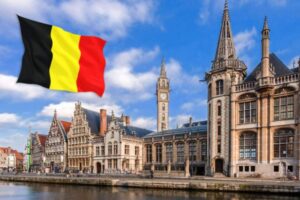
Ukrainians’ attitudes toward Belgium in August 2026 improved slightly compared to the previous survey wave: 59.8% of respondents view the country positively, while only 1.4% view it negatively. At the same time, more than a third of those surveyed—36%—remain neutral, according to the Experts Club Information and Analytical Center.
According to the results of the August survey, 21.1% of Ukrainians view Belgium entirely positively, and 38.7% view it mostly positively. A neutral attitude was expressed by 36% of respondents. Only 0.8% view the country mostly negatively, 0.6% view it entirely negatively, and another 2.7% were undecided.
According to the table, the balance of positive and negative assessments is +58.4 percentage points. Thus, Belgium remains among the Western European countries with a distinctly positive perception, and negative attitudes toward it are virtually marginal.
In March 2026, 58.7% of respondents viewed Belgium positively: 19.3% viewed it entirely positively and 39.4% viewed it mostly positively. 37.1% of respondents held a neutral view, 2.3% held a negative view, and another 1.9% were undecided.
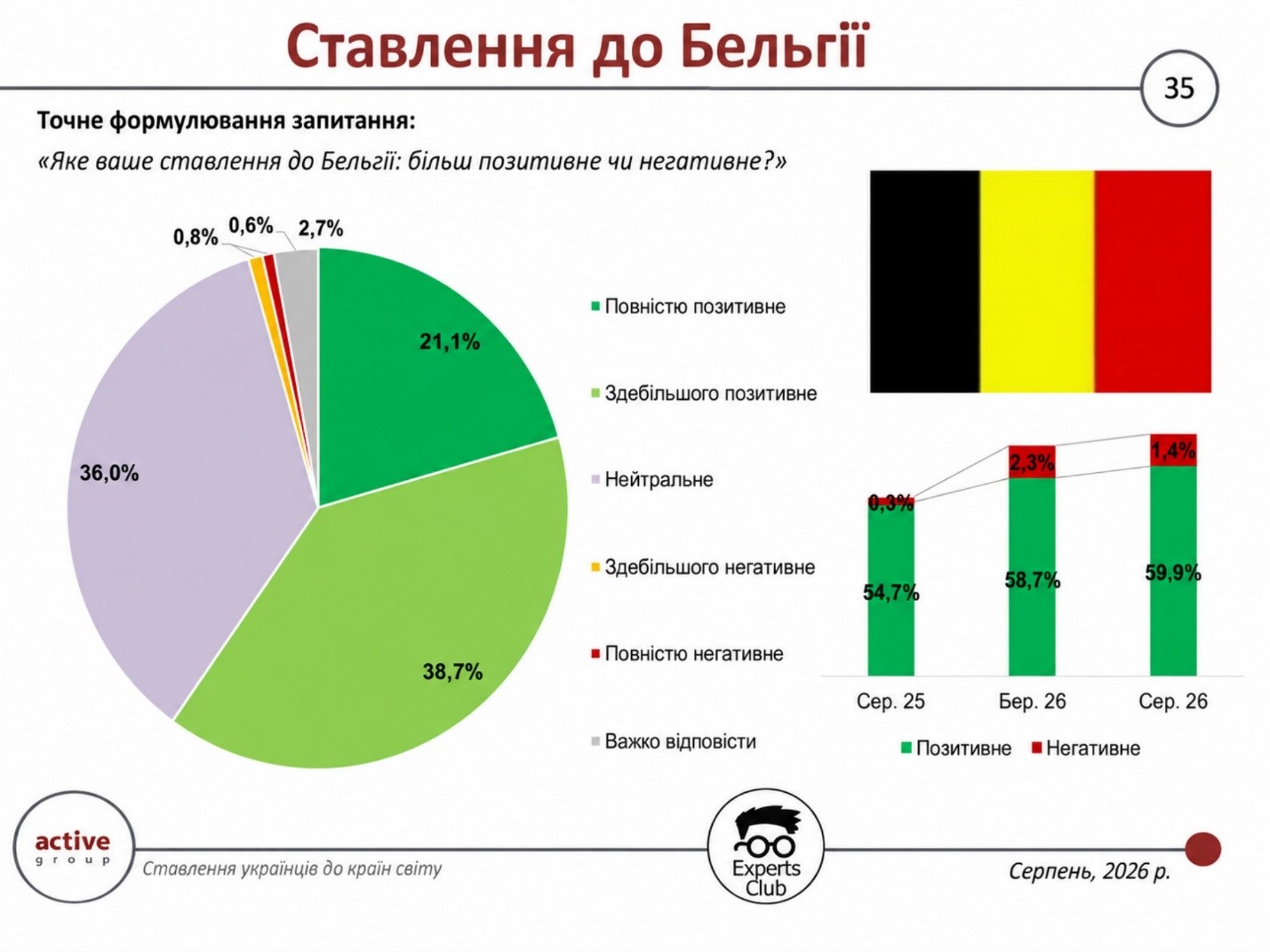
Thus, over the course of five months, the share of positive assessments rose by 1.1 percentage points—from 58.7% to 59.8%—while negative assessments fell by 0.9 percentage points—from 2.3% to 1.4%. The neutral segment also decreased by 1.1 percentage points. The balance between positive and negative attitudes rose from approximately plus 56.4 to plus 58.4 percentage points.
At the same time, the internal structure of positive responses changed slightly. The share of fully positive assessments increased from 19.3% to 21.1%, while the share of mostly positive assessments decreased from 39.4% to 38.7%. This means that the overall improvement was modest, but a portion of respondents began to view Belgium more unequivocally positively.
Oleksandr Pozniy, director of the research firm Active Group, previously noted that a significant proportion of neutral responses regarding Belgium is not linked to a negative perception but rather to the specific characteristics of the country’s established image.
“Belgium is perceived by Ukrainians as an important member of the European Union and NATO, a country that consistently supports Ukraine on the international stage. At the same time, its relative distance and the lack of deep historical ties account for the high proportion of neutral assessments,” Pozniy explained.
The new wave of the survey generally confirms this characterization. The positive segment is gradually expanding, negative assessments remain at a minimal level, yet more than a third of Ukrainians still hold a neutral position. This indicates significant potential for further shaping a more defined image of Belgium through economic, humanitarian, educational, and intercultural contacts.
The previous wave of the survey was conducted in March 2026 among 800 Ukrainian citizens aged 18 and older using self-administered online questionnaires on the SunFlowerSociology panel. The sample was representative by age, gender, and region; the maximum theoretical margin of error for indicators at the 50% confidence level was ±3.5 percentage points.
ACTIVE GROUP, BELGIUM, EUROPEAN UNION, EXPERTS CLUB, international relations, NATO, Pozniy, PUBLIC OPINION, SOCIOLOGY, UKRAINE
Spain continues to strengthen its positive image among Ukrainians: in August 2026, 65.2% of respondents expressed a positive attitude toward the country, while only 1.6% expressed a negative one. Compared to the previous survey, the share of positive assessments has increased, while negative attitudes remain at a minimal level, according to the Experts Club Information and Analytical Center.
According to the results of the August survey, 23.9% of Ukrainians have a completely positive attitude toward Spain, and 41.3% have a mostly positive attitude. A neutral stance is held by 31.3% of respondents. 1.4% view the country mostly negatively, only 0.2% view it entirely negatively, and another 2% were undecided.
The balance of positive and negative assessments stands at plus 63.6 percentage points. Thus, positive attitudes toward Spain outweigh negative ones by more than 40 times, and over 96% of respondents view the country positively or neutrally.
Compared to March 2026, attitudes toward Spain have improved. In the previous survey, 18.9% of respondents described their attitude as entirely positive, and 44.8% as mostly positive. The overall positive rating stood at 63.6%, the negative rating at 0.9%, and 33.6% of respondents held a neutral position.
Over the course of five months, the share of positive assessments increased by approximately 1.6 percentage points—to 65.2%. At the same time, there were changes within the positive group: the share of “entirely positive” responses rose by 5 percentage points—from 18.9% to 23.9%—while the share of “mostly positive” responses declined slightly. The share of neutral assessments decreased from 33.6% to 31.3%.
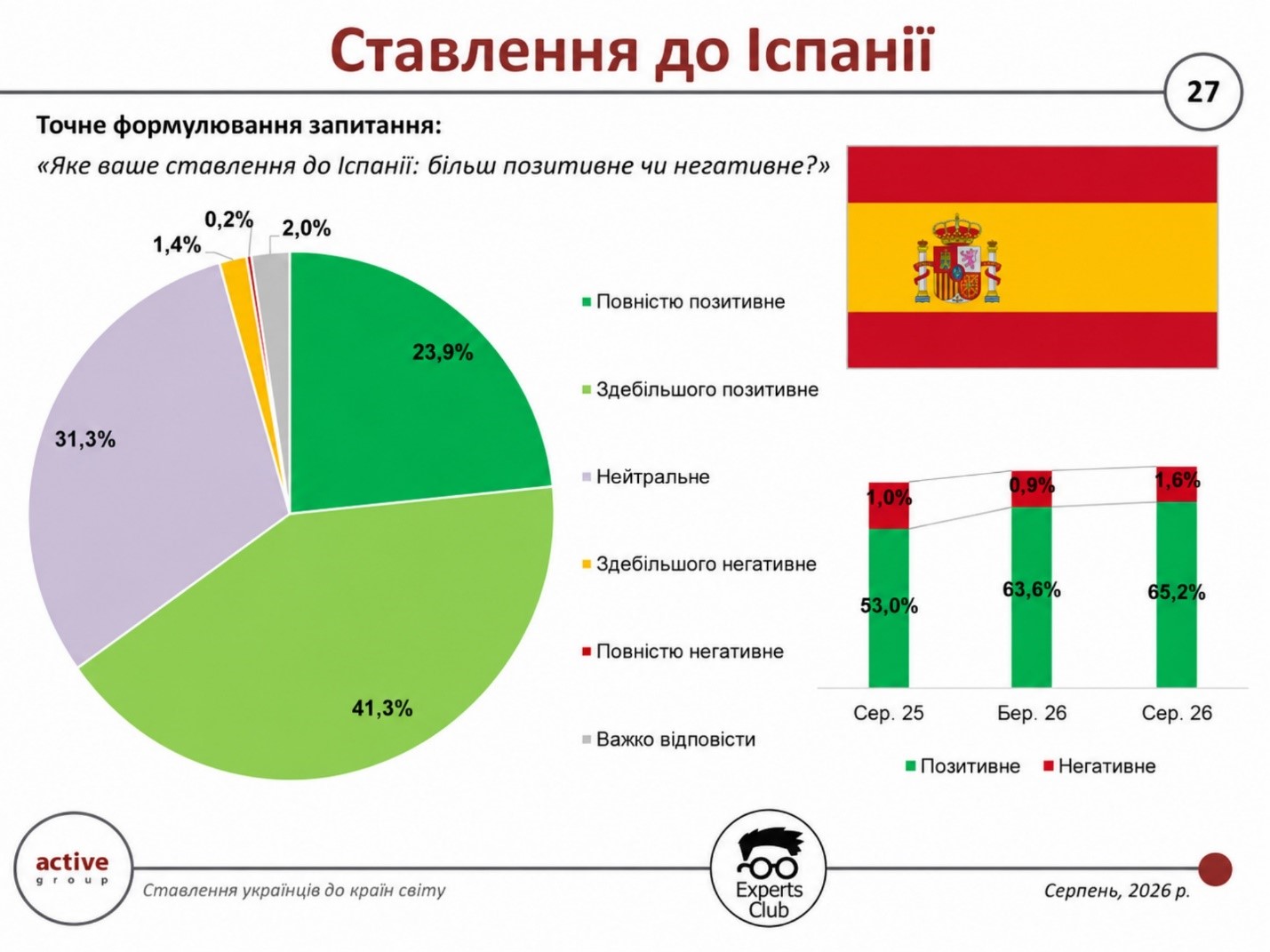
This continues the positive trend observed in previous waves of the survey: in August 2025, the balance of positive and negative attitudes toward Spain stood at approximately plus 52 percentage points; in March 2026, it was approximately plus 62.7 percentage points; and in August, it was plus 63.6 percentage points.
Spain remains not only one of the most positively perceived European countries but also one of Ukraine’s most advantageous trading partners. Recently, Spain has been among the leaders in terms of a trade surplus for Ukraine—that is, Ukrainian exports to this country significantly exceed imports. This makes the Spanish market particularly important in terms of foreign exchange earnings, export diversification, and the presence of Ukrainian businesses in the EU market.
Maksym Urakin, founder of the information and analytical center Experts Club, notes that in this case, the country’s positive public image is combined with real economic benefits for Ukraine.
“Spain is not only a country with a consistently positive image among Ukrainians but also one of Ukraine’s most advantageous economic partners. Recently, it has demonstrated a very strong position in bilateral trade and stands out as one of the leaders in terms of a trade surplus favorable to Ukraine. The combination of economic benefits, political support, humanitarian openness, and a positive public attitude forms a very solid foundation for the further development of Ukrainian-Spanish relations,” Urakin noted.
Oleksandr Pozniy, director of the research company Active Group, attributed the positive perception of Spain to a combination of political, humanitarian, and social factors.
“Spain actively supports Ukraine on the international stage, provides humanitarian aid, and creates favorable conditions for Ukrainian displaced persons. At the same time, cultural openness and traditional ties between our peoples reinforce this positive image. Therefore, there is virtually no mistrust or criticism of Spain within Ukrainian society,” Pozniy noted.
The latest wave of the survey generally confirms this trend. The increase in the share of entirely positive assessments, coupled with an extremely low level of negative sentiment, indicates that Spain continues to enjoy a consistently positive image among the Ukrainian public.
The survey was conducted in August 2026 using self-administered online questionnaires in the SunFlowerSociology panel among 800 Ukrainian citizens aged 18 and older. In the previous wave conducted in March, 800 respondents were also surveyed, and the sample was representative by age, gender, and region.
ACTIVE GROUP, EXPERTS CLUB, international relations, Pozniy, PUBLIC OPINION, SOCIOLOGY, SPAIN, TRADE, UKRAINE, URAKIN
The Netherlands continues to enjoy one of the highest levels of positive perception among Ukrainians: in August 2026, a total of 71.3% of respondents expressed a positive attitude toward the country, while only 1.6% expressed a negative one. Compared to March, the share of positive assessments declined slightly, but the net sentiment remains one of the highest among the countries surveyed, according to the Experts Club Information and Analytical Center. Experts.news
According to the results of the August survey, 28.4% of Ukrainians have a completely positive attitude toward the Netherlands, and 42.9% have a mostly positive attitude. A neutral stance is held by 26.4% of respondents. 1.4% view the country mostly negatively, only 0.2% view it entirely negatively, and another 0.8% were undecided.
The net balance of positive and negative assessments, based on rounded figures, stands at plus 69.7 percentage points. Based on this indicator, the Netherlands ranks among the countries with the most favorable public perception among Ukrainians, trailing only Canada and Sweden in the overall ranking.
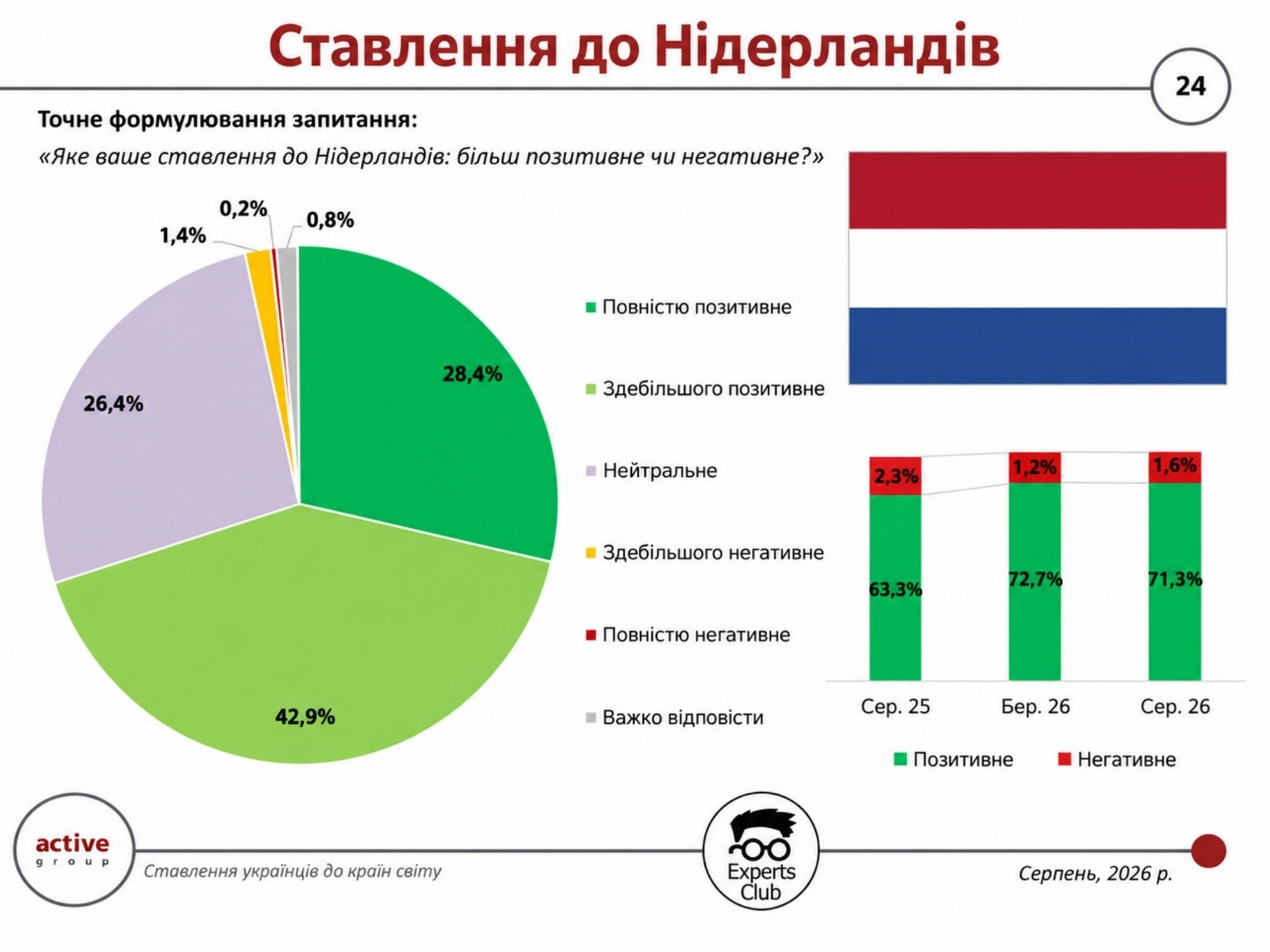
A previous survey conducted in March 2026 also showed a very high level of favorability. At that time, 34.3% of respondents viewed the Netherlands entirely positively, 38.5% viewed it mostly positively, and 24.2% held a neutral position. In the aggregated results, the share of positive assessments was reported at 72.7%, while negative assessments accounted for only 1.2%.
Thus, between March and August, the overall share of positive assessments decreased by approximately 1.4 percentage points. At the same time, the structure of positive attitudes changed more noticeably: the share of entirely positive responses decreased by 5.9 percentage points, while that of mostly positive responses increased by 4.4 percentage points. The share of neutral assessments increased by approximately 2.2 percentage points. Overall, these changes do not indicate a significant deterioration in attitudes—the negative segment remains minimal.
Oleksandr Pozniy, director of the research firm Active Group, had previously highlighted the stability of the Netherlands’ positive image. He attributed the high ratings to the country’s consistent stance and a nature of engagement that is understandable to Ukrainian society. In his view, stable indicators across several survey waves are more important than minor fluctuations between individual measurements.
This positive public perception is also coupled with trade figures that are favorable to Ukraine. In the first half of 2026, trade with the Netherlands totaled approximately $1.82 billion, with Ukrainian exports exceeding $1 billion and a trade surplus for Ukraine of about $221.5 million.
Thus, the Netherlands remains an example of a country where a high level of public support is combined with its important role as a market for Ukrainian exports. A slight decline in the positive rating compared to March does not currently change the overall picture: only a small portion of respondents view the country negatively.
ACTIVE GROUP, EUROPEAN UNION, EXPERTS CLUB, FOREIGN TRADE, international relations, NETHERLANDS, Pozniy, PUBLIC OPINION, SOCIOLOGY, UKRAINE
Ukrainians’ attitudes toward Hungary have improved significantly compared to March 2026, but negative views still outnumber positive ones. In August, 22.9% of respondents viewed the country positively, 35.6% negatively, and another 37.4% took a neutral stance. This is evidenced by the results of the third wave of a survey conducted by Active Group and Experts Club, according to the Experts Club Information and Analytical Center. Experts.news
According to the results of the August survey, 6.3% of Ukrainians view Hungary entirely positively, while 16.6% view it mostly positively. A neutral attitude was expressed by 37.4% of respondents. At the same time, 28.8% view the country mostly negatively, 6.8% view it entirely negatively, and another 4.1% were undecided.
The balance of positive and negative assessments in August stands at minus 12.7 percentage points. Based on this indicator, Hungary remains among the countries with a negative balance of public opinion; however, the trend over the past five months has shifted significantly in a positive direction. In the survey’s overall ranking, China had a lower balance in August at minus 25.4 percentage points, and India at minus 14.3 percentage points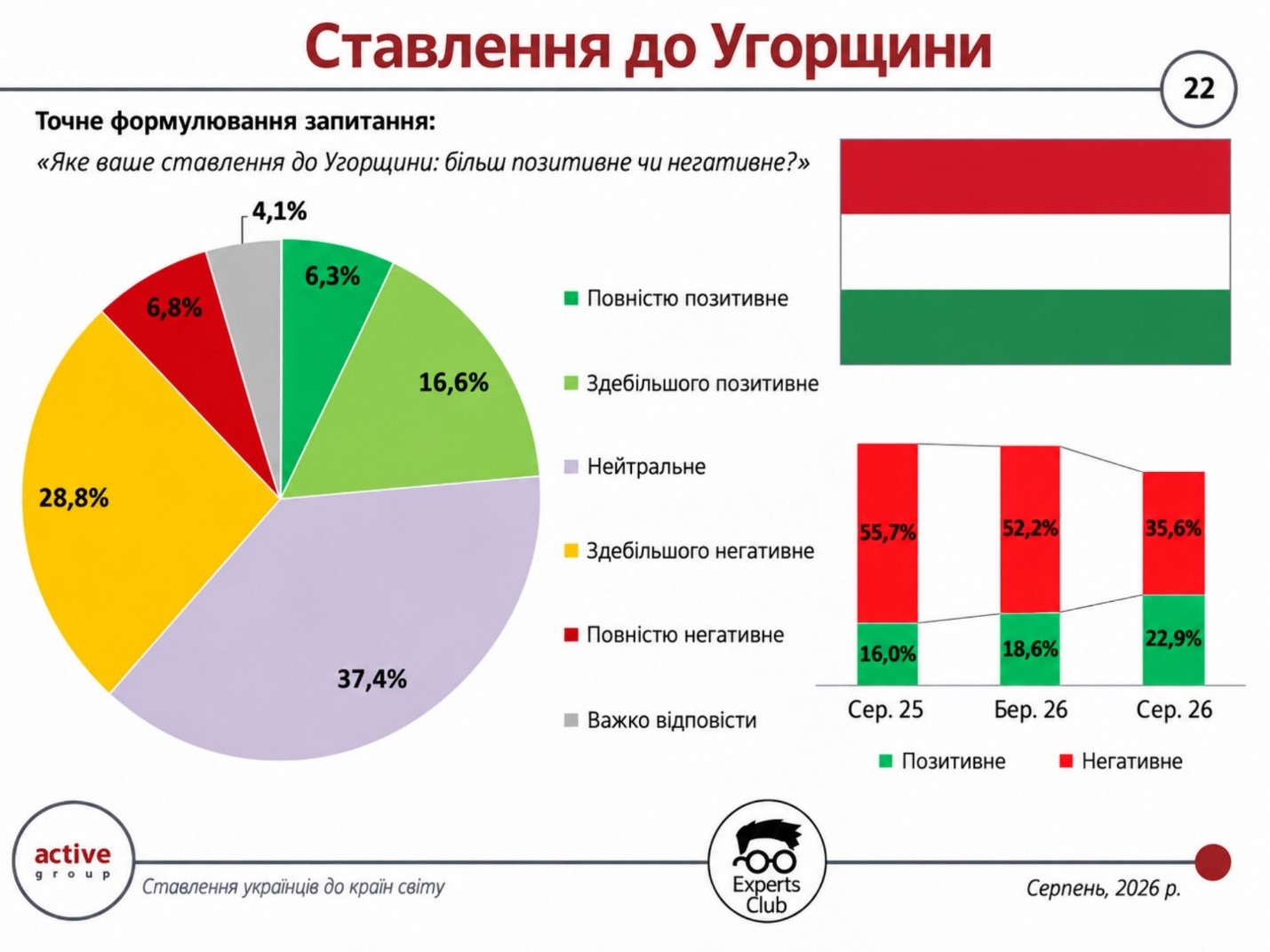
In March 2026, the situation was noticeably more negative. At that time, 4.9% of respondents viewed Hungary entirely positively, and 13.8% viewed it mostly positively—meaning that positive assessments totaled 18.6%. A total of 52.2% of respondents viewed the country negatively: 34.3% viewed it mostly negatively and 17.9% viewed it entirely negatively. 27.3% held a neutral position.
Thus, between March and August, the share of positive assessments increased by 4.3 percentage points—from 18.6% to 22.9%—while negative assessments fell by 16.6 percentage points—from 52.2% to 35.6%. At the same time, the share of neutral responses rose by 10.1 percentage points—to 37.4%.
The shift in the balance is even more pronounced: in March, it stood at minus 33.6 percentage points, and in August, at minus 12.7 percentage points. Thus, the gap between positive and negative assessments narrowed by 20.9 percentage points. At the same time, a significant portion of the former negative sentiment did not directly shift to positive assessments—it was the group of respondents with a neutral attitude that increased significantly.
Oleksandr Pozniy, director of the research company Active Group, commenting on previous waves of the survey, drew attention to the connection between public assessments and international politics as well as perceptions of support for Ukraine.
“This survey confirms the general trend in public sentiment in Ukraine, which has intensified since the start of the full-scale war. Ukrainians clearly associate the support received primarily from European Union countries and the United Kingdom with a positive attitude toward them,” Pozniy noted. Speaking specifically about Hungary, he emphasized: “These results are not surprising—the official rhetoric from Budapest and Bratislava often diverges from Ukraine’s interests and is viewed as pro-Russian, which inevitably influences public opinion.”
The new wave shows a significant softening in assessments of Hungary compared to March. At the same time, it is still too early to speak of a predominantly positive perception: negative responses remain about one and a half times more common than positive ones, and respondents with a neutral attitude now constitute the largest single group.
The survey was conducted in August 2026 using an online self-administered questionnaire via the SunFlowerSociology panel among 800 Ukrainian citizens aged 18 and older. The sample is representative by age, gender, and region; the maximum theoretical margin of error for indicators at the 50% confidence level is ±3.5 percentage points.
ACTIVE GROUP, EUROPE, EXPERTS CLUB, HUNGARY, international relations, Pozniy, PUBLIC OPINION, SOCIOLOGY, UKRAINE



