

The updated licensing requirements for motor carriers could take effect in Ukraine by the end of 2026, according to Volodymyr Golubosh, deputy head of the State Service of Ukraine for Transport Safety.
According to “Interfax-Ukraine”, the draft of the new licensing conditions was published by Ukrtransbezpeka on March 18. The agency then collected and reviewed proposals from stakeholders, and the finalized document was resubmitted for approval.
“We expect that after amendments are made to the legislation and the new procedure is approved, the updated conditions will take effect by the end of this year,” Golubosh said during the conference “Regional Dialogues with Business on European Integration: The Transportation Sector” in Lviv.
The changes are part of the harmonization of Ukrainian transportation legislation with European Union standards, specifically EU Regulations No. 1071, No. 1072, and No. 1073. According to a representative of Ukrtransbezpeka, Ukraine must fulfill the relevant European integration obligations by April 2027.
The draft amendments are being developed by Ukrtransbezpeka in collaboration with the Ministry of Community and Territorial Development. Its goal is to modernize the road transport licensing system and bring Ukrainian requirements in line with European market access rules.
The new approach stipulates that a license will confirm more than just a company’s formal right to provide transportation services. Carriers will also be required to demonstrate their ability to organize operations professionally and safely.
Specifically, the right to operate in the licensed road transport sector will be granted to companies and entrepreneurs who can demonstrate professional competence, financial capacity, and integrity.
The introduction of these criteria is intended to bring the operating rules for Ukrainian road carriers in line with the requirements of the EU’s single transport market and serve as one of the steps toward integrating Ukraine’s transport sector into the European space.
EUROPEAN INTEGRATION, LICENSE, ROAD TRANSPORT, TRANSPORTATION, UKRAINE

Ukraine and Albania have signed an agreement on international road transport, which provides for regular freight and passenger transportation, according to Deputy Prime Minister for Recovery and Minister of Community and Territorial Development Oleksiy Kuleba.
“In practice, this means more opportunities for exporting Ukrainian goods, simplifying operations for carriers, developing new transport routes through the countries of Southeast Europe, and improving transport accessibility for citizens of both countries,” Kuleba wrote on Telegram on Tuesday.
According to him, Albania has now become the 37th country with which Ukraine will have “transport visa-free travel.”
It is noted that the ministry is also continuing to work on expanding Ukraine’s international transport links and opening new markets for carriers.
ALBANIA, CARRIERS, ROAD TRANSPORT, transport visa-free travel, UKRAINE
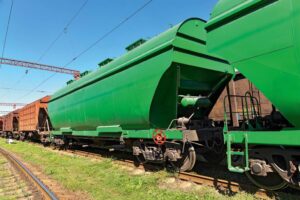
Ukraine’s export logistics entered 2026 in a new configuration, where Ukrzaliznytsia’s transition to a fixed tariff for grain car rental reduced cost volatility, according to the information and analytical agency UkrAgroConsult.
According to analysts, the main cargo flows are currently concentrated in the direction of the ports of Greater Odessa, where terminal utilization has stabilized at 50%. In early February, the number of grain cars heading for ports exceeded 9,000 units, which is associated with the active fulfillment of contracts and the need for working capital for farmers before spring field work.
“The dynamics of grain car traffic demonstrates continued pressure on infrastructure capacity. This situation indicates a resumption of activity by exporters, but at the same time leaves minimal margin for the logistics system,” experts noted.
The agency noted a shift in the competitive balance between modes of transport: railways retain a key role in mass shipments, while road transport is increasing its share due to faster turnover.
“This model of coexistence will become a long-term reality for Ukrainian exports,” UkrAgroConsult predicts.
EXPORTS, GRAIN, LOGISTICS, RAILWAYS, ROAD TRANSPORT, TARIFFS, УЗ

At a meeting on Friday, the Ukrainian government approved the composition of the delegation to begin negotiations with the European Union on an agreement on road freight transport between Ukraine and the EU, said Prime Minister Denis Shmygal.
“This means the maximum possible liberalization in this matter and in the issue of access to European ports,” he said, opening the meeting.
The Prime Minister pointed out that, according to the operative data of the State Customs Service, the total value of goods exported from Ukraine in April amounted to $ 2.7 billion, which is twice lower than in April 2021.
“Every day the government team works to increase the capacity of our western border. We are building a new logistics system. We are opening new checkpoints, green corridors. We have simplified customs as much as possible so that businesses can export products freely and quickly,” Shmygal said.
Given the closure of transit through the territory of Belarus and the Russian Federation, as well as an increase in the number of freight transport by road, a number of restrictions are being removed or adjusted from April 4, 2022, the Ministry of Infrastructure of Ukraine announced on its Facebook page on Monday.
According to the report, in particular, the period of validity of the electronic application for permits has been extended from seven to 10 days.
In addition, the following changes have been adopted for carriers: Poland – increased to five permits of all types per vehicle from April to May; Czech Republic – increased to two permits of all types but one vehicle up to 10 tons (for a month); Serbia – the restriction on travel across the country for vehicles up to 10 tons has been lifted; Romania – temporary registration of permits of the Organization of the Black Sea Economic Cooperation to Georgia, Azerbaijan, Kazakhstan, Uzbekistan for vehicles of the ecological standard Euro-3 and higher.
The Ministry of Infrastructure notes that from the very beginning of the war, it has been conducting systemic negotiations with partner countries on the abolition of the permit system for the period of martial law.
“As of April 4, we managed to agree on the cancellation of bilateral and transit permits for transportation through the territory of six countries of the European Union, in particular from Bulgaria, Hungary, Italy, Denmark, Latvia, Estonia, as well as through the territory of Georgia and Turkey. Slovakia also provided transportation without permits,” the report says.
In addition, as noted, a mechanism has been established for permit-free passage of all humanitarian cargo with Moldova, Romania, Slovenia, Austria, the Czech Republic, Poland, Germany, the Netherlands and Lithuania.



