
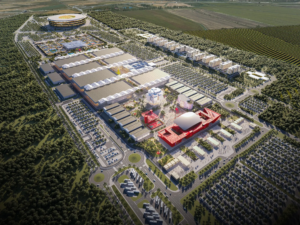
Serbian Foreign Minister Marko Đurić has stated that Belgrade hopes to confirm Ukraine’s participation in the specialised Expo 2027 exhibition, which is due to take place in the Serbian capital from 15 May to 15 August 2027, according to the Telegram channel ‘Serbian Economist’.
Đurić posted this on X following a meeting with Ukraine’s Ambassador to Serbia, Oleksandr Litvinenko. According to the Serbian Foreign Minister, the parties discussed further intensifying political dialogue, supporting bilateral political consultations and improving trade cooperation between the two countries.
He also thanked Ukraine for its principled stance on the issue of respecting the territorial integrity and sovereignty of the Republic of Serbia.
“As Serbia and Ukraine traditionally enjoy very good relations, we hope to confirm Ukraine’s participation in the upcoming EXPO 2027 specialised exhibition,” the Serbian Foreign Minister emphasised.
For Belgrade, Ukraine’s potential participation in Expo 2027 has not only diplomatic but also economic significance. Serbia is seeking to use the exhibition as a tool for expanding trade, investment and logistics ties, as well as a platform for promoting the country as a regional hub for the Western Balkans.
For Ukraine, participation in Expo 2027 could provide an opportunity to present in Serbia not only a national pavilion but also a business programme focused on reconstruction, the agro-industrial sector, energy, IT, construction materials, logistics and industrial cooperation.
Expo 2027 Belgrade will be held under the theme “Play for Humanity: Sport and Music for All”. It will be the first specialised Expo hosted by Serbia and the region of the former Yugoslavia. According to the Bureau International des Expositions, the Belgrade site is set to welcome over 130 countries, more than 6 million visitors and over 8,000 events during the 93-day programme.
According to the official Expo 2027 website, 137 countries have formally confirmed their participation to date. These include Japan, South Korea, China, Turkey, Hungary, Austria, Switzerland, Slovakia, Azerbaijan, Ecuador, Monaco, as well as a number of countries from Africa, Asia, Oceania and Latin America. In March 2026, Belgrade also hosted the second international meeting of Expo 2027 participants, which, according to the Serbian government, was attended by representatives from 138 countries.
A distinctive feature of the Belgrade Expo is that it is intended to be not a general world exhibition, but a specialised Expo – that is, a more focused international event with a limited theme and duration. For Serbia, this is the largest image-building and infrastructure project of the decade: it involves the construction of a new exhibition complex in Surčin, the development of transport infrastructure, the hotel sector, the city’s economy and Belgrade’s international positioning.

According to Serbian Economist, Serbia may decide on the location and technology for its future nuclear power plant in 2027, said Minister of Mining and Energy Dubravka Jedović-Handanović. According to her, the country has already entered the first phase of developing its nuclear program and has corrected a “historic mistake” by lifting the ban on considering nuclear energy.
The minister stated that an analysis is currently underway to determine where and how a nuclear facility could be integrated into Serbia’s power grid. A preliminary study has already examined possible options for connecting the future nuclear power plant to the grid, and next year the authorities expect to reach a decision on the site and technology.
Serbia views nuclear energy as part of a long-term response to rising electricity consumption, decarbonization, and the need for stable baseload generation. Serbia’s first nuclear power plant could be connected to the grid by 2040, and the country aims to become part of the global “nuclear renaissance.”
Authorities expect to complete the initial stages of preparation for construction by 2032. This involves not only selecting a site and technology but also establishing a regulatory framework, training personnel, forming a national organization to implement the nuclear program, assessing financing, and engaging with public opinion.
For Serbia, nuclear energy is becoming part of a broader discussion about the future structure of its energy mix. The country remains heavily dependent on coal-fired generation, while simultaneously developing solar and wind projects, battery storage, and gas infrastructure. However, for energy-intensive industries, data centers, artificial intelligence, and the future electrification of transportation, the authorities consider it necessary to have a stable source of baseload power.
Serbia’s most likely international partners for its nuclear program could be France, Russia, China, South Korea, the United States, Slovenia, and Hungary. France’s EDF has already presented Serbia with a roadmap for a nuclear program comprising 19 key steps: completion of studies by 2027, selection of technology and preparation of a construction contract by 2032, and commissioning of the nuclear power plant by 2040.
Russia, through Rosatom, has also discussed with Belgrade possible cooperation during the preparatory phase, primarily in the areas of knowledge exchange and support for the development of a nuclear program. However, political and sanctions-related risks make the Russian option more complicated, especially if Serbia aligns itself with European standards for financing and regulation.
China already has a memorandum of cooperation with Serbia in the nuclear sector, covering issues such as radioactive waste, radiation protection, personnel training, and technical support. South Korea’s KHNP has also signed a memorandum of cooperation with Serbia on nuclear energy and hydrogen, making Korea one of the potential technology partners.
The U.S. may be of interest to Serbia primarily through small modular reactors (SMRs) and technological cooperation, as Belgrade has previously spoken of seeking support to obtain approximately 1.2 GW of capacity based on SMR technology. Separately, the option of Serbia participating in the Hungarian Paks NPP by purchasing 5–10% of the capacity or a stake was discussed, which could be a faster way to access nuclear power generation without immediately building its own plant.
https://t.me/relocationrs/2800
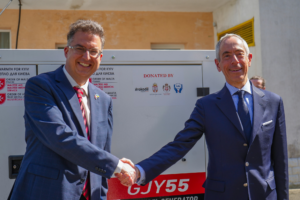
The ‘Kapitoshka’ nursery school in Bucha, Kyiv Oblast, has received a diesel generator and a modern backup power system as part of an international aid initiative, according to Andon Sapundži, Serbia’s ambassador to Ukraine, on his Facebook page.
The facility was provided with a 35 kW (or 44 kVA) diesel generator, as well as a hybrid backup power system comprising an inverter and batteries. The equipment is intended to ensure the nursery’s uninterrupted operation in the event of external power cuts.
According to the Education Department of Bucha City Council, ‘Kapitoshka’ previously had no alternative power sources. The installed system will enable the nursery to increase its energy independence and maintain stable conditions for the children even during potential power cuts.
According to the Telegram channel Serbian Economist, the aid was delivered by the Maltese Relief Service as part of the Sovereign Order of Malta’s Warmth for Ukraine programme. An international delegation, comprising diplomatic representatives and deputy heads of mission from the Sovereign Order of Malta, Serbia, Montenegro, Albania, Azerbaijan, Indonesia, Croatia, Poland and North Macedonia, visited the nursery where the equipment has already been installed.
“Unfortunately, modern wars share one common characteristic. They primarily target those most affected by the war. And we must protect these people,” said Antonio Gazzanti Puliese di Cotrone, Ambassador of the Sovereign Order of Malta to Ukraine.
“That is why I am particularly pleased that a project aimed at meeting the needs of children has been completed. This is for the future of Ukraine and for the whole world,” he added.
Andon Sapundži, Serbia’s Ambassador to Ukraine, emphasised the significance of the project for Bucha and its residents.
“This town and its residents are heroes who stood firm in the face of the horrific crimes of 2022. Your courage and unity are an example to us all. The launch of the hybrid energy system at the ‘Kapitoshka’ nursery is not only a technical foundation but also a symbol of care for the future. This project is the result of joint efforts and international solidarity,” he said.
Taras Shapravsky, Secretary of the Bucha City Council, noted that a difficult winter may lie ahead, which is why such support is particularly important for the community’s education sector.
Nikita Gerashchenko spoke on behalf of the Kyiv Regional State Administration. He stated that thanks to the implementation of such projects, more educational and social infrastructure facilities are becoming energy-independent and energy-efficient.
For Serbia, participation in such humanitarian projects has not only diplomatic but also practical significance. Belgrade has not officially joined the EU’s anti-Russian sanctions, but is providing humanitarian support to Ukraine, including through international frameworks and assistance to civil infrastructure.
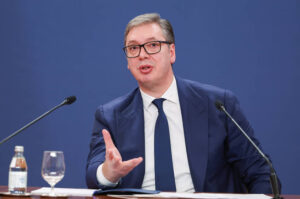
According to Serbian Economist, Serbian President Aleksandar Vucic stated that the country needs “bold and important decisions” and serious reforms in the near future, rather than “revolutionary chaos.” He wrote this in an op-ed for Kurir.
According to Vučić, Serbia must change not only its institutions but also the habits of society, as the country’s future will be determined by hard work, discipline, and the ability to adapt to new technological and energy challenges.
The first point of the plan concerns downsizing the government apparatus. Vučić advocated for a sharp reduction in the number of government members, state secretaries, deputy ministers, and related administrative structures. He also stated the need to abolish a number of agencies, offices, and departments which, in his assessment, lack sufficient justification for their existence. Separately, the president mentioned economic deregulation, including the elimination of unnecessary certification of goods from the EU, which makes them more expensive in Serbia than in the European Union.
The second section concerns labor productivity. Vučić opposed the idea of reducing working hours and stated that Serbia must “work more, not less.” According to him, the country cannot afford an approach that attempts to boost motivation by reducing the number of workdays or hours. He cited Germany as an example, which, in his view, will be forced to increase the workload to compete with China and the United States.
The third point of the plan is a comprehensive reform of education. The president stated that Serbia needs a more open system of higher and vocational education, as well as more active implementation of dual education. According to him, preparing young people for the labor market must become one of the central priorities of educational policy.
The fourth point concerns energy. Vučić stated that Serbia needs to comprehensively address energy issues, including the construction of oil pipelines, gas pipelines, interconnectors, hydroelectric power plants, wind farms, and solar power plants. However, he said that without small and large nuclear power plants, the country will not be able to ensure long-term energy stability. The president called nuclear energy “the cleanest and safest” and noted that one of the main challenges for the future government will be securing the expertise and funding for such projects.
The fifth point is devoted to artificial intelligence, robotics, and modern technologies. Vučić advocated for the “aggressive” acquisition of new knowledge and the continued procurement of supercomputers and construction of data centers. He called data centers “factories of intelligence” that could give Serbia an advantage in the region. At the same time, the president directly linked digital development to the energy sector, noting that the construction of data centers should not be halted due to a shortage of electricity.
For the Serbian economy, the proposed plan represents an attempt to combine administrative reform, increased labor efficiency, technological modernization, and a new energy strategy. In practice, the most challenging aspects may be downsizing the bureaucracy, abandoning populist ideas regarding the labor market, and preparing the country for nuclear energy, which will require significant investment, specialists, a regulatory framework, and public consensus.
https://t.me/relocationrs/2771

According to Serbian Economist, the Chinese industrial group TBEA is considering Serbia as a potential location for establishing transformer production facilities geared toward exporting to the European market. Negotiations between Serbian authorities and the company’s management in Tianjin have moved beyond preliminary discussions and shifted to more concrete talks regarding an industrial project.
The possibility of opening a manufacturing facility in Serbia is being discussed, one that will focus not only on equipment assembly but also on deeper localization—including technology transfer, the development of a local supply chain, and workforce integration.
TBEA’s interest in Serbia is driven by several factors. First, the country offers proximity to EU markets without the full cost burden characteristic of the European Union itself. Second, growing logistics links and a free trade agreement with China make Serbia a convenient platform for both the supply of components and the export of finished products.
The overall situation in Europe adds particular significance to the project. Demand for transformers and grid equipment is growing amid the integration of renewable energy, electrification, and the modernization of transmission networks, while a shortage of production capacity is already becoming one of the constraints on infrastructure programs. Against this backdrop, the potential establishment of a new plant in Serbia could partially relieve pressure on European supply chains.
For Serbia, such a project would mean not just an influx of investment, but deeper integration into the European energy industry.
TBEA is one of China’s largest industrial groups in the field of high-voltage equipment, transformers, and energy infrastructure. The company operates in the power transmission and distribution, power machinery, solar energy, and industrial equipment segments and is one of the key providers of solutions for large-scale grid and energy projects in China and beyond.
https://t.me/relocationrs/2741
According to Serbian Economist, 34,155 foreign citizens arrived in Serbia for permanent or long-term residence in 2024, which is 17.2% less than the previous year, the Statistical Office of the Republic of Serbia reported.
According to Serbian statistics, Russian citizens once again constituted the largest group of immigrants—17,103 people, or 50.1% of the total number of foreign arrivals.
Citizens of China ranked second in terms of the number of arrivals—4,511 people, followed by citizens of India—2,109, and Turkey—1,951. Other notable groups of immigrants to Serbia included citizens of Sri Lanka—829 people, Nepal—780, Belarus—366, and Ukraine—365 people.
In addition, in 2024, citizens of Montenegro—299 people, Uzbekistan—289, Bosnia and Herzegovina—285, Bangladesh—277, Germany—258, and Romania—257 arrived in Serbia.
The Statistical Office also reported that the number of foreign citizens who left Serbia in 2024 was 17,331, which is 12.2% more than in 2023. The largest group among those who left was also made up of Russian citizens—5,421 people, or 31.3% of the total number of foreign emigrants.
https://t.me/relocationrs/2734



