
According to Serbian Economist, the Hungarian opposition’s victory in the parliamentary elections and the upcoming change of government in Budapest have added uncertainty to the deal regarding the exit of Russian shareholders from NIS (Naftna industrija Srbije)—the company that operates Serbia’s only oil refinery in Pančevo and, according to estimates, supplies about 80% of the country’s fuel needs.
This refers to negotiations regarding the acquisition by Hungary’s MOL of a 56.15% stake in NIS, which is owned by Gazprom entities (44.9% by Gazprom Neft and 11.3% by Gazprom). In January, MOL announced the signing of a Heads of Agreement regarding this deal, as well as that it is considering the participation of ADNOC (UAE) as a minority partner.
A key factor is the deadlines set by the U.S. OFAC. In March, MOL reported that it had received an extension from OFAC on its license to negotiate until May 22, 2026. At the same time, MOL is seeking extensions of specific permits allowing it to continue operations and import raw materials during the negotiations.
The issue of price remains sensitive: the terms of the deal have not been officially disclosed. Serbian President Aleksandar Vučić previously mentioned a range of up to €1 billion for the 56.15% stake, while a number of media outlets and analytical publications cited higher estimates.
Why the Hungarian elections have become a risk factor
The deal itself is corporate in nature and requires regulatory approvals, specifically from OFAC and Serbia. However, the change in government in Hungary affects the political backdrop and the pace of decision-making. The new leader, Péter Magyar, has publicly stated his intention to form a government quickly (specifically citing May 5 as the start date), meaning just a few weeks before the May 22 deadline. In this scenario, any additional government-level reviews, disputes over the transparency of terms, or simply the restructuring of interagency coordination could cause delays.
The most likely baseline scenario is that the parties will try to meet the deadline or request an additional license extension from OFAC if they are close to the final closing. Market participants have already seen extensions in this situation.
The negative scenario is a protracted negotiation process without a clear resolution. In that case, the risks for NIS become not a legal abstraction but a matter of supply stability: the U.S. sanctions regime is specifically aimed at the exit of Russian majority owners, and any disruptions with licenses complicate the logistics and financing of raw material procurement and operations.
For Belgrade, this turns the issue into one of energy security. Serbian authorities have previously signaled their interest in increasing the state’s stake in NIS, and if the situation worsens, tougher decisions regarding the ownership structure may be necessary to remove the company from under sanctions pressure and prevent a shock to the fuel market.
https://t.me/relocationrs/2628

According to Serbian Economist, FAS/USDA forecasts corn production in Serbia for the 2025/2026 marketing year (beginning in October 2025) at 7.1 million tons, with a harvested area of 950,000 hectares.
Corn exports in the 2025/26 marketing year are estimated at 2.5 million tons, domestic consumption at 4.25 million tons, and ending stocks at 827,000 tons. The report notes that demand for Serbian corn on FOB terms from Danube ports is being held back by strong competition from Ukraine and Russia.
https://t.me/relocationrs/2622
Ukrainians’ attitudes towards Serbia in March 2026 show a moderate increase in positive views against a backdrop of declining negative perceptions; however, the overall picture remains mixed. The proportion of positive attitudes rose to 21.7% compared to 13.7% in August 2025, whilst negative attitudes fell from 26.0% to 19.6%. This is evidenced by the results of a public opinion poll conducted in March 2026 by the research company Active Group in collaboration with the Experts Club information and analytical centre.
Despite these changes, neutrality remains the key characteristic of perceptions of Serbia: 55.0% of respondents do not have a clearly formed attitude towards this country. This indicates the absence of a stable image of Serbia in Ukrainian society and a significant degree of uncertainty regarding the perception of its role in the international context.
The breakdown of responses shows that the positive perception is formed mainly through moderate assessments: only 5.6% of respondents chose the ‘entirely positive’ option, whilst 16.1% selected ‘mostly positive’. At the same time, negative assessments also carry significant weight: 16.3% of respondents expressed a ‘mostly negative’ attitude, and a further 3.3% — ‘completely negative’. The proportion of those who were unable to decide on an answer stands at 3.7%.
The trend indicates a certain softening of attitudes towards Serbia: an increase in positive views is accompanied by a simultaneous decrease in negative ones. At the same time, these changes have not led to the formation of a clearly positive image of the country, as neutral assessments remain dominant.
In a broader context, this means that Serbia is perceived by Ukrainians as a country with an ambiguous position in international affairs. It does not provoke a sharply negative reaction, yet it is not associated with unconditional support for Ukraine, which limits the level of trust and emotional attachment.
‘The results for Serbia show that Ukrainian society reacts quite sensitively to the foreign policy behaviour of countries. The rise in positive assessments indicates a certain softening of perception, yet the high level of neutrality means that the country’s image remains ambiguous. In such cases, consistency in actions and signals plays a key role in building trust at the societal level,” noted Maksym Urakin, founder of the Experts Club information and analytical centre.
At the same time, he added that over the past year, Ukrainians’ attitudes towards Serbia have improved significantly, not least due to the activities of the Republic’s embassy, led by Ambassador Extraordinary and Plenipotentiary Andon Sapundži.
“The Serbian mission’s active involvement, led by the new ambassador, in humanitarian initiatives and the establishment of intergovernmental dialogue has undoubtedly had a positive impact on Ukrainians’ attitudes towards this Balkan state compared to last year’s figures,” added Urakin.

Thus, attitudes towards Serbia can be characterised as transitional: they demonstrate positive momentum but have not yet transformed into a stable positive image. Further changes will largely depend on how clear and consistent the country’s position is on issues important to Ukrainian society.
According to a study conducted by the Experts Club information and analytical centre based on data from the State Customs Service, Serbia ranks 40th in terms of total trade in goods with Ukraine, which amounts to $444.1 million. However, imports of Serbian goods exceed Ukrainian exports, resulting in a bilateral trade deficit of $92.9 million.
The study was presented at the Interfax-Ukraine press centre; the video can be viewed on the agency’s YouTube channel. The full version of the study can be found via this link on the Experts Club analytical centre’s website.
ACTIVE GROUP, EXPERTS CLUB, Pozniy, SERBIA, SOCIOLOGY, SURVEYS, UKRAINE, URAKIN

Serbia is preparing to launch drone production on its territory in cooperation with Israeli company Elbit Systems, the Telegram channel “Serbian Economist” reported, citing a joint investigation by BIRN and Haaretz.
According to the published information, the new enterprise will be established as a joint structure between Elbit Systems and Serbia’s state-owned company Yugoimport SDPR. The Israeli side is expected to receive a 51% stake in the project, while 49% will remain with SDPR.
The facility is expected to produce two types of UAVs — for short-range and long-range missions. According to available information, the production site may be located in the industrial zone of Šimanovci, about 30 km west of Belgrade.
Serbian President Aleksandar Vučić said publicly on March 7, 2026, that the country would get its “first factory of serious drones,” noting that the project was being implemented with a foreign partner from Israel and could start as early as April. At that time, however, the partner’s name was not officially disclosed.
According to the authors of the investigation, the new deal brings military-technical cooperation between Serbia and Israel to a new level. Data cited by Haaretz/BIRN show that over the past two years Serbian arms exports to Israel increased 42-fold and reached EUR114 million in 2025, with a significant share of those deliveries going through SDPR.
For Serbia, the project is important not only as another defence production facility, but also as a channel for gaining access to advanced technologies. One of the sources cited by Haaretz and BIRN said the new UAVs are expected to outperform Serbia’s Pegaz model, while engineers from UTVA are also expected to be involved in the project alongside SDPR.
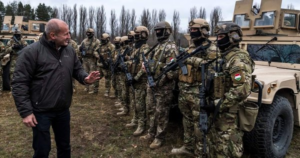
Hungary has decided to strengthen security around its section of the TurkStream gas pipeline and place it under military control following an incident on Serbian territory, according to the Telegram channel “Serbian Economist”.
According to the report, the decision was made after an emergency meeting of the defence council convened by Hungarian Prime Minister Viktor Orbán. Hungarian Foreign Minister Péter Szijjártó said the military would guard the entire Hungarian section of the pipeline — from the border with Serbia to the border with Slovakia.
The move followed an incident in Serbia, where, according to Serbian and Hungarian authorities, powerful explosive devices were found near gas infrastructure through which Russian gas is delivered to Hungary and further into the region.
At the same time, the episode has already triggered political debate. Some publications and commentary in the region question the official version of events and suggest the story may have a political dimension, particularly against the backdrop of the election campaign in Hungary.
Ukraine, for its part, has officially rejected any attempts to link it to the incident in Serbia.

According to Serbian Economist, Serbia is increasingly becoming a key industrial platform for China to enter the European market. This is no longer a matter of scattered investments, but rather a well-established system that integrates metallurgy, mining, transport infrastructure, and export channels.
A turning point was the acquisition by the Chinese company HBIS of the steel plant in Smederevo in 2016 for approximately €46 million, followed by investments in modernization. The second major flagship project was Zijin Mining’s expansion in Serbia’s copper sector—in Bora and at the Čukaru-Peki deposit, where total investment commitments exceeded €3 billion. This allowed Serbia to take a more prominent place in the European steel and copper supply chain.
Analysts emphasize that Chinese capital in Serbia controls several links in the industrial chain at once: copper mining, processing and smelting, steel production, and the export of products to European markets. Against this backdrop, Serbia is increasingly acting not merely as a recipient of foreign investment, but as a functional extension of China’s industrial base within the European economic space.
This is also reflected in trade. By 2025, China had become Serbia’s second-largest trading partner, with bilateral trade exceeding $7 billion. At the same time, a significant portion of exports from Serbia to China is provided by Chinese companies operating in the country, primarily in the copper and metallurgical sectors.
Infrastructure plays a distinct role. Analysts link the new model to projects under the Belt and Road Initiative, including the Belgrade–Budapest railway, bridges, highways, and logistics hubs. In this system, Serbia serves as a transit hub between Piraeus, the Balkans, and Central Europe, reducing transportation costs and speeding up deliveries to the EU.
In addition to metals, China’s presence is expanding in the manufacturing sector as well. Consider the Linglong tire plant in Zrenjanin, valued at around €900 million, as well as projects by Hisense in Valjevo and the Minth Group in the automotive components sector. These manufacturers leverage Serbia’s lower costs and its trade preferences for supplying the EU market.
The country’s trade architecture has been an additional factor. Serbia combines preferential access to the EU market with a free trade agreement with China, which entered into force in 2024. As a result, the country has become a rare hub where Chinese capital can operate simultaneously under both European and non-European trade regimes.
At the same time, this model faces new constraints. The importance of the energy transition and the CBAM mechanism is growing, which could increase costs for Serbia’s energy-intensive export sectors. This is pushing Chinese investors toward the next phase—investments in renewable energy, storage, and grid infrastructure—to maintain the competitiveness of assets in Serbia on the European market.
Thus, Serbia is increasingly establishing itself as an industrial and logistics hub between China and Europe. However, the further development of this role will depend on Belgrade’s ability to simultaneously retain Chinese capital and adapt to the EU’s stricter regulatory requirements.



