
Both directions of cross-border electricity trade increased during the period of October 5–11: imports rose by 6% compared to the previous week—to 13,100 MWh—while exports rose by 20%—to 176,400 MWh.
“Despite localized restrictions, Ukraine remained a net exporter throughout the week,” the DIXI Group analytical center reported on Tuesday, citing data from Energy Map.
As previously reported, since October 6, due to Russian attacks on energy infrastructure, power restriction schedules (PRS) for industry and businesses and hourly blackout schedules (HBS) for the general public have been in effect in some regions of Ukraine.
However, even amid localized restrictions, Ukraine remained a net exporter throughout the past week due to a power surplus in other regions. This situation was caused by the inability to transmit power to certain regions and cities because the enemy had damaged transmission grids, substations, and distribution lines—particularly near major cities.
According to Energy Map, Hungary accounted for the largest share of exports that week—84,900 MWh, or 48.1%. Moldova accounted for 56,600 MWh (32.1%), Romania for 33,100 MWh (18.7%), and Poland for 1,800 MWh (1.0%).
Exports to Hungary, Romania, and Moldova increased by 15%–26%, and exports to Poland increased eightfold, though the volumes remained insignificant. No electricity was sold to Slovakia. The average daily export volume for the week was 25.2 thousand MWh.
Hungary remained the main source of imports, accounting for 8.7 thousand MWh (66.6%). Romania accounted for 3.6 thousand MWh (27.6%), Poland for 0.7 thousand MWh (5.5%), and Moldova for 0.05 thousand MWh (0.4%).
Imports from Romania and Moldova increased by 70% and 124%, respectively, while those from Hungary and Poland decreased by 3% and 39%. There were no deliveries from Slovakia for five consecutive weeks. The average daily import volume was 1.9 thousand MWh.
As previously reported, the week before last, from September 28 to October 4, electricity exports rose by 75.6% compared to the previous week—to 147.0 thousand MWh, marking the highest weekly export volume since September 2025.
According to Experts Club, Ukrainians’ attitudes toward Romania remain predominantly positive or neutral; however, in August 2026, the share of positive assessments declined slightly compared to the previous survey wave. 45.2% of respondents view the country positively, 9.8% negatively, while 42.3% hold a neutral stance, reports the Experts Club Information and Analytical Center.
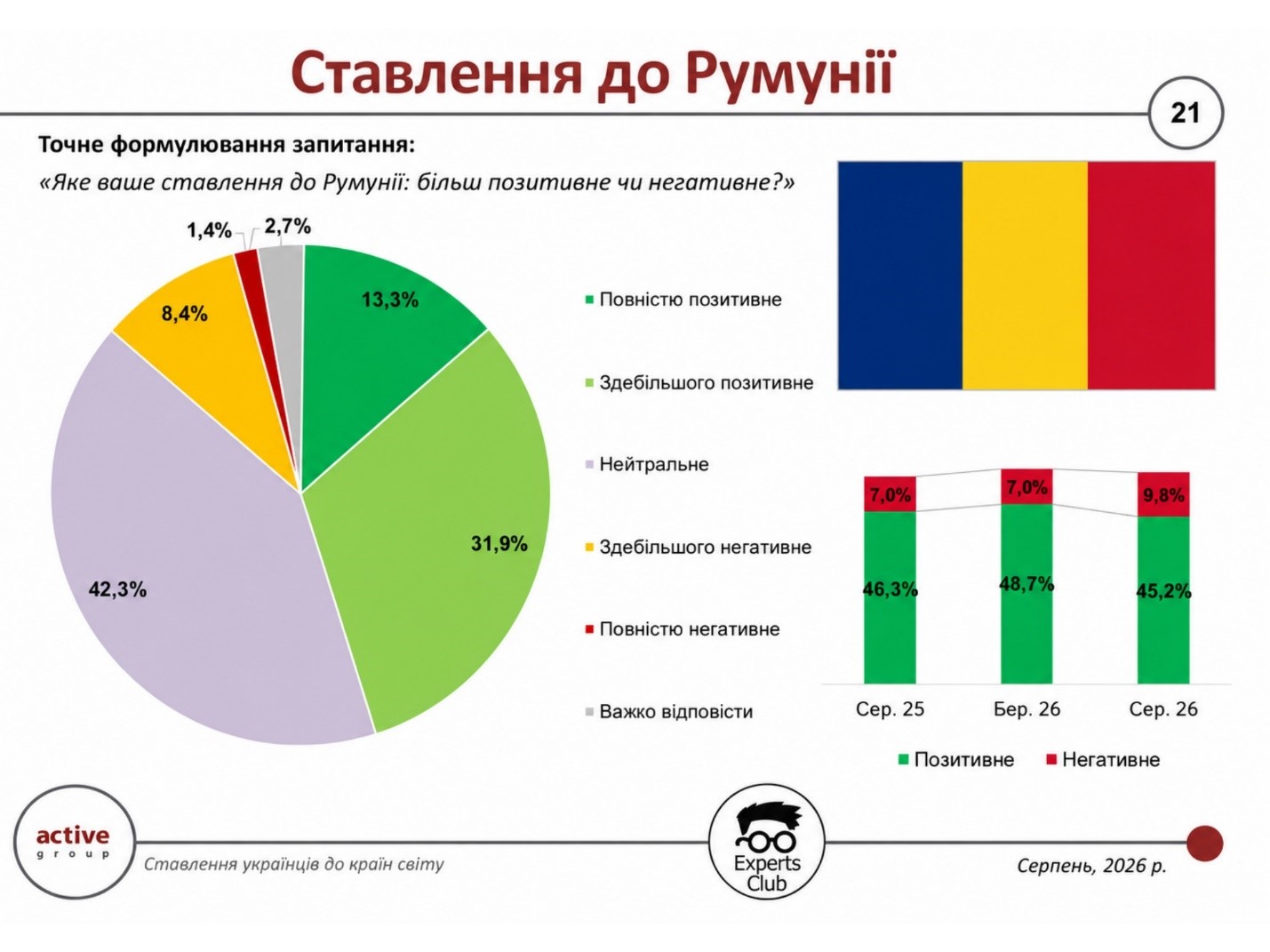
According to the results of the August survey, 13.3% of Ukrainians view Romania entirely positively, and 31.9% view it mostly positively. A neutral attitude was expressed by 42.3% of respondents. 8.4% view the country mostly negatively, 1.4% view it entirely negatively, and another 2.7% were undecided.
The balance of positive and negative assessments stands at plus 35.4 percentage points. Thus, positive responses outnumber negative ones by more than four to one, although respondents with a neutral attitude remain the largest single group.
Compared to March 2026, public perception of Romania has deteriorated slightly. In the previous survey wave, 14.9% of respondents rated the country entirely positively, and 33.8% rated it mostly positively—meaning the total share of positive responses was 48.7%. Seven percent of respondents had a negative view of Romania, and 42.2% were neutral.
Thus, over the course of five months, the positive attitude decreased by 3.5 percentage points—from 48.7% to 45.2%—while the negative attitude increased by 2.8 percentage points—to 9.8%. The share of neutral responses remained virtually unchanged: 42.2% in March and 42.3% in August. The balance between positive and negative assessments decreased from +41.7 to +35.4 percentage points, or by 6.3 percentage points.
These results indicate a moderate weakening of positive perceptions rather than a fundamental shift in attitude. The neutral group remains stable, and negative assessments, despite their increase, still lag significantly behind the positive ones.
Maksym Urakin, founder of the Experts Club information and analytical center and a candidate of economic sciences, commenting on the need to compare public assessments with the actual economic role of international partners, emphasized the deterioration of Ukraine’s overall foreign trade balance.
“For Ukraine, Romania is not an abstract foreign policy partner, but a neighboring country with which logistics, trade, the movement of people, the transit of Ukrainian goods, and humanitarian contacts are intertwined on a daily basis. Therefore, public perception here is shaped not only by political statements but also by concrete experiences of interaction. I would not yet interpret the current decline in positive assessments as a fundamental shift in attitude—the positive balance remains very significant,” Urakin noted.
In the case of Romania, the new wave of the survey shows that the country maintains a positive balance in public opinion, but this margin has narrowed compared to March. At the same time, the virtually unchanged proportion of neutral responses indicates that the main changes occurred specifically between the positive and negative segments.
The survey was conducted in August 2026 using an online self-administered questionnaire via the SunFlowerSociology panel among 800 Ukrainian citizens aged 18 and older. The previous wave also included 800 respondents, and the sample was representative by age, gender, and region.
ACTIVE GROUP, CENTRAL AND EASTERN EUROPE, EXPERTS CLUB, international relations, PUBLIC OPINION, ROMANIA, SOCIOLOGY, UKRAINE
Spain continues to strengthen its positive image among Ukrainians: in August 2026, 65.2% of respondents expressed a positive attitude toward the country, while only 1.6% expressed a negative one. Compared to the previous survey, the share of positive assessments has increased, while negative attitudes remain at a minimal level, according to the Experts Club Information and Analytical Center.
According to the results of the August survey, 23.9% of Ukrainians have a completely positive attitude toward Spain, and 41.3% have a mostly positive attitude. A neutral stance is held by 31.3% of respondents. 1.4% view the country mostly negatively, only 0.2% view it entirely negatively, and another 2% were undecided.
The balance of positive and negative assessments stands at plus 63.6 percentage points. Thus, positive attitudes toward Spain outweigh negative ones by more than 40 times, and over 96% of respondents view the country positively or neutrally.
Compared to March 2026, attitudes toward Spain have improved. In the previous survey, 18.9% of respondents described their attitude as entirely positive, and 44.8% as mostly positive. The overall positive rating stood at 63.6%, the negative rating at 0.9%, and 33.6% of respondents held a neutral position.
Over the course of five months, the share of positive assessments increased by approximately 1.6 percentage points—to 65.2%. At the same time, there were changes within the positive group: the share of “entirely positive” responses rose by 5 percentage points—from 18.9% to 23.9%—while the share of “mostly positive” responses declined slightly. The share of neutral assessments decreased from 33.6% to 31.3%.
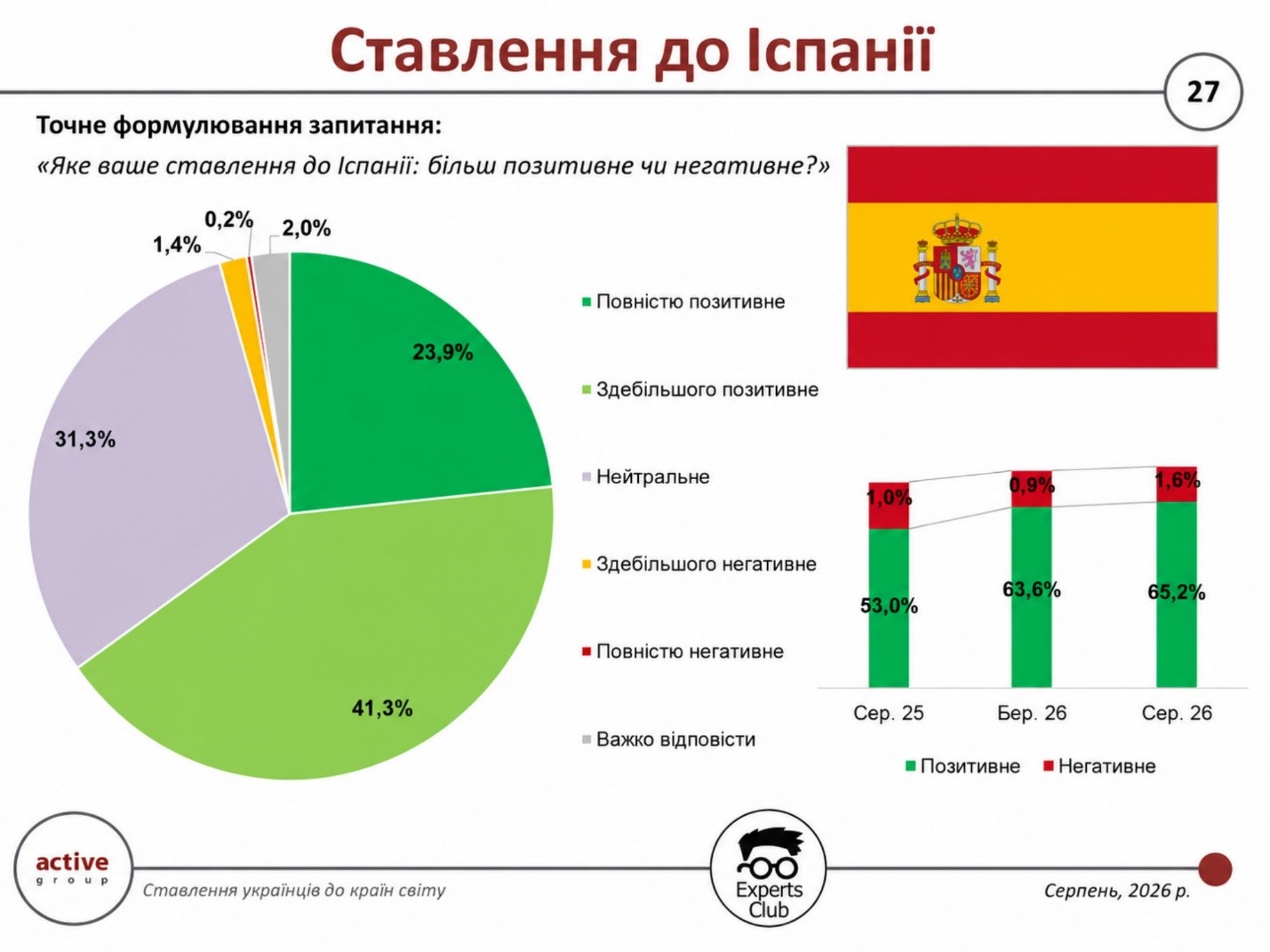
This continues the positive trend observed in previous waves of the survey: in August 2025, the balance of positive and negative attitudes toward Spain stood at approximately plus 52 percentage points; in March 2026, it was approximately plus 62.7 percentage points; and in August, it was plus 63.6 percentage points.
Spain remains not only one of the most positively perceived European countries but also one of Ukraine’s most advantageous trading partners. Recently, Spain has been among the leaders in terms of a trade surplus for Ukraine—that is, Ukrainian exports to this country significantly exceed imports. This makes the Spanish market particularly important in terms of foreign exchange earnings, export diversification, and the presence of Ukrainian businesses in the EU market.
Maksym Urakin, founder of the information and analytical center Experts Club, notes that in this case, the country’s positive public image is combined with real economic benefits for Ukraine.
“Spain is not only a country with a consistently positive image among Ukrainians but also one of Ukraine’s most advantageous economic partners. Recently, it has demonstrated a very strong position in bilateral trade and stands out as one of the leaders in terms of a trade surplus favorable to Ukraine. The combination of economic benefits, political support, humanitarian openness, and a positive public attitude forms a very solid foundation for the further development of Ukrainian-Spanish relations,” Urakin noted.
Oleksandr Pozniy, director of the research company Active Group, attributed the positive perception of Spain to a combination of political, humanitarian, and social factors.
“Spain actively supports Ukraine on the international stage, provides humanitarian aid, and creates favorable conditions for Ukrainian displaced persons. At the same time, cultural openness and traditional ties between our peoples reinforce this positive image. Therefore, there is virtually no mistrust or criticism of Spain within Ukrainian society,” Pozniy noted.
The latest wave of the survey generally confirms this trend. The increase in the share of entirely positive assessments, coupled with an extremely low level of negative sentiment, indicates that Spain continues to enjoy a consistently positive image among the Ukrainian public.
The survey was conducted in August 2026 using self-administered online questionnaires in the SunFlowerSociology panel among 800 Ukrainian citizens aged 18 and older. In the previous wave conducted in March, 800 respondents were also surveyed, and the sample was representative by age, gender, and region.
ACTIVE GROUP, EXPERTS CLUB, international relations, Pozniy, PUBLIC OPINION, SOCIOLOGY, SPAIN, TRADE, UKRAINE, URAKIN

Prices for construction and installation work in Ukraine rose by 25.4% in August 2026 compared to August 2025, according to the State Statistics Service (State Statistics Service).
According to the statistics agency, prices rose across all segments of construction from August 2026 to August 2025: in residential construction by 21.5% (up 1.3% from the previous month), in non-residential construction by 26.4% (2%), and in civil engineering by 26.1% (1.6%).
From January through August of this year compared to the same period last year, construction material and equipment prices rose by 18%; specifically, in the residential sector by 15.5%, in the non-residential sector by 18.7%, and in civil engineering by 18.4%.
As previously reported, in 2025, construction material prices rose by 5.8% compared to the previous year; in 2024, by 7.9%; and in 2023, by 15.8%.
CONSTRUCTION, CONSTRUCTION MATERIALS, PRICE, State Statistics Service, UKRAINE
Ukrainians’ attitude toward Slovakia in August 2026 improved significantly compared to the previous survey: the share of positive assessments rose to 40.7%, while negative assessments fell to 12.2%. Respondents with a neutral attitude remain the largest group—44.4%, according to the Experts Club Information and Analytical Center. Experts.news
According to the results of the August survey, 9.8% of Ukrainians have a completely positive attitude toward Slovakia, and 30.9% have a mostly positive attitude. A neutral attitude was expressed by 44.4% of respondents. 10.8% view the country mostly negatively, 1.4% view it entirely negatively, and another 2.7% were undecided.
Based on the rounded figures in the table, the balance of positive and negative assessments is approximately plus 28.5 percentage points, while in the consolidated survey results it is reported at plus 28.6 percentage points. This is one of the most notable examples of improved public perception among the countries of Central and Eastern Europe.
In March 2026, 34.3% of respondents viewed Slovakia positively: 8.9% viewed it entirely positively and 25.4% viewed it mostly positively. At that time, 18.2% of respondents expressed a negative attitude, while 43.6% were neutral.
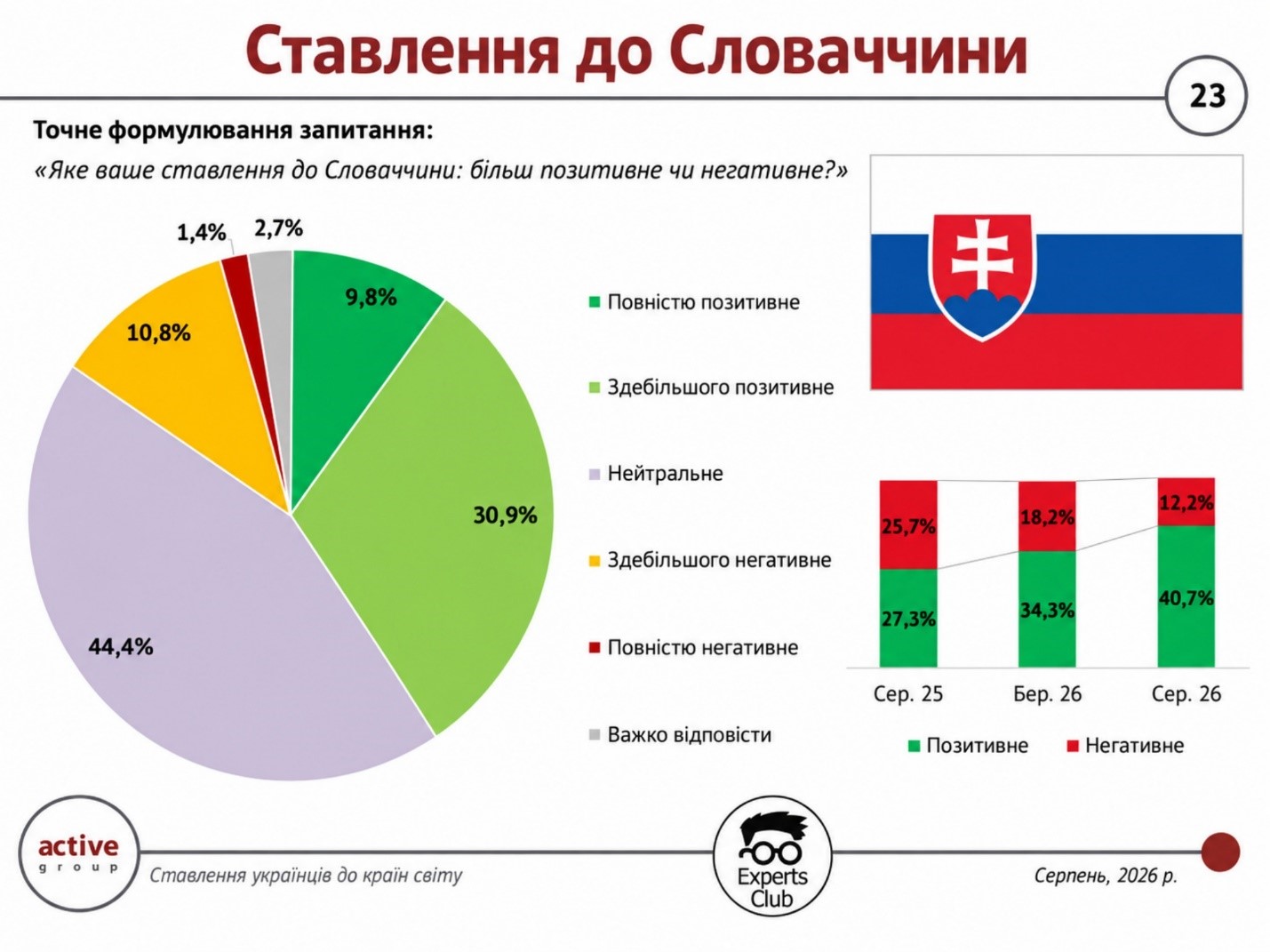
Thus, over the course of five months, the share of positive assessments increased by 6.4 percentage points—from 34.3% to 40.7%—while negative assessments decreased by approximately 6 percentage points—from 18.2% to 12.2%. The neutral group remained virtually unchanged—43.6% in March versus 44.4% in August.
Even more noticeable is the shift in the balance between positive and negative assessments: it rose from approximately plus 16.1 percentage points to plus 28.6 percentage points, or by more than 12 percentage points. Unlike a number of other countries in the region, where August saw a deterioration or largely stable trends, the survey shows a shift toward a more favorable perception in the case of Slovakia.
Maksym Urakin, founder of the Experts Club information and analytical center and a candidate of economic sciences, believes that the improvement in attitudes toward Slovakia may be linked to a gradual shift from an emotional perception of political rhetoric to a more pragmatic assessment of the actual relations between the two countries.
“For Ukraine, Slovakia is a neighboring country with which there are very concrete daily ties: trade, transit, energy, border cooperation, humanitarian contacts, and the movement of people. When the public sees these practical ties and they remain stable, it gradually softens even a rather tense political backdrop. In my opinion, the current increase in positive assessments indicates precisely this shift toward a more pragmatic perception of Slovakia,” noted Maksym Urakin.
According to him, the simultaneous growth of the positive segment and the decline in the negative segment are particularly telling.
“It’s not just the shift in the overall balance that’s important here. Over the course of five months, the share of negative assessments has fallen by about a third, while positive assessments have increased significantly. This means that some of the people who previously viewed Slovakia critically are shifting not just to the neutral group, but to the positive one as well. At the same time, the 44.4% of neutral responses indicate that there remains significant potential for further shaping the country’s image in Ukraine,” added Urakin.
The survey was conducted in August 2026 using an online self-administered questionnaire via the SunFlowerSociology panel among 800 Ukrainian citizens aged 18 and older. The previous wave in March also included 800 respondents; the sample was representative by age, gender, and region, with a maximum theoretical margin of error of ±3.5 percentage points for a 50% indicator.
ACTIVE GROUP, Central Europe, EXPERTS CLUB, international relations, PUBLIC OPINION, SLOVAKIA, SOCIOLOGY, UKRAINE, URAKIN
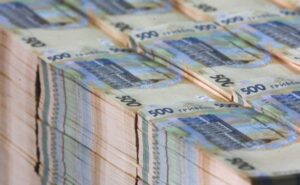
The amount of cash in circulation in Ukraine from January through September 2026 increased by 5%, or 46.7 billion hryvnia, to 973 billion hryvnia, according to the National Bank of Ukraine (NBU).
According to the regulator, cash was withdrawn from circulation in the first quarter, while demand for cash picked up in the second and third quarters, in line with traditional seasonal trends.
At the same time, the growth rate of cash volume slowed compared to the same period in 2025, when the increase over nine months was 8.2%.
An additional factor contributing to the increase in the volume of cash in the third quarter was the intensification of airstrikes on critical infrastructure, particularly in the energy, logistics, food, and telecommunications sectors.
As of October 1, 2026, there were 2.6 billion banknotes in circulation with a total value of 962.5 billion UAH, as well as 15.4 billion coins—excluding commemorative and investment coins—with a total value of 10.4 billion UAH.
Among banknotes, those with a denomination of 500 UAH accounted for the largest share by number—25.3%—while those with a denomination of 2,000 UAH accounted for the smallest share—0.01%. Since this denomination was first introduced into circulation on September 4, 400,000 such banknotes totaling 700 million UAH have entered circulation.
The highest growth rates over the first nine months of 2026 were recorded for 1,000-hryvnia banknotes and 10-hryvnia coins: their quantities in circulation increased by 12.1% and 19.1%, respectively.
Among coins in circulation, 1-hryvnia coins were the most numerous, while 5-hryvnia coins were the least: their shares accounted for 4.9% and 2.7%, respectively, of the total number of coins in circulation.
One year after the start of the gradual withdrawal of 10-kopeck coins from circulation, the NBU withdrew 7.8 million of them on October 1, 2025. As of October 1, 2026, they accounted for 26.7% of the total number of coins in circulation.
Coins with a denomination of 50 kopecks accounted for 9.1%, and demand for them from the retail and service sectors remained steady.
As previously reported, during the first half of 2026, the volume of cash in circulation increased by 4.8%, or 44.5 billion hryvnias, to 970.8 billion hryvnias.



