
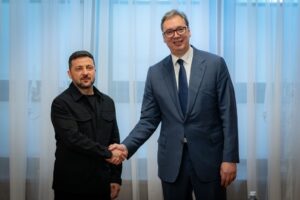
According to Serbian Economist, Serbian President Aleksandar Vucic reaffirmed that the country’s accession to the European Union remains Belgrade’s strategic goal and expressed hope to host Ukrainian President Volodymyr Zelenskyy on a bilateral visit.
Vucic made these remarks in an interview with Rainer Novak, editor-in-chief of the Austrian newspaper Die Presse, published on July 23.
“The European path is our strategic goal. There are no other paths for us. This means that we must cooperate closely with all candidate countries,” said the Serbian president.
According to him, it is in the European Union that he sees his country’s future.
Speaking about relations with Ukraine, Vučić stated that he sees no reason to abandon cooperation with Kyiv. He reiterated that Serbia supports Ukraine’s territorial integrity and provides it with financial, medical, energy, and humanitarian aid.
“I hope we will be able to welcome him to Serbia on a bilateral basis,” said Vučić, referring to Zelenskyy.
Vucic also announced that Serbia is ready to participate in the reconstruction of one of Ukraine’s smaller cities. In addition, the parties are discussing the development of a road and rail route from Trieste through Croatia, Serbia, Romania, and Moldova to Ukraine.
The Serbian president had previously reaffirmed his support for Ukraine’s sovereignty and territorial integrity, but did not sign the final declaration, which condemned Russian aggression and called for increased sanctions pressure on Moscow.
Commenting on criticism of cooperation with Kyiv, Vučić stated that Ukraine had not taken any action against Serbia and had not recognized Kosovo’s independence.
“We cannot oppose someone just because someone else opposes them. I see no reason why we should not cooperate with Ukraine,” he said.
At the same time, Vučić emphasized the need to take into account Serbia’s relations with Asian countries and Russia and reaffirmed the country’s military neutrality.
Serbia was granted EU candidate status in March 2012, and membership negotiations began in January 2014. In recent years, the opening of new negotiation chapters has effectively stalled, despite Belgrade’s statements that it is ready to meet the technical criteria for membership.
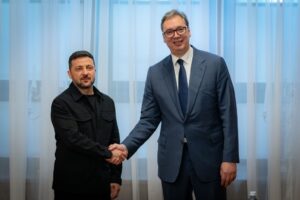
According to “Serbian Economist”, Serbian President Aleksandar Vucic stated that he intends to travel to Kyiv to participate in the “Southeast Europe–Ukraine” summit, scheduled for Wednesday, July 15.
“I am going to Kyiv for the ‘Southeast Europe–Ukraine’ summit,” Vučić told reporters in Paris after attending a military parade marking France’s national holiday.
His statement was reported by the Serbian state news agency Tanjug.
Vucic noted that he had previously participated in four such meetings—in Odesa, Dubrovnik, Athens, and Tirana. At the same time, he warned that the upcoming summit in Kyiv “will not be easy,” given the content of the proposed final declaration.
The Serbian president also announced that he is scheduled to meet with Ukrainian President Volodymyr Zelenskyy during his trip.
In June 2025, Vučić had already visited Ukraine to participate in the previous “Ukraine–Southeast Europe” summit, which took place in Odesa.
According to “Serbian Economist”, Serbia does not expect candidate countries to join the European Union anytime soon, but believes that the European path remains the best option for the region, Serbian President Aleksandar Vučić said at a conference of the speakers of the parliaments of EU candidate countries in Belgrade.
According to him, the EU is unlikely to be able to make quick decisions on enlargement in the coming years. However, Vucic emphasized that this does not mean Serbia and other candidate countries should halt their reforms.
The Belgrade Format is also important from an economic standpoint: Serbia is effectively promoting the idea that candidate countries should be partners rather than competitors. This is particularly relevant for the Western Balkans, Ukraine, Moldova, and Georgia, where European integration is increasingly viewed not only as a political project but also as a trade and logistics initiative.
Vucic placed special emphasis on Ukraine. He stated that Ukraine has demonstrated resilience and that Europe has much to gain from its potential. For Serbia, this also presents an opportunity to strengthen economic ties with Kyiv without waiting for formal EU membership.
Trade between Serbia and Ukraine in 2025 returned to roughly pre-war levels and, according to Serbian data, amounted to approximately $442 million. Serbian exports to Ukraine reached $202.9 million, while imports from Ukraine totaled $239.3 million. Electricity, mineral and chemical fertilizers, tires, and industrial goods play a significant role in the structure of Serbian exports. Ukraine supplies Serbia with iron ore, semi-finished rolled steel products, metal products, and agricultural goods, including frozen raspberries. In the first quarter of 2026, trade turnover had already reached $152.8 million, and Serbia recorded a trade surplus of $36.8 million. The parties have also resumed negotiations on a free trade agreement, which could become a key instrument for further growth in trade volumes.
According to “Serbian Economist”, Serbian President Aleksandar Vučić has effectively announced the start of a new election campaign, stating at a rally of the ruling Serbian Progressive Party in Belgrade that he will resign as head of state in a few weeks. Formally, this appears to be a resignation nearly a year before the end of his term, but politically, it is less about the end of the Vučić era and more about an attempt to relaunch it in a new configuration.
Speaking to supporters at the “Serbia—One Family” rally, Vučić stated that this was likely his last address to such a large gathering of citizens in his capacity as president of the republic. He emphasized that for 14 years he had “served Serbia” in various government positions—as deputy prime minister, prime minister, and president—and thanked his supporters for their backing during periods of political crisis.
The key moment of his speech was the announcement of his upcoming resignation. “These are my last days and last weeks as President of the Republic,” Vučić said, rejecting his opponents’ accusations that he intends to cling to power at any cost. At the same time, he immediately noted that he is not leaving politics: according to him, if the leadership of the Serbian Progressive Party deems it necessary, he will assist the ruling party in the upcoming elections.
It is precisely this combination—resignation plus participation in the campaign—that constitutes the main political message of the statement. Vučić is not simply cutting short his presidential term, but is shifting the crisis of legitimacy into the electoral arena. For him, this is a way to regain the initiative after a year and a half of protests that began following the tragedy at the train station in Novi Sad, where the collapse of a canopy became a symbol of the public’s grievances regarding corruption, the quality of public administration, and oversight of infrastructure projects.
The name Vucic has proposed for the list—“United Serbia”—is also no coincidence. It is intended to pit the ruling party not against individual opposition parties, but against the entire protest movement, primarily the student movement. This name incorporates a tactic typical of Vučić: to present the elections not as a competition of platforms, but as a referendum on stability, national unity, and the government’s ability to protect the country from chaos.
At the same time, Vučić clearly seeks to prevent the protest agenda from becoming the sole framework of the campaign. That is why, in his speech, socioeconomic promises took on almost as much importance as political statements. He promised that in two years, the average salary in Serbia would reach 1,400 euros and the average pension would reach 650 euros; he also announced additional support measures for low-income pensioners.
The economic portion of the speech serves several purposes at once. First, it is intended to steer the campaign back onto a track favorable to the government—growth in incomes, investments, infrastructure, and industrial development. Second, it is aimed at the most loyal segments of the electorate, primarily pensioners and workers in public-sector-dependent industries. Third, it allows Vučić to shift from a defensive stance on the issues of corruption and protests to an offensive agenda focused on “future development.”
Separately, Vučić emphasized technological modernization, energy, and defense. He spoke about robot manufacturing, data centers, gas-fired power plants, hydropower, and even future small- and large-scale nuclear power facilities. This segment is aimed at a different audience—those who see Serbia as a regional industrial and technological hub.
However, the president’s early resignation also carries risks for Vučić. If he does indeed resign in the coming weeks, Serbia will enter a period of accelerated institutional procedures. Presidential elections must be held within a limited timeframe, and holding early parliamentary elections will require a separate decision to dissolve parliament. This means that the government is taking on the responsibility of drastically compressing the political calendar and conducting a campaign amid high levels of polarization.
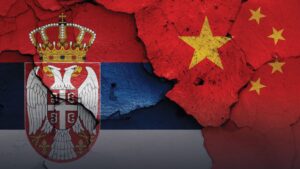
According to Serbian Economist, Serbia and a number of leading Chinese companies have signed new investment agreements that are expected to bring the country over €940 million in investments and 1,650 new jobs, Chinese media reported.
The documents were signed in the Chinese city of Jiaxing in the presence of Serbian President Aleksandar Vučić. The agreements cover auto parts, high-tech manufacturing, components for electric vehicles, tires, lighting systems, and precision plastic parts.
The largest block of agreements involves the Mint Group. The company, a global player in the production of exterior automotive parts, structural components, and aluminum battery cases for electric vehicles, is implementing two projects in Serbia. The first involves an investment of €135 million and the creation of 600 jobs in Loznica, while the second involves an investment of €91 million and 220 jobs in Šabac.
An agreement has been signed with the Chinese company SHAK for a €33.5 million project in Novi Sad, which is expected to create 50 new jobs. The company specializes in the production of high-quality automotive chassis and structural components.
An investment agreement will also be signed with BMTS Technology, a manufacturer of turbochargers and electrical auxiliary systems for passenger and commercial vehicles. The project focuses on automation and is estimated to cost €13.3 million.
Another project involves Xingyu Automotive, one of China’s leading manufacturers of automotive lighting systems, including LED headlights, taillights, and lighting modules. The company plans to invest €77 million in Niš and create 100 jobs.
Separately, a new €566 million investment by Linglong Tire in Zrenjanin was announced, which is expected to create 400 new jobs. Linglong has been operating in Serbia since 2019; it is China’s largest tire manufacturer and ranks among the world’s top ten manufacturers of passenger, truck, and specialty tires.
A planned investment by Yusei in Niš was also announced, amounting to €27 million and creating 280 jobs. Yusei is a Chinese manufacturer of high-precision plastic automotive parts, injection molds, and chrome-plated components.
A memorandum of understanding was also signed at the ceremony between Mint Holding Group and China Construction Fourth Engineering Division Corp. Ltd. Southeast Branch. The document is intended to support the implementation of Mint’s investments in Serbia.
For Serbia, these agreements are important not only for creating new jobs but also for deepening China’s presence in the country’s automotive and technology industries. The new projects involve electric vehicles, battery casings, lighting, tires, turbo systems, and plastic components—that is, the segments where Serbia is seeking to integrate into European and global automotive supply chains.
https://t.me/relocationrs/2899
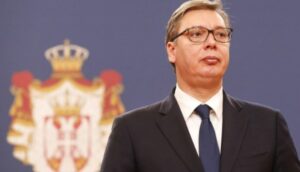
According to Serbian Economist, Serbian President Aleksandar Vučić published an op-ed for the American television network Fox News, in which he presented Serbia as a country ready for a closer partnership with the US, and stated that Donald Trump’s policies are viewed in Belgrade not as a threat, but as an opportunity for stability and economic development.
In the column, Vučić contrasted the attitude of some European elites toward Trump with the mood in Serbia. He wrote that “contempt” for the America First philosophy has spread from Brussels to Berlin, whereas Serbia sees it as an opportunity for a more pragmatic policy focused on results, security, and economic growth.
Vucic emphasized that Serbia, despite the painful memory of the 1999 NATO bombings, has in recent years become one of the few corners of Europe where sympathy for the U.S. has grown. According to him, reflexive anti-Americanism—which he believes has spread throughout much of Europe—is rarely found in the country today.
Separately, the Serbian president described his experience interacting with Trump and his team during his first presidential term. According to Vučić, his meetings at the White House following difficult negotiations left him with the impression that Serbia’s position was listened to without prejudice or arrogance. He also wrote that the image of Trump as an “aggressive bully” did not match his personal experience of interacting with him.
The column’s key political thesis is that Serbia’s European path should not mean distancing itself from the U.S. Vucic stated that for Belgrade, the path to Brussels “does not require distancing from Washington,” and that Serbia’s special relationship with the U.S. could be an asset for the stability and growth of the entire European continent.
The economic section of the text was built around the idea of Serbia as a modern and strategically important partner for the West. Vučić noted that Serbia is one of Europe’s most dynamic economies, with GDP growth exceeding that of the Eurozone, and is becoming a hub for future technologies—from data centers to supply chains for electric vehicles.
He gave special attention to the lithium agenda. According to the president, Serbia has the second-largest lithium reserves in Europe, and this resource is key to Western industrial independence. Vucic also emphasized that Serbia is not seeking aid, but rather “deals” that secure supply chains, accelerate energy independence, and create jobs.
This is an important signal for the Serbian economy. Belgrade is attempting to position the country not only as an EU candidate and a regional player in the Western Balkans, but also as a potential component of American and European industrial strategy. In this context, lithium, energy, infrastructure, IT, data centers, and manufacturing for the electric vehicle industry are not separate projects but part of Serbia’s broader geo-economic agenda.
Vucic also effectively urged Washington to reconsider its view of the region. He stated that it is time for the U.S. to stop viewing the Balkans through the lens of the 1990s and to pay attention to Serbia as the largest economy in the Western Balkans, an “anchor of stability,” and a country that remembers its friends.
The most striking part of the column was the invitation to Trump to visit Belgrade. Vucic noted that no American president has visited the Serbian capital in over half a century since Richard Nixon’s visit in 1970, and stated that if Trump were to come to Belgrade, he would receive “a welcome the likes of which Europe hasn’t seen since Nixon.”



