
According to Experts Club, Ukrainians’ attitudes toward India in August 2026 worsened compared to the previous survey round: 31.5% of respondents view the country negatively, while 17.2% view it positively. At the same time, the group with a neutral attitude remains the largest—48.3%, reports the Experts Club Information and Analytical Center. Experts.news
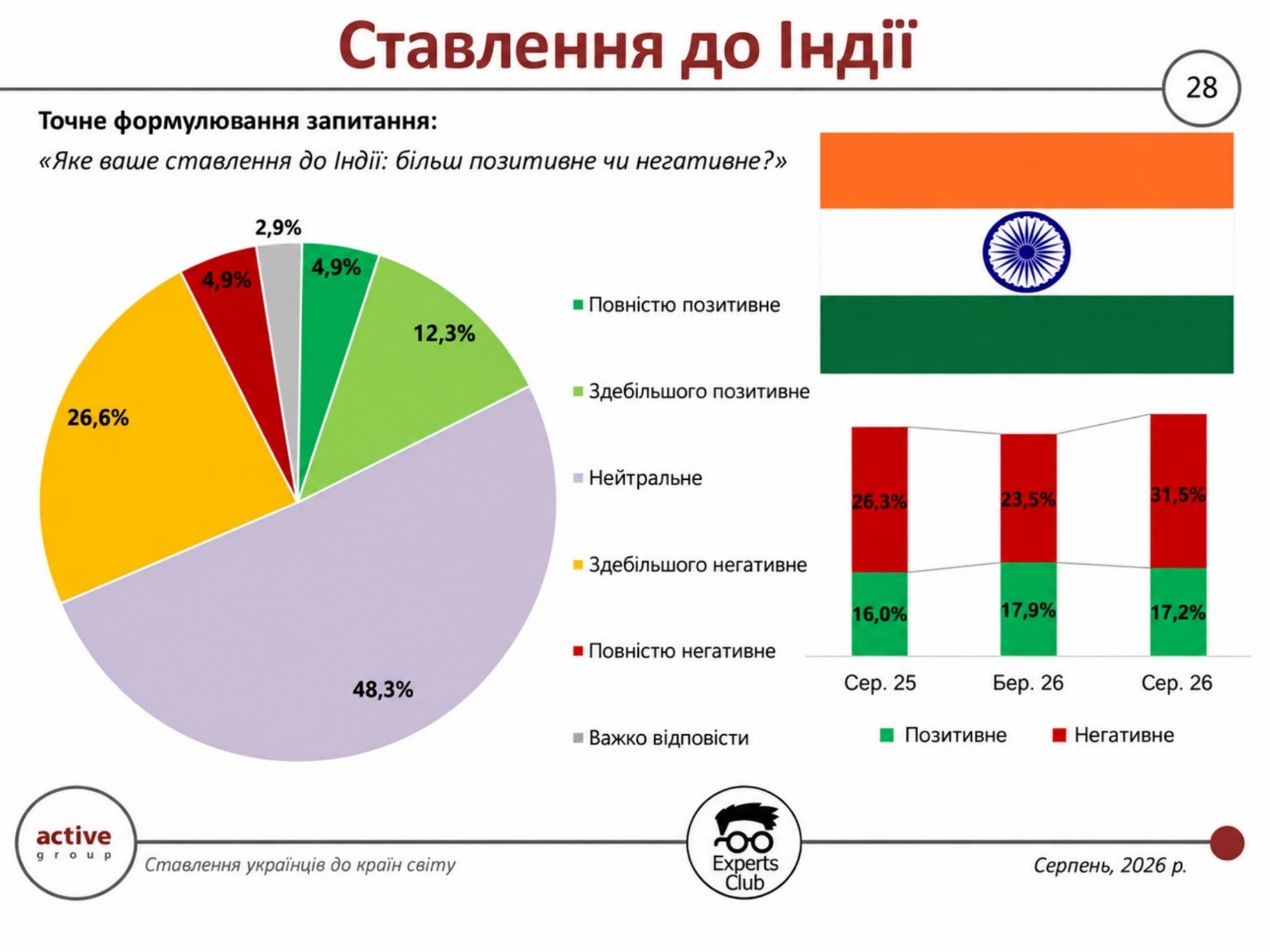
According to the results of the August survey, 4.9% of Ukrainians have a completely positive attitude toward India, and 12.3% have a mostly positive attitude. A neutral stance is held by 48.3% of respondents. A mostly negative attitude was expressed by 26.6%, a completely negative one by 4.9%, and another 2.9% were undecided.
The balance of positive and negative assessments stands at minus 14.3 percentage points. By this measure, India has the second-lowest result among the countries surveyed, after China, whose balance stands at minus 25.4 percentage points. At the same time, a distinctive feature of perceptions of India remains the very large neutral group: nearly half of those surveyed express neither a positive nor a negative assessment.
Compared to March 2026, negative attitudes have noticeably intensified. In the previous survey wave, 4.2% of respondents rated India entirely positively, while 13.8% rated it mostly positively. The overall positive rating stood at about 17.9%, the negative rating at 23.5%, and 55.5% of respondents expressed a neutral attitude.
Thus, the share of positive assessments remained virtually unchanged—17.9% in March versus 17.2% in August. In contrast, negative attitudes rose by 8 percentage points—to 31.5%—while the share of neutral responses fell by 7.2 percentage points. The balance of attitudes worsened from approximately minus 5.6 percentage points to minus 14.3 percentage points.
This trend sets India apart from most other countries in South and Southeast Asia, where the survey typically shows a predominance of neutral assessments with a positive balance. In India’s case, neutrality also dominates; however, among those who have formed a clear opinion, negative responses outnumber positive ones by nearly two to one.
Maksym Urakin, Ph.D. in Economics and founder of the Experts Club information and analytical center, emphasized that when assessing relations with major international partners, one should not limit oneself to trade statistics alone. According to him, reputation, trust, humanitarian presence, and a sense of partnership at the societal level are also important. That is precisely why economic ties must be considered alongside the extent to which a country’s presence is understood and perceived by the Ukrainian public.
The latest wave of the survey shows that, in the case of India, the main change was not a decrease in the positive group but a shift of some neutral assessments toward the negative. At the same time, nearly half of Ukrainians still hold a neutral position, which leaves significant room for further shifts in public perception.
The survey was conducted in August 2026 using an online self-administered questionnaire in the SunFlowerSociology panel among 800 Ukrainian citizens aged 18 and older. The sample is representative by age, gender, and region; the maximum theoretical margin of error for indicators at the 50% confidence level is ±3.5 percentage points.
ACTIVE GROUP, EXPERTS CLUB, INDIA, international relations, PUBLIC OPINION, SOCIOLOGY, SOUTH ASIA, UKRAINE
According to Experts Club, most countries in South and Southeast Asia are characterized by a high proportion of neutral attitudes among Ukrainians—ranging from 48.3% for India to 68.9% for Malaysia. Thailand received the highest proportion of positive assessments among the countries surveyed—30.9%—while India is the only country in the group with a distinctly negative balance of attitudes. This is evidenced by the results of the third wave of the study “Ukrainians’ Attitudes Toward Countries Around the World,” conducted by Active Group in collaboration with Experts Club, reports the Experts Club Information and Analytical Center.
Thailand is viewed positively by 30.9% of respondents, neutrally by 59.5%, negatively by 3.9%, and 5.7% were undecided. The balance of positive and negative assessments stands at 27 percentage points, compared to 25 percentage points in March 2026.
Vietnam is viewed positively by 21.5% of respondents, neutrally by 60.5%, and negatively by 12.1%. The balance stands at 9.4 percentage points and has gradually increased over the three waves of the survey: from 6.7 percentage points in August 2025 to 8.8 percentage points in March and 9.4 percentage points in August 2026.
Regarding Indonesia, 20.9% of Ukrainians expressed a positive attitude, 66.3% chose a neutral response, 6.1% expressed a negative attitude, and another 6.7% were undecided. The balance calculated from these percentages is 14.8 percentage points; on the slide, it is shown as 14.2 percentage points, which may be due to rounding or a technical discrepancy in the presentation.
Malaysia has the highest share of neutral assessments in the group—68.9%. 18.6% of respondents view it positively, 4.1% negatively, and another 8.4% were unable to answer. Overall, the published results confirm that public opinion regarding Thailand, Vietnam, Indonesia, and Malaysia is predominantly neutral rather than negative.
India stands out noticeably from the other countries in this group. 17.2% of respondents view it positively, while 31.5% view it negatively and 48.3% view it neutrally. As a result, the balance stands at minus 14.3 percentage points, compared to minus 5.6 percentage points in March 2026 and minus 10.3 percentage points in August 2025. Based on the overall results of the entire study, India has the second-lowest balance after China.
Maksym Urakin, founder of Experts Club, deputy director of the Interfax-Ukraine news agency, and candidate of economic sciences, emphasized the need to analyze Ukrainians’ attitudes toward other countries alongside actual economic ties.
“In other words, the deficit has increased by more than $10 billion over the past year. Therefore, it is very important for us to analyze our main partners,” Urakin noted. In his opinion, sociological data can complement trade analysis and help better understand promising areas of international cooperation.
Oleksandr Pozniy, Director of the research company Active Group, drew attention to the importance of the economic and informational components of bilateral relations.
“We need to do more than just raise general awareness. First and foremost, business associations, the Ministry of Economy, and the Ministry of Foreign Affairs must work to develop bilateral relations and improve the balance,” Pozniy noted. He also advocated for expanding cooperation with markets where Ukraine has opportunities to increase exports.
Overall, the results show a significant difference in perceptions of individual Asian countries. While neutrality prevails regarding Thailand, Vietnam, Indonesia, and Malaysia—with positive assessments outnumbering negative ones—perceptions of India lean toward the negative.
The survey was conducted in August 2026 using self-administered online questionnaires in the SunFlowerSociology panel among 800 Ukrainian citizens aged 18 and older. The sample is representative by age, gender, and region; the stated maximum theoretical statistical margin of error is ±3.5 percentage points. This is the third wave of the study, following surveys conducted in August 2025 and March 2026.
ACTIVE GROUP, EXPERTS CLUB, INDIA, INDONESIA, MALAYSIA, SOCIOLOGY, SOUTH ASIA, Southeast Asia, THAILAND, UKRAINE, VIETNAM
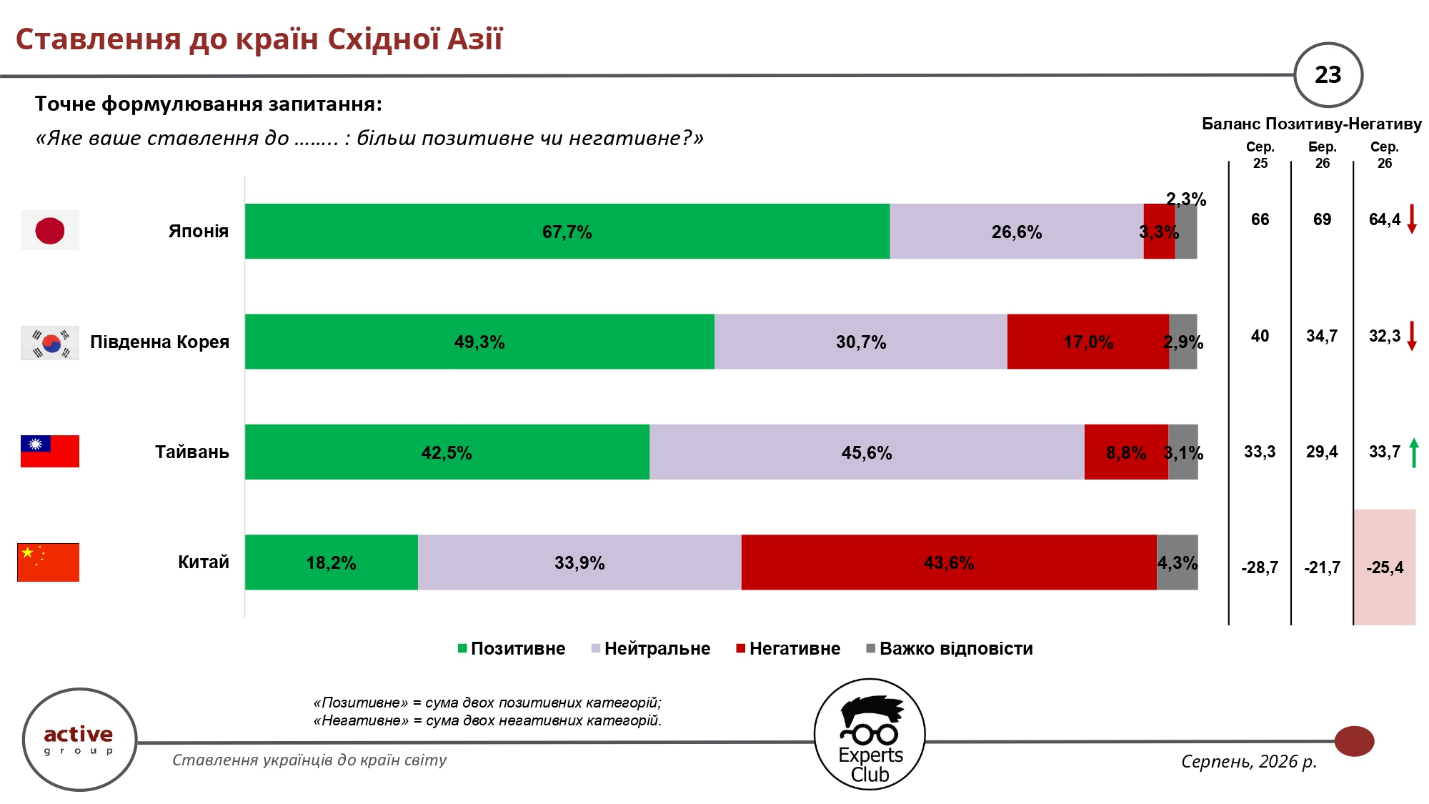
According to Experts Club, China ranked last among Ukraine’s 50 largest trading partners in terms of the balance of positive and negative attitudes among Ukrainians—in August 2026, the figure stood at minus 25.4 percentage points. The next lowest results were recorded for India and Hungary—minus 14.3 and minus 12.7 percentage points, respectively. This is evidenced by the results of the third wave of the study “Ukrainians’ Attitudes Toward Countries Around the World,” conducted by Active Group in collaboration with Experts Club, reports the Experts Club Information and Analytical Center.
The balance was defined as the difference between the shares of positive and negative assessments. Regarding China, 18.2% of respondents expressed a positive attitude, 43.6% a negative one, and another 33.9% a neutral one. Thus, China received the lowest score among all countries surveyed, despite the fact that in the first half of 2026, China was Ukraine’s largest trading partner with a trade volume of approximately $14.68 billion.
The top ten countries with the lowest scores also included Lebanon—minus 9.2 percentage points—and Poland—minus 2.3 percentage points. Serbia, Algeria, Libya, Vietnam, and Tunisia remained in the positive range, however, their scores were among the lowest among the countries surveyed: Serbia at plus 2.3 percentage points, Algeria at plus 2.2, Libya at plus 1.0, Vietnam at plus 9.4, and Tunisia at plus 11.0 percentage points.
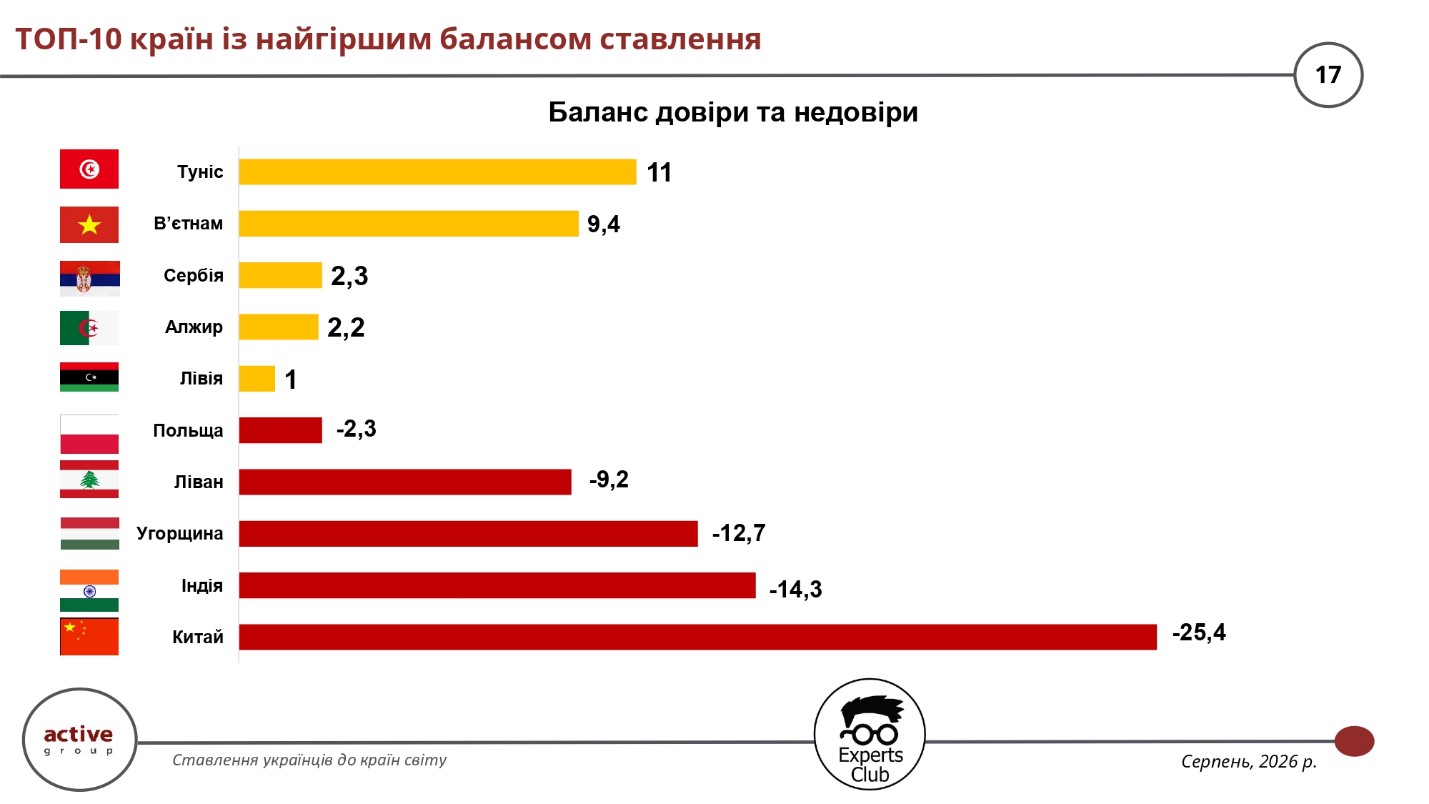
The shift in attitudes toward Poland was particularly noticeable. In March 2026, the balance of positive and negative assessments stood at +41.7 percentage points, whereas in August it fell to –2.3 percentage points. A positive attitude toward Poland was expressed by 34.6% of respondents, a negative one by 37%, and a neutral one by 25.4%. At the same time, Poland remains one of Ukraine’s largest trading partners and the largest market for Ukrainian goods exports among individual countries in the first half of 2026.
Maksym Urakin, founder of the Experts Club Information and Analytical Center, deputy director of the Interfax-Ukraine news agency, and candidate of economic sciences, noted that the results of the sociological survey should be analyzed in conjunction with actual trade figures.
“Second, we must be open to questions and inquiries from the media and the public. We also need to make use of our sociological research,” Urakin noted. In his view, systematic communication and the demonstration of concrete results of cooperation can help governments better explain the nature of bilateral relations to Ukrainian society.
Oleksandr Pozniy, director of the research company Active Group, highlighted the need to combine public awareness with the practical development of economic ties.
“We need to do more than just raise general awareness. We must expand cooperation with countries where we can achieve a positive trade balance,” Pozniy noted. He emphasized the role of business associations, economic institutions, and diplomatic missions in developing bilateral ties, especially with markets where Ukraine can increase its exports.
Overall, the survey results show that the scale of trade and economic ties does not always correspond to public attitudes toward the respective country. China stands out as the most striking example: it has the highest trade volume among individual partners, yet is simultaneously associated with the lowest ratings among Ukrainians.
The survey was conducted in August 2026 using self-administered online questionnaires in the SunFlowerSociology panel among 800 Ukrainian citizens aged 18 and older. The sample is representative by age, gender, and region; the maximum theoretical margin of error for indicators at the 50% confidence level is ±3.5 percentage points. This is the third wave of the study, following surveys conducted in August 2025 and March 2026.
ACTIVE GROUP, CHINA, EXPERTS CLUB, FOREIGN TRADE, HUNGARY, INDIA, international relations, POLAND, SOCIOLOGY, UKRAINE
India has proposed a three-part ceasefire plan to Ukraine and Russia that calls for an end to attacks on energy and other infrastructure, the assurance of uninterrupted exports of grain and energy resources through the Black Sea, and a halt to attacks on commercial vessels.
This was reported on October 7 by the Hindustan Times, citing sources familiar with the proposal. The full text of the Indian initiative has not yet been made public.
According to the publication, the first point calls for a halt to attacks on energy facilities and other critical infrastructure.
The second concerns ensuring the unimpeded passage of grain and energy resources through Black Sea ports.
The third calls for a halt to attacks on commercial shipping in the Black Sea.
According to the Hindustan Times, the proposal was presented to Ukrainian leaders during a visit by Indian Foreign Minister Subramanyam Jaishankar to Kyiv on September 3. He discussed the initiative in separate meetings with Ukrainian President Volodymyr Zelenskyy and Foreign Minister Andriy Sybiga.
The Indian initiative combines elements of several other proposals for a partial ceasefire. According to the publication, Egypt and Turkey proposed focusing on the safety of commercial shipping and grain exports through the Black Sea, while the U.S. proposal primarily concerned a halt to attacks on energy infrastructure.
On October 2, Sybiga confirmed that Ukraine had received ceasefire proposals from India, Turkey, Egypt, and the U.S., and described the Indian proposal as the most comprehensive. He noted that Kyiv is ready to consider various formats of a ceasefire, including an energy and Black Sea ceasefire, provided it also extends to port infrastructure.
On October 4, Indian Foreign Minister Jaishankar also publicly confirmed that New Delhi had shifted in recent months from general calls for peace to direct consultations with Moscow and Kyiv. According to him, the Indian side is discussing the safety of shipping in the Black Sea, the export of grain and energy resources, as well as the possibility of a mutual renunciation of certain types of attacks.
One of the motivations behind the Indian initiative is New Delhi’s interest in the stability of energy supplies and the security of maritime transport. According to the Hindustan Times, nearly 30% of Russian energy supplies to India pass through Black Sea ports. In recent weeks, attacks on commercial vessels have led to supply disruptions and rising freight costs.
In addition, five Indian sailors have been killed in attacks on merchant ships in the region over the past few weeks, prompting Indian authorities to repeatedly call for an end to attacks on civilian shipping.
Russia and Ukraine have not yet officially announced their direct responses to all three points of the Indian plan. The Hindustan Times reports on ongoing contacts between the parties, though details of these talks have not been disclosed.
The Ukrainian Foreign Ministry previously stated that Kyiv is ready for a complete and unconditional ceasefire, as well as for separate agreements to halt attacks on energy and food infrastructure.

India continues to strengthen its position as the world’s second-largest steel producer and is gradually closing the gap with China, according to data from the World Steel Association (Worldsteel) published on September 24, 2026.
From January through August 2026, Indian steelmakers produced 115.9 million metric tons of steel, a 6% increase compared to the same period last year. During the same period, China’s production fell by 3.1% to 651.9 million metric tons.
According to Open4Business calculations based on Worldsteel data, India produced approximately 109.3 million metric tons of steel in the first eight months of 2025, while China produced approximately 672.8 million metric tons. Thus, the absolute gap between the two largest producers over the year narrowed from approximately 563 million to 536 million metric tons, or by nearly 5%.
The ratio of production volumes is also shifting in India’s favor. While China produced about 6.2 times more steel than India from January through August of last year, that figure fell to about 5.6 times in 2026.
This trend continued in August. India increased its steel output by 4.6% year-over-year—to 14.8 million metric tons—while production in China fell by 3.7%—to 74.6 million metric tons. (World Steel Association)
India also more than doubles the output of the United States, which ranks third among the world’s largest producers. U.S. steelmakers produced 57.5 million metric tons of steel from January through August, increasing output by 5.5%. Japan produced 54 million metric tons, Russia—43.8 million metric tons, and South Korea—42.8 million metric tons.
Thus, India’s output over the eight-month period is already roughly double that of the U.S. and more than double that of Japan.
India accounted for about 9.5% of all steel produced by the 70 countries that provide statistics to Worldsteel, while China’s share was about 53% and the U.S.’s was about 4.7%. These 70 countries accounted for approximately 98% of global steel production in 2025.
The difference is particularly noticeable against the backdrop of the industry’s overall stagnation. From January through August, global steel production fell by 0.7% to 1.225 billion metric tons, while India continued to show steady growth. In August, global production declined by 1.2% year-over-year to 144.2 million metric tons.
Vietnam remains another fast-growing Asian producer. Over the eight-month period, it increased its output by 29.1%—to 20.6 million metric tons—with growth reaching 36.4% in August alone. Overall, however, steel production in Asia and Oceania has declined by 0.9% since the beginning of the year—to 906.4 million metric tons—primarily due to trends in the Chinese market.
China, meanwhile, maintains a huge lead and remains the undisputed leader in the global steel industry. However, the diverging trends of the two largest producers indicate a gradual increase in India’s share of the global steel industry.
Original source: World Steel Association — August 2026 crude steel production
Global steel production in August 2026 fell by 1.2% compared to August of last year, to 144.2 million metric tons, according to data from the World Steel Association (Worldsteel) published on September 24.
The statistics cover 70 countries, which accounted for about 98% of global steel production in 2025. From January through August 2026, they produced 1.225 billion metric tons of steel, which is 0.7% less than a year earlier.
China remains the largest producer, having produced 74.6 million metric tons of steel in August, a 3.7% year-over-year decline. Thus, China accounted for more than half of global output.
India, which ranks second, increased production by 4.6% to 14.8 million metric tons. The United States increased production by 3% to 7.3 million metric tons, while Japan increased production by 0.4% to 6.7 million metric tons.
Russia produced about 5.5 million metric tons of steel, down 0.3% from August of last year, while South Korea increased production by 2.6% to 5.4 million metric tons.
Turkey produced about 3.4 million metric tons of steel, which is 0.4% less than last year’s figure. Brazil’s production fell by 6.2% to 2.7 million metric tons, while Germany increased its output by 1.7% to 2.6 million metric tons.
Among the largest producers, Vietnam showed the strongest growth: the country’s steel production rose by 36.4% to 2.7 million metric tons.
From January through August, China produced 651.9 million metric tons of steel, which is 3.1% less than a year earlier. India increased production by 6% to 115.9 million metric tons, and the United States by 5.5% to 57.5 million metric tons.
The top ten producers since the beginning of the year also include Japan (54 million metric tons), Russia (43.8 million metric tons), South Korea—42.8 million metric tons, Turkey—26.6 million metric tons, Germany—23.9 million metric tons, Brazil—21.8 million metric tons, and Vietnam—20.6 million metric tons.
Vietnam has also shown the fastest growth among this group since the beginning of the year—approximately 29%. Production in Russia fell by 5.1%, in China by 3.1%, and in Brazil by 1.8%.



