
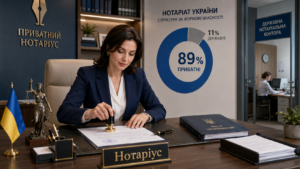
Ukraine continues to see a structural shift of notarial services toward the private sector: as of the end of August 2026, 5,484 out of 6,156 notaries included in the Unified Register of Notaries were working privately.
Thus, the share of private notaries reached about 89%, or almost nine out of ten professionals, according to an Experts Club analysis based on Opendatabot data.
There were 652 notaries working in state notary offices, accounting for about 10.6% of the total number, while another 20 professionals worked in state notarial archives.
Over the past year, the number of private notaries increased by 345 people. At the same time, the number of notaries in state institutions decreased by 34.
As a result, the entire net increase in the register was provided by the private sector. The total number of notaries increased by 311 people over the year, or by approximately 5%, to 6,156.
According to Experts Club, this dynamic indicates a further shift of the Ukrainian notarial services market toward the private model. The state segment is gradually shrinking both in absolute terms and as a share of the total number of professionals.
At the same time, the increase in the register does not mean a similar influx of new personnel. Of the total increase, only 40 notaries were new, while the majority were professionals who renewed their certificates. Another 104 notaries stopped working during the year.
A notable feature of the profession remains the significant predominance of women: they account for 82% of all notaries in Ukraine. Over the year, the number of women in the register increased by 250, while the number of men increased by 61.
Source: Opendatabot, data from the Unified Register of Notaries as of the end of August 2026.

Ukrainian President Volodymyr Zelenskyy has submitted two bills to the Verkhovna Rada for consideration aimed at tightening penalties for organizing fraudulent call centers and participating in their activities, as well as providing additional, substantial protection for people against illegal actions involving payment instruments and bank accounts.
“Penalties for fraudulent call centers must be clear and severe—not only for those who carry out the work at these call centers, but also for those who organize them, profit from them, and own them. The first bill provides for exactly that,” Zelenskyy emphasized, commenting on the bills on his Telegram channel.
According to the president, the bills also provide for the introduction of stricter liability for organizing fraudulent schemes involving banking instruments, in particular so-called “drops.”
“At the level of internal regulation of the banking system, there must be appropriate steps and changes to algorithms that will give banks more opportunities to protect the rights and legitimate interests of individuals and businesses and prevent the use of accounts for tax evasion or the laundering of funds from illegal activities. At the legislative level, we will create the necessary framework to counter the organizers of fraudulent schemes involving bank accounts and payment instruments,” Zelenskyy explained.
He added that this same bill aims to implement European Union legal standards in Ukraine, as provided for in agreements with partners.
BANK, BILL, call center, fraud, UKRAINE
China was the only G20 country that did not support a number of provisions in the final document of the meeting of finance ministers and central bank governors of the “Group of Twenty,” held August 31–September 1, 2026, in Asheville, North Carolina.
As a result, instead of a joint communiqué agreed upon by all participants, the United States, as G20 chair, issued a chair’s statement. The official document from the U.S. Department of the Treasury states that it was endorsed by all G20 members present, except for China, which opposed four sections.
One of the main points of contention was the issue of global trade imbalances. The text, supported by the other countries, calls on nations to abandon non-market policies and practices that exacerbate imbalances. Countries with excessive and persistent external trade surpluses are urged to eliminate factors that constrain domestic consumption and create excessive dependence of economic growth on exports.
U.S. Treasury Secretary Scott Bessent stated after the meeting that China was the only dissenting participant. He called China’s current account surplus the largest and “unsustainable” and stated that a non-market economic model that constantly increases the supply of cheap export goods cannot be sustainable.
China also did not support provisions to expand the International Monetary Fund’s role in monitoring global economic imbalances. The other G20 members advocated for strengthening the IMF’s analysis, including an assessment of non-market policies, the factors driving external trade imbalances, and their impact on other economies.
Another point of contention was the Strait of Hormuz. The G20 statement expressed concern over ongoing disruptions to energy trade and emphasized the need for free, safe, and predictable shipping through the Strait of Hormuz and other key maritime routes. China opposed the entire relevant section of the document.
In addition, Beijing disagreed with the section concerning sovereign debt restructuring and the continued application of the G20’s Comprehensive Framework for Addressing the Debt Problems of Developing Countries. An official document from the U.S. Treasury Department explicitly states that China objected to paragraphs 4, 10, 11, and 13 of the statement.
Despite the lack of full consensus, the remaining 19 G20 members supported the approach to reducing global imbalances. Reuters notes that the issue has effectively turned into a debate over China’s export model, industrial subsidies, and the growing supply of Chinese products to global markets.
These disagreements come amid growing concerns from the U.S., the EU, and several other major economies regarding China’s manufacturing capacity and its expanding trade surplus. Western nations fear that a glut of Chinese industrial goods could intensify pressure on local manufacturers and increase dependence on specific supply chains.
The meeting in Asheville marked the second gathering of G20 finance ministers and central bank governors under the U.S. presidency in 2026. Key topics included economic growth, global imbalances, public debt, digital assets, financial literacy, and the state of the global financial system.
The G20 currently comprises 19 countries: Argentina, Australia, Brazil, the United Kingdom, Germany, India, Indonesia, Italy, Canada, China, Mexico, Russia, Saudi Arabia, the United States, Turkey, France, South Africa, South Korea, and Japan.
In addition, the European Union and the African Union are full members of the G20. Thus, following the African Union’s accession in 2023, the G20 effectively comprises 21 members—19 countries and two regional organizations.

The Business Activity Expectations Index (BAEI) fell to 48.3 points in August 2026 from 50.1 points in July and was lower than the August 2025 figure (49.0 points), the National Bank of Ukraine (NBU) reported on its website.
The last time the BAI was in negative territory was in February 2026, when it stood at 45.9 points.
“Significant losses resulting from the widespread destruction of production facilities, warehouses, and logistics infrastructure, the blockage of seaports, high fuel prices, and a shortage of skilled workers limited economic activity among enterprises and negatively affected business sentiment,” the regulator noted.
At the same time, business activity was supported by steady consumer demand, international financial support, budgetary funding for infrastructure restoration and road construction, a stable situation in the energy sector, as well as seasonal factors.
Construction companies were the only sector among those surveyed to maintain positive assessments of their performance: the sectoral index stood at 50.7 points in August, compared to 54.2 a month earlier and 54.0 in August of last year.
Construction companies expected an increase in construction volumes, new orders, and purchases of raw materials and supplies, as well as continued growth in the volume of contractor services purchased, albeit at a slower pace.
In the services sector, the sectoral index rose to 49.5 points from 48.8 in July and exceeded the August 2025 figure (47.0 points). Companies maintained positive assessments of new orders and resumed optimistic expectations regarding the volume of services provided and those currently in progress.
Retail businesses reported weaker assessments: the sectoral index fell to 47.5 points from 50.8 in the previous month and 51.8 in August of last year. They expected a decline in sales and purchases of goods for resale, a further reduction in their inventories, and a decrease in profit margins.
Assessments from industrial firms were the most subdued: the sectoral index fell to 47.3 points in August from 50.7 in July and 48.7 in August 2025.
Unlike the previous month, manufacturers expected a decline in production volumes and new orders—particularly export orders—while forecasting an increase in inventories of raw materials and supplies.
Most of the surveyed companies expected price pressures to intensify for both purchases and their own products and services. Only construction companies forecast a slight slowdown in price growth.
Only construction companies planned to increase their workforce, while enterprises in manufacturing, trade, and the service sector expected a reduction in the number of employees, with the most significant decline expected in manufacturing.
The survey was conducted from August 4 to 21, 2026, with 586 enterprises participating: 43.7% from manufacturing, 25.9% from the service sector, 24.6% from trade, and 5.8% from construction.
Among the respondents, 30.9% were large enterprises, 29.2% were medium-sized, and 39.9% were small. Export and import operations were conducted by 35.0% of respondents; 8.0% engaged only in exports; 17.6% engaged only in imports; and 39.4% did not engage in any foreign economic operations.
The Central, Ingulets, and Northern Mining and Processing Complexes (MPCs) of the Metinvest Mining and Metallurgical Group, which were merged into the United Mining and Processing Complex, transferred 2.8 billion hryvnias to budgets at all levels for the January–June period of this year, which is 200 million hryvnias more than in the same period last year.
According to the company’s press release, Metinvest’s Kryvyi Rih mining and processing plants remain a reliable financial foundation for Ukraine even during the war and economic crisis, channeling billions of hryvnias into budgets at all levels. As has traditionally been the case, the main sources of revenue remain subsoil use fees—1.3 billion hryvnias—the unified social contribution—nearly 400 million hryvnias—and personal income tax—350 million hryvnias.
“Ukraine’s mining and metallurgical sector is going through an extremely difficult period; however, thanks to our professional and responsible specialists, Metinvest’s mining and processing plants continue to operate amid shelling and severe logistical and export restrictions. And even despite the decline in production, the United Mining and Processing Complex consistently pays all required taxes and fees. Because taxes right now mean support, protection, and survival for the country as a whole and for local communities in particular,” said Igor Tonev, CEO of the United Mining and Processing Complex.
As previously reported, including its associated companies and joint ventures, the Metinvest Group paid 8.5 billion UAH in taxes and fees to budgets at all levels in Ukraine during the first half of 2026.
In the first quarter of 2026, the United Mining and Processing Complex transferred 1.3 billion UAH to budgets at all levels.
Metinvest is a vertically integrated group of mining and metallurgical enterprises. Its facilities are located in Ukraine—in the Donetsk, Luhansk, Zaporizhzhia, and Dnipropetrovsk regions—as well as in European Union countries, the United Kingdom, and the United States. The holding’s main shareholders are the SCM Group (71.24%) and Smart Holding (23.76%). Metinvest Holding LLC is the management company of the Metinvest Group.
BUDGET, KRYVYI RIH, METINVEST, TAX, ГЗК



