

The highest average pension payment in Ukraine as of July 1, 2026, was recorded in Kyiv at UAH 9,901.43 per month, according to data from the Pension Fund of Ukraine and Opendatabot.
The Experts Club information and analytical center notes that the capital’s figure is 36% higher than the national average, which stands at UAH 7,272.68. Donetsk region ranks second with an average pension of UAH 8,990.33, while Luhansk region ranks third with UAH 8,752.15.
The lowest average payments were recorded in Ternopil region at UAH 5,656.53, Chernivtsi region at UAH 5,839.45, and Zakarpattia region at UAH 5,917.68.
Thus, the difference between Kyiv and Ternopil region amounts to approximately UAH 4,250, or 75%. Regional differences are associated with the employment structure, previous salary levels, insurance records, and the proportion of recipients of special and occupational pensions.
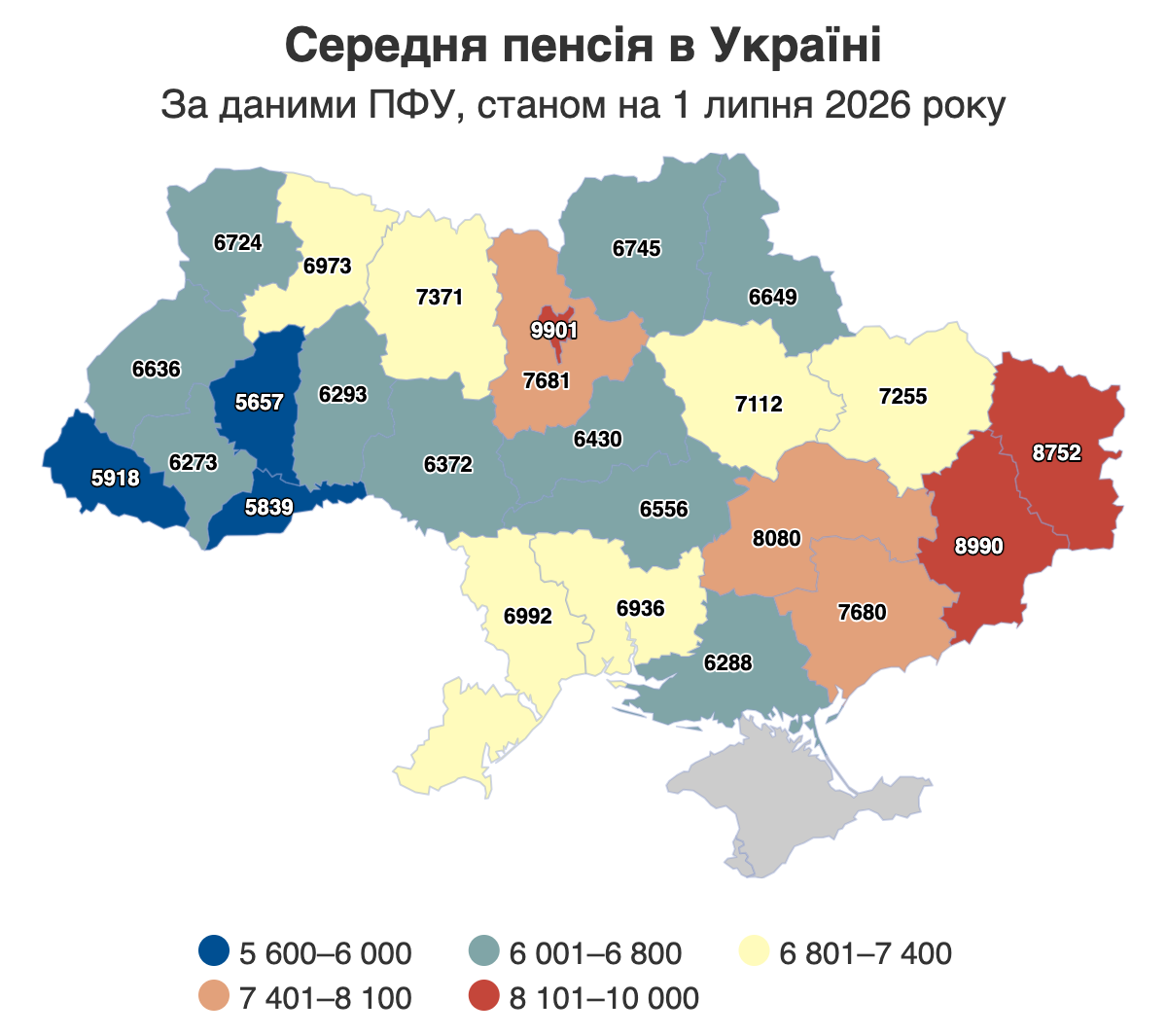
Overall, pensioners in seven regions receive payments above the national average.

The website of the Ukrainian Center for Educational Quality Assessment (UCEQA) is temporarily unavailable due to technical issues.
“Due to a technical glitch, the UCEQA website is temporarily unavailable. Our specialists are already working to resolve the issue and restore the website as soon as possible. We emphasize that these temporary technical difficulties do not affect the administration of the National Multidisciplinary Test (NMT). All assessments are proceeding as scheduled,” the Center stated in a post on Facebook.
It is noted that if applicants need to log in to their personal National Multidisciplinary Test (NMT) account, they can use the following link: https://my.testportal.gov.ua/cabinet/login
As previously reported, the additional sessions of the National Multidisciplinary Test began on July 17 and will continue through July 24
Applicant, National Multidisciplinary Test, outage, UCOYAO, WEBSITE
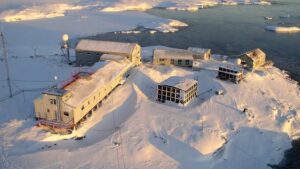
Thanks to Ukraine’s participation in the POLARIN project under the Horizon Europe program, two new international research projects are launching at the “Akademik Vernadsky” station and on the icebreaker “Noosphere,” according to the National Antarctic Scientific Center (NASC).
“At the ‘Vernadsky’ station, researchers will study the aerosol-mediated dispersal of microbial communities in polar regions as part of the MICROAIRPOLAR project. The second project—TRICUSO-FLOATS—is dedicated to monitoring carbon in the Southern Ocean; for this project, six argon buoys equipped with a range of sensors will be deployed from aboard the icebreaker ‘Noosphere,’” the NANC stated in a press release on Tuesday.
Specifically, as part of the MICROAIRPOLAR project, which is being carried out by scientists from the Autonomous University of Madrid (Spain) and Northumbria University (United Kingdom), special MicroAirCollector equipment will be installed at three stations in the Arctic and three in Antarctica to collect samples of microorganisms from the air. Scientists will conduct genetic analysis to determine exactly what the wind carries into the polar regions and will track the trajectories of air masses and the movement of bacteria in the Arctic and Antarctic, as well as between them.
As part of the second project—TRICUSO-FLOATS, carried out by scientists from the National Oceanography Center (United Kingdom), the Norwegian Research Center, and Sorbonne University (France)—carbon monitoring will be conducted in the Southern Ocean. To this end, six argon buoys equipped with a range of sensors will be deployed from the Noosphere to measure total alkalinity and dissolved inorganic carbon content, which will help quantify how much carbon the Southern Ocean absorbs.
Both studies will begin during the next Antarctic season, which starts in late 2026.
The NASC also notes that POLARIN brings together 64 polar research infrastructures belonging to organizations from around the world. MICROAIRPOLAR and TRICUSO-FLOATS are the first winning projects to gain access to the “Vernadsky” and “Noosphere” stations as part of POLARIN.
“For Ukraine, such initiatives represent an opportunity to participate in cutting-edge scientific research and to be an active member of the global polar community,” the NASC concludes.

As of July 21, Ukrainian farmers had threshed 1.34 million hectares—or 11% of the projected area—and harvested 5.47 million metric tons of grain from the new crop, according to the press service of the Ministry of Agrarian Policy and Food.
Wheat production totaled 2.6 million metric tons from an area of 633,200 hectares, with an average yield of 41.1 centners per hectare.
Barley production totaled 2.56 million metric tons from an area of 580,500 hectares, with a yield of 44.1 centners per hectare.
Peas yielded 301,400 metric tons from an area of 121,600 hectares, with a yield of 24.8 centners per hectare.
The Odesa region currently leads in terms of the volume of early grain and legume crops harvested, with 1.597 million metric tons harvested from an area of 385,000 hectares. In the Mykolaiv region, 1.303 million metric tons were harvested from an area of 365.5 thousand hectares. In the Dnipropetrovsk region, 1.005 million metric tons were harvested from an area of 256.5 thousand hectares.
Winter and spring rapeseed have already been threshed across an area of 216,200 hectares, yielding 429,600 metric tons with an average yield of 19.9 centners per hectare.
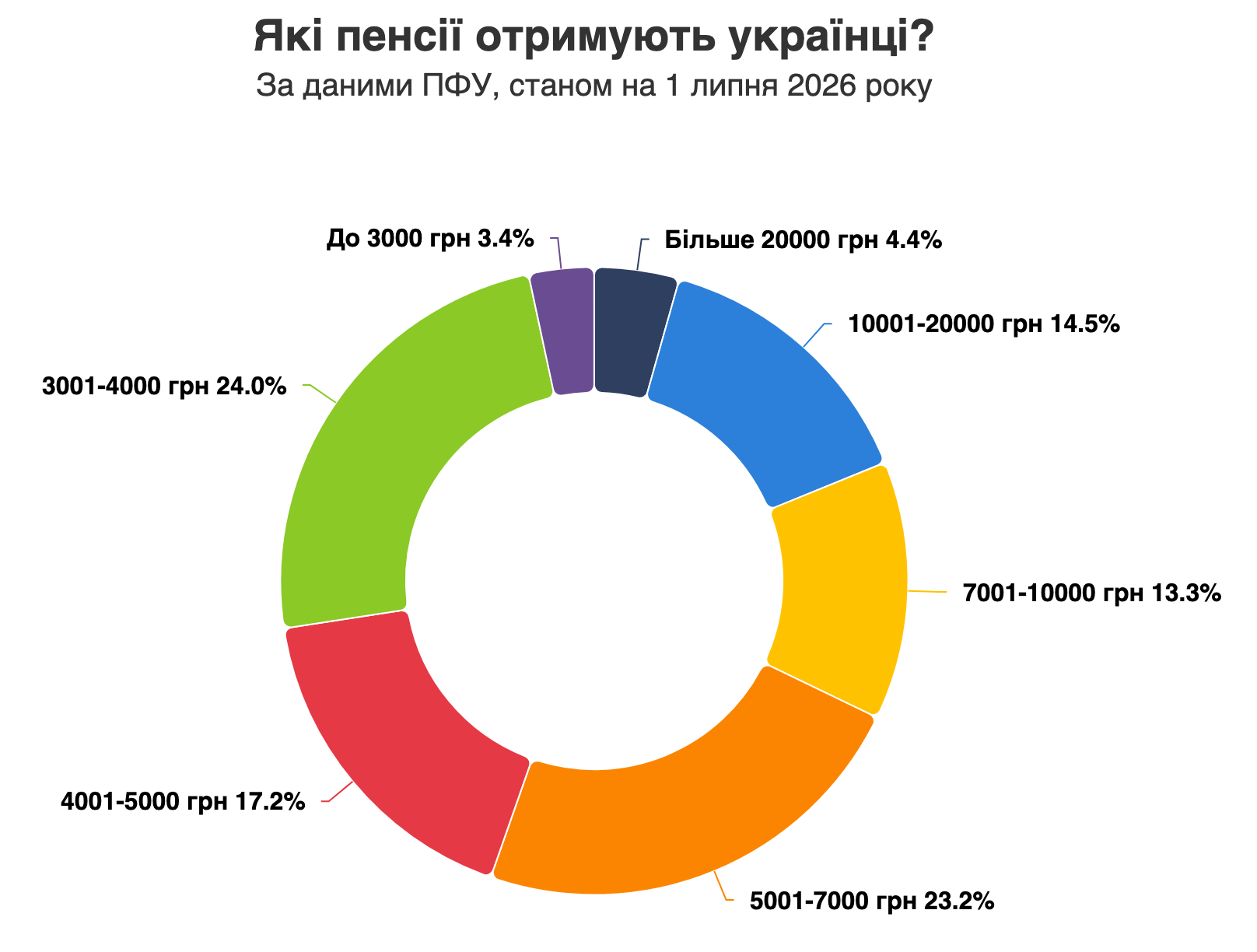
According to data from the Pension Fund of Ukraine as of July 1, 2026, approximately 2.4 million Ukrainian pensioners—or 24% of the total number—receive between 3,001 and 4,000 UAH per month.
The average payment within this group is 3,581.58 UAH. Another 335,800 people, or 3.4% of pensioners, receive no more than 3,000 UAH, while 1.72 million people receive between 4,000 and 5,000 UAH.
At the same time, approximately 3.21 million people—or nearly one-third of all pensioners—receive a pension of more than 7,000 UAH. Payments exceeding 20,000 UAH are made to 436,200 people, including 29,500 pensioners who receive more than 30,000 UAH per month.
The average pension nationwide is 7,272.68 UAH; however, it exceeds the amount received by most recipients due to significantly higher pensions for certain categories.

State-owned PrivatBank and Limagrain, one of the world’s largest seed companies, have launched two partnership financing programs for agricultural producers ahead of the fall planting season, the bank’s press service reported.
“We are expanding financing options and offering farmers new tools that are more effective and convenient, given the specific nature of agricultural production,” the press service quoted Mykhailo Kovalov, head of PrivatBank’s Department of Documentary Operations and Trade Finance, as saying.
According to the announcement, farmers can take advantage of a working capital financing program to purchase seeds and a promissory note program, which allows for flexible payment planning and optimizes the financial burden on the farm.
The bank noted that both programs offer preferential financing terms as well as a simplified application process.
For more details on the loan terms, please contact Limagrain Ukraine managers or visit your nearest PrivatBank branch.
Limagrain—a seed company founded by farmers in France over 50 years ago—ranks fourth in the global seed industry. The company has been operating in Ukraine since 2008. The main crops it breeds include corn, sunflower, rapeseed, spring and winter wheat, and spring and winter barley (for feed and brewing). The company’s global network of branches spans 56 countries. Each year, the company invests approximately 14% of its revenue in research.
PrivatBank is Ukraine’s largest bank. According to the National Bank, the financial institution’s total assets as of June 1, 2026, amounted to 965.11 billion UAH (22.7% of the total).
The state-owned bank noted that, according to regular Brand Health Tracking surveys for the first quarter of 2026, the level of trust in it is higher than that of other financial institutions on the market and stands at 49%. The bank attributes this to the availability of accessible, personalized, and digitized products for its customers.



