
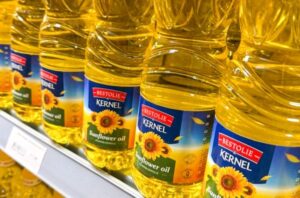
Agricultural holding Kernel is expanding its presence in the European consumer market: in the Netherlands, just a year and a half after launching its own sunflower oil brand, Bestolie&Kernel, sales have already reached 5.5 million liters, the company’s press service reported on Monday.
“The European market is very competitive and ‘closed’ to new brands. It is dominated by large international FMCG companies and supermarket chains’ private labels. Getting on the shelf is difficult, and staying there is even harder,” the release quotes Serhiy Neroshchyn, director of the marketing and sales department for packaged products at Kernel, as saying.
The company noted that it previously produced oil for the Dutch food distributor Fangoo&Zon Impex under a private label, whereas the launch of its own Bestolie&Kernel brand in 2024 allowed the company to build a complete value chain—from the Ukrainian field to the European consumer.
“Kernel” is responsible for production and quality control at all stages—from seed to finished oil—as confirmed by ISO 9001 and ISO 22000 certifications, while Fangoo&Zon Impex handles distribution in the local market.
Since its launch, the company has also expanded its product range, adding new packaging formats and frying oil for the HoReCa segment.
“Kernel” estimates its share of global sunflower oil exports at 10%. Kernel sells refined sunflower oil in Ukraine under its own brands, “Stozhar” and “Shchedry Dar,” and exports it under its own Kernel brands to 12 European countries, as well as to Jordan, Lebanon, Bangladesh, Guinea, under the Le Blanc and Premi brands in Egypt, the Middle East, and South Asia, as well as under its partners’ private labels.
Fangoo&Zon Impex is a Dutch company specializing in the import and distribution of food products and FMCG goods in the Benelux countries.
Kernel Agricultural Holding is the world’s largest producer and exporter of sunflower oil, Ukraine’s largest grain exporter, an operator of an extensive network of logistics assets, and a leading producer of grain and oilseeds in Ukraine. It is one of the largest producers and sellers of bottled oil in Ukraine. It is engaged in the cultivation and sale of agricultural products.
According to results for the first nine months of fiscal year 2026 (July 2025 – March 2026), Kernel saw its net profit decline by 5% to $208 million, while its revenue increased by 0.4% to $3.092 billion, and EBITDA by 1% to $403 million.
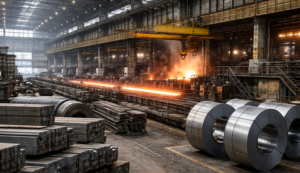
The ‘Kametstal’ plant, part of the “Metinvest” mining and metallurgical group and established at the facilities of the Dniprovsky Metallurgical Plant (Kamenskoye, Dnipropetrovsk Oblast), has reduced electricity consumption in its converter shop by 6 kWh per ton of steel produced, from 27.4 to 21.4 kWh/t, through measures to reduce equipment load during periods between smelting runs.
According to the company, in particular, the downtime for unloading converter exhaust fan rotors has been cut in half. Operations have been organized on a rotational basis for each of the two converters, allowing equipment not involved in the current melt to be shut down and minimizing idle time, thereby ensuring a systematic reduction in electricity consumption.
In addition, electricity consumption by circulation pumps No. 1 and No. 2—which supply water to the converter gas cooling boilers on both operating converters—has been reduced by 1.2 kWh/t. As part of the investment project, frequency converters and modern controllers from Schneider were installed on CN-1 and CN-2. This allows for the automatic unloading of pumping equipment in accordance with the steelmaking process, thereby minimizing its electricity consumption between converter purges.
In the post-converter steel processing department, electricity consumption was reduced by 4.6 kWh/t through the phased implementation of effective engineering solutions to optimize metal heating. At the same time, the algorithm for automatic control of the metal heating process in the “furnace-ladle” unit was refined and improved by selecting the optimal combination of heating stages and heating rates.
Kametsal was established on the basis of PJSC Dniprovsky Coke Chemical Plant (DKCHZ) and PJSC Dniprovsky Metallurgical Plant (DMP). It is part of the Metinvest Group.
Metinvest is a vertically integrated group of mining and metallurgical enterprises. Its facilities are located in Ukraine—in the Donetsk, Luhansk, Zaporizhzhia, and Dnipropetrovsk regions—as well as in European countries. The holding’s main shareholders are the SCM Group (71.24%) and Smart Holding (23.76%). Metinvest Holding LLC is the management company of the Metinvest Group.

In the context of war, economic recovery, and integration into European markets, Ukrainian businesses need to develop a new culture of corporate due diligence. This involves a shift from operating “on recommendation” or following only a minimal legal review to a systematic analysis of counterparties, partners, suppliers, and customers.
One of the tools for fostering this culture is Dun & Bradstreet’s international business data, which is made available in Ukraine by D&B-Interfax-Ukraine. This data can be used to identify businesses, vet counterparties, assess commercial and credit risks, ensure compliance, and manage global supply chains.
“Ukraine is gradually transitioning to a new quality of business environment. This requires not only reforms, investments, and digitalization, but also a daily culture of business verification. Trust in the modern economy must be based not only on personal contacts, but also on data, transparency, and the possibility of independent verification,” noted Maksym Urakin, Director of Development and Marketing at Interfax-Ukraine, Head of the D&B-Interfax-Ukraine business unit, and Candidate of Economic Sciences.
According to him, this is particularly important for Ukraine in the process of recovery, attracting foreign investors, and expanding the presence of Ukrainian companies in foreign markets. The more transparent companies are to international partners, the easier it is for them to enter into new contracts, supply chains, and investment projects.
D&B-Interfax-Ukraine can be useful for large businesses as well as SMEs, financial companies, exporters, importers, investors, consultants, and organizations working with procurement or international projects.
A culture of company verification helps reduce the risk of fraud, non-payment, and dealing with shell companies or counterparties with a murky history. At the same time, it supports ethical businesses that are willing to be transparent with partners and demonstrate their business integrity.
For the Ukrainian market, this is also a matter of long-term competitiveness. Businesses that operate transparently and can be verified have a better chance of attracting financing, entering international markets, participating in tenders, and working with large corporate clients.
Dun & Bradstreet is an American company specializing in business data, analytics, commercial information, and risk management, founded in 1841. The company provides international tools for business identification, counterparty verification, credit and commercial risk assessment, compliance, and working with global supply chains. D&B maintains a global business data database and works with companies, financial institutions, government agencies, and international organizations.
Interfax-Ukraine is an independent Ukrainian news agency that has been operating in the Ukrainian political and economic information market since 1992 and has a reputation as a reliable and competent provider of timely and objective information. The editorial office and the agency’s headquarters are located in Kyiv.

According to the Interfax-Ukraine Culture project, the 23rd Docudays UA International Human Rights Documentary Film Festival has begun in the capital and will run until June 12, the Ukrainian State Film Agency reports on Facebook.
“This year’s festival theme—‘Simple Structures’—is dedicated to the search for internal and social supports that help Ukrainians hold on amid the war,” the statement reads.
The opening film was the documentary “Born a Forger” by German directors Erek Bremer and Benjamin Rost, which explores the high-profile media scandal involving journalist Michael Born and raises questions about media literacy and the verification of information in the post-truth era.
Among the festival’s innovations is the establishment of the Viktor Onysko Memorial Award for Best Editing in Ukrainian Documentary Film.
The Docudays UA program includes 82 feature-length and short films, most of which were made in 2025–2026. Among them are 33 Ukrainian films: 12 national premieres and eight world premieres.
The State Film Agency noted that the festival features a strong lineup of Ukrainian documentary films that explore the consequences of war, personal resilience, and the reinterpretation of art.
Angelina Karyakina and Maksym Shcherbyna hosted the opening ceremony.
The festival’s main offline venues are traditionally the Kyiv cinemas “Zhovten” and Kino42. Additionally, from June 7 to 11, 20 films will be screened at the online cinema DOCUSPACE.
The 23rd Docudays UA is held with the financial support of the European Union, the Embassy of Sweden in Ukraine, and the Ukrainian State Film Agency.
https://interfax.com.ua/news/culture/1174607.html
docudays_ua, international_documentary_film_festival, state_film_agency
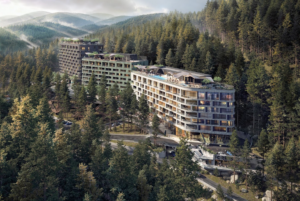
Hotel real estate in the Carpathians is reaching new heights. How three phases, a single standard, and the right partners are shaping a new-generation investment product
FORREST Trinity Resort — a project where answers to key investor questions are thought through before sales begin: who manages it, what is the financial model, how are my rights protected, and is there demand for this property in summer and winter?
Bukovel has long ceased to be exclusively a ski resort. According to market analysts, tourist traffic reaches 2.5 million people per year, and occupancy rates for high-quality hotels during peak season are 100%. In summer and during the off-season, this figure remains at 67–73%.
This means that a properly positioned hotel product in Bukovel doesn’t sit idle—it generates revenue.
But there’s a catch: not every project is the same. High-quality hotels with full-scale management, consistent service, and actual occupancy throughout the year are few and far between. Most offerings on the market are apartment complexes where operational efficiency depends on the decisions of each individual owner. FORREST Trinity Resort is built on a different logic.
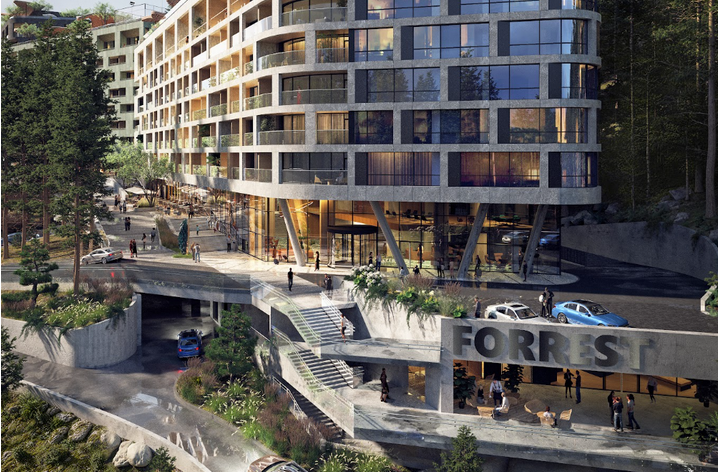
Most resort projects are geared toward a single audience. Forrest is built differently.
Phase One — a space for those seeking peace and rejuvenation. Surrounded by forest, a wellness center, and a rooftop pool. For those tired of the city who just want to unwind.
Phase Two—conference rooms, meeting spaces, a paddle tennis court, and a networking area. For corporate groups, small forums, and teams combining work with relaxation. The MICE segment in Ukraine is underrated—and this is an opportunity.
Phase Three—a children’s area, a large spa, a climbing wall, an outdoor pool, and the panoramic restaurant FORREST Sky View—the resort’s signature dining destination, located 48 meters above ground, offering a 360° panorama of the Carpathian mountain landscapes. For those who want their children to have something to do while their parents relax.
Three distinct target audiences mean three different reasons to visit—and three independent booking streams. If one segment slows down, the other two continue to perform. This directly impacts occupancy stability and, consequently, the monthly payment to the owner.
At FORREST Trinity Resort, the model is fundamentally different. All 461+ units, without exception, are transferred to Maestro Hotel Management—a condition stipulated in the contract. The owner handles nothing: no bookings, no check-ins, and no maintenance of the rooms. Maestro is responsible for the entire cycle. A guest on Booking sees a fully-fledged resort property with consistent ratings—a higher average check and stable payments to every owner.
Maestro Hotel Management—a management company with 10 years of experience in the hospitality industry. Crucially, they joined the project not after construction, but at the very start. Together with the Perspektyva Group team, they shaped the room layouts, service standards, and financial model. When a management company participates in the creation of a hotel, the rooms are designed to fit the operational model—not the other way around. This ensures a different level of readiness on opening day.
The financial model is transparent: 80% of rental income goes to the owner, and 20% to the management company based on EBITDA. Operating costs are calculated in advance, and a profitability calculator is available before signing.
The unit owner has the right to stay at the hotel up to 30 days a year during the low season and up to 10 days during the high season—with full hotel service. On these days, no revenue is generated from the room, but the vacation is yours.

Perspektyva Group is a company with 30 years of experience and 17 completed projects. Over $300 million in attracted investments. FORREST Trinity Resort is the company’s first hotel project, which is why it has been approached with particular care: architecture, materials, engineering, and partners—no compromises.
The first phase is being built using the developer’s own funds. This means that the pace of construction does not depend on sales velocity. The first phase will be completed regardless of the number of units sold today. For investors, this eliminates one of the key risks.
Commissioning — Q4 2028. The second and third phases are being built in parallel — completion in 2029. The site is active, and construction is underway.
The quality of the architecture directly influences the average rental rate. Architecture by Filimonov & Kashirina, winners of architectural awards. A stone and glass facade, seamlessly integrated into the landscape. This is not just another hotel in the mountains—it is a property with its own distinct character.
Interiors where natural aesthetics blend with premium comfort — Makhno Studio, Serhii Makhno’s studio. Guests choose a hotel that is beautiful. Beauty is a driver of occupancy.
FORREST Trinity Resort has direct access to the 5G trail—one of Bukovel’s best panoramic trails. Ski-in/ski-out—a WOW advantage that saves time and underscores the project’s status.
Surrounded by forest, a waterfall, and a mountain river. A promenade that creates the atmosphere of a European resort.
One of the key fears of investors in Ukraine is: what if the developer doesn’t deliver? FORREST Trinity Resort operates under the MON model—a special property right to the future property. What this means: — the agreement is registered in the State Register — double sales are impossible; — there is a refund mechanism if the completion is delayed by more than 6 months; — changes to the property without the investor’s consent are impossible; — assignment (sale of a unit before completion) — unrestricted, without penalties.
Minimum unit size — 26 m². Price starting at $4,500/m².
Projected return on management: up to 12% per annum in currency.
Asset appreciation from the start of sales to opening: projected 19–20%. An investor who enters at the start receives an asset valued at ~$5,400–5,500/m² by the time of commissioning—even before the hotel’s first day of operation.
FORREST Trinity Resort stands out for its combination of rare factors: Product: three phases for three target audiences, 5G connectivity, architecture by Filimonov & Kashirina, interiors by Makhno Studio. Management: 100% of units managed by Maestro. The management company joined at the design stage. Developer: Perspektyva Group, 30 years of experience, 17 projects. Phase 1 is funded with the developer’s own capital. Security: Ministry of Education and Science approval, state registry, transparent model, free transferability.
Together, this is an asset backed by a system, not just a promise.
FORREST Trinity Resort. Three worlds—one asset. A unique resort ecosystem created for living, relaxation, and capital growth.
More details on investment terms and profitability calculations: +380 (777) 999-999
BUKOVEL, FORREST Trinity Resort, INVESTMENT, PROFITABILITY, REAL ESTATE, VACATION
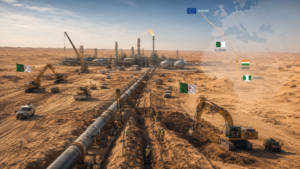
Algeria has officially begun construction of the Algerian section of the Trans-Saharan Gas Pipeline (TSGP), which is intended to connect Nigeria, Niger, and Algeria and provide a new route for natural gas supplies to Europe and other international markets.
According to the Algerian news agency APS, the start of work on the Algerian section marks the project’s transition into the practical implementation phase. The Nigeria–Niger–Algeria gas pipeline is expected to stretch over 4,000 km and is considered one of Africa’s largest energy infrastructure projects.
As noted by the Experts Club information and analytical center, the fifth meeting of the project’s ministerial steering committee took place in Algeria on the eve of the construction launch. Following the meeting, the parties approved the final report of the updated feasibility study, prepared by the international consulting firm Penspen, and agreed to move on to the next stages of the project’s implementation.
The project involves transporting natural gas from Nigeria through Niger to Algeria. From there, the gas can be fed into Algeria’s existing gas transmission system and exported to European and other international markets.
According to Anadolu, citing project documents, the new Algerian section under construction is expected to be approximately 1,210 km long—from the border with Niger to Aoulef, where it will connect to the network leading to the Hassi Rmel gas hub. From there, the gas can be routed to export terminals on the Algerian coast.
The total length of the Trans-Saharan Gas Pipeline is estimated at approximately 4,327 km. Of this, about 1,185 km are to run through Nigeria, 720 km through Niger, and the Algerian section, including both new and existing segments, totals about 2,424 km.
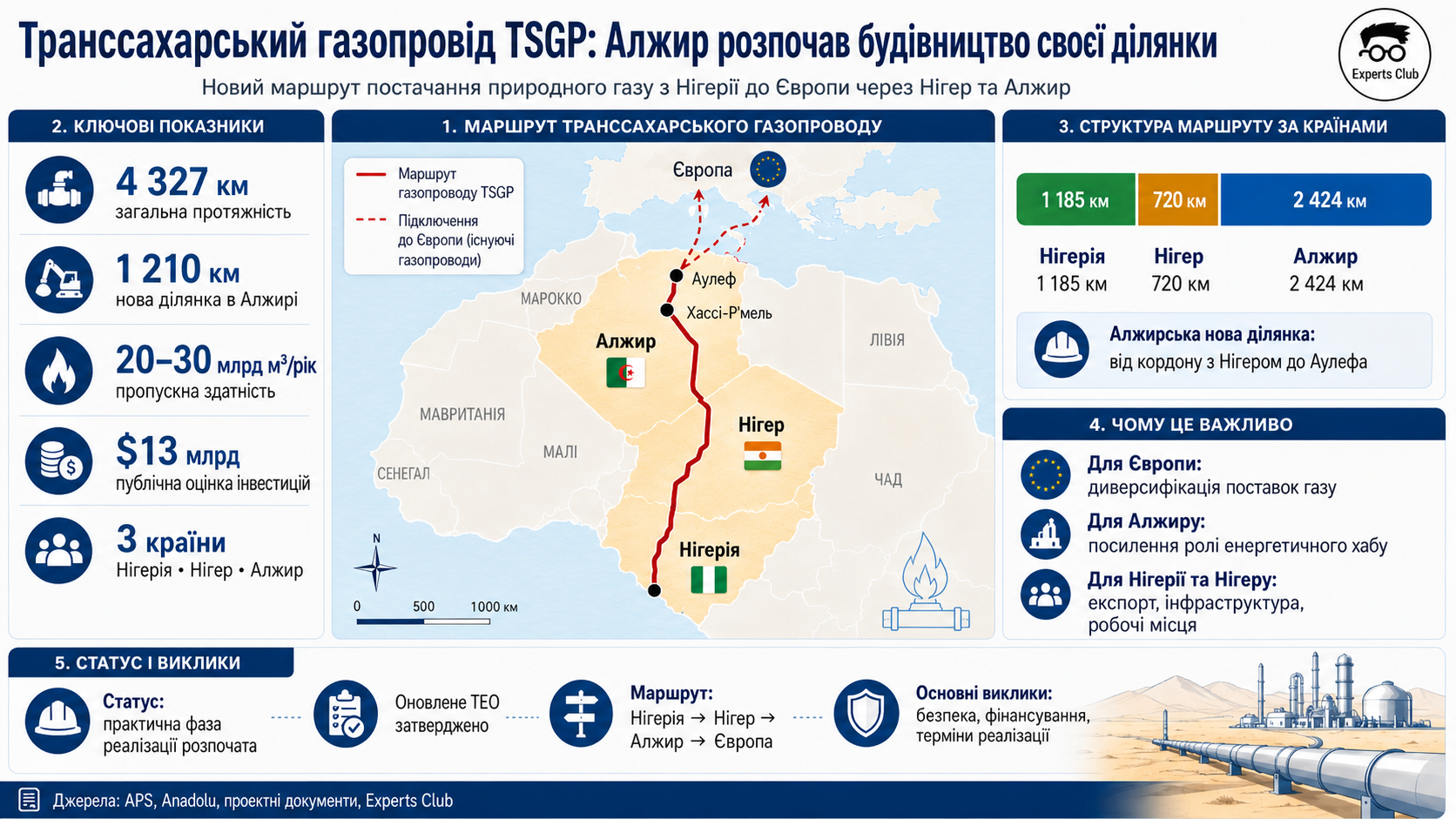
Various estimates put the project’s capacity at over 20 billion cubic meters of gas per year, though earlier figures cited a capacity of up to 30 billion cubic meters. Public estimates previously valued investment in the project at approximately $13 billion; however, updated financing parameters may be refined following the approval of the feasibility study and the transition to practical implementation.
For Europe, the Trans-Saharan gas pipeline could become another potential source of gas supply diversification. Following the onset of the energy crisis and efforts to reduce dependence on Russian gas, the EU has intensified its interest in alternative routes from North Africa, the Eastern Mediterranean, the U.S., and other regions.
For Algeria, the project strengthens the country’s role as one of Europe’s key gas suppliers. Algeria already exports gas to Europe via pipelines to Spain and Italy, as well as through LNG infrastructure. Connecting Nigerian gas to the Algerian system could enhance the country’s significance as an energy hub between Africa and Europe.
For Nigeria and Niger, the project has not only export but also economic significance. The gas pipeline is expected to create new opportunities for monetizing Nigerian gas resources, developing infrastructure, creating jobs, and strengthening Africa’s energy integration.
At the same time, the project remains challenging in terms of security, financing, and implementation timelines. The route spans vast distances and territories with high infrastructure and political risks. Therefore, the actual completion timeline will depend on financing, route security, and coordination among the three countries.
The Trans-Saharan Gas Pipeline has been discussed since the early 2000s as one of Africa’s key energy corridors. The project aims to connect Nigeria’s gas resources with Algeria’s export infrastructure and the European market via Niger.



