

A fully operational set of nut processing equipment is offered for sale—from initial cracking and cleaning to calibration, sorting, and drying of the kernels. The facility is equipped with everything necessary to organize a complete production cycle and may be of interest to both existing processors looking to expand their capacity and entrepreneurs considering launching a turnkey nut processing business.
The cost of the complete equipment set is $27,000.
The core of the production line is a system with a capacity of 60–80 kg per hour, costing $15,000. It includes an impact machine for cracking nuts, a small aspiration unit that removes up to 15% of impurities, a vertical conveyor, a cracking machine with millstones, a large aspiration system for primary cleaning that removes up to 80% of debris and shells, as well as two conveyor sorting tables.
The owner has extended the large conveyor table to facilitate manual sorting of the product. On the small table, nut fragments are separated from the remaining shells.
To increase productivity, the line has been supplemented with a vibrating hopper for uniform feed of raw materials, costing $1,000.
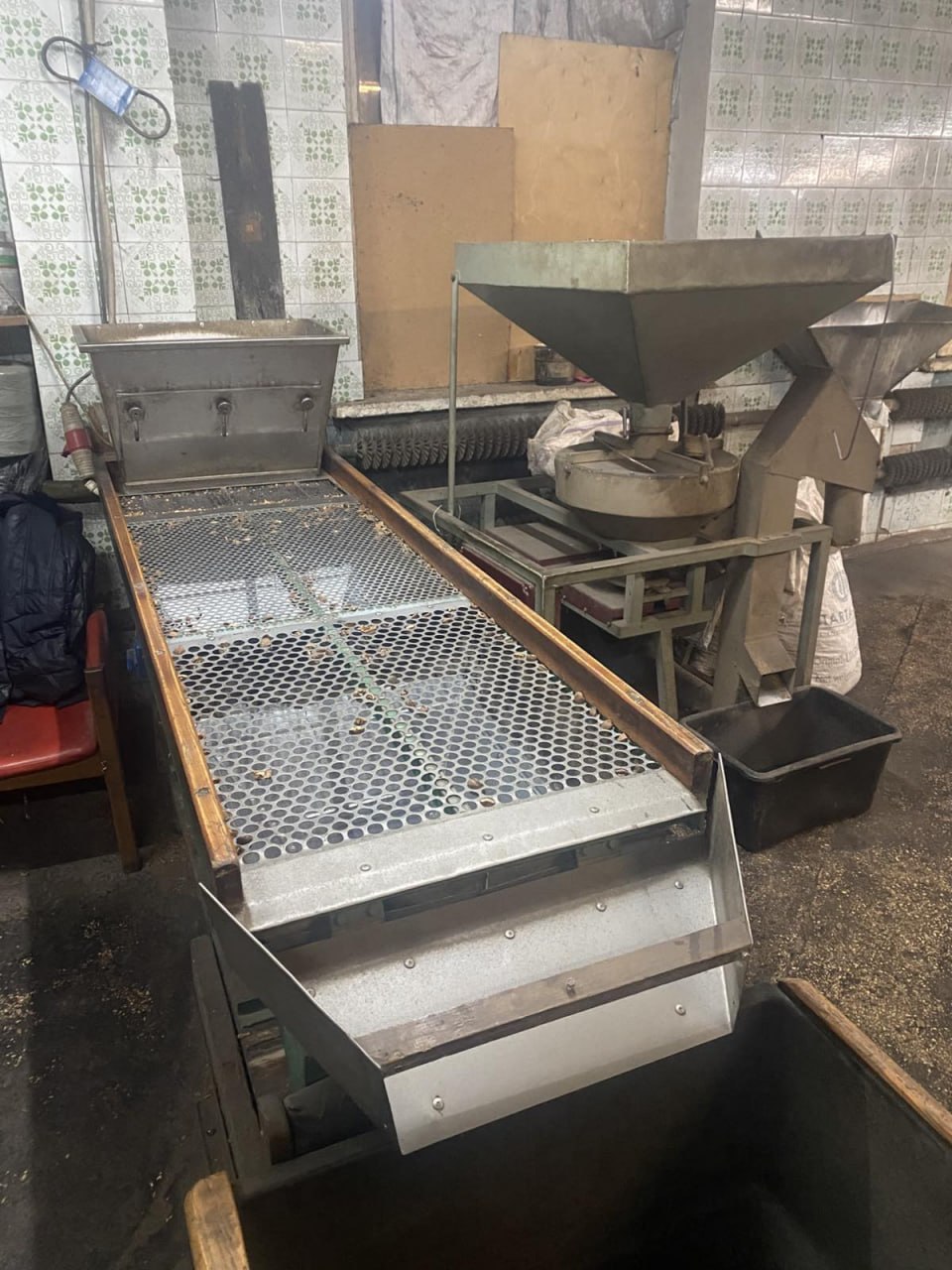
Another unit, costing $1,500, includes a vibrating hopper to separate shells from uncracked nuts and an additional large-capacity dust extraction system. Afterward, the uncracked nuts can be fed to a separate machine for re-cracking, costing $1,000.
For product sorting, the set includes a calibrator with 5 mm, 13 mm, and 19 mm openings—$1,000.
The set also includes a kernel drying unit with a capacity of up to 200 kg per load. The set includes the drying unit itself and a heat gun. The cost of the equipment is $500.
A separate advantage of the complex is a refrigeration unit costing $4,000, which has seen virtually no use and allows for the proper storage of finished kernels and the maintenance of product quality.
For waste processing, there is a machine worth $500 that grinds eggshells into a fine powder. This not only reduces the volume of production waste but also allows the eggshells to be treated as a separate product for further use or sale.
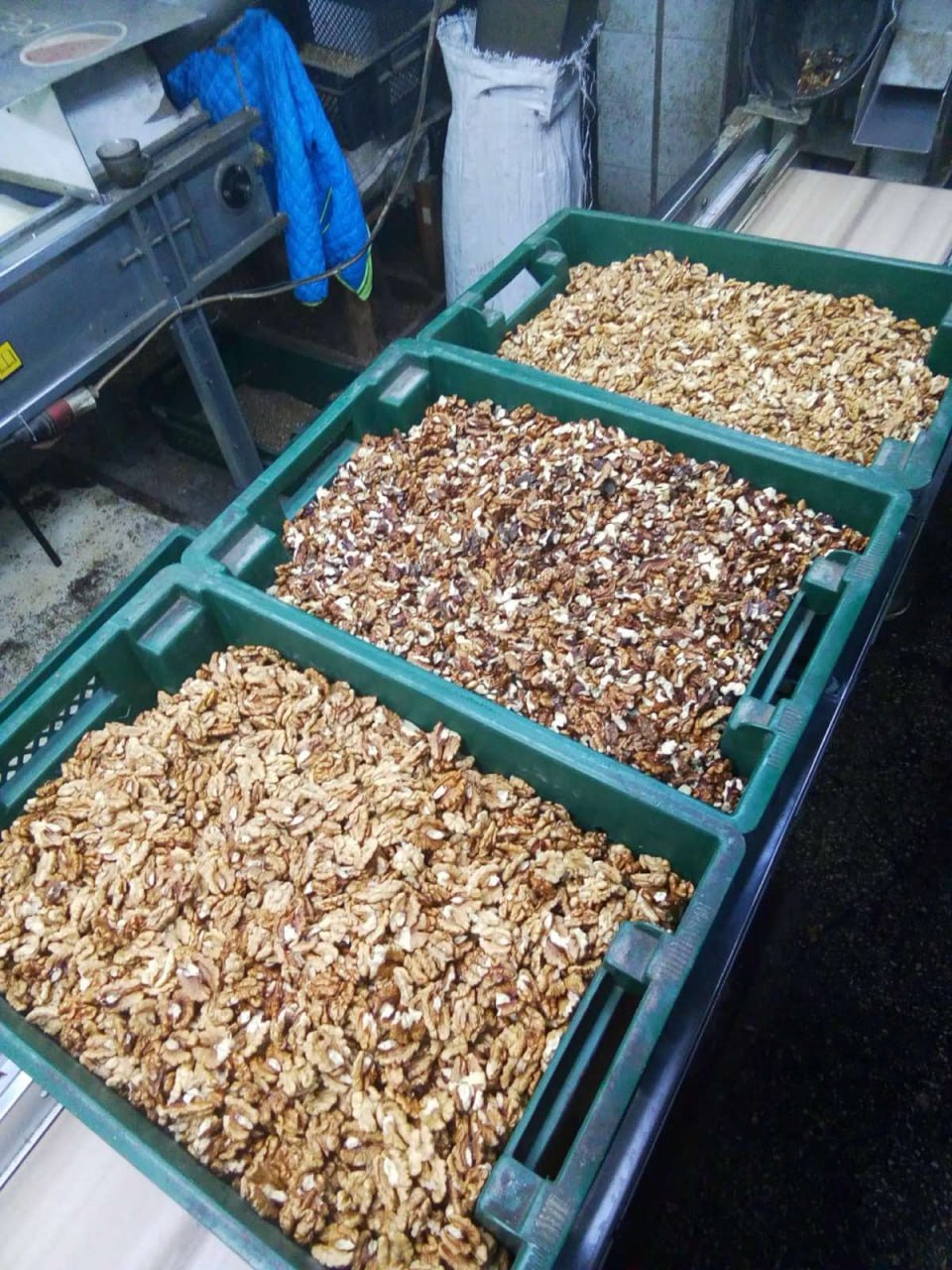
Along with the main equipment, the buyer receives a substantial set of production inventory with a total estimated value of approximately $1,500. This includes two scales, a hydraulic pallet jack, about 150 plastic crates, 40–50 pallets,two containers or devices for transferring products, bags and consumables, ties, lubricants, fasteners, cables, a spare engine for the drying cannon, a capacitor for the calibrator, tools, and other small items necessary for operation.
Additionally, the complex may include a nut dryer for nuts in the shell, valued at $1,000. It is currently located at the supplier’s orchard. This equipment also offers an additional commercial advantage: the supplier uses the dryer and, in return, sells the owner of the complex a harvest of premium-grade nuts. Thus, along with the equipment, it is potentially possible to retain the already established relationships with the raw material supplier.
If necessary, the price can be reduced to $25,500 by excluding the in-shell nut dryer and the shell crusher from the deal. The remaining equipment forms a single production line and is essential for full-scale, streamlined processing.
In fact, the buyer receives not a set of individual machines, but a ready-to-use production line: raw material feed → cracking → aspiration cleaning → re-cracking → sorting → grading → drying → storage of finished kernels.
The complex is suitable for processing your own harvest, purchasing nuts from farms and orchardists, producing kernels for wholesale and retail sales, as well as for the further development of shell processing operations.
The price of the complete complex is $27,000.
Optimized configuration: $25,500.
Main production line capacity: 60–80 kg/hour.
Kernel dryer loading capacity: up to 200 kg.
+380639425723
Dmytro
BUSINESS, EQUIPMENT, MANUFACTURING, NUTS, PROCESSING, PRODUCTION
Life Cycle Assessment (LCA) of buildings is gradually evolving in Europe from a voluntary tool to a mandatory regulatory requirement, changing the approach to design, material selection, and calculating the true cost of a building over its entire service life.
This is discussed in an analytical report by the Ukrainian engineering and construction company Rauta, published on September 20, 2026.
According to data cited by the company from the United Nations Environment Programme’s Global Status Report for Buildings and Construction 2025–2026, the construction and operation of buildings account for nearly 50% of global material extraction and about 37% of global carbon dioxide emissions. This is drawing increased attention from investors and designers not only to the initial construction costs but also to a building’s environmental impact over decades of operation.
LCA assesses the environmental impact of a building or a specific material from the extraction of raw materials through production, transportation, construction, operation, repair, demolition, and final recycling or disposal.
The methodology involves analyzing global warming potential, energy and water consumption, emissions to air, water, and soil, as well as waste generation. In Ukraine, this approach is based, in particular, on the international standards ISO 14040 and ISO 14044 and the European standard EN 15978.
According to Rauta, applying LCA as early as the design stage allows architects and engineers to compare alternative solutions not only in terms of price or thermal insulation performance, but also in terms of their total carbon footprint.
This makes it possible to change materials or structural solutions even before construction begins, when making adjustments to the project is significantly less expensive. LCA can also improve a building’s rating during certification under international systems such as LEED, BREEAM, and DGNB.
Environmental Product Declarations (EPDs), which contain verified data on a specific material’s environmental impact, are a key component of such analysis. Integrating this information into a BIM model allows for the automatic recalculation of the environmental performance metrics for the entire project following design changes.
According to Rauta, LCA calculations utilize both universal software solutions such as SimaPro, Sphera LCA, and openLCA, as well as specialized construction systems like Athena Impact Estimator and Preoptima, along with Revit add-ins such as One Click LCA, Tally, and Beacon.
The application of this methodology also changes the criteria for selecting building materials. Preference is given to solutions with lower embodied carbon, a long service life, the ability to be repaired or replaced without interrupting the building’s operation, as well as the potential for reuse or recycling.
Rauta notes that, based on these criteria, steel load-bearing and enclosure structures can offer a number of advantages due to their lower weight, reduced costs for foundations and transportation, and the ability to recycle steel and reuse metal structures, profiled sheeting, sandwich panels, and facade elements.
Changes in European regulations are becoming a particularly important factor for the Ukrainian construction market.
The EU Directive on the Energy Performance of Buildings (EPBD) (EU) 2024/1275 provides for the gradual introduction of accounting for the total carbon footprint of new buildings throughout their entire life cycle. Starting in 2028, the Global Warming Potential (GWP) must be included in the energy performance certificates for large new buildings with an area exceeding 1,000 square meters, and starting in 2030—for all new buildings.
In Ukraine, there is currently no mandatory requirement to conduct LCA calculations, so the methodology is primarily used in projects involving international clients or funding.
At the same time, Order No. 168 of the Ministry of Community and Territorial Development, dated February 6, 2025, which establishes requirements for nearly zero-energy buildings, lays the groundwork for a gradual transition from assessing energy efficiency alone to a broader life-cycle assessment.
At Rauta, they believe that European integration and post-war reconstruction could serve as additional incentives for the widespread adoption of LCA in Ukraine, as international financial organizations and donors are increasingly focusing on projects that meet European standards for energy efficiency and sustainable construction.
Companies that begin using LCA even before mandatory regulatory requirements are introduced can gain advantages in the form of lower operating costs, better preparedness to attract international financing, and faster adaptation to future European regulations.
A separate tool is Life Cycle Costing (LCC), which assesses not the environmental impact but the total cost of owning a building over its life cycle. Combining LCA and LCC allows investors to simultaneously evaluate the environmental consequences and long-term financial costs of various design solutions.
Thus, the approach to building assessment is gradually shifting from minimizing initial construction costs to analyzing the total cost and environmental impact over decades of operation.
Original source: Rauta article “How Building Life Cycle Assessment Is Changing the Approach to Design and Material Selection,” published on September 20, 2026. Rauta – Building Life Cycle Assessment

In January–August 2026, Ukraine produced 4.1 million metric tons of raw milk, which is 13% less than in the same period of 2025, according to the Association of Milk Producers (AMP), citing preliminary data from the State Statistics Service.
In January–August, agricultural enterprises accounted for 54% of raw milk production, while private farms accounted for 46%.
In August, private households produced 268,000 metric tons of raw milk, which is 5.2% less than in July and 28% less than in August 2025. From January through August, their production fell by 27% to 1.89 million metric tons.
In August, industrial enterprises produced 275,700 metric tons of raw milk, which is 1.9% less than in July but 2.8% more than in August 2025. In January–August, milk production on commercial dairy farms increased by 5%, to 2.21 million metric tons.
The industrial sector is increasing raw milk production compared to the same period last year, particularly due to growth in the western regions.
“The Rivne region is showing the highest growth rates in raw milk production. Improved efficiency in dairy cattle farming has contributed to increased milk yields in the Chernihiv region. Among the leaders in terms of milk yield growth are the western regions of Lviv, Ternopil, and Ivano-Frankivsk, as well as Chernihiv and Zhytomyr. Meanwhile, the Poltava region remains the leader in raw milk production,” the report states.
In January–August, approximately 55% of the raw milk produced by agricultural enterprises came from five regions: Poltava—318,700 metric tons, Cherkasy—267,800 metric tons, Khmelnytskyi—210,900 metric tons, Chernihiv—208,200 metric tons, and Vinnytsia—199,300 metric tons.
The AVM forecasts an increase in prices for dairy products due to rising transportation costs for delivering them to retail chains as a result of Russian shelling and the lengthening of logistics routes. This could lead to a decline in consumer demand and a decrease in the production of fresh dairy products.

As of September 22, Ukrainian farmers had threshed 7 million hectares, or 61% of the projected area, according to the press service of the Ministry of Agrarian Policy and Food.
The gross harvest of grains and legumes totaled 32.95 million metric tons, with an average yield of 47 ts/ha.
Wheat harvests totaled 25.31 million metric tons from 5.11 million hectares at an average yield of 49.5 centners per hectare, while barley harvests totaled 6.39 million metric tons from 1.48 million hectares at a yield of 43.3 centners per hectare. The harvest of these crops is complete.
Peas were harvested at 812,200 metric tons from an area of 301,900 hectares, with an average yield of 26.9 centners per hectare; millet—62,200 metric tons from 26,900 hectares, with a yield of 23.2 centners per hectare; buckwheat—37,100 metric tons from 26,600 hectares at a yield of 13.9 centners per hectare, and corn—339,800 metric tons from 67,900 hectares at a yield of 50 centners per hectare.
Farmers in the southern and central regions harvested the largest volumes of grain. In the Odesa region, 4.83 million metric tons of grain were harvested from an area of 1.19 million hectares; in the Dnipropetrovsk region, 2.72 million metric tons from 663,300 hectares; and in the Kirovohrad region, 2.43 million metric tons from 561,000 hectares.
The highest average grain yields were recorded in farms in the Khmelnytskyi region (70.6 centners per hectare), the Sumy region (60.6 centners per hectare), and the Kyiv region (55.8 centners per hectare).
More than 6 million metric tons of oilseeds were harvested from approximately 2.4 million hectares. In particular, the rapeseed harvest has been completed, with 3.857 million metric tons harvested from 1.33 million hectares at a yield of 29 centners per hectare.
Sunflower seeds totaled 1.5 million metric tons from 756,200 hectares—or 14% of the projected area—at a yield of 19.8 centners per hectare.
Soybeans totaled 655,400 metric tons from 327,600 hectares—or 21% of the projected area—at a yield of 20 centners per hectare.
Farmers have also begun harvesting sugar beets. 19.3 thousand metric tons have been harvested from an area of 0.45 thousand hectares, with an average yield of 428.9 centners per hectare.

According to Experts.news, Turkish Airlines took first place among European airlines in the regional ranking of the 2026 World Airline Awards by the international organization Skytrax, published on September 18.
Air France took second place among European carriers, and Lufthansa took third. They were followed by Iberia, Virgin Atlantic, Swiss International Air Lines, British Airways, KLM Royal Dutch Airlines, Austrian Airlines, and Finnair.
Thus, the ranking of the top ten European airlines is as follows: Turkish Airlines, Air France, Lufthansa, Iberia, Virgin Atlantic, Swiss, British Airways, KLM, Austrian Airlines, and Finnair.
Skytrax also published separate rankings by European region.
In Western Europe, Air France took first place, Lufthansa second, and Virgin Atlantic third. In Northern Europe, Finnair took the lead, followed by SAS Scandinavian and Icelandair.
In Southern Europe, Turkish Airlines also took first place, Iberia second, and Vueling Airlines third.
In Central Europe, LOT Polish Airlines topped the rankings. Wizz Air took second place, and Croatia Airlines came in third. These carriers are of particular practical importance to Ukrainian passengers, as a significant portion of international flights now operate through airports in neighboring European countries following the closure of Ukraine’s civil airspace.
In Eastern Europe, Latvia’s airBaltic topped the 2026 ranking. Air Serbia came in second, and Georgian Airways took third. Bulgaria Air and Romania’s TAROM also made it into the top five.
The World Airline Awards are based on an international passenger survey. The 2025/2026 survey was conducted from September 2025 through August 2026 and covered more than 300 airlines. Respondents represented over 100 nationalities.
PrivatBank has listed the “Dnipro-Arena” stadium and a training facility in Dnipro for an open auction on the “Prozorro.Sales” platform with a starting price of 140.7 million UAH, excluding VAT, the financial institution’s press service reported.
The auction will take place on October 6 in a three-round English auction format. The security deposit is 7.04 million UAH.
The lot includes a stadium with a total area of 15,950 square meters, a training complex covering 13,060 square meters, and a separate indoor soccer field measuring 7,470 square meters.
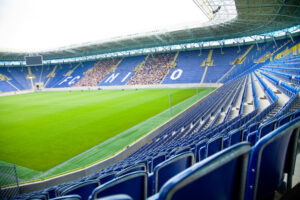
“Dnipro Arena” has a capacity of approximately 31,000 spectators, a VIP box with 296 seats, a restaurant with 550 seats, a 105×68-meter soccer field with underfloor heating and automatic irrigation, and parking lots for buses and cars.
The training complex includes four natural-turf fields, three outdoor fields with artificial turf, an indoor field with stands seating 506 people, a cottage village, a dormitory, a medical and rehabilitation center, a swimming pool, a gym, and other infrastructure.
The land plots on which the facilities are located are municipally owned; PrivatBank uses some of them under lease agreements, and the right to use one plot is currently being formalized.
The transfer of the property to the buyer is contingent upon receiving approval from the Antimonopoly Committee of Ukraine (AMCU) for the concentration or a conclusion that such approval is not required, and upon full payment for the property.
Persons subject to sanctions, associated with jurisdictions posing an unacceptably high risk, or involved in corruption offenses, terrorist financing, or money laundering are not permitted to participate in the auction.
Restrictions also apply to companies with opaque ownership structures in offshore jurisdictions, as well as individuals affiliated with oligarchs, former executives, or owners of PrivatBank.
As previously reported, PrivatBank last attempted to sell this complex in the fall of 2025, but the auction scheduled for October 30 did not take place due to a lack of bids. The starting price was 150 million UAH.
After that, the bank tried to lease out “Dnipro-Arena” and the training facility, but the January 2026 auction also did not take place due to a lack of participants. The starting rent was 2.7 million UAH per month, including VAT.
PrivatBank is Ukraine’s largest bank. According to the National Bank, the financial institution’s total assets as of August 1, 2026, amounted to 979.31 billion UAH (22.7% of the total).



