
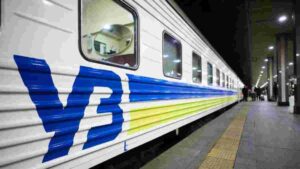
Ukrzaliznytsia, in cooperation with Moldovan authorities, is launching a trial logistics service to Chisinau International Airport—on April 13, the route of Train No. 351 (Kyiv–Chisinau) will be extended to Revaca Station, located near the airport.
According to the company, a free shuttle will be provided for passengers at Revaka Station to transport them to the airport terminal.
Ukrzaliznytsia noted that the test run is intended to demonstrate the feasibility of a stop near the airport, and if there is significant demand, Revaka could become a permanent stop on Train No. 351’s route.
Ukrainians’ attitudes toward Hungary in March 2026 retain a clearly negative character, although the dynamics of recent months indicate a slight improvement in certain indicators. According to the results of a study conducted in March 2026 by the research company Active Group in cooperation with the information and analytical center Experts Club, the share of positive assessments increased to 18.6%, compared to 16.0% in August 2025, while the level of negative attitudes slightly decreased—from 55.7% to 52.2%.
Despite this dynamic, the overall structure of responses demonstrates the dominance of negative evaluations. The largest share consists of respondents who assess their attitude toward Hungary as “mostly negative” — 34.3%, while another 17.9% chose “completely negative.” Thus, the total level of negative perception exceeds half of all responses.
Positive assessments remain significantly lower: only 4.9% of respondents chose the option “completely positive,” and 13.8% selected “mostly positive.” At the same time, 27.3% of Ukrainians hold a neutral position, indicating the presence of an audience segment that does not have a formed or clearly expressed attitude toward this country. Another 1.9% of respondents were unable to provide an answer.
A comparison with August 2025 shows that the changes are evolutionary rather than radical in nature. The increase in positive assessments and the decrease in negative ones are relatively minor, indicating the persistence of a formed negative image of Hungary in Ukrainian society. At the same time, the trend toward improvement may indicate a gradual softening of perceptions or the influence of certain factors that are changing the information background.
An important feature is that even with some growth in positive sentiment, Hungary remains one of the few countries where negative assessments significantly outweigh positive ones. This distinguishes it from most other states in the region, where the balance is either positive or at least close to neutral.
At the same time, the presence of a significant share of neutral responses—more than a quarter of respondents—indicates potential for a shift in public opinion. A portion of Ukrainians does not have a clearly formed attitude, which creates opportunities for improving the country’s image through more active communication, economic cooperation, and public diplomacy.

“We conducted the survey at the beginning of March, and it is already evident that the political context surrounding certain countries can quickly influence evaluations. In the case of Hungary, this factor remains decisive in shaping negative perception. At the same time, even a slight increase in positive sentiment shows that these assessments are not entirely static,” said Oleksandr Pozniy, Director of the research company Active Group.
Thus, the results of the study demonstrate that Hungary is currently perceived by Ukrainians as a country with a predominantly negative image that has a systemic nature. Despite minor positive shifts, the balance of evaluations remains significantly tilted toward critical perception, which defines the specifics of public opinion regarding this state.
According to a study conducted by the Experts Club information and analytical center based on data from the State Customs Service, Hungary ranks ninth in terms of total trade in goods with Ukraine, with a figure of $3.30 billion. Imports of Hungarian goods exceed Ukrainian exports, creating a negative balance for Ukraine.
The study was presented at the Interfax-Ukraine press center; the video can be viewed on the agency’s YouTube channel. The full version of the study can be found via a link on the Experts Club analytical center’s website.
ACTIVE GROUP, EXPERTS CLUB, HUNGARY, Pozniy, SOCIOLOGY, SURVEY, UKRAINE, URAKIN

Prices for construction and installation work (CIW) in Ukraine rose by 7.2% in February 2026 compared to February 2025, according to the State Statistics Service (SSS).
According to the statistical agency, in February 2026, compared to February 2025, prices rose across all construction segments: in residential construction by 6.7% (up 1.6% from the previous month), in non-residential construction by 7.7% (2.1%), and in civil engineering by 7% (1.6%). In January–February of this year, compared to the same period last year, prices for construction work rose by 6.5%, specifically in the residential sector by 6.1%, in the non-residential sector by 6.9%, and in civil engineering by 6.4%.
As reported, in 2025, prices for construction and installation work rose by 5.8% compared to the previous year, in 2024 by 7.9%, and in 2023 by 15.8%.

Ukrainians’ attitudes towards Serbia in March 2026 show a moderate increase in positive views against a backdrop of declining negative perceptions; however, the overall picture remains mixed. The proportion of positive attitudes rose to 21.7% compared to 13.7% in August 2025, whilst negative attitudes fell from 26.0% to 19.6%. This is evidenced by the results of a public opinion poll conducted in March 2026 by the research company Active Group in collaboration with the Experts Club information and analytical centre.
Despite these changes, neutrality remains the key characteristic of perceptions of Serbia: 55.0% of respondents do not have a clearly formed attitude towards this country. This indicates the absence of a stable image of Serbia in Ukrainian society and a significant degree of uncertainty regarding the perception of its role in the international context.
The breakdown of responses shows that the positive perception is formed mainly through moderate assessments: only 5.6% of respondents chose the ‘entirely positive’ option, whilst 16.1% selected ‘mostly positive’. At the same time, negative assessments also carry significant weight: 16.3% of respondents expressed a ‘mostly negative’ attitude, and a further 3.3% — ‘completely negative’. The proportion of those who were unable to decide on an answer stands at 3.7%.
The trend indicates a certain softening of attitudes towards Serbia: an increase in positive views is accompanied by a simultaneous decrease in negative ones. At the same time, these changes have not led to the formation of a clearly positive image of the country, as neutral assessments remain dominant.
In a broader context, this means that Serbia is perceived by Ukrainians as a country with an ambiguous position in international affairs. It does not provoke a sharply negative reaction, yet it is not associated with unconditional support for Ukraine, which limits the level of trust and emotional attachment.
‘The results for Serbia show that Ukrainian society reacts quite sensitively to the foreign policy behaviour of countries. The rise in positive assessments indicates a certain softening of perception, yet the high level of neutrality means that the country’s image remains ambiguous. In such cases, consistency in actions and signals plays a key role in building trust at the societal level,” noted Maksym Urakin, founder of the Experts Club information and analytical centre.
At the same time, he added that over the past year, Ukrainians’ attitudes towards Serbia have improved significantly, not least due to the activities of the Republic’s embassy, led by Ambassador Extraordinary and Plenipotentiary Andon Sapundži.
“The Serbian mission’s active involvement, led by the new ambassador, in humanitarian initiatives and the establishment of intergovernmental dialogue has undoubtedly had a positive impact on Ukrainians’ attitudes towards this Balkan state compared to last year’s figures,” added Urakin.

Thus, attitudes towards Serbia can be characterised as transitional: they demonstrate positive momentum but have not yet transformed into a stable positive image. Further changes will largely depend on how clear and consistent the country’s position is on issues important to Ukrainian society.
According to a study conducted by the Experts Club information and analytical centre based on data from the State Customs Service, Serbia ranks 40th in terms of total trade in goods with Ukraine, which amounts to $444.1 million. However, imports of Serbian goods exceed Ukrainian exports, resulting in a bilateral trade deficit of $92.9 million.
The study was presented at the Interfax-Ukraine press centre; the video can be viewed on the agency’s YouTube channel. The full version of the study can be found via this link on the Experts Club analytical centre’s website.
ACTIVE GROUP, EXPERTS CLUB, Pozniy, SERBIA, SOCIOLOGY, SURVEYS, UKRAINE, URAKIN

The ceremony to light the Holy Fire took place on Holy Saturday at the Church of the Holy Sepulchre in Jerusalem. The Holy Fire appeared in the cuvulion (a small chapel built above the site of Jesus’ burial) during the prayer of Patriarch Theophilos III of Jerusalem, as happens every year on the eve of Easter according to the Julian and New Julian calendars. The descent of the fire was accompanied by cheers from the approximately one thousand people present in the church, to whom the Patriarch handed the holy relic after the ceremony.
The faithful lit candles from the Holy Fire, mostly in traditional bundles of 33 to symbolise Christ’s age, after which they shared the holy relic with hundreds of Christians gathered outside the church.
There is a widespread tradition in the Orthodox tradition associated with the Holy Fire: it is believed that its annual descent is a sign of God’s mercy, and if the fire were ever to fail to descend, this would be seen as a harbinger of great upheavals and the end of the world.

JSC Ukrzaliznytsia held limited negotiations from April 1 to 8 with members of the ad hoc group (AHG) of holders of its Eurobonds with a face value of $1.055 billion, during which it presented its proposal for their restructuring, but so far without success.
“…the bondholders noted that, although they support a consensual restructuring of the bonds, they do not wish to participate in Ukrzaliznytsia’s proposal and have not submitted a counterproposal at this stage,” the company said in a statement on Friday.
It is noted that the group of bondholders decided not to seek an extension of the limited negotiations after the expiration of the specified period.
“Although Ukrzaliznytsia and the holders of restricted-rights bonds did not reach an agreement on the terms of the bond restructuring during the limited period, Ukrzaliznytsia intends to continue good-faith cooperation with AHG, in particular through the parties’ respective advisors, with the aim of reaching an agreement,” the statement noted.
According to the statement, Ukrzaliznytsia was joined by its legal advisors Clifford Chance LLP and Sayenko Kharenko, as well as its financial advisors Rothschild & Cie and FinPoint LLC, while the holders of restricted-rights bonds were joined by AHG’s legal advisors Hogan Lovells International LLP.
As stated in the restructuring presentation, Ukrzaliznytsia proposed writing off 20% of the principal amount, deferring the final repayment of the Eurobonds until June 2033, and beginning their soft amortization starting in December 2030—in six equal installments of $150 million.
At the same time, the company additionally wants to link the amount of these payments to the volume of freight traffic. “Each individual payment of $150 million may be adjusted upward or downward within the range of $112–168 million depending on the volume of freight traffic,” the presentation notes.
As for interest, in the first year (from June 2026 to June 2027), it was proposed to pay only 1.5% in cash; in the second year, 2%; in the third, 4%; in the fourth, 6%; and in the last three years, 7.75% each.
As for overdue interest, which will amount to $83 million as of June 30 of this year, Ukrzaliznytsia would also like to write off 20% of this amount, and of the remaining $67 million, pay 20% in cash—or 1.3 cents per dollar of face value—and capitalize the rest into a new instrument.
If this proposal is accepted, the company would pay only $20 million and $16 million in cash on the Eurobonds this year and next year, respectively, while in 2028 – $77 million, in 2029 – $121 million, in 2030 – $240 million, $389 million in 2031, $434 million in 2032, and $155 million in 2033.
As reported, in January 2025, Ukrzaliznytsia capitalized the coupon payments on the 2026 Eurobonds with a rate of 8.25% totaling $108.28 million, and on the 2028 Eurobonds with a 7.875% coupon rate totaling $51.9 million. This increased the outstanding amounts of these issues to $703.2 million and $351.9 million, respectively.
In January of this year, the company defaulted on $45 million in coupon payments on the 2026 and 2028 Eurobonds, due on January 9 and 15, respectively, and announced its intention to initiate a comprehensive restructuring of its financial obligations under the credit agreements related to the bonds, with the participation of qualified financial and legal advisors.
The company cited the prolonged decline in freight revenue amid a decrease in freight volumes—which is expected to reach approximately 17% in 2025— as well as an increase in attacks on the railway, the total number of which in 2025 (1,195) exceeded the combined figure for 2023–2024.
In February, the international rating agency Fitch Ratings downgraded the long-term issuer default rating (IDR) of JSC Ukrzaliznytsia to “RD” (Restricted Default) from “C,” and downgraded the long-term ratings of its Eurobonds maturing in 2026 and 2028 to “D” from “C.”
According to the presentation, in 2025, Ukrzaliznytsia saw its revenue decline by 15.6% to $2.189 billion and its EBITDA by 30.2% to $293 million, of which $270 million consisted of budgetary support. The net debt-to-EBITDA ratio rose to 5.2.



