
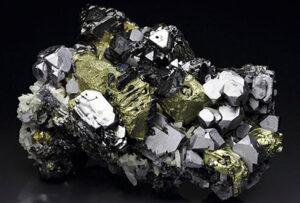
At the same time, Ukraine reduced imports of lead and lead products by 6.2 times in January-February 2026, to $198,000 (in February – $86,000).
Exports of lead and lead products increased by 23.3% to $1,660 thousand (in February – $607 thousand).
In 2025, the country increased imports of lead and lead products by 3.3 times to $7.801 million.
Exports of lead and lead products decreased by 17.8% to $9.377 million.
Lead is currently mainly used in the production of lead-acid batteries for the automotive industry. In addition, lead is used in the manufacture of bullets and certain alloys.

The price of May Brent futures on the London ICE Futures exchange rose by $6.09 (6.62%) to $98.07 per barrel at 7:12 a.m. Earlier during the session, Brent again exceeded $100 per barrel. On Wednesday, the contract rose in price by $4.18 (4.8%) to $91.98 per barrel.
WTI crude oil futures for April delivery on the New York Mercantile Exchange (NYMEX) are currently up $5.29 (6.06%) to $92.54 per barrel. At the end of the previous session, the value of these contracts rose by $3.8 (4.6%) to $87.25 per barrel.
An Iranian underwater drone attacked two oil tankers in the Persian Gulf overnight, Iranian state television IRIB reported. Earlier, a source in the Iraqi security service in Basra told CNN that a ship loaded with explosives rammed into two tankers at once.
CNN specifies that the ships Zefyros, flying the Maltese flag, and Safesea Vishnu, flying the Marshall Islands flag, were on fire. The registered owner of the Safesea Vishnu is the American company Safesea Transport Inc., while the owner of the Zefyros is based in Greece.
Iraq’s oil ports have been suspended following the fire, according to Farhan al-Fartousi, head of the Iraqi Ports Authority. He said one person had died and 38 others had been rescued.
Meanwhile, Oman has ordered ships to leave the Mina al-Fahal export terminal as a precaution, Bloomberg reports, citing informed sources. According to Kpler, about 1 million barrels of oil were exported from the terminal daily.
Earlier, a representative of the Iranian armed forces said that the world should prepare for oil at $200 per barrel, as fuel prices depend on security in the region, and Israel and the US have violated this security with their actions.
“The only thing that could lead to a long-term decline in prices is the resumption of oil supplies through the Strait of Hormuz,” ING analysts wrote. “If this does not happen, we can expect new highs.”
Oil prices rose yesterday, despite the fact that OPEC member countries agreed to supply a record 400 million barrels from their strategic reserves to the world market. The timing of the release of reserves will depend on the circumstances in each individual country. The total strategic oil reserves of IEA member countries exceed 1.2 billion barrels, with another 600 million barrels in state-owned industrial reserves.
“The release of IEA oil reserves may only be a temporary solution, while supply disruptions and significant production cuts in some Middle Eastern countries could cause a long-term supply shortage,” said Tina Teng of Moomoo ANZ.
On Wednesday, it was also reported that commercial oil reserves in the US rose by 3.824 million barrels last week to a maximum of 443.1 million barrels since May 2025. Experts had forecast an average increase of 1.1 million barrels, according to Trading Economics.
Earlier, the Experts Club information and analytical center released a video dedicated to global oil production in 1900–2024 and the leading producing countries.
Brent, EXPERTS CLUB, IRAN, OIL, TANKER

Oilseed production in Ukraine in the 2026-2027 season will show growth due to high margins and the development of domestic processing, according to the information and analytical agency UkrAgroConsult.
Analysts noted that sunflower will remain a priority crop for farmers. At the beginning of 2026, sunflower seed prices approached UAH 30,000/t, which encourages farms to expand their crops. The area under this crop in the new season may increase to 6.1 million hectares.
The soybean and rapeseed markets remain stable. At the same time, domestic processing of these crops is growing in Ukraine, which strengthens the country’s role in the Black Sea region. An increase in gross seed harvest will stimulate plant utilization and further growth in oil and meal exports.
Among the key trends for the 2026/27 season, UkrAgroConsult named the preservation of oilseeds as one of the most profitable segments of agricultural production, with sunflower maintaining its leading position. Analysts also predict an increase in processing capacity utilization and a further increase in exports of processed products amid relative stability in the soybean and rapeseed markets.

In January-February 2026, Ukraine increased imports of nickel and nickel products 2.3 times compared to the same period last year, to $4.518 million (in February – $2.052 million).
Exports of nickel and nickel products amounted to $51,000 (in February – $47,000), while in January-February 2025 they amounted to $33,000.
In addition, in 2025 Ukraine reduced imports of nickel and nickel products by 2.7% compared to 2024 – to $26.011 million.
Exports of nickel and nickel products amounted to $1.420 million, compared to $602 thousand in 2024.
Nickel is used in the production of stainless steel and for nickel plating. Nickel is also used in the production of batteries, in powder metallurgy, and in chemical reagents.

The mayor of Barcelona, Jaume Collboni, has proposed banning citizens of countries outside the European Union from buying second homes in the city, explaining that this is to combat speculative demand amid a protracted housing crisis. This primarily concerns buyers who purchase real estate not for permanent residence but as an investment asset. In February, Collboni himself said that if it were within his power, he would ban British, American, and other non-EU citizens from buying second homes in the Catalan capital.
At the moment, this is only a political initiative and not an adopted norm. At the same time, at the national level, the Spanish government announced in January 2025 its intention to significantly tighten the conditions for purchasing housing for non-residents from countries outside the EU, increasing the tax burden for them to 100% of the property value. This measure also remains a proposal and requires further legislative formalization.
Barcelona’s initiative is part of a broader policy by city authorities to cool the overheated housing market. Earlier, the city had already decided not to renew licenses for short-term tourist rentals, of which there are about 10,101 in Barcelona, after 2028. The authorities explain the tough stance by the fact that over the past ten years, the average rent in the city has increased by 68%, and the cost of purchasing housing by 38%.
According to official data from Idescat, at the beginning of 2025, 1,713,247 people lived in Barcelona, of whom 437,663 were foreigners, or 25.55% of the population. Accordingly, there were about 1.276 million Spanish citizens in the city. At the same time, if we look not at citizenship but at place of birth, according to the city report for 2024, 33.6% of Barcelona’s residents were born outside Spain, and those born directly in Barcelona accounted for only 46.1% of the population.
The largest diasporas in Barcelona by citizenship at the beginning of 2025 were Italian (50,754 people), Colombian (29,574), Pakistani (24,857), Chinese (22,333), Peruvian (22,105), Moroccan (19,300), and French (18,437). The city authorities separately noted that the statistics for Italian citizens also include many people born in Argentina with Italian passports.




