
According to Fixygen, the international payment system Visa has announced the expansion of pre-funding capabilities for cross-border money transfers using stablecoins in the Asia-Pacific region. The program will be implemented through the Visa Direct payment infrastructure.
As the company announced on November 18, 2026, the new mechanism will allow eligible customers to use supported stablecoins to fund international payments, with final recipients receiving funds in their local currency.
Visa’s first partner in the regional pilot program will be the Singapore-based payment company dtcpay.
It is expected that the use of digital assets to pre-fund payments will allow companies to manage liquidity more flexibly and ensure that cross-border transactions can be processed outside standard banking hours.
In the traditional model of international payments, financial institutions often have to pre-fund accounts in various countries to ensure timely execution of transfers.
The use of stablecoins has the potential to reduce dependence on specific time constraints and accelerate the flow of liquidity between financial systems.
At the same time, the payment recipient does not need to purchase or hold cryptocurrency themselves. Settlements on their end will be conducted in fiat currency.
Visa emphasizes that the development of such solutions is aimed at integrating blockchain infrastructure with existing international payment systems.
The new project is a continuation of the company’s previously launched program on the use of digital assets in international settlements.
In 2025, Visa launched pilot projects for pre-funding and payments using stablecoins. In October 2026, the corresponding mechanism went into commercial operation in the U.S. in collaboration with Inyo Global.
Visa now intends to expand the use of this technology to Asian markets, where there is high demand for international payments and cross-border liquidity management services.
The company clarifies that regulated services directly related to digital assets will be provided by independent, licensed partners.
The expansion of Visa’s program reflects the growing interest among major international payment operators in using stablecoins not so much as investment instruments but rather as an element of financial infrastructure.
Visa is one of the largest international payment companies. Its network facilitates payment transactions between consumers, businesses, financial institutions, and government organizations in more than 200 countries and territories.
Japan remains one of the Asian countries with the highest level of positive perception among Ukrainians: in August 2026, 67.7% of respondents viewed it positively, while only 3.3% viewed it negatively. At the same time, compared to the previous wave of the survey, the share of positive assessments has decreased slightly, according to the Experts Club Information and Analytical Center.
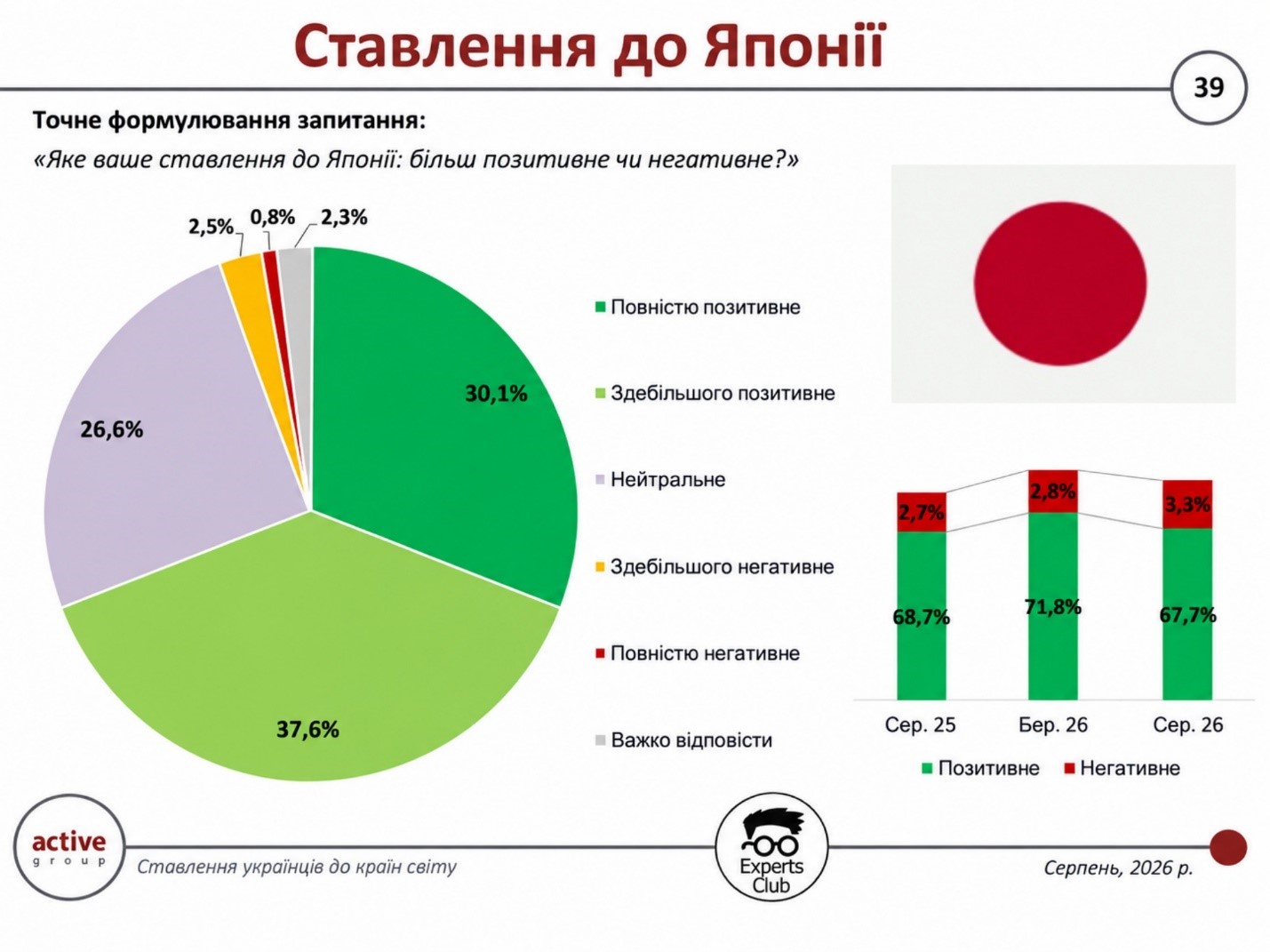
According to the results of the August survey, 30.1% of Ukrainians view Japan entirely positively, and 37.6% view it mostly positively. A neutral stance is held by 26.6% of respondents. 2.5% view the country mostly negatively, 0.8% view it entirely negatively, and another 2.3% were undecided.
The balance between positive and negative assessments stands at plus 64.4 percentage points. Thus, positive attitudes toward Japan outnumber negative ones by more than 20 to 1, and over two-thirds of respondents have a favorable perception of the country.
In March 2026, 71.8% of Ukrainians had a positive attitude toward Japan: 32.9% viewed it entirely positively and 38.9% viewed it mostly positively. A neutral stance was held by 24.2% of respondents, negative attitudes accounted for 2.8%, and another 1.2% were undecided.
Thus, over the course of five months, the share of positive assessments decreased by 4.1 percentage points—from 71.8% to 67.7%. The negative segment increased by only 0.5 percentage points—to 3.3%, while the share of neutral responses rose by 2.4 percentage points—to 26.6%. The balance between positive and negative attitudes decreased from plus 69 to plus 64.4 percentage points, respectively.
These trends primarily indicate a slight decline in the intensity of positive attitudes rather than the emergence of a negative image. The share of entirely positive responses fell from 32.9% to 30.1%, and that of mostly positive responses—from 38.9% to 37.6%. Negative assessments, meanwhile, remain at a very low level.
Oleksandr Pozniy, director of the research firm Active Group, commenting on the results of the previous wave of the survey, emphasized the stability of Japan’s positive image among Ukrainians.
“For Ukrainians, Japan is an example of a country with a high level of trust and a consistently positive image. We see that even without any major news events, perceptions of Japan are gradually improving. This means that a long-term reputation and a consistent policy of cooperation are far more effective than short-term media effects,” Pozniy noted.
The latest round of the survey shows a slight decline in the figures compared to March, but this does not change the overall picture: Japan continues to have a distinctly positive image in Ukrainian society, and negative attitudes toward it remain minimal.
The survey was conducted in August 2026 using self-administered online questionnaires in the SunFlowerSociology panel among 800 Ukrainian citizens aged 18 and older. The previous survey in March also included 800 respondents; the sample was representative by age, gender, and region, with a maximum theoretical margin of error of ±3.5 percentage points at the 50% confidence level.
ACTIVE GROUP, ASIA, EXPERTS CLUB, international relations, JAPAN, PUBLIC OPINION, SOCIOLOGY, UKRAINE

According to Experts Club, Vietnam is showing the highest growth rates in steel production among the world’s top ten countries, as evidenced by data published on September 24 by the World Steel Association.
In August 2026, the country produced approximately 2.7 million metric tons of steel, increasing output by 36.4% compared to August of last year.
From January through August, production reached 20.6 million metric tons, rising by approximately 29% year-over-year. This represents the highest growth rate among the world’s largest producers.
Based on cumulative results, Vietnam is already among the top ten global steel producers, closing in on Brazil in terms of production volume; Brazil produced 21.8 million metric tons over the same eight-month period.
By comparison, the world’s largest producer—China—reduced production by 3.1% to 651.9 million metric tons over the same period, while India increased its output by 6% to 115.9 million metric tons. The United States increased production by 5.5%, Turkey by 6.8%, and Germany by 6.3%.
As a result, the global steel market is becoming increasingly heterogeneous: despite an overall 0.7% decline in production from January through August, certain Asian markets continue to rapidly expand their capacity and production volumes.
The difference is particularly noticeable within Asia. In August, production across the Asia-Pacific region fell by 1.4% due to a decline in output in China, while India and Vietnam continued to grow.
As of the end of August, countries in Asia and Oceania accounted for 106.7 million metric tons of the 144.2 million metric tons of global output, or about 74% of global steel production.

Ukraine is interested not only in developing partnerships with countries in Europe, North America, and the Persian Gulf, but also with other regions of the world, particularly Africa, Asia, and Latin America, stated Ukrainian Foreign Minister Andriy Sibiga.
According to him, Ukraine’s unique defense capabilities and experience in protecting lives are of great interest to many countries around the world. “Countries around the world are watching developments in the Middle East and seeing just how cost-effective and technologically advanced Ukraine’s capabilities are,” Sibiga noted in a post published on social media platform X.
The minister emphasized that years of brutal Russian war have brought immense suffering and destruction to the Ukrainian people, but at the same time have forced Ukraine to develop its own unprecedented strength. Modern Ukraine is a guarantor of security and a reliable partner for those who share its values and seek to protect life from any threats.
“From this new perspective, it is also difficult to understand why any decision-maker in any NATO member country would prefer to have Ukrainian strength outside the Alliance rather than integrated into it,” the minister added.

Against the backdrop of rapid growth in international gold prices, residents of a number of Asian countries really did rush to buy bullion — and in the first half of the day, stores sometimes closed by noon. Vietnamese people in a number of cities lined up at dawn when legislation finally abolished the state monopoly on gold trading.
Meanwhile, the price of gold has already surpassed $4,300 per ounce and continues to hit historic highs.
Growing expectations of a Fed interest rate cut and tensions in US-China relations have pushed investors toward “safe havens” — gold has become a safe asset. Against the backdrop of inflationary pressure and market volatility, the precious metal is once again in the spotlight for investors.
In Australia, at the peak of gold price growth, areas and rivers traditionally used by amateur gold miners (washing gold in river streams) are once again attracting attention. Some people are earning hundreds of dollars in just a few hours. This phenomenon is being covered by the media as a “gold renaissance” not only in the corporate sector, but also among mass investors.
Earlier, the Experts Club analytical center presented an analysis of the world’s leading gold-producing countries in its video on YouTube channel — https://youtube.com/shorts/DWbzJ1e2tJc?si=YuRnDiu7jtfUPBR9
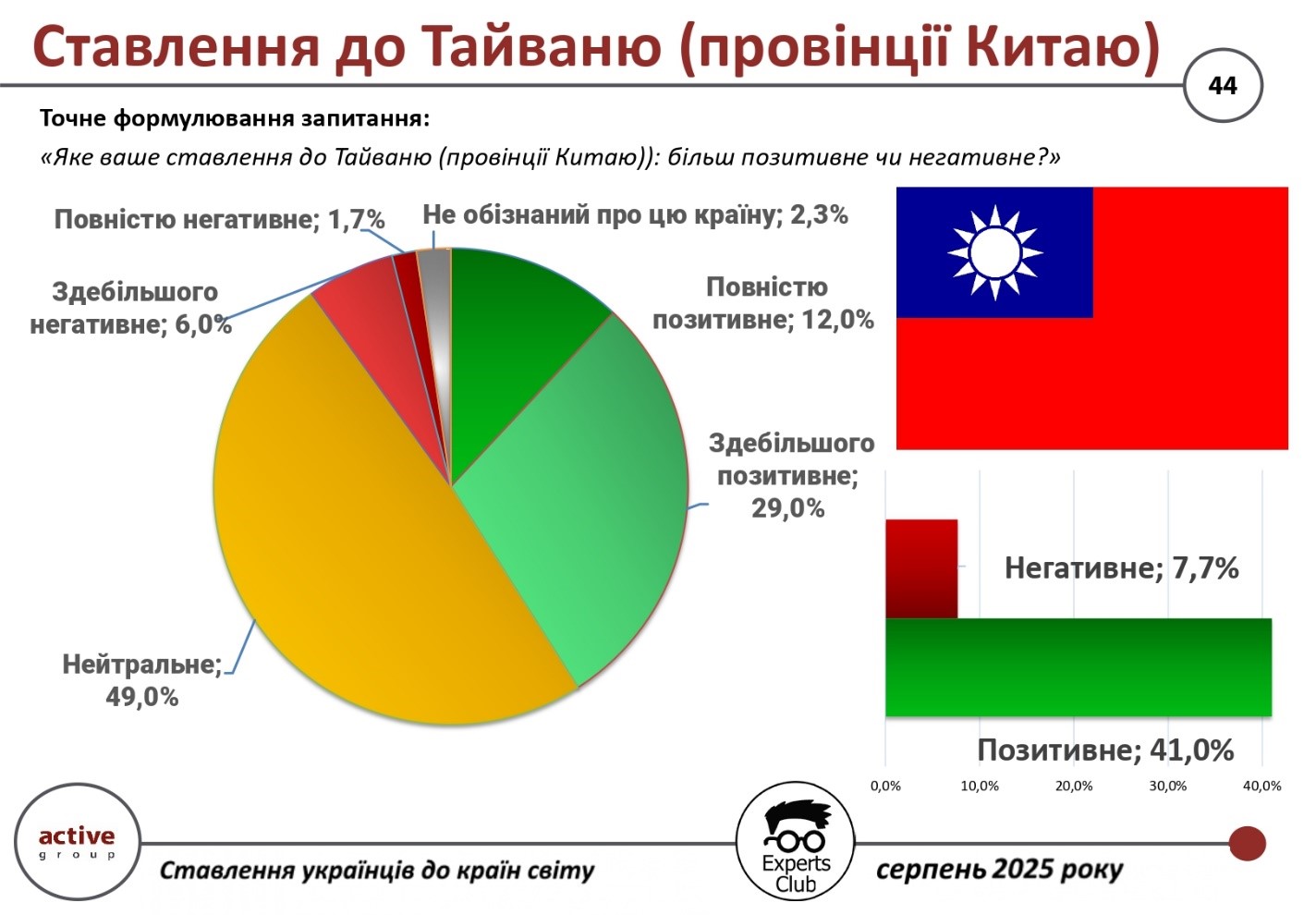
The results of a study conducted by Active Group and Experts Club in August 2025 showed that Ukrainians generally have a favorable attitude toward Taiwan, although a significant portion of respondents remain neutral.
Thus, 41.0% of respondents expressed a positive attitude (12.0% – completely positive, 29.0% – mostly positive). Only 7.7% gave negative assessments, while almost half — 49.0% — took a neutral position, and 2.3% admitted to being insufficiently informed about this country.
“Taiwan is perceived quite evenly in Ukrainian society, without any strong emotions. At the same time, the positive significantly outweighs the negative, which indicates the general open attitude of Ukrainians towards this important player in the global economy,” said Alexander Pozniy, head of Active Group.
Maksim Urakin, founder of Experts Club, noted that there is a significant imbalance in trade and economic relations between Ukraine and Taiwan:
“According to the results of January-August 2025, trade turnover amounted to about $262.1 million. At the same time, exports from Ukraine amounted to only $8.8 million, while imports from Taiwan amounted to more than $253.3 million. As a result, the negative balance exceeded $244.6 million. This indicates the weak representation of Ukrainian goods on the Taiwanese market,” he said.
Thus, Taiwan occupies an important place in Ukraine’s foreign economic relations, but mainly as a supplier of high-tech goods.
The full video can be viewed at: https://www.youtube.com/watch?v=YgC9TPnMoMI&t
You can subscribe to the Experts Club YouTube channel here: https://www.youtube.com/@ExpertsClub
ACTIVE GROUP, ASIA, EXPERTS CLUB, Pozniy, SOCIOLOGY, TAIWAN, TRADE, UKRAINE, УРАКИН



