
The Bulgarian government has proposed significantly tightening the rules for maintaining permanent residency for foreigners, including investors. According to the bill submitted to parliament, permanent residents may be required to be physically present in Bulgaria for at least 183 days during each calendar year.
Bill No. 52-602-01-29, amending the Law on Foreigners of the Republic of Bulgaria, was submitted by the Council of Ministers to the National Assembly on July 28, 2026, according to official data from the Bulgarian parliament.
The bill is currently under review, so the new regulations are not yet in effect.
The main change concerns the distinction between two residency regimes for foreigners.
For holders of EU long-term resident status, it is proposed to maintain the current principle, under which a prolonged continuous absence from the territory of the European Union may serve as grounds for loss of status.
For holders of a Bulgarian permanent residence permit, it is proposed to introduce a significantly stricter national requirement: a foreign national must actually spend more than half the year in Bulgaria.
Thus, if the bill is adopted in its current form, merely holding a Bulgarian permanent residence permit while residing permanently in another country will not be sufficient.
The new rule will affect investors
These changes are of particular significance for foreigners who obtained permanent residence through investment.
Current Bulgarian legislation provides several options for obtaining permanent residence through investment. Specifically, the official government portal lists investments of at least 1 million leva in certain Bulgarian investment funds and a number of other instruments, while a threshold of 2 million leva applies to certain types of securities.
Following Bulgaria’s transition to the euro, the corresponding amounts are converted to the new currency at a fixed exchange rate. The former threshold of 1 million leva corresponds to approximately EUR 511,300, while 2 million leva is equivalent to about EUR 1.02 million.
However, another significant change is taking effect: an investment will no longer automatically allow the holder of permanent residence to live permanently outside Bulgaria.
In the published version of the new requirement, no separate exception is provided for investment residents. This is precisely why the changes could significantly reduce the appeal of the Bulgarian investment program for people who viewed permanent residence primarily as an additional European status rather than as a basis for actually moving to the country.
The new rule potentially applies to a much broader segment than just investors. It may also apply to other foreigners with permanent residence in Bulgaria—including individuals who obtained permanent residence after a long period of residence in the country, certain family members of Bulgarian citizens, and foreigners of Bulgarian origin.
Thus, the proposed changes effectively alter the very concept of permanent residence: the state aims to more closely link the possession of this status to a person’s actual physical presence in the country.
This may prove particularly important for foreigners who hold Bulgarian permanent residence but spend most of the year working or conducting business in other EU countries, the United Kingdom, the United States, CIS countries, or the Middle East.
Investment Thresholds Are Converted from Levs to Euros
The bill also brings the financial requirements of immigration law into line with Bulgaria’s transition to the euro.
Specifically, the previous amounts in levs are replaced by their equivalents in euros.
The threshold of 1 million leva corresponds to approximately EUR 511,000, 2 million leva to about EUR 1.02 million, and 6 million leva to approximately EUR 3.07 million.
This is primarily a technical conversion, so the actual value of the investment requirements does not change significantly as a result of this change.
Permanent Residency Through Investment in Bulgaria Remains in Place; Citizenship-by-Investment Has Been Abolished
It is important to distinguish between the two programs.
Bulgaria previously abandoned the fast-track scheme for direct acquisition of citizenship through investment, which had drawn serious criticism from EU institutions.
However, the investment-based grounds for obtaining a permanent residence permit remain in place. Official government information still lists several types of investments that can serve as grounds for granting a foreigner a permanent residence permit.
It is precisely this program that may now become significantly less “passive”: it will no longer be sufficient for an investor to simply maintain their investment—if the amendments are adopted, they will also have to actually spend a significant portion of the year in Bulgaria.
It is not yet possible to speak of the mandatory 183 days as a rule that has come into effect.
The bill has only just been submitted to parliament and must undergo review by the relevant committees and the parliamentary procedure. The National Assembly currently lists it on its official website as a document submitted by the Council of Ministers, with no information regarding its final adoption.
During the review process, lawmakers may amend the 183-day requirement, add exemptions for certain categories of foreigners, or provide for a transition period for current permanent residents.
Legal experts have specifically pointed out the absence of a clear transition mechanism in the initial draft. Therefore, one of the most important issues to be addressed during parliamentary review will be whether the new requirements will apply to foreigners who obtained permanent residence under the previous rules.

Bulgarian authorities are considering changing the methodology for determining the taxable value of real estate, which could lead to an increase in annual property taxes and transaction costs when buying or selling real estate.
The changes may be included in the 2027 state budget, said Bulgarian MP Yavor Gechev. The legislative framework for implementing the new system is scheduled to be drafted in October–November 2026, after which a special working group will determine the new valuation coefficients. A final decision has not yet been made.
When calculating the taxable value, it is proposed to take into account more accurately the property’s location, type, and technical condition, the year of construction, as well as actual prices on the real estate market. The current methodology has not been revised for many years, so the tax assessment of many apartments and houses is significantly lower than their market value.
According to tax consultant Mykola Ivanchev, a reasonable increase in the tax value could be 20–30%. At the same time, he recommends limiting the increase to 20% to avoid placing an excessive burden on property owners, especially retirees and low-income citizens.
As an example, the expert cited an apartment or house in Sofia with a market value of 150,000–200,000 euros, whose tax assessment is approximately 50,000 euros. At the municipal rate of 2 per mille, the owner currently pays about 100 euros per year. After a 20–30% increase in the assessment, the payment could rise to approximately 120–130 euros.
The reform will affect more than just owners’ annual payments. The tax assessment is used to calculate a portion of local taxes, notary fees, and other costs associated with the purchase or sale of real estate. Therefore, an increase in the assessment will make transactions somewhat more expensive even if municipal rates remain unchanged.
Legal experts suggest that rising costs associated with purchasing and maintaining housing could affect demand. Properties that previously attracted buyers with low taxes and operating costs may become less appealing if mandatory payments increase significantly.
Authorities have long delayed revising the methodology due to the high proportion of homeowners. According to estimates by participants in the discussion, over 90% of Bulgaria’s residents own real estate, so a tax increase could trigger significant public and political backlash.
At the same time, the idea of a higher tax on second and subsequent apartments is being discussed. However, experts consider this difficult to administer: about 8–9% of the population owns multiple properties, and the additional costs for municipalities may prove to be comparable to the expected revenue.
Thus, Bulgaria has not yet made a decision to raise the property tax. At this stage, discussions are focused on updating the tax assessment of properties, with the possible implementation of a new methodology starting in 2027. The actual amount of payments will depend on the approved coefficients and rates set by each municipality.

In January–June of this year, Ukraine increased its exports of carbon steel semi-finished products by 35.8% in volume terms compared to the same period last year—to 766,603 metric tons from 564,683 metric tons.
According to statistics released by the State Customs Service (SCS), 163,183 thousand metric tons of semi-finished products were exported in June, 165,050 thousand metric tons in May, in April—116,550 thousand metric tons, in March—138,203 thousand metric tons, in February—61,629 thousand metric tons, and in January—121,988 thousand metric tons.
In monetary terms, exports of carbon steel semi-finished products during this period increased by 39.6% to $388.650 million. The main export destinations were Bulgaria (36.59% of shipments in monetary terms), Turkey (13.44%), and Poland (12.90%).
In the first six months of 2026, Ukraine imported 40,805 thousand metric tons of semi-finished products worth $26,990 million from Oman (80.71%), the Czech Republic (13.03%), and Germany (4.93%), whereas in January–June 2025, it imported 3,303 thousand metric tons worth $2,687 million.
As reported, in 2025, Ukraine reduced its exports of semi-finished steel products by 26.4% in volume terms compared to the previous year—to 1,388,183 thousand metric tons—while revenue fell by 28.9% to $659.625 million. The main export destinations were Bulgaria (32.73% of shipments in monetary terms), Poland (22.13%), and Turkey (14.88%).
Last year, Ukraine imported 88,923 thousand metric tons of semi-finished products worth $65.989 million, mainly from Oman (37.42%), Germany (22.21%), and the Czech Republic (16.71%), whereas in 2024, it imported 306 metric tons of semi-finished products worth $278 thousand.

Romania, Bulgaria, and Turkey have agreed to expand the mission of the joint Black Sea Mine Countermeasures Task Group by adding the protection of critical infrastructure to its mandate.
The agreement was reached during the NATO summit in Ankara. This involves expanding the authority of the Mine Countermeasures Black Sea Task Group, which had previously focused primarily on locating and neutralizing mines in the Black Sea.
According to Reuters, the new mandate calls for the protection of energy and telecommunications facilities and undersea pipelines owned or operated by the three countries.
The Romanian Ministry of Defense stated that protecting critical infrastructure in the Black Sea requires a comprehensive, integrated, and long-term approach. The ministry also noted that a memorandum establishing the mine countermeasures security group was signed on January 11, 2024, by the defense ministers of Romania, Bulgaria, and Turkey.
The joint group became the first trilateral initiative of its kind among the three NATO countries with access to the Black Sea. Its initial task was to improve the safety of navigation following the appearance of drifting mines in the sea as a result of Russia’s war against Ukraine.
According to Reuters, the group has already neutralized more than 150 mines since its creation. The expansion of its mandate reflects growing concerns among countries in the region regarding the security of maritime infrastructure, particularly against the backdrop of developing gas projects in the Black Sea.
For Ukraine, this decision is of direct importance, as Black Sea security affects shipping, export routes, energy infrastructure, and the overall naval situation in the region. Stronger coordination between Romania, Bulgaria, and Turkey also signals greater NATO focus on the Black Sea region.
BLACK SEA, BULGARIA, DEFENSE, INFRASTRUCTURE, ROMANIA, TURKEY
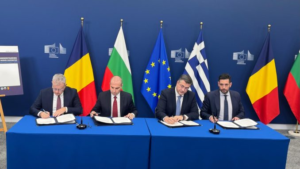
Greece, Bulgaria, and Romania are promoting the construction of the “Black Sea–Aegean Sea” multimodal transport corridor, which is intended to connect the ports, railways, highways, and logistics hubs of the three countries with access to the Ukrainian and Moldovan borders.
The project will become part of the EU’s Trans-European Transport Network (TEN-T). The European Commission notes that the broader “Baltic Sea–Black Sea–Aegean Sea” corridor spans 11 EU countries, as well as Ukraine and Moldova, connecting the Baltic, Black, and Aegean Seas.
The new section between Greece, Bulgaria, and Romania will consist of three main branches. The western branch is planned to run along the route Athens–Thessaloniki–Promachonas–Kulata–Sofia–Vidin/Calafat–Craiova–Bucharest. The central branch will connect Thessaloniki and Alexandroupolis with the Bulgarian cities of Svilengrad and Ruse, then continue through Giurgiu and Bucharest to
Siret on the Romanian border with Ukraine, as well as to Ungheni on the border with Moldova. The Eastern Branch will connect Alexandroupolis with the Bulgarian ports of Burgas and Varna, and then on to Constanța in Romania.
To coordinate the project, the three countries are establishing the Black Sea–Aegean Sea Corridor Platform (BACP). The European Commission reported that Greece, Bulgaria, and Romania signed a memorandum on the development of transport infrastructure on December 3, 2025, in Brussels. The document provides for coordination at the political and technical levels, the exchange of data on national investment plans, and the joint promotion of priority TEN-T projects.
European Commissioner for Transport Apostolos Tzitzikostas called the project a step toward strengthening the strategic north-south corridor in Southeast Europe. According to him, closer cooperation between Greece, Bulgaria, and Romania should strengthen ties for citizens and businesses, as well as enhance Europe’s security, competitiveness, and resilience in the Aegean, Black Sea, and Danube regions.
The project’s significance for the region goes beyond mere transportation modernization. The corridor could provide Ukraine with an additional southern logistics route to ports in the Aegean Sea, Bulgaria, and Romania, as well as strengthen the role of Constanța, Burgas, Varna, Alexandroupoli, and Thessaloniki as hubs for trade, agricultural exports, industrial cargo, and container transport.
For the Balkans, this also represents an opportunity to reduce dependence on overburdened or vulnerable routes. Since the outbreak of full-scale war against Ukraine, the importance of alternative routes via the Danube, the Black Sea, Romania, Bulgaria, and Greece has risen sharply. The central branch to Siret could effectively become an extension of Ukrainian logistics routes to southern Europe.
The project is also important for the military and crisis mobility of the EU and NATO, but its civilian economic value is no less significant. This involves faster transport between the three seas, better connections between ports and railways, reduced logistics costs, and the creation of a sustainable infrastructure for trade between Ukraine, Moldova, the Balkans, Central Europe, and the Mediterranean.
For Ukraine, this represents a potential new route to the Mediterranean; for Romania, Bulgaria, and Greece, it means strengthening their roles as transit countries; and for the entire region, it is a step toward more sustainable logistics between the Baltic Sea, the Black Sea, the Danube, and the Aegean Sea.
Aegean Sea, BACP, BLACK SEA, BULGARIA, GREECE, INFRASTRUCTURE, LOGISTICS, ROMANIA, TEN-T, UKRAINE
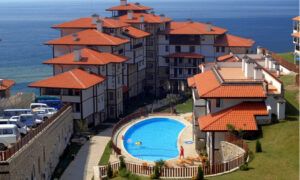
In the first quarter of 2026, the real estate market in neighboring Bulgaria faced a sharp disconnect between rising prices and actual buyer activity: housing prices continue to rise at double-digit rates, but the number of transactions is declining significantly, according to the National Institute of Statistics of Bulgaria.
According to statistics, residential real estate prices in Bulgaria rose by 14.8% year-over-year in the first quarter. In the first three months of the year alone, the national average price increased by another 6.2%. At the same time, the number of transactions involving new and existing homes fell by 18.5% year-over-year and by nearly 20% compared to the previous quarter.
This disparity points to a phase of price overheating: sellers continue to set high price expectations, while buyers are increasingly postponing transactions. The market is influenced by a combination of several factors—expectations following Bulgaria’s transition to the euro, low mortgage rates, rising construction costs, and limited high-quality supply in major cities and along the coast.
Burgas led the price increases, with prices rising 17.7% year-over-year and 5.9% quarter-over-quarter. At the same time, this very market saw one of the sharpest declines in activity: the number of transactions fell by 30.5% year-over-year. This means that demand along the coast has become significantly more price-sensitive.
In Sofia, housing prices rose by 16% year-over-year and by 5.8% quarter-over-quarter. Average prices in the capital settled in the range of 1.8–2.6 thousand euros per square meter. At the same time, the volume of transactions in Sofia fell by 19.2%, and the market’s total transaction value decreased by 7%.
Varna also remained in the double-digit price growth range: housing prices rose by 13.2% year-over-year, but the number of transactions fell by 27.6%. In Stara Zagora, annual price growth stood at 12.7%, though the number of transactions fell by 25%. On a quarterly basis, housing prices in Stara Zagora declined by 2.1%.
Plovdiv appears to be the most stable among the major markets. Prices there rose by 8.8% over the year, while the number of transactions fell by only 0.6%. In monetary terms, the Plovdiv market even grew by 2.4%, making it the most balanced among Bulgaria’s major cities.
For investors, the situation is becoming more challenging. Rapid price growth amid a decline in the number of transactions means that market liquidity is deteriorating: a property may be gaining value on paper, but selling it at the desired price is becoming more difficult. This is especially true for locations where prices have risen faster than household incomes and rental yields.
For a long time, the Bulgarian housing market was supported by relatively affordable mortgages, an influx of foreign buyers, interest in resort real estate, and expectations related to the country’s accession to the eurozone. However, current statistics show that purchasing power is already approaching its limit.



