
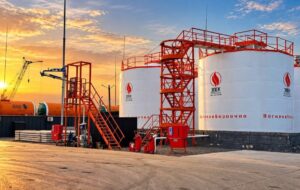
The Western Fuel and Energy Company (ZPEK) has begun supplying Arctic diesel fuel produced by the Finnish company Neste to Ukraine. The volume of the first shipment exceeded 6,000 metric tons, the company reported on November 23, 2026, according to Interfax-Ukraine.
The imported fuel meets the Euro 5 environmental standard and is designed for use at temperatures as low as -37°C. According to the quality certificate, the cloud point of the diesel fuel is -22°C. The company plans to continue supplying Arctic diesel throughout the 2026–2027 winter season.
ZPEK explained the choice of the Finnish manufacturer by citing the experience of the previous winter, when demand for cold-resistant fuel rose significantly in Ukraine due to extremely low temperatures.
According to the A-95 Consulting Group, Ukraine imported a record 260,000 metric tons of Arctic diesel fuel during the winter of 2025–2026. The largest source of supply was the oil refineries of the Polish ORLEN Group in Poland and Lithuania, which accounted for 216,000 metric tons, or about 83% of total imports. Supplies from Finland totaled 13,700 metric tons.
Expanding cooperation with Neste will help diversify the sources of winter diesel fuel for the Ukrainian market. The main consumers of this fuel are transportation, logistics, agricultural, and industrial enterprises, as well as owners of diesel generators.
In January–October 2026, ZPEK imported 285,000 metric tons of diesel fuel, which is 2.5 times higher than the figure for the same period in 2025 and ten times higher than the figure for the corresponding period in 2024.
In addition, by the end of 2026, the company plans to launch its own network of FENIX Energy gas stations. Initially, the network will consist of about 20 locations, as previously stated by ZPEK CEO and co-owner Oleg Chikida in an exclusive interview with the Interfax-Ukraine news agency.
Western Fuel and Energy Company LLC was founded in 2023 by Oleg Chikida and Anastasia Gavrilenko. The company specializes in the import, wholesale trade, storage, and distribution of petroleum products and is developing road, rail, and maritime logistics. The ZPEC Group also includes the fuel importer “Khimzakhid.”
The group’s international partners include ORLEN, UNIMOT, Vitol, and the Polish company Oktan Energy, which operates a marine fuel terminal in Szczecin. As of the end of 2025, ZPEK ranked tenth among the largest importers of diesel fuel in Ukraine with 190,000 metric tons and fifth among suppliers of diesel via rail.
Sources: “Interfax-Ukraine,” interview with Oleg Chikida, Enkorr, NaftoRynok.
The Finnish Immigration Service (Migri) systematically fails to meet statutory deadlines for processing residence permit applications and is also facing substantial backlogs in permanent residence and citizenship applications. The longest delays have been recorded in family reunification cases, the Experts Club information and analytical center reports, citing the findings of an investigation by Finland’s Parliamentary Ombudsman.
According to Deputy Parliamentary Ombudsman Susanna Lindroos-Hovinheimo, approximately 22,000 family reunification residence permit applications have accumulated in the processing queue. Of these, 4,346 have exceeded the statutory nine-month processing period. During 2026, Migri managed to meet the required deadlines in only 61% of such cases, while the number of decisions issued in this category decreased by approximately 20% compared with the previous year.
A particularly difficult situation has emerged with applications for family members of international students. Among pending applications, 3,065, or 55%, had been under consideration for longer than the prescribed three-month period.
Delays also affect permanent residence and Finnish citizenship applications. According to Migri data published in November, approximately 17,300 citizenship applications were awaiting processing. Processing times depend on the application category and the circumstances of each individual case.
The Finnish authorities cite staff shortages, reduced budget funding, and numerous amendments to immigration legislation as the main reasons for the growing backlog. Additional pressure comes from document verification, modernization of information systems, and administrative procedures carried out at diplomatic missions abroad.
To accelerate application processing, the authorities plan to redistribute staff, improve administrative procedures, and expand automation. However, the Parliamentary Ombudsman emphasized that insufficient resources do not exempt government agencies from complying with statutory deadlines. Finland’s Ministry of the Interior and Ministry of Economic Affairs and Employment must report on measures to address the violations by March 1, 2027.
Against the backdrop of these problems, Finland’s permanently resident foreign population continues to grow. According to Statistics Finland, 432,654 foreign citizens lived in the country as of December 31, 2025, representing a 5.2% increase compared with the previous year. Foreign nationals accounted for approximately 7.7% of the country’s population.
At the end of 2025, the country was home to 49,369 Ukrainian citizens, an increase of 19.2% year on year. Their number grew by almost 8,000 people during the year.
Ukrainians overtook Estonian citizens, whose number stood at 48,894 (down 3.1% year on year). Russian citizens remained the third-largest group, with 33,848 people (down 3.8%). They were followed by citizens of the Philippines (17,663), India (16,842), China (16,680), Iraq (12,586), Vietnam (11,311), Bangladesh (10,766), and Sri Lanka (10,329).
However, permanent population statistics do not include all Ukrainians staying in Finland under the EU temporary protection mechanism. According to Statistics Finland, 14,168 permanently resident foreign citizens acquired Finnish citizenship in 2025.
Finland continues to enjoy one of the highest levels of positive perception among Ukrainians: in August 2026, 71.3% of respondents viewed the country positively, while only 2% viewed it negatively. Compared to March, the share of positive assessments has decreased slightly, while the share of neutral responses has increased, according to the Experts Club Information and Analytical Center.
According to the results of the August survey, 34.1% of Ukrainians view Finland entirely positively, and 37.2% view it mostly positively. A neutral stance is held by 25.4% of those surveyed. 1.8% view the country mostly negatively, only 0.2% view it entirely negatively, and another 1.4% were undecided.
The balance between positive and negative assessments stands at plus 69.3 percentage points. Positive attitudes thus outweigh negative ones by more than 35 times, characterizing public perception of Finland as distinctly favorable.
In March 2026, 76.2% of respondents had a positive attitude toward Finland: 38% viewed it entirely positively and 38.2% viewed it mostly positively. A neutral attitude was expressed by 21.4% of respondents, a negative one by about 1.1%, and another 1.2% were undecided.
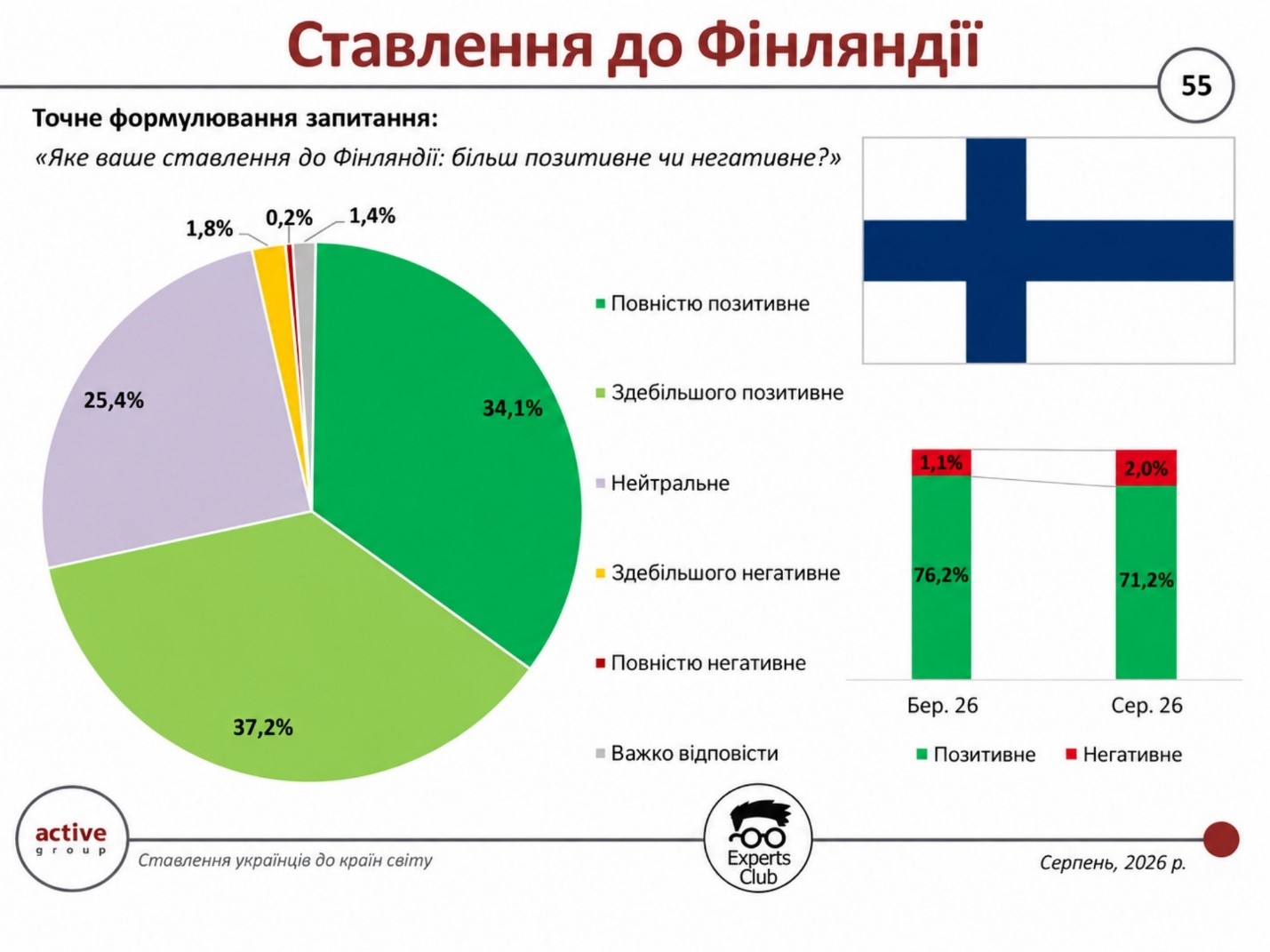
Thus, over the course of five months, the positive segment decreased by 4.9 percentage points—from 76.2% to 71.3%. The share of negative assessments increased by approximately 0.9 percentage points, while neutral responses rose by 4 percentage points. The balance between positive and negative attitudes decreased from plus 75.1 to plus 69.3 percentage points, respectively.
The most notable decline was in the share of respondents with a completely positive attitude—from 38% to 34.1%. The share of mostly positive responses changed much less—from 38.2% to 37.2%. In other words, the bulk of the changes was not due to a shift toward a negative attitude, but rather to an increase in the neutral segment.
Alexander Pozniy, director of the research firm Active Group, previously attributed Finland’s consistently high ratings to the trust and predictability of its image among Ukrainians.
“Ukrainians quite clearly distinguish between countries based on the level of trust and predictability of their policies. Where there is consistency and a clear position, a stable positive attitude is formed. That is why countries like Finland maintain high ratings regardless of short-term fluctuations in the news,” Pozniy noted.
The August wave shows a certain softening of assessments, but no fundamental change in public perception. More than seven out of ten respondents continue to view Finland positively, while the share of negative responses remains at just 2%.
The previous wave of the survey was conducted in March 2026 among 800 Ukrainian citizens aged 18 and older using an online questionnaire. The sample was representative in terms of age, gender, and region.
ACTIVE GROUP, EXPERTS CLUB, FINLAND, international relations, NORTHERN EUROPE, Pozniy, PUBLIC OPINION, SOCIOLOGY, UKRAINE
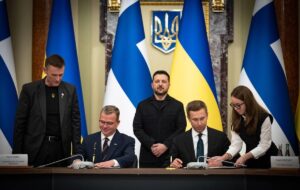
Finland is allocating EUR5 million to support Ukraine’s energy sector and is also donating ten locomotives to assist the country’s railway infrastructure, Prime Minister Petteri Orpo announced.
“Due to Russian attacks on Ukraine’s railway infrastructure, we… are transferring 10 locomotives to Ukraine. We hope they will help keep your society moving while Russia tries to bring it to a halt. We are allocating EUR5 million to the Ukraine Energy Support Fund. This fund complements Finland’s existing support for energy resilience, providing assistance where and when it is needed,” Orpo said at a press conference with Ukrainian President Volodymyr Zelenskyy in Kyiv, according to an Interfax-Ukraine correspondent.
He also announced that Finland will provide Ukraine with mobile heating containers in December, capable of heating medium-sized hospitals or apartment buildings.
Orpo added that Finland is preparing additional support totaling EUR3 million as part of Ukraine’s recovery program and will continue to provide significant support in the form of defense equipment.
“This year, we have provided Ukraine with five defense aid packages totaling over half a billion euros. We are currently preparing 36 packages, and we are doing so in close cooperation with the Ukrainian military. And we intend to make a decision by the end of this year,” he emphasized.

Sweden, Finland, and Estonia plan to lay a telecommunications cable between the three countries along the bottom of the Baltic Sea, the Estonian broadcaster ERR reported on Wednesday.
“The project developer and owner of the future infrastructure is GlobalConnect AB, a telecommunications company registered in Sweden. The same company is organizing the surveys necessary for project preparation,” the report states.
The cable will run along the seabed from the Swedish island of Gotland to the Estonian islands of Saaremaa and Hiiumaa, then connect to the Estonian mainland, and finally continue along the seabed to Helsinki.
“In Estonia, the project involves both submarine and terrestrial fiber-optic communication cables,” Tinu Nirk, head of the Communications Markets Department at the Ministry of Justice and Digital Technologies, told ERR. The total length of the terrestrial cable route in Estonia is expected to be 250 km; undersea connections to Finland,
Sweden, and the major islands will add another 300 km.
Construction of the cable will cost approximately EUR40 million, of which EUR15.7 million will be provided by the European Union’s Cohesion Fund.
Currently, there are two communication lines between Estonia and Sweden, and six between Estonia and Finland. However, various cables and pipes have been damaged at sea on multiple occasions in recent years, so a new alternative connection is needed, Nirk stated.
According to him, demand for data transmission is constantly growing, and the new connection will increase data transmission capacity across networks in the Baltic Sea region.
Preparations for the project began in 2025. Cable laying is scheduled for this year and next, and the connection is set to become operational in 2027.
ESTONIA, FINLAND, INFRASTRUCTURE, SWEDEN, telecommunications
According to Experts Club, Ukrainians’ attitudes toward the United Kingdom, the Scandinavian countries, and the Baltic states remain predominantly positive: in August 2026, the share of positive assessments for the countries included in the study ranged from 66.9% to 72.6%. At the same time, the balance between positive and negative attitudes toward all countries in this group has declined slightly compared to the previous survey wave in March 2026. This is evidenced by the results of a study conducted by Active Group and the Experts Club Information and Analytical Center, reports the Experts Club Information and Analytical Center.
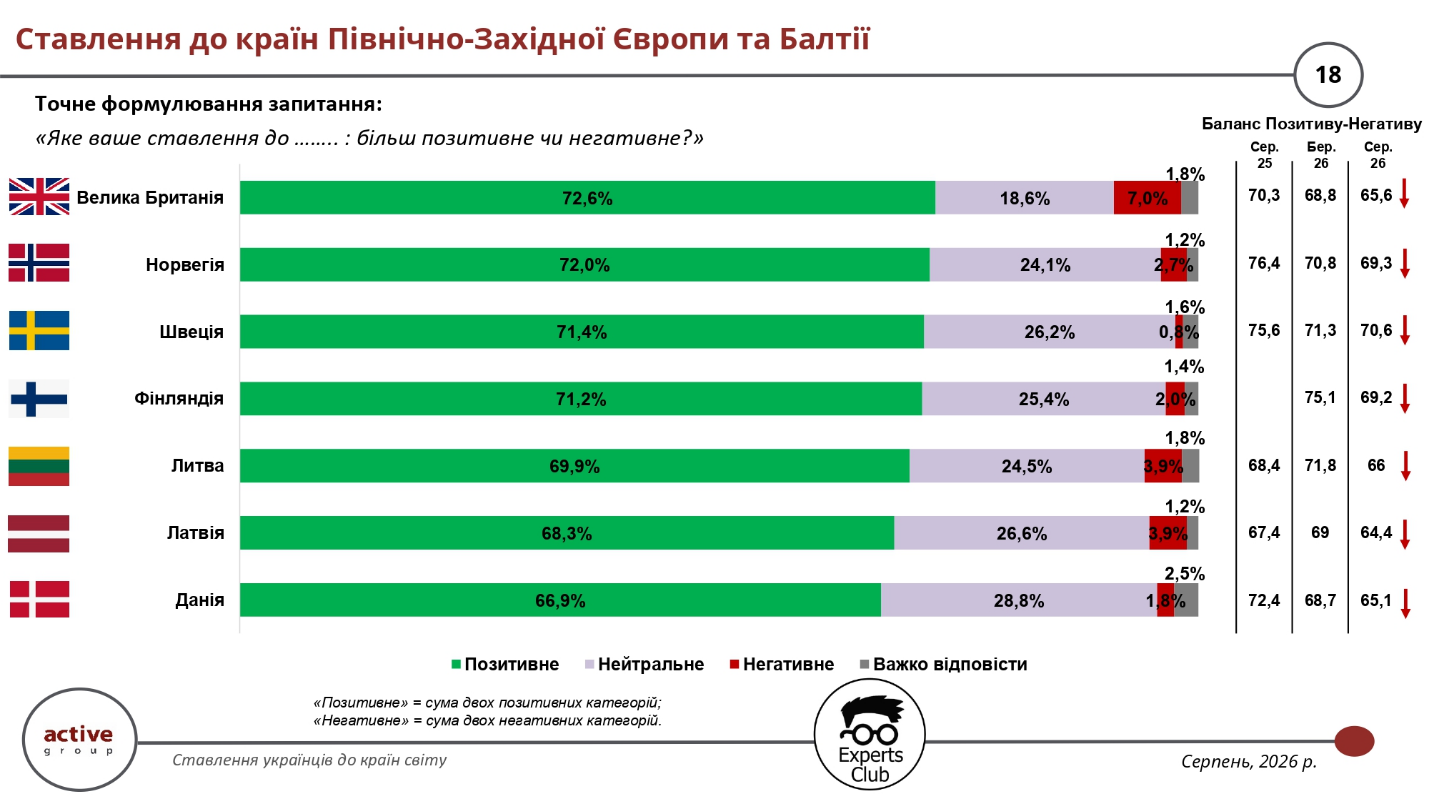
The United Kingdom received the highest share of positive assessments in the group—72.6%. 18.6% of respondents had a neutral attitude toward it, 7% had a negative attitude, and another 1.8% were undecided. The balance of positive and negative assessments stands at 65.6 percentage points, compared to 68.8 percentage points in March 2026 and 70.3 percentage points in August 2025.
Seventy-two percent of Ukrainians view Norway positively, while only 2.7% view it negatively, resulting in a balance of 69.3 percentage points. In March, this balance stood at 70.8 percentage points, and in August of last year, at 76.4 percentage points. Sweden has 71.4% positive and only 0.8% negative assessments—its balance stands at 70.6 percentage points and is the highest among the countries presented on the slide. Overall, the study records approximately 67–73% positive ratings for the countries of Northwestern Europe and the Baltic states.
71.2% of respondents view Finland positively, 25.4% neutrally, and 2% negatively. The balance stands at 69.2 percentage points, down from 75.1 percentage points in March. Lithuania is viewed positively by 69.9% of respondents and negatively by 3.9%; the balance fell from 71.8 percentage points in March to 66 percentage points in August.
A positive attitude toward Latvia was expressed by 68.3% of respondents, a neutral one by 26.6%, and a negative one by 3.9%. Its balance stands at 64.4 percentage points, compared to 69 percentage points in March. For Denmark, the corresponding figures are 66.9% positive, 28.8% neutral, and 1.8% negative assessments, with a balance of 65.1 percentage points, compared to 68.7 percentage points in the previous survey wave.
Maksym Urakin, founder of the Experts Club Information and Analytical Center, deputy director of the Interfax-Ukraine news agency, and candidate of economic sciences, emphasized the importance of constant communication between foreign partners and Ukrainian society.
“The first recommendation is to regularly showcase concrete achievements and concrete actions. Second, be open to questions and inquiries from the media and the public,” Urakin noted. According to him, the results of sociological surveys can be used to strengthen bilateral relations, particularly trade relations.
Alexander Pozniy, director of the research company Active Group, also drew attention to the need to combine public perceptions of countries with the development of practical economic cooperation.
“We should do more than just raise general awareness. We need to expand cooperation with countries where we can maintain a positive balance,” Pozniy noted. He also emphasized the role of business associations and government agencies in developing bilateral economic ties.
Overall, the results show that Northern and Northwestern Europe, along with the Baltic states, continue to enjoy a high level of positive perception among Ukrainians. At the same time, the decline in the balance compared to March 2026 indicates that even regarding countries with traditionally high ratings, public opinion is not static. In the overall ranking, Sweden, Finland, Norway, Lithuania, and the United Kingdom were among the top ten countries with the highest net sentiment.
The survey was conducted in August 2026 using self-administered online questionnaires via the SunFlowerSociology panel. It included 800 Ukrainian citizens aged 18 and older. The sample is representative by age, gender, and region; the stated maximum theoretical margin of error is ±3.5 percentage points. This is the third wave of the study, following surveys conducted in August 2025 and March 2026.
ACTIVE GROUP, DENMARK, EXPERTS CLUB, FINLAND, LATVIA, LITHUANIA, NORWAY, SOCIOLOGY, SWEDEN, UKRAINE, UNITED KINGDOM



