
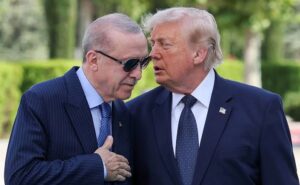
U.S. President Donald Trump said Washington will lift sanctions against Turkey that were imposed because Ankara purchased Russian S-400 air defense missile systems.
“We will lift the sanctions,” Trump told reporters on Tuesday in Ankara, responding to a question about the measures imposed against Turkey under the CAATSA law.
The statement came at the start of Trump’s meeting with Turkish President Recep Tayyip Erdogan on the sidelines of the NATO summit in Ankara.
The U.S. imposed sanctions on Turkey in 2020 after Ankara purchased Russian S-400 air defense systems. Washington also excluded Turkey from the F-35 fighter jet program, stating that the use of Russian systems poses risks to American aircraft.
Trump also said that the U.S. would make a decision regarding the possible sale of F-35s to Turkey. According to Reuters, the U.S. administration is ready to support such a deal, but legal and congressional obstacles have not yet been fully resolved.
For Turkey, the lifting of sanctions and a possible return to the F-35 issue would represent a significant breakthrough in relations with the U.S. This is also a sensitive issue for NATO, as Ankara remains one of the alliance’s key members, but its purchase of Russian S-400 systems in recent years has been one of the main sources of friction in its relations with Washington.
The NATO summit in Ankara is taking place against the backdrop of the alliance’s efforts to demonstrate increased defense spending and strengthened military-industrial cooperation. The meeting between Trump and Erdogan has become one of the summit’s central bilateral meetings, as it concerns not only sanctions but also future deliveries of U.S. weapons to Turkey.
The U.S. dollar is rising modestly against the euro, the pound sterling, and the yen on Tuesday morning amid increased demand for safe-haven assets.
The ICE DXY index, which tracks the dollar’s performance against six currencies (the euro, Swiss franc, yen, Canadian dollar, pound sterling, and Swedish krona), is up 0.1%, while the broader WSJ Dollar Index is up 0.09%.
The U.S. military struck two boats belonging to the Islamic Revolutionary Guard Corps (IRGC) and an anti-aircraft missile system position in Bandar Abbas in southern Iran, Fox News reporter Jennifer Griffin reported.
Meanwhile, U.S. Secretary of State Marco Rubio stated that negotiations with Iran in Qatar are ongoing, though finalizing the wording of the agreement between Washington and Tehran could take several days.
Meanwhile, European Central Bank (ECB) Executive Board member Isabel Schnabel said in an interview with Reuters that the regulator will likely have to raise key interest rates in June, even if the U.S. and Iran manage to sign a peace agreement by then.
“Given the scale and duration of the shock we are seeing, it can no longer be ignored,” she said. “Based on the information available at this time, I believe a rate hike will be necessary in June.”
French Central Bank Governor François Villeroy de Galhau, who will step down at the end of May, told Le Figaro in an interview that the regulator will not hesitate to take measures to curb inflation and bring it back to the 2% target.
As of 9:19 a.m., the euro/dollar pair is trading at $1.1631, compared to $1.1643 at the close of the previous session; the single European currency is down about 0.1%.
The pound fell 0.2% against the dollar to $1.3474, compared to $1.3505 at the close of trading on Monday.
The U.S. dollar rose 0.1% against the yen to 159.06 yen, compared to 158.91 yen at the close of the previous session.
The dollar is stable against the offshore yuan at 6.7875 yuan.

Foreign direct investment (FDI) into China’s economy fell by 10.3% year-over-year in January–April, to 287.69 billion yuan ($42 billion), according to the Ministry of Commerce.
The manufacturing sector attracted 78.9 billion yuan, while the services sector attracted 204.2 billion yuan. Notably, investment in high-tech industries rose by 20.3% to reach 166.3 billion yuan.
Luxembourg more than doubled its FDI (by 110.3%), Switzerland increased it by 60.8%, France by 58.3%, and the U.S. by 24.5%, according to data from the ministry cited by Xinhua News Agency.
In January–April, 20,113 new enterprises with foreign capital were registered in China, which was 6.8% higher than the figure for the same period in 2025.
As reported, FDI for 2025 fell by 9.5% to 747.7 billion yuan.

According to Serbian Economist, Serbian President Aleksandar Vučić published an op-ed for the American television network Fox News, in which he presented Serbia as a country ready for a closer partnership with the US, and stated that Donald Trump’s policies are viewed in Belgrade not as a threat, but as an opportunity for stability and economic development.
In the column, Vučić contrasted the attitude of some European elites toward Trump with the mood in Serbia. He wrote that “contempt” for the America First philosophy has spread from Brussels to Berlin, whereas Serbia sees it as an opportunity for a more pragmatic policy focused on results, security, and economic growth.
Vucic emphasized that Serbia, despite the painful memory of the 1999 NATO bombings, has in recent years become one of the few corners of Europe where sympathy for the U.S. has grown. According to him, reflexive anti-Americanism—which he believes has spread throughout much of Europe—is rarely found in the country today.
Separately, the Serbian president described his experience interacting with Trump and his team during his first presidential term. According to Vučić, his meetings at the White House following difficult negotiations left him with the impression that Serbia’s position was listened to without prejudice or arrogance. He also wrote that the image of Trump as an “aggressive bully” did not match his personal experience of interacting with him.
The column’s key political thesis is that Serbia’s European path should not mean distancing itself from the U.S. Vucic stated that for Belgrade, the path to Brussels “does not require distancing from Washington,” and that Serbia’s special relationship with the U.S. could be an asset for the stability and growth of the entire European continent.
The economic section of the text was built around the idea of Serbia as a modern and strategically important partner for the West. Vučić noted that Serbia is one of Europe’s most dynamic economies, with GDP growth exceeding that of the Eurozone, and is becoming a hub for future technologies—from data centers to supply chains for electric vehicles.
He gave special attention to the lithium agenda. According to the president, Serbia has the second-largest lithium reserves in Europe, and this resource is key to Western industrial independence. Vucic also emphasized that Serbia is not seeking aid, but rather “deals” that secure supply chains, accelerate energy independence, and create jobs.
This is an important signal for the Serbian economy. Belgrade is attempting to position the country not only as an EU candidate and a regional player in the Western Balkans, but also as a potential component of American and European industrial strategy. In this context, lithium, energy, infrastructure, IT, data centers, and manufacturing for the electric vehicle industry are not separate projects but part of Serbia’s broader geo-economic agenda.
Vucic also effectively urged Washington to reconsider its view of the region. He stated that it is time for the U.S. to stop viewing the Balkans through the lens of the 1990s and to pay attention to Serbia as the largest economy in the Western Balkans, an “anchor of stability,” and a country that remembers its friends.
The most striking part of the column was the invitation to Trump to visit Belgrade. Vucic noted that no American president has visited the Serbian capital in over half a century since Richard Nixon’s visit in 1970, and stated that if Trump were to come to Belgrade, he would receive “a welcome the likes of which Europe hasn’t seen since Nixon.”

The average price of a single-family home in the U.S. resale market exceeded $400,000 in the first quarter of 2026, despite weak demand and reduced mortgage availability, according to data from the National Association of Realtors (NAR).
According to NAR, the median price of an existing single-family home in the U.S. rose by 0.5% year-over-year to $404,300. Price increases were recorded in 71% of urban markets, or in 167 of the 235 metropolitan areas tracked. At the same time, the pace of price increases has slowed: in the fourth quarter of 2025, annual growth stood at 1.2%.
Regional trends remain mixed. In the Northeast, the median price reached $506,500, up 4.9% over the year. In the Midwest, homes cost an average of $308,100, with a 3.6% increase. In the South, prices remained virtually unchanged at $362,300, while in the West, the most expensive region, they fell by 2.9% to $607,600.
The rise in single-family home prices is occurring against a backdrop of weak buyer activity. According to NAR, existing home sales in March 2026 fell by 3.6% from the previous month, with declines recorded in all regions. NAR Chief Economist Lawrence Yun noted that the market remains sluggish due to declining consumer confidence and weaker job growth.
High mortgage rates remain one of the main constraints on demand. Even with slowing price growth, buying a home is becoming less affordable for many American families: monthly mortgage payments remain high, and sellers are in no hurry to lower prices due to limited supply of quality housing.
The new-home market, however, looks softer. According to data from the U.S. Census Bureau and the Department of Housing and Urban Development, the median price of a new home sold in March 2026 was $387,400, down 6.2% year-over-year. This is due to a high inventory of new homes on the market and developers’ efforts to stimulate demand.
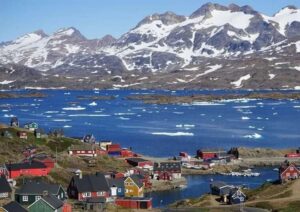
The potential cost of a hypothetical deal on the purchase of Greenland by the United States could be up to $700 billion, a number of media outlets reported, citing NBC News. The publications claim that the assessment was prepared by experts and former U.S. officials, and U.S. Secretary of State Marco Rubio was allegedly tasked to draft a proposal for the purchase of the island in the coming weeks.
At the same time, it is emphasized that this is not an official price position of the US government, but a calculation within the framework of discussions around the initiative of President Donald Trump. According to NBC News’ retelling of the story, the $700 billion amount is comparable to more than half of the Pentagon’s annual budget, illustrating the scale of the financial and political hurdles to any such “deal.”
The reaction from Copenhagen and Nuuk remains negative. Denmark and Greenland authorities have publicly stated that the island is not for sale and that the issue of the autonomous territory’s status is related to sovereignty and the right to self-determination. Reuters reported this week that after a meeting in Washington between Rubio and U.S. Vice President J.D. Vance, the Danish and Greenlandic sides, while not changing their “no-sale” position, agreed to set up a working group to discuss a wide range of issues related to security and cooperation around the island.
The new $700 billion estimate falls in line with a number of previous, highly divergent “paper” estimates that have appeared in recent years. For example, The Washington Post in 2019 within the hypothetical valuation called a very wide range of possible price – from hundreds of millions of dollars to $1.7 trillion.
U.S. interest in Greenland is usually explained by a combination of security and resource factors. The island occupies a key position in the Arctic and North Atlantic, and is also seen as a potentially significant territory in terms of access to minerals and strategic infrastructure.
At the same time, even if there is political will in Washington, the “purchase” scenario is constrained by basic legal and political limitations: Greenland is an autonomous territory within the Kingdom of Denmark, and its status and future, according to the position of local and Danish authorities, cannot be subject to external “bargaining”. Against this background, analysts call the most realistic continuation of the plot not a change of sovereignty, but bargaining around increased U.S. cooperation with Denmark and Greenland – on defense, infrastructure and investment – without formally changing the island’s status.



