
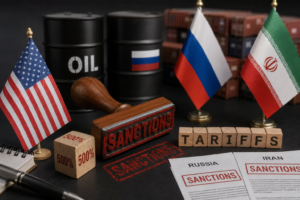
The US Senate on Friday approved the Lindsey O. Graham Sanctioning Russia and Iran Act of 2026, which significantly expands sanctions pressure on the Russian energy sector and gives the US president the authority to impose tariffs of up to 500% on imports of Russian goods.
The bill was supported by 86 senators, with 11 voting against it, the New York Post reports. The bill must now pass the House of Representatives, which will return from its summer recess on August 31, after which it must be signed by the US president. Until then, the new sanctions and tariffs will not take effect.
The bill is a revised version of a sanctions initiative that Congress has been discussing since 2025. The original version did indeed provide for 500% tariffs for virtually all countries purchasing Russian oil, gas and uranium. In the final Senate version, this mechanism was significantly narrowed.
500% — Directly on Russian Goods
If the law takes effect, the US president will be required within 30 days to receive the authority to raise tariffs on all goods of Russian origin imported into the United States to 500% of their value.
The text specifically lists oil, natural gas, LNG, petroleum products, petrochemical products, coal and other Russian goods.
Moreover, these tariffs will be imposed in addition to existing US tariffs, anti-dumping duties and other charges.
In practice, a 500% tariff effectively makes most direct Russian exports to the United States commercially meaningless.
For example, with a customs value of $1 million, the additional tariff could theoretically reach $5 million.
However, the significance of this mechanism for Russian exports is limited by the fact that direct trade between Russia and the United States has already declined substantially following the introduction of previous sanctions.
The second mechanism — the so-called secondary tariffs — could prove considerably more significant for global trade.
The president will be able to impose tariffs of up to 100% on all goods imported into the United States from countries that rank among the five largest purchasers of Russian oil or natural gas.
For a country to fall under this mechanism, it must continue making new purchases of Russian commodities 30 days after the law takes effect and simultaneously rank among the top five importers by volume over the previous 12 months.
China and India are primarily at potential risk. Reuters notes that, depending on the structure of supplies, certain European countries and Japan could also be included in the relevant list. The law itself does not name specific countries in advance.
This means that the tariff would not apply to the Russian oil purchased, for example, by India, but potentially to all Indian exports to the United States.
This is precisely why the mechanism is a significantly more serious instrument of pressure than conventional sanctions against Russian companies.
In simple terms, a country is given a choice — continue large-scale purchases of Russian energy and risk access for its goods to the US market, or reduce imports from Russia.
Separately, the law allows tariffs of up to 100% to be imposed against the five largest countries that, according to the US assessment, facilitate the circumvention of sanctions on Russian oil.
Thus, the sanctions mechanism applies not only to buyers of Russian commodities, but also to countries through which schemes involving their resale, transportation or concealment of origin may operate.
In addition, the bill provides for additional sanctions against Russia’s “shadow fleet” — tankers and companies associated with them that are used to transport Russian energy resources in circumvention of Western restrictions.
US authorities will be required to review the list of the largest buyers and potential violators every 180 days, meaning that the composition of countries at risk may change along with trade flows.
The bill includes a provision for countries importing Russian natural gas.
Tariffs may not be applied if the respective country accounts for less than 15% of Russia’s total natural gas exports and simultaneously takes substantial steps to reduce its dependence on Russian gas.
This provision is particularly important for European countries that still receive some Russian gas but are gradually reducing their purchases.
The widely circulated claim about additional 100% tariffs on the largest buyers of Russian uranium does not correspond to the current version of the bill. In the original version, uranium did indeed feature in the mechanism of 500% secondary tariffs. However, following negotiations with the White House, this mechanism was changed.
In the current document, Russian uranium is regulated separately.
The law requires the implementation of restrictions on imports of Russian uranium into the United States and provides for sanctions against the leadership, management and controlling shareholders of Rosatom and entities associated with it.
Tariffs Are Only One Part of the Package
The law provides for mandatory sanctions against Russia’s top political and military leadership, a number of major Russian financial institutions, state-owned companies and foreign persons supporting the Russian military-industrial complex.
The official overview of the bill specifically names the Central Bank of the Russian Federation, Sberbank and Gazprombank.
The sanctions also apply to major energy projects, including Yamal LNG, Arctic LNG 1, Arctic LNG 2 and Arctic LNG 3, as well as future Russian projects in the Arctic.
US persons will be prohibited from making new investments in Russia and the Russian energy sector, purchasing Russian sovereign debt, making certain financial transfers to the Russian state, as well as exporting US energy products to Russia.
Another important feature of the law is that the president will have the ability to adjust the intensity of secondary tariffs.
The rate may range from zero to 100%, depending on the behavior of a particular country and the volume of its purchases of Russian energy.
If a country reduces its purchases, the US Trade Representative will be able to lower the tariff. If imports increase, the pressure may be intensified.
The president will also have the right to temporarily waive the application of certain sanctions or tariffs if he formally certifies to Congress that such a step is in the national interests of the United States.
Thus, the new law is not an automatic trade blockade of China, India or other buyers of Russian oil, but rather an instrument that the White House will be able to use to exert pressure in negotiations.
The Iranian part of the bill is somewhat different in nature.
The package includes a five-year extension of existing US sanctions authorities against Iran’s energy and weapons sectors, which were due to expire at the end of 2026.
Therefore, the claim that Russia and Iran will face an entirely identical regime of “500% sanctions” is incorrect.
The main new tariff mechanism is specifically directed against Russia and the largest buyers of Russian energy resources, while the Iranian part primarily preserves the United States’ existing sanctions authorities.
Why the New Mechanism Is Considered Particularly Tough
The key idea of the law is to exert pressure not only directly on the Russian economy but also on buyers of Russian commodities.
After 2022, Russia redirected a significant portion of its oil exports from Europe to Asia. Therefore, restricting only the US or European market does not stop oil revenues from flowing into the Russian budget.
The new mechanism attempts to change this situation through access to the US market.
For major exporters such as China and India, a potential tariff of up to 100% on goods supplied to the United States could carry far greater economic weight than the benefit obtained from purchasing discounted Russian oil.
This is why the authors of the bill expect to confront the largest buyers with an economic choice between trading with Russia and maintaining full access to the US market.
At the same time, the consequences of such a mechanism could also be significant for the US economy itself. Reuters reported that some Democrats and Republicans are concerned about rising import costs, retaliatory trade measures and an excessive expansion of the president’s tariff powers.
EXPERTS CLUB, SANCTIONS AGAINST RUSSIA, SECONDARY TARIFFS, URAKIN, US SANCTIONS

How to conduct sanctions screening of a foreign company, its owners and executives, and reduce the risk of payments and contracts being blocked. The strengthening of international sanctions has made counterparty screening a mandatory part of the work of Ukrainian exporters, importers, banks, logistics companies, and enterprises attracting foreign financing.
Searching for a partner’s name in an open sanctions list is only the initial stage. A company may not be directly subject to restrictions but may be linked to a sanctioned owner, director, parent company, or another legal entity from the same corporate group.
Additional complexity is created by different spellings of company names and surnames, transliteration, trade names, changes in registered addresses, and the use of intermediaries. Because of this, a simple check based on an exact name match may fail to identify a significant risk.
D&B compliance solutions are used to screen legal entities, beneficial owners, and related persons against sanctions lists, lists of politically exposed persons, information on legally significant events, and negative media coverage.
“Sanctions screening should not be reduced to entering a company’s name into a search bar. It is necessary to identify its owners, executives, parent companies, and subsidiaries. Amid tightening international restrictions, an error can lead to a payment being blocked, a contract being terminated, or reputational losses,” said Maksym Urakin, Director of Development and Marketing at Interfax-Ukraine, Head of the D&B-Interfax-Ukraine business unit, PhD in Economics.
Before concluding a contract, a Ukrainian company should identify the legal entity, verify its registration details, establish its ownership structure, and compare the information obtained against sanctions and other risk lists.
Banks, carriers, insurance companies, and other participants in the future transaction require particular attention. Even when the seller and buyer are not subject to sanctions, a payment or delivery may be stopped due to the involvement of a high-risk intermediary, vessel, financial institution, or related company.
Based on the results of the screening, a business may refuse the transaction, request additional documents, change the payment route, include sanctions clauses in the contract, or provide for the right to terminate cooperation if the partner’s status changes.
Sanctions compliance does not end after a contract is signed. The status of a company or its owner may change while a long-term contract is already being performed. That is why regular monitoring is advisable for key partners.
Dun & Bradstreet has been operating in the field of business information since 1841. The company provides solutions for third-party screening, analysis of corporate relationships, identification of beneficial ownership, sanctions screening, credit risk management, and supply chain monitoring.
In Ukraine, Dun & Bradstreet products and data are represented by the Interfax-Ukraine News Agency. Its specialized division helps Ukrainian companies screen foreign counterparties and work with international business information. Interfax-Ukraine is an independent Ukrainian news agency that has been operating since 1992 and is headquartered in Kyiv.
Questions can be submitted through the specialized D&B resource — dnb.ua, by email at Urakin@interfax.kyiv.ua, or by phone at +38 (044) 270-65-74.

According to Interfax-Ukraine, this article presents key macroeconomic indicators for Ukraine and the global economy as of the end of April 2026. The analysis is based on data from the State Statistics Service of Ukraine, the National Bank of Ukraine, the Ministry of Finance, the State Customs Service, the International Monetary Fund, Eurostat, BEA, BLS, NBS, ONS, TurkStat, IBGE, and other official institutions. Monthly and quarterly statistical data published after the end of the reporting period were used for April indicators.
Maksim Urakin, Ph.D. in Economics and founder of the information and analytical center Experts Club, presented an overview of the key trends that shaped the state of the Ukrainian and global economies in April and early May 2026.
Ukraine’s Macroeconomic Indicators
As of the end of April, the Ukrainian economy remained macro-financially stable, although inflationary, currency, and foreign trade risks had intensified. Compared to March, consumer inflation accelerated, international reserves declined for the third consecutive month, and the trade deficit continued to widen. At the same time, the government ensured funding for defense, social benefits, and critical budgetary needs, while the National Bank of Ukraine (NBU) maintained control over the foreign exchange market.
According to a preliminary estimate by the State Statistics Service, Ukraine’s real GDP in the first quarter of 2026 decreased by 0.6% compared to the first quarter of 2025. On a seasonally adjusted basis, the decline was 0.7% compared to the previous quarter.
Nominal GDP amounted to 2,047.2 billion UAH. This negative trend was attributed to electricity shortages, infrastructure damage, delays in external financing, weak investment activity, and adverse weather conditions at the beginning of the year. At the same time, private consumption remained relatively stable, while the manufacturing sector, trade, and certain service sectors showed growth.
In its April forecast, the National Bank revised downward its estimate for Ukraine’s real GDP growth in 2026 to 1.3%. The main reasons were further damage to energy and logistics infrastructure, a larger electricity shortage, high energy prices, and weaker first-quarter results. The NBU expected economic growth to be supported by consumer demand and investments in reconstruction and the defense-industrial complex, but did not forecast a rapid transition to a sustainable recovery.
“The first-quarter results confirmed that the Ukrainian economy remains extremely sensitive to energy, military, and fiscal shocks. Positive domestic demand and business resilience can no longer fully offset the losses from infrastructure destruction, electricity shortages, and weak exports. The 1.3% growth forecast implies actual stagnation on a per-capita basis. “Therefore, the main priority should be not only to maintain financial stability but also to restore production capacity,” Urakin noted.
The inflation situation worsened in April. Consumer inflation accelerated to 8.6% year-over-year, up from 7.9% in March. Prices rose by 1.4% over the month and by 4.9% since the beginning of the year. Core inflation rose to 7.6% year-over-year, inflation for services reached 13.3%, and the increase in fuel prices hit 36.1% year-over-year.
The main source of inflationary pressure was the rise in energy and fuel prices, which increased business costs for logistics, electricity, and production. Additional factors included wage increases, the pass-through of the hryvnia’s earlier depreciation to consumer prices, and rising costs of certain food products and transportation services. Bread, grains, sunflower oil, fish, restaurant services, and household services saw the fastest price increases.
The NBU’s April forecast projected that inflation would accelerate to 9.4% by the end of 2026. A return to a steady decline was expected in 2027, when inflation was projected to slow to 6.5%, and to reach the 5% target in 2028.
On April 30, the National Bank’s Board kept the policy rate at 15% per annum. The regulator explained the decision by the need to maintain the attractiveness of hryvnia-denominated assets, keep inflation expectations under control, and ensure the stability of the foreign exchange market. The NBU’s forecast called for keeping the rate at 15% at least until the second quarter of 2027. In the event of further intensification of price pressures, the regulator did not rule out the use of additional measures, including a rate hike.
“The acceleration of inflation to 8.6% and the sharp rise in fuel prices left the National Bank no room to continue its policy easing cycle. Under current conditions, the 15% rate is not so much a tool for curbing lending as it is a mechanism for safeguarding confidence in the hryvnia. The risk of a premature rate cut now significantly outweighs the potential short-term effect on economic activity,” Urakin emphasized.
The foreign exchange sector remained under control but required significant support from the regulator. As of May 1, 2026, Ukraine’s international reserves stood at $48.215 billion, having declined by 7.3% in April. This marked the third consecutive monthly decline in reserves.
In April, the NBU sold $3.577 billion on the foreign exchange market, while inflows into the government’s foreign currency accounts totaled only $377.9 million. $716.6 million was allocated to service and repay foreign-currency government debt, and Ukraine paid another $255.3 million to the IMF. The losses were partially offset by a positive revaluation of financial instruments amounting to $378 million. Despite the decline, the reserves were sufficient to finance 4.9 months of future imports.
“The decline in reserves from nearly $52 billion to $48.2 billion in a single month is significant, but not yet critical. Far more important is the underlying cause: the private foreign exchange market remains structurally in deficit, and international inflows do not always coincide with the timing of intervention needs and debt payments. Therefore, the stability of the hryvnia will continue to depend on the regularity of external financing and Ukraine’s ability to narrow the trade gap,” Urakin believes.
According to the State Customs Service, Ukraine’s trade turnover in January–April 2026 amounted to $46.1 billion. Imports reached $32.2 billion, while exports totaled $13.9 billion. Thus, the trade deficit for the four-month period was approximately $18.3 billion, with imports exceeding exports by a factor of 2.3.
Ukraine imported the most goods from China—$8.7 billion—followed by Poland—$3.1 billion—and Turkey—$2.2 billion. The main destinations for Ukrainian exports were Poland—$1.5 billion—Turkey—$1.2 billion—and Italy—$857 million.
In the import structure, machinery, equipment, and transportation accounted for $13.3 billion; fuel and energy products—$5.3 billion; and chemical industry products—$4.6 billion. Exports were primarily driven by food products at $8.5 billion, metals and metal products at $1.3 billion, and machinery, equipment, and transportation at $1.2 billion.
“The increase in the trade deficit to $18.3 billion in just four months is one of the main macroeconomic challenges. A significant portion of imports is objectively necessary—these include energy resources, equipment, transportation, and defense products. However, the export base remains too narrow and reliant on raw materials. Without the development of processing, machine building, the defense industry, and service exports, Ukraine will continue to offset the trade deficit with international aid and reserves,” Urakin emphasized.
The budgetary situation remained tense but under control. From January through April, the general fund of the state budget received 1.04 trillion UAH. Total cash expenditures from the general fund amounted to 1.35 trillion UAH, which is 13.8% more than during the same period in 2025. In April alone, General Fund revenues totaled 302.6 billion hryvnias, while expenditures amounted to 433.1 billion hryvnias.
Expenditures on security and defense over the four-month period reached 854.1 billion hryvnias, or 63.3% of all General Fund expenditures. In April, 283.1 billion hryvnias were allocated for these purposes. UAH 555.5 billion was spent on public sector wages and related benefits, UAH 235 billion on social security, UAH 205.4 billion on subsidies and transfers to enterprises, UAH 151.4 billion on goods and services, and UAH 103.2 billion on servicing the national debt.
International grants for January–April totaled 228.2 billion hryvnias, with 55.1 billion hryvnias received in April alone. In total, 1.43 trillion hryvnias flowed into the general and special funds of the state budget over the four-month period, while state budget cash expenditures amounted to 1.7 trillion hryvnias.
“The budget remains functional, but its structure is entirely dictated by the war. When nearly two-thirds of the general fund’s expenditures are directed toward defense and security, the capacity to finance long-term development remains limited. Under these conditions, it is particularly important that international aid cover the budget’s civilian needs, while domestic resources are directed as effectively as possible toward defense, energy, and industrial recovery,” Urakin noted.
The Global Economy
As of the end of April 2026, the global economy remained resilient, but the geopolitical and inflationary environment had deteriorated significantly. The war in the Middle East caused energy prices to rise, heightened inflationary expectations, and forced major central banks to postpone further monetary easing.
In its April World Economic Outlook, the International Monetary Fund projected global economic growth of 3.1% in 2026 and 3.2% in 2027, assuming the conflict would be limited in duration and scope. The IMF warned that a longer war, deepening geopolitical fragmentation, new trade disputes, and high public debt could significantly worsen the outlook.
The U.S. economy maintained positive momentum. According to the BEA’s revised estimate, real GDP in the first quarter of 2026 grew by 2.1% on an annualized basis compared with the previous quarter. Growth was driven by investment, exports, and government and consumer spending.
At the same time, inflation in the U.S. continued to accelerate. In April, the CPI rose by 3.8% year-over-year, following a 3.3% increase in March. Core inflation stood at 2.8%, while energy inflation reached 17.9%. In just one month, energy prices rose by 3.8%, and gasoline prices by 5.4%.
On April 29, the Federal Reserve kept the federal funds rate target range at 3.5–3.75%. The Fed cited elevated inflation, rising global energy prices, and high uncertainty surrounding events in the Middle East.
The eurozone showed significantly weaker economic momentum. According to a preliminary Eurostat estimate released on April 30, eurozone GDP in the first quarter grew by only 0.1% compared to the previous quarter and by 0.8% year-over-year. This indicated that the region’s economy was effectively stagnating.
Annual inflation in the eurozone accelerated to 3.0% in April, up from 2.6% in March. In the European Union, it rose to 3.2%. Services, energy, and food made the largest contributions to the rise in prices.
On April 30, the European Central Bank kept its deposit rate at 2.0%, its main refinancing rate at 2.15%, and its marginal lending rate at 2.40%. The ECB emphasized that risks of rising inflation and a slowdown in economic growth had intensified due to the energy shock.
In the United Kingdom, by contrast, inflation slowed to 2.8% year-over-year in April, down from 3.3% in March. Core CPI fell to 2.5%, and services inflation to 3.2%. At the same time, motor fuel prices rose significantly due to the external energy shock.
On April 30, the Bank of England kept its base rate at 3.75%. Eight members of the Monetary Policy Committee supported this decision, while one voted to raise the rate to 4%.
“April showed that the global cycle of rapid interest rate cuts has effectively been put on hold. The U.S. faced accelerating inflation to 3.8%, the eurozone to 3%, and central banks were once again forced to focus on energy risks. For Ukraine, this means more expensive global capital, more challenging conditions for exports, and additional pressure due to fuel prices,” Urakin noted.
China’s economy grew by 5.0% year-over-year in the first quarter of 2026. Nominal GDP reached 33.419 trillion yuan. Industrial production increased by 6.1%, the services sector by 5.2%, and foreign trade in goods by 15%. At the same time, real estate investment fell by 11.2%, indicating that structural problems persist. In April, China’s CPI rose by 1.2% year-over-year and by 0.3% month-over-month. Average inflation for January–April stood at 0.9%. Meanwhile, retail sales in April grew by only 0.2% year-over-year, indicating weakness in domestic consumer demand.
India maintained the highest growth rates among major economies. Following the transition to a new statistical base, the official estimate for real GDP growth in fiscal year 2025/26 was raised to 7.6%, and nominal GDP growth to 8.6%. The main drivers remained the services sector, domestic consumption, construction, and government investment.
Turkey again faced a sharp spike in inflation in April. Consumer prices rose by 4.18% month-over-month and by 32.37% year-over-year. Year-to-date inflation stood at 14.64%. The figure exceeded March’s level of 30.87%, indicating the instability of the disinflation process. At the same time, Turkey’s GDP grew by approximately 3.6% in 2025, confirming the economy’s ability to sustain business activity even amid high price pressures.
Brazil showed more balanced dynamics, although inflation also accelerated. The country’s GDP grew by 2.3% in 2025, reaching 12.7 trillion reais at current prices. In April 2026, the IPCA index rose by 0.67% month-over-month, and annual inflation reached 4.39%, up from 4.14% in March. The largest contributions came from food, medical goods, and services.
“China, India, Turkey, and Brazil demonstrate four distinct development models. China maintains high growth rates thanks to industry and exports, but still faces challenges with domestic demand and real estate. India relies on demographics, services, and investment. Turkey sustains growth at the cost of very high inflation. Brazil is moving more slowly but is trying to strike a balance between economic activity and price stability. “For Ukraine, the main conclusion is that long-term growth is impossible without its own manufacturing, technological, and export base,” Urakin believes.
Conclusions
As of the end of April 2026, Ukraine maintained macrofinancial stability, but key indicators pointed to increasing risks. Real GDP contracted by 0.6% year-over-year in the first quarter; inflation accelerated to 8.6% in April, with core inflation rising to 7.6%, while the policy rate remained at 15%.
International reserves fell to $48.2 billion, a decrease of 7.3% over the month. The trade deficit for January–April reached $18.3 billion. Revenues to the general fund of the state budget totaled 1.04 trillion UAH, while expenditures amounted to 1.35 trillion UAH. UAH 854.1 billion, or 63.3% of all general fund expenditures, was allocated to security and defense.
Positive factors included substantial reserves, a controlled exchange rate policy, international financing, steady consumer demand, business adaptability, and the development of defense production. The main risks were the continuation of the war, the destruction of energy infrastructure, rising fuel prices, labor shortages, weak exports, and the budget’s dependence on foreign aid.
The global economy also entered a more challenging period. The IMF projected global growth of 3.1% in 2026 but warned that downside risks predominated. Inflation in the U.S. accelerated to 3.8%, and in the eurozone to 3.0%, while the central banks of the U.S., the eurozone, and the United Kingdom kept interest rates unchanged. China grew by 5% in the first quarter, India maintained a growth rate of over 7%, while Turkey once again faced inflation exceeding 32%.
“April 2026 showed that Ukraine’s stabilization model remains viable, but its financial buffer is shrinking. The simultaneous acceleration of inflation, depletion of reserves, and widening of the trade deficit signal that external aid cannot be the sole foundation of economic stability. Ukraine needs to transition from financing its immediate survival to creating a new production model. This model should be based on energy self-sufficiency, the defense-industrial complex, agricultural processing, machine building, logistics, digital technologies, and exports of high-value-added products. “Only such a transition can transform macrofinancial stability from a temporary safety net into the foundation for long-term development,” concluded Maksym Urakin.
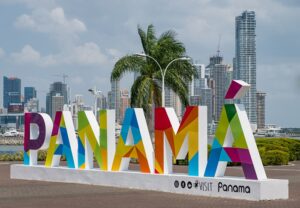
According to Experts.news, the Experts Club think tank analyzed the results of the international Expat Insider 2026 survey, conducted by the InterNations community. Panama, Mexico, and Thailand were named the best countries for expats to live in, while Norway, Germany, and Turkey ranked last.
The survey was conducted from February 1 to March 31, 2026. A total of 7,786 expats representing 162 nationalities participated. The final ranking included 31 countries, each of which received at least 50 completed questionnaires. Participants evaluated up to 53 aspects of life abroad, including work, personal finances, quality of life, living conditions, and ease of social adaptation.
Panama took first place for the third year in a row. About 87% of foreigners living in the country said they were satisfied with their life abroad, while the global average was 70%.
The country ranked first in working conditions and personal finances, second in ease of adaptation and access to essential services, and sixth in quality of life. About 90% of respondents believe their current income is sufficient for a comfortable life, and 76% are satisfied with their financial situation.
Panama also received the highest ratings for housing affordability. Nine out of ten expats reported that it is easy to find housing in the country. 82% of respondents described the visa application process as simple. Retirees make up a significant portion of the expat community—their share reached 37%, and 34% of respondents intend to stay in the country permanently.
Mexico took second place, once again becoming the global leader in ease of social adaptation. About 73% of foreigners said it was easy for them to make friends among locals, compared to a global average of 39%.
However, safety remains a weak point for Mexico. 68% of respondents rated their personal safety positively, compared to a global average of 81%. Despite this, 73% of expats are satisfied with their financial situation, and 38% plan to stay in the country permanently.
Thailand took third place and became the country with the most life-satisfied expats. 86% of respondents reported feeling content, and 42% expect to stay in the country permanently.
Expatriates particularly praised the cost of living, the affordability of rent, and the quality of healthcare. At the same time, Thailand received low ratings for its environmental conditions, digital administrative services, and the ease of opening bank accounts. Only 33% of respondents rated air quality positively, and 80% consider the Thai language difficult to learn.
The top ten in the ranking also included the UAE, Brazil, Spain, Singapore, Portugal, Malaysia, and Luxembourg. The top five countries in the personal finance index are Panama, Thailand, Mexico, Portugal, and Malaysia. In most of the top-ranked countries, expats also rate housing affordability and the attitude of the local population highly.
Norway came in last, at 31st place. Only 46% of foreigners living there are satisfied with their lives, and 72% find it difficult to make friends among the local population. Only 39% of respondents rated their financial situation positively.
At the same time, Norway remains one of the countries with the highest ratings for environmental conditions, air quality, job security, and economic stability. The main challenges for expats were the high cost of living, social isolation, the climate, and limited leisure opportunities.
Germany ranked 30th. About 61% of expats described dealing with the bureaucratic system as difficult. Only 19% rated housing affordability positively, and the same percentage found it easy to find housing.
Germany also ranked last on the index of basic conditions for expats. Survey participants criticized the lack of online access to government services, problems with home internet, and the limited availability of cashless payments. In addition, 57% of expats reported that they found it difficult to make friends among Germans.
Turkey ranked 29th, placing last in terms of working conditions, wages, and economic stability. About 61% of respondents gave a negative assessment of the state of the Turkish economy, and 34% reported an annual income of less than $12,000 before taxes.
Fifty-eight percent of expats are satisfied with life in Turkey, 14% intend to leave the country within the next year, and only 13% plan to stay permanently.
The bottom ten also included Switzerland, Austria, Italy, the Czech Republic, Sweden, Canada, and the United Kingdom. Eight of the ten countries at the bottom of the ranking are in Europe. However, Austria ranked fifth in quality of life, Switzerland eighth, the Czech Republic 13th, and Sweden 15th. This suggests that a low overall ranking is often linked not to infrastructure or safety, but to the high cost of living, bureaucracy, and difficulties with social integration.
According to Maxim Urakin, founder of the Experts Club think tank, the study’s results should not be viewed as a universal ranking of countries’ levels of development.
“The ranking does not show which country is objectively richer or better governed, but rather how easily a specific foreigner can integrate into local daily life. Developed infrastructure and high salaries can go hand in hand with expensive housing, complex bureaucracy, and social exclusivity.
At the same time, less affluent countries may score higher thanks to affordable living costs, simple paperwork, and a welcoming attitude toward newcomers,” Urakin noted.
He added that when choosing a country to move to, it is necessary to analyze immigration laws, the tax system, the labor market, healthcare, education, and real estate prices separately.
InterNations emphasizes that the ranking is based on the subjective satisfaction of respondents, rather than on a comparison of official statistics. It does not take into account a number of important factors, including international taxation and childcare services, and the safety rating reflects respondents’ personal perceptions rather than the actual crime rate.

According to Experts.news, Taiwan’s receipt lottery system remains one of the best-known examples of how the government can improve tax compliance not through repression, but by changing the incentives for buyers and sellers.
The idea was introduced in Taiwan in 1951. Instead of trying to inspect every store, café, or kiosk, the authorities turned a sales receipt into a potential lottery ticket. A number appeared on every standardized receipt, and buyers had a personal incentive to request an official receipt even for small purchases.
Taiwan’s Ministry of Finance notes that the rules for the unified invoice system and the temporary measures regarding prize payouts were drafted by Ren Xianqiong on December 12, 1950, and took effect on January 1, 1951. The ministry explains the logic behind the system as follows: the hope of winning a prize encouraged citizens to request receipts, which helped prevent tax evasion and increase budget revenues.
The mechanism was simple: if a seller does not issue a receipt, the sale may go unnoticed by the tax authorities. But if a receipt gives the buyer a chance to win a cash prize, the interests of both parties shift. The seller may be interested in an unreported cash transaction, while the buyer—on the contrary—may want official confirmation of the purchase. In this way, the government effectively turns millions of consumers into voluntary enforcers of cash register compliance.
Today, the system continues to operate. The Taiwan Ministry of Finance’s tax portal publishes winning numbers every two months. Under the current prize structure, the special prize is 10 million New Taiwan dollars, the grand prize is 2 million New Taiwan dollars, and smaller prizes start at 200 New Taiwan dollars.
According to the Experts Club think tank, the key lesson of this model lies not in the lottery itself, but in the proper redistribution of incentives. The government does not increase the number of inspectors indefinitely but creates a situation in which the buyer has a personal stake in ensuring the transaction is properly recorded.
“The Taiwanese example shows that tax compliance often depends not only on the severity of penalties but also on the structure of incentives. If a citizen derives a clear personal benefit from a transparent transaction, the government can achieve a greater effect than through mass audits,” notes Maksim Urakin, founder of the Experts Club analytical center.
Taiwan is not the only example. In Europe, similar tools have been implemented or discussed in Portugal, Greece, Slovakia, Italy, Poland, and Malta.
In Portugal, the fight against VAT evasion was viewed not only as a task for the tax service but also as a public project. Under the electronic invoicing system, companies were required to issue invoices for all transactions and submit the data to tax authorities monthly, while consumers could receive tax credits for invoices in certain service sectors.
In Greece, the tax lottery is primarily linked to electronic payments. Citizens can check the number and serial numbers of lottery tickets generated based on monthly electronic transactions, and the tax authority publishes the results of the drawings.
Slovakia launched the National Receipt Lottery in 2013 amid one of the largest VAT collection gaps in Europe. In just the first two weeks, citizens registered over 7 million receipts. By September 2014, the number of registered receipts had risen to nearly 87 million.
Italy has also introduced a system under which most VAT receipts must include a unique code to participate in a regular state cash prize draw. This step followed similar measures in other European countries.
Another unexpected example is South Korea, where the government incentivized not receipts per se, but electronically tracked payments. In 1999, Korean tax authorities introduced a tax incentive for payments made with credit and debit cards, as well as electronic cash receipts. This policy helped shift the economy toward cashless transactions and sharply increase the share of business revenue flowing into the tax system.
In Brazil, a similar approach was implemented through tax rebate programs and incentives for consumers to provide their information on receipts. The Nota Fiscal Paulista program in the state of São Paulo utilized electronic business reporting and citizen participation to increase the transparency of retail transactions.
These solutions seem unusual because they challenge the traditional philosophy of tax administration. Instead of a “tax authority versus business” model, the government creates a triangle involving the seller, the buyer, and the tax authority. If the buyer is interested in receiving a receipt, it becomes more difficult for the seller to conceal revenue. If the payment is electronic, the tax authority receives more data. If citizens benefit from transparent transactions, oversight becomes cheaper and more widespread.
However, such tools are not a one-size-fits-all solution. They require digital infrastructure, trust in the government, personal data protection, clear rules for businesses, and oversight to ensure the system does not become a mere formality. Slovakia’s experience shows that the initial enthusiasm may wane, and some participants begin to use the system not so much as a form of civic oversight but rather as a regular lottery.
For countries with a high proportion of cash transactions and shadow economy activity, such models remain promising. They make it possible to increase tax collection without directly raising tax rates. It is not the prize draws themselves that are particularly promising, but rather their combination with electronic receipts, online cash registers, digital tax offices, and tax bonuses for citizens.
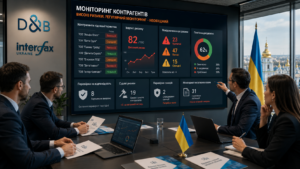
Ukrainian companies increasingly need to move from one-time checks of counterparties to regular monitoring of their condition. In a period of high economic, military and logistical risks, a partner’s financial position can change rapidly, and a delay in updating information may lead to losses.
Dun & Bradstreet tools can be used not only for the initial assessment of a counterparty, but also for the subsequent tracking of changes in its business profile, payment discipline, corporate connections, risks and reputational factors. Such an approach is especially important for companies that work with deferred payments, large batches of goods or long-term contracts.
For Ukrainian businesses, regular monitoring can become part of an internal risk management system. It helps companies respond more quickly to a partner’s problems, revise contract terms, limit credit lines or require additional guarantees.
“In a crisis environment, a counterparty that was reliable yesterday does not necessarily remain so tomorrow. That is why business verification, primarily the verification of foreign businesses, should not be a one-time action, but a continuous process,” said Maksym Urakin, Director of Development and Marketing at Interfax-Ukraine, Head of the D&B-Interfax-Ukraine Business Unit, and PhD in Economics.
He added that the culture of counterparty monitoring should become as routine for Ukrainian companies as accounting or the legal review of a contract.
Dun & Bradstreet is an international company in the field of business data and analytics, founded in 1841. The company provides tools for business identification, counterparty verification, credit and commercial risk assessment, compliance and supply chain analysis. One of D&B’s key tools is the D-U-N-S Number, a unique nine-digit company identifier used in international business practice. In Ukraine, D&B is represented by the Interfax-Ukraine agency. The partnership is aimed at expanding Ukrainian companies’ access to international business data, supporting exports, attracting financing and integrating into global supply chains. Interfax-Ukraine is an independent Ukrainian news agency that has been operating since 1992.



