

Switzerland, with official international reserves totaling $1.0877 trillion, ranked first among European countries, according to an analysis by the Experts Club information and analytical center based on the latest available data from central banks.
Germany came in second with $539.77 billion. Russia, after adjusting the figure to account for immobilized assets, dropped to third place.
“Switzerland’s $120,700 in reserves per capita is nearly seven times higher than those of Denmark and the Czech Republic—$17,950 and $17,200, respectively—while Poland and Hungary have about $7,800. This gap reflects not the level of citizens’ personal well-being, but the scale of the external financial cushion relative to the population base. For small countries, the denominator sharply amplifies the result, so the ranking must be analyzed alongside import coverage, short-term external debt, liquidity, and the structure of reserve assets. “Without this context, a high ranking can easily be mistaken for a universal assessment of financial stability,” emphasized Maxim Urakin, an economist and founder of the Experts Club analytical center.
The Bank of Russia estimated the country’s gross reserves at $755.6 billion. At the same time, approximately $285 billion of Russian sovereign assets remain frozen in G7 jurisdictions. After excluding these, the analytical estimate of the operationally available portion of reserves stands at approximately $470.6 billion. This figure is not an official statistic for net reserves.
The next places were taken by Italy with $414.52 billion, France with $404.02 billion, and Poland with $294.95 billion. The top ten also included the United Kingdom, Turkey, the Czech Republic, and Spain.
The ranking was compiled using the IMF’s IRFCL methodology. The European Central Bank’s aggregate reserve figure and the broader balance sheet assets of central banks were not included.

“Nova Poshta,” Ukraine’s leading express delivery service and part of the Nova Group, increased its consolidated net profit by 24.3% in the first half of 2026 compared to the same period in 2025—to 2.195 billion UAH, while revenue rose by 31.8% to 39.127 billion UAH.
According to the company’s consolidated financial report, its gross profit rose by 19.9% compared to the same period last year—to 8.474 billion UAH—and operating profit increased by 29.5%, to 4.633 billion UAH.
Consolidated revenue in the second quarter of this year increased by 35.5% compared to the same period a year ago, reaching 20.909 billion UAH, while consolidated net income rose by 8.5% to 1.299 billion UAH.
Consolidated gross profit in the second quarter rose by 15.7% compared to April–June 2025, reaching 4.520 billion UAH, while operating profit increased by 18.5%, to 2.590 billion UAH.
As of June 30, 2026, Nova Poshta had UAH 14.2 billion in equity against total assets of UAH 40.452 billion, which is lower than the figures as of December 31, 2025—UAH 16.803 billion and UAH 44.219 billion, respectively.
The amount of cash and cash equivalents also decreased—to 10.829 billion UAH from 12.360 billion UAH. The company paid 4.380 billion UAH in dividends over the first half of the year, compared to 726 million UAH in January–June 2025.
The consolidated report notes that expenditures on the acquisition of fixed assets and intangible assets in the first half of this year amounted to 1 billion 322 million UAH, compared to 1 billion 973 million UAH a year ago.
As reported in the interim financial statements, “Nova Poshta” increased its net profit 2.3-fold in the first half of 2026 compared to the same period last year—to 2 billion 708 million hryvnias—and its revenue by 31.7%, to 32.5 billion hryvnias.
It was previously noted that in the first six months of 2026, the company increased the volume of processed shipments by 11.5% compared to the same period last year: the volume of delivered packages and cargo reached 254.4 million, including 17.9 million international shipments.
As of July 13, 2026, the “Nova Poshta” network comprised 54,700 service points: 16,800 branches and 37,900 parcel lockers throughout Ukraine.
In 2025, “Nova Poshta” increased its revenue by 21.6% compared to 2024—to 54.2 billion UAH—and its net profit rose by 4.4%—to 2.6 billion UAH. The number of parcels and shipments delivered increased by 7.4%—from 486 million to 522 million—with international shipments rising by 52.6%, from 19 million to 29 million.
Nova Poshta’s core business remains the express delivery of documents, parcels, and palletized large-sized cargo. The company is the leader in express delivery in Ukraine. Its ultimate beneficial owners are Volodymyr Poperešniuk and Vyacheslav Klimov.

According to The Serbian Economist, early parliamentary elections in Serbia are scheduled to take place on October 18 or 25, 2026, as per current plans, President Aleksandar Vucic said on August 20.
“Parliamentary elections in Serbia will, apparently, take place on either October 18 or 25, and we will know the exact date in a few days,” Vučić said on Radio and Television of Serbia (RTS).
Previously, Serbian authorities had been considering holding the election in late October or early November; however, according to the president, the likely date has now been practically determined. That said, the election has not yet been officially scheduled, so October 18 and 25 remain the two dates under consideration.
According to Serbia’s Law on the Election of Members of Parliament, parliamentary elections are scheduled by the President of the Republic, and no fewer than 45 and no more than 60 days must elapse between the date of the announcement and Election Day. Election Day must fall on a non-working day.
As early as August 16, Vučić stated that the elections would be scheduled “very soon”—within the next 15 to 25 days. Prior to that, on August 14, he had indicated a broader timeframe for the elections—October or November.
At the same time, the parliamentary and presidential elections will most likely take place at different times. In July, Vučić stated that the parliamentary elections should take place first, followed by the presidential elections. On August 6, he also announced that he intends to resign from the presidency before joining the election campaign.
Commenting on the upcoming campaign on August 20, Vučić also confirmed that the Serbian Progressive Party (SNS) will run in the elections with its own electoral list. Referring to the decision by the Socialist Party of Serbia (SPS) to run independently, he noted that citizens should have the opportunity to choose between different political options.
The previous early parliamentary elections in Serbia took place on December 17, 2023. According to the results, the “Aleksandar Vučić—Serbia Must Not Stop” list received the most votes.
https://t.me/relocationrs/3504

The introduction of uniform hospitalization criteria in Ukraine does not mean an automatic reduction in the hospital network; however, complex medical procedures will increasingly be concentrated in facilities capable of ensuring the necessary level of safety, said Yevhen Honchar, Ukraine’s Deputy Minister of Health, in an exclusive interview with Interfax-Ukraine.
According to him, in most communities where hospitals currently operate, medical care facilities should remain. The key issue is the range of services that a specific facility is capable of providing safely.
A small hospital does not necessarily need to perform surgical procedures or deliver babies if it lacks a sufficient number of specialists and the necessary infrastructure.
In particular, safe round-the-clock monitoring of surgical patients requires several anesthesiologists, whereas small facilities sometimes have only one surgeon and one anesthesiologist on staff.
At the same time, basic services—family medicine, consultations with a cardiologist, an obstetrician-gynecologist, and other specialists—must remain as geographically accessible as possible.
Thus, the development of the hospital network will proceed simultaneously in two directions: the concentration of specialized care and the preservation of a broad network of basic medical services.
HOSPITAL, HOSPITALIZATION, MEDICINE, Ministry of Health, REFORM

Greece ranks first among European countries in terms of seasonal growth in short-term rental prices: in the summer, the average rental price is 54.9% higher than in the rest of the year, according to data from the analytics platform AirDNA.
The AirDNA study was published on May 21, 2026, and updated on May 29. Analysts compared the average daily rate (ADR) for short-term rentals in June–August with the rate for the remaining nine months of the year.
In Greece, the average off-season rate is 112.64 euros per night, while in June–August it rises to 174.46 euros. Thus, the seasonal premium reaches 54.9%—the highest rate among the European countries analyzed.
Croatia ranks second, with summer prices 37.6% higher—€154.28 compared to €112.09 during the rest of the year. Portugal ranks third, with a seasonal increase of 36.5%, to €160.06 from €117.27.
Seasonal fluctuations are particularly pronounced on popular Greek islands. On Mykonos, the average cost of a short-term rental rises from approximately 458 euros during the off-season to 758 euros per night in the summer—an increase of 65.6%.
At the same time, even more dramatic fluctuations are observed among individual European resorts. For example, Portimão, Portugal, shows a seasonal increase of about 71.6%, but Greece ranks first overall among countries.
The sharp rise in prices is accompanied by steady demand. According to AirDNA estimates, before the start of the season, the number of nights booked in Greece for June–August 2026 was approximately 9.3% higher than a year earlier. For July, the growth in early bookings was 13.5%, and for August, 11.4%.
Actual statistics for the summer confirm the high price levels. In June, the average cost of a short-term rental in Greece reached 178.8 euros per night, an increase of 12.2% year-over-year, while the European average was 150.05 euros, up 7.5%. At the same time, the number of available properties in Greece decreased by 2.5%, to approximately 156,000
. In July, the average price rose to 200.35 euros per night, which is 12.8% higher than in July 2025. The European average rate was €159.20, up 8.2% year-over-year. Revenue per available night in Greece increased by 14.3% to €142.8.
Over a longer period, the growth is even more pronounced. According to AirDNA, the average cost of a short-term rental in Greece has increased by approximately 100% over the past ten years—from about 100 euros in 2016. Over the past five years, the increase has been about 38%.
However, the claim that Greece “has outpaced all of Europe in terms of Airbnb price growth” should be interpreted with caution. The top ranking specifically refers to seasonal summer growth—that is, a comparison of June–August with the rest of the year—rather than annual price growth. Based on actual July data, year-over-year growth in Greece was 12.8%, compared to an 8.2% average across Europe.
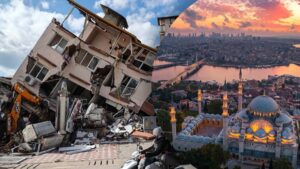
Every year in Istanbul, about 10,000 potentially dangerous buildings are demolished and rebuilt as part of a large-scale housing renovation program that authorities are accelerating due to the high risk of a major earthquake in the Marmara Sea region.
According to the Turkish newspaper Hürriyet Daily News, citing official data and estimates from urban planning experts, Istanbul accounts for approximately half of all projects involving the demolition and reconstruction of unsafe buildings in Turkey. Nationwide, about 20,000 such structures are demolished each year.
A particularly large-scale program is underway in Istanbul itself, home to more than 15 million people. According to Turkish authorities’ estimates, about 1.5 million standalone residential and commercial buildings in the city are at risk, with approximately 600,000 requiring urgent reconstruction.
The pace of urban renewal has increased significantly. According to the Anadolu Agency as of July 25, 2026, since Turkey’s Urban Transformation Law was enacted in 2012, more than 1.274 million standalone properties in Istanbul have been included in the renovation program. Construction on 998,000 of these has already been completed, while more than 276,000 properties are currently being renovated across all 39 districts of the city.
One of the main tools for accelerating the renovation process has been the government program Yarısı Bizden—“Half Is on Us.” The government provides owners of apartments in buildings deemed unsafe with a grant of 875,000 Turkish lira, a preferential loan of 875,000 lira, and 125,000 lira in relocation assistance. The total support package for a single residential property can thus reach 1.875 million lira.
The program runs through December 31, 2026. In February, the authorities further relaxed the conditions: all owners of residential and commercial properties in Istanbul whose buildings are officially designated as high-risk by that date will be eligible for state support. Thus, the program applies, in particular, to properties that received this status in 2025–2026.
Against this backdrop, property owners are rushing to submit applications, and construction and demolition work is underway in virtually all districts of the metropolis. Old five- to eight-story buildings are gradually being replaced by new structures designed in accordance with modern seismic safety requirements. At the same time, representatives of the construction industry caution that accelerating demolition should not come at the expense of residents’ safety or environmental standards.
Seismic risk for Istanbul remains one of the key factors in urban policy.
According to the Istanbul Municipality’s official scenario for a 7.5-magnitude earthquake, it is estimated that approximately 48,000 buildings could sustain severe or very severe damage, while the number of buildings with moderate or higher levels of damage could reach 194,000.
Thus, the current construction boom in Istanbul is linked not only to the development of the real estate market but, above all, to the authorities’ attempt to accelerate the replacement of the most vulnerable housing stock before a possible major earthquake.



