

In July 2026, Ukrainians purchased 22,600 used passenger cars imported from abroad, which is 1% more than during the same period in 2025, according to a report by “Ukravtoprom” on its Telegram channel.
Gasoline-powered cars accounted for the largest share of this segment of the auto market, increasing their share by 7 percentage points compared to July 2025—to 55%.
Next came diesel cars at 17% (19%), while the share of electric vehicles fell to 15% from 24%, though they still outpaced hybrids, which accounted for 10% (6%). The share of cars with LPG systems remained unchanged at 3%.
The average age of imported used cars was 8.8 years.
The Volkswagen Tiguan confidently tops the list of the ten most popular imported used models with 937 units. It is followed by the VW Golf with 862 units, the Audi Q5 with 803 units, the Nissan Rogue with 799 units, the Skoda Octavia with 661 units, the Renault Megane with 618 units, the Tesla Model Y with 509 units, the Ford Escape with 465 units, the Tesla
Model 3 with 456 units, and the Mazda CX-5 with 432 units.
As reported with reference to “Ukravtoprom,” in 2025 Ukrainians purchased 274,300 used passenger cars imported from abroad, which is 24% more than in 2024, and the top three most popular models after the Volkswagen Golf included two Tesla electric vehicles—the Model Y and Model 3.

Nur ein kleiner Teil der Menschen ist in der Lage, zwei komplexe Aufgaben gleichzeitig zu erledigen, ohne dass sich die Ergebnisse merklich verschlechtern. Dies zeigte eine Studie der Psychologen Jason Watson und David Strayer von der University of Utah.
Die Arbeit mit dem Titel Supertaskers: Profiles in Extraordinary Multitasking Ability wurde in der wissenschaftlichen Fachzeitschrift Psychonomic Bulletin & Review veröffentlicht. An der Studie nahmen 200 Personen teil.
Die Teilnehmer wurden in einem hochrealistischen Fahrsimulator getestet. Zunächst erledigten sie die Aufgaben getrennt. Anschließend steuerten sie gleichzeitig ein Auto und absolvierten den komplexen auditiven OSPAN-Test, der das Einprägen von Informationen und die Lösung kognitiver Aufgaben erforderte.
Bei der überwiegenden Mehrheit der Teilnehmer verschlechterten sich beim Übergang zum Multitasking entweder die Ergebnisse beim Autofahren, beim kognitiven Test oder bei beiden Aufgaben gleichzeitig.
Allerdings zeigten 2,5 % der Teilnehmer – also etwa fünf von 200 Personen – bei der gleichzeitigen Ausführung beider Aufgaben keinerlei Verschlechterung ihrer Ergebnisse. Die Forscher bezeichneten sie als „Supertaskers“ – Menschen mit einer ungewöhnlich hohen Fähigkeit zum Multitasking.
Darüber hinaus erzielten diese Teilnehmer auch bei der getrennten Ausführung jeder einzelnen Aufgabe hohe Ergebnisse: Bei allen wichtigen Messwerten des Fahrens und des Arbeitsgedächtnistests gehörten sie zum besten Viertel der Stichprobe. Statistische Modellierungen zeigten, dass das Auftreten einer solchen Gruppe nur mit geringer Wahrscheinlichkeit durch reinen Zufall erklärt werden konnte.
Die Studie stellte die Annahme infrage, dass die Fähigkeit, die Aufmerksamkeit effektiv auf mehrere komplexe Aufgaben zu verteilen, bei allen Menschen gleich ausgeprägt ist. Die Autoren kamen zu dem Schluss, dass erhebliche individuelle Unterschiede bei den Mechanismen der Aufmerksamkeit und der kognitiven Kontrolle bestehen.
Dabei sollte der Wert von 2,5 % nicht unmittelbar als Beweis dafür interpretiert werden, dass genau dieser Anteil der gesamten Weltbevölkerung über außergewöhnliche Multitasking-Fähigkeiten verfügt. Die Studie wurde mit einer Stichprobe von 200 Teilnehmern durchgeführt und untersuchte eine konkrete Kombination von Aufgaben – das Autofahren und eine komplexe Belastung des Arbeitsgedächtnisses.
Die Arbeit hat zudem praktische Bedeutung für die Frage der Nutzung von Telefonen am Steuer. Ihre Ausgangsannahme basierte auf früheren Studien, die zeigten, dass Telefongespräche in der Regel die Fähigkeit des Fahrers beeinträchtigen, die Verkehrssituation zu kontrollieren. Die Entdeckung einer kleinen Gruppe von „Supertaskers“ war eine Ausnahme von der allgemeinen Regel und kein Beweis dafür, dass Multitasking für die meisten Fahrer sicher ist.
Die Studie wurde am Fachbereich Psychologie der University of Utah durchgeführt.
Pharmaceutical products, medical goods and equipment in Ukraine cost an average of 2.9% less in July 2026 than a year earlier, while outpatient medical services increased in price by 13.3%, according to data from the State Statistics Service.
Overall, the healthcare category rose in price by only 2.2% over the year, significantly slower than the general consumer inflation rate of 7.7%. Prices in this group increased by 0.6% in July.
Pharmaceutical products, medical goods and equipment became 0.9% cheaper from the beginning of 2026. In July, however, this category rose in price by 0.6% compared with June.
Outpatient services, by contrast, increased in price by 0.8% over the month, by 8.3% from the beginning of the year and by 13.3% year-on-year. On average, they cost 13.6% more in January–July than during the same period of 2025.
Thus, a noticeable gap can be observed within the medical segment between the price dynamics of medical goods and those of services themselves.

The premiere of the Ukrainian short film Another Day in the Metal Box, directed by Hlib Feldman, took place on 9 August at the 79th Locarno International Film Festival in Switzerland.
The film was included in the Pardi di Domani — Concorso Internazionale international competition, according to the official programme of the Locarno Film Festival. The film was produced in Ukraine in 2026 and has a running time of 18 minutes.
According to the Embassy of Ukraine in Switzerland and Liechtenstein, the story takes viewers to Ukraine in 2008 and tells the personal story of an ordinary person faced with a difficult choice. A representative of the Ukrainian embassy attended the festival screening and met with the film’s creative team.
The Locarno Film Festival is one of Europe’s largest international film festivals. Its Pardi di Domani programme focuses on short films and works by emerging filmmakers from around the world. Another Day in the Metal Box was presented in the international competition of this section.
ANOTHER DAY IN THE METAL BOX, HLIB FELDMAN, LOCARNO FILM FESTIVAL, Ukrainian cinema

In January–July 2026, Ukraine imported approximately 10.9 thousand metric tons of manganese ore, whereas there were no imports of this product during the same period last year.
According to data from the State Customs Service, virtually the entire volume of shipments came from Ghana—10,896 metric tons worth $1.677 million. An additional 5 metric tons, worth $3,000, were imported from China.
Thus, Ghana accounted for 99.82% of the value of Ukraine’s manganese ore imports in January–July.
The resumption of imports coincides with the recovery of foreign trade in manganese ore overall. Over the seven-month period, Ukraine exported 24,647 metric tons of such products worth $4.227 million.
The average estimated price of exported ore was approximately $171 per metric ton, while that of ore imported from Ghana was approximately $154 per metric ton. These figures are estimates based on customs value and physical shipment volumes and do not reflect differences in the quality and characteristics of the raw material.
Manganese ore imports into Ukraine have fluctuated significantly in recent years. In 2024, the country imported 84,293 thousand metric tons worth $18.302 million.
In 2025, imports fell to 37,006 thousand metric tons, valued at $5.546 million. Notably, the entire volume was shipped from Ghana in November alone, while imports were virtually nonexistent from January through October.
The resumption of shipments as early as the first half of 2026 may indicate growing demand for raw materials in the ferroalloy industry amid a gradual recovery in production.
The main consumers of manganese ore in Ukraine are enterprises in the ferroalloy industry. The Nikopol and Zaporizhzhia Ferroalloy Plants halted smelting after Ukrainian mining companies ceased extraction of raw manganese ore in the fall of 2023; however, ferroalloy production was partially resumed in the summer of 2024.
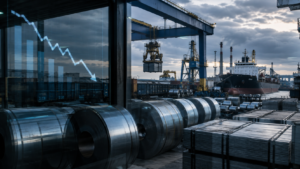
Ukraine’s revenue from ferrous metal exports in July 2026 totaled $199.9 million, down approximately 31.9% from June’s $293.6 million, according to the Experts Club Information and Analytical Center.
This calculation is based on data from the State Customs Service of Ukraine.
The July dynamics significantly worsened the industry’s results for the seven-month period. Overall, in January–July, foreign currency revenue from exports of ferrous metals decreased by 7.6% year-on-year to $1.678 billion.
At the same time, Ukraine imported $176.4 million worth of ferrous metals in July. Thus, the monthly gap between exports and imports of these products narrowed to approximately $23.5 million.
Exports of metal products generated another $71.4 million in July, while imports of these products amounted to $106.3 million. Consequently, imports of metal products directly exceeded exports by almost $35 million in July.
In total, exports of ferrous metals and metal products amounted to approximately $271.3 million in July, while imports reached around $282.6 million.
Thus, if these two groups are considered together, Ukraine effectively recorded a small negative trade balance of approximately $11 million in July, although the balance for the entire seven-month period remains positive so far.
For comparison, in 2025 Ukraine received $3.339 billion from exports of ferrous metals and $916.2 million from exports of metal products.
The sharp decline in July requires further monitoring: data for a single month alone do not yet make it possible to determine whether this marks the beginning of a sustained deterioration in export conditions or a short-term fluctuation in supplies.



