
Ukraine has updated the rules governing international scheduled bus services, which include changes to the procedures and deadlines for opening or extending routes, according to a statement from the Ministry of Community and Territorial Development.
“The changes are aimed at establishing rules for organizing international transport services for businesses and expanding the regular network of international passenger routes to ensure seamless, safe, and comfortable travel,” the release quotes Deputy Prime Minister for Ukraine’s Recovery and Minister of Community Development Oleksii Kuleba as saying.
In particular, the changes provide for a 30-calendar-day period for reviewing route applications submitted via the online portal (opening, closing, changing, or extending a route). Provided that the feasibility of operating an international route is agreed upon with the foreign state, a decision will be made within 10 calendar days, and permits will be issued to carriers within five business days. Carriers will be given up to 20 calendar days to correct deficiencies in the applications and documents submitted via the online portal.
“The updated procedure also includes information on the number of slots at border crossing points for opening routes. This refers to the capacity to allow buses to pass at specific times,” the statement notes.
The Ministry of Development added that from now on, the approval period with neighboring countries will be up to six months, and with other countries—up to 12 months. In addition, every 12 months (instead of four months), the agency will verify the operation of international routes. Specifically, during the relevant period, the carrier must complete at least 30% of the trips specified in the permit. If this requirement is not met, the route permit will not be extended and the international route will be closed. It is noted that route performance verification is carried out based on data from the “eCherga” system.
Among other updates, new deadlines have been added for launching international routes. Specifically, from now on, the carrier must begin operating the route within 90 calendar days from the date the latest permit is uploaded to the carrier’s electronic account.
“Previously, this deadline was shorter, but now the Ministry of Development has approved a longer period so that carriers can properly prepare for the start of operations,” the ministry noted.
Among other changes, the regulations also provide for accounting for the total number of buses serving an international route in cases where several Ukrainian carriers are collaborating.
“The new procedure also includes sample documents, such as a schedule of drivers’ duty periods and breaks, a form for filling out the passenger list, and a form for transportation rates,” the ministry added.
The Ministry of Development noted that for the first time in 20 years, the procedure for organizing international transportation was updated in November 2024 as part of the reform of international bus transportation, where the main change was the digitization of procedures for managing international routes via an online portal.

The online taxi service Uklon ranks second in the ride-hailing market in Tashkent, the capital of Uzbekistan, and 90% of its team in the country consists of local specialists, said Alexander Komarov, CEO and President of the Ukrainian mobile operator Kyivstar.
“Uklon is number two in the ride-hailing market in Tashkent, and Tashkent is already the second-largest market after Kyiv among all cities where Uklon operates. Ukrainian business knows how to move the world,” Komarov added on Facebook on Tuesday.
According to him, a meeting of Uklon’s supervisory board took place in the city.
In turn, Sergey Grishkov, CEO of the online taxi service, noted that a strategic workshop with the local team and the board was held as part of the working meetings.
“We came away with a clear understanding of where we’re heading next,” he emphasized.
According to Grishkov, Uklon has secured the second position over the past three years and has potential for growth.
“Experience competing with global players in Ukraine has shown that market position is determined by product quality, local adaptation, technology, and user trust,” he emphasized.
Uklon, which was consolidated into Kyivstar’s financial statements in April 2025, generated UAH 1.425 billion in revenue, or $32.9 million, in the first quarter of 2026. Its EBITDA amounted to UAH 538.9 million, or $12.4 million. The number of rides in the first quarter of 2026 was 43.7 million, and deliveries totaled 1.5 million.
As previously reported by the CEO of the online taxi service during a Forbes Ukraine Businessbreakfast, the most important task for Uklon, in partnership with Kyivstar, Ukraine’s largest mobile operator, is to identify significant synergies between the businesses. Specifically, starting in the second or third quarter of 2026, the companies will have offers that users will see.

The governments of Serbia and Ukraine have issued a joint statement on the continuation of negotiations on a free trade agreement, said Marko Čadež, president of the Serbian Chamber of Commerce and Industry, in an interview with the Interfax-Ukraine news agency.
“Ukraine is the only European country with which Serbia does not have a signed free trade agreement. After direct contacts between the relevant institutions on this issue were reestablished last year, this week, during the visit of a Ukrainian government-business delegation to Belgrade, we must take this long-awaited step forward,” he said.
According to Chadezh, the document is expected to be signed in the coming days by Taras Kachka, Ukraine’s Deputy Prime Minister for European and Euro-Atlantic Integration, and Jagoda Lazarević, Serbia’s Minister of Domestic and Foreign Trade.
The President of the Serbian Chamber of Commerce and Industry noted that there is interest in such an agreement among both the Serbian and Ukrainian business communities, especially in sectors where lower tariffs, simplified procedures, and more predictable business conditions could increase companies’ exports.
“That is precisely why it is important that, as negotiations continue, we arrive at a well-prepared sector-specific agreement focused on specific industries,” Chadezh emphasized.
He also noted that the amended and simplified rules for the cumulation of preferential origin under the Pan-Euro-Mediterranean Convention, to which both Serbia and Ukraine are signatories, could expand the range of components for products traded on preferential terms with the EU, EFTA, Moldova, Montenegro, North Macedonia, and Turkey.
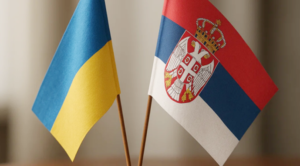
There are currently over 480 businesses with majority Ukrainian capital operating in Serbia, including 161 companies and 320 entrepreneurs, according to Marko Čadež, president of the Serbian Chamber of Commerce and Industry, citing data from the Serbian Business Registration Agency.
“Mostly in the fields of IT, consulting services, trade, and small business,” he said in an interview with the agency “Interfax-Ukraine”.
For comparison, Čadež cited data from pre-war 2021, when 202 Ukrainian companies and 117 entrepreneurs were operating in Serbia. According to him, about 40% of them were subsequently closed, but after 2022, a significant number of new registrations were recorded.
“Last year, for example, not a single company or entrepreneur was closed,” he noted.
The president of the Serbian Chamber of Commerce and Industry added that Ukrainian business in Serbia is gradually shifting from traditional trade to digital and other knowledge-based services.
“The number of IT entrepreneurs, consulting firms, and design studios is growing year after year,” said Chadezh.
BUSINESS, IT, SERBIA, Serbian Chamber of Commerce and Industry, UKRAINE

The Institute for Veterans at Kyiv National University of Construction and Architecture hosted Ukraine’s first Open Discussion Day with veterans and their families, dedicated to education, retraining, social adaptation, mental rehabilitation, and employment for veterans.
The event took place at the KNUCA Culture and Leisure Center in Kyiv as part of an Open House for veterans and their families and brought together veterans, their family members, representatives of the university community, medical professionals, socially responsible businesses, and partner organizations.
“Education and the learning process itself are not just about a diploma. They are an important element of veterans’ social adaptation and mental rehabilitation. The university is a large, new-type ecosystem where a veteran can rediscover themselves, feel the support of the community, acquire new skills, and ultimately find employment and return to an active life,” noted Artem Goncharenko, head of the KNUCA Veterans Institute.
The event was attended by representatives of Kyiv National University of Construction and Architecture, the National University of Physical Education and Sports of Ukraine, the Igor Sikorsky Kyiv Polytechnic Institute, the National University of Life and Environmental Sciences of Ukraine, and other higher education institutions in the capital and regions.
The event was co-organized by the Kyiv City Employment Service, which, according to the organizers, underscores a systematic approach to supporting veterans—from education, psychological, and medical support to professional retraining and subsequent employment.
One of the practical components of the Open Discussion Day was a training session on first aid titled “Don’t Panic. Act Correctly,” led by neurologist and epileptologist Denys Boichuk. Participants discussed how to act before, during, and after an epileptic seizure, what common mistakes can harm a person, and why certain widespread “tips from the internet”—in particular, the myth about “putting a spoon in the mouth”—have no medical basis and can be dangerous.
A separate segment of the training was dedicated to medical checkups for veterans and their families, developing the habit of getting regular health screenings, managing the effects of stress and trauma, and supporting loved ones consistently rather than sporadically.
During the event, a prize drawing was also held, and gifts were presented to participants. The event’s partners were Poparada.ua, Axor Industry, and CosmoMultimall. The organizers note that business participation in such initiatives demonstrates the potential for practical and meaningful collaboration between companies and veterans’ organizations.
According to the organizers, the Open Discussion Day held at the KNUBA Veterans Institute marked the first step toward establishing a permanent ecosystem to support veterans and their families through education, practical knowledge, professional retraining, and cross-sectoral cooperation.
The Veterans Cluster of Ukraine and the KNUBA “Architecture of Resilience” Veterans Institute have already begun accepting applications for educational programs for veterans, defenders, and their children. Participants are offered opportunities to study in over 50 fields and more than 100 educational programs, including retraining, courses, second higher education, master’s and doctoral programs, psychological support and rehabilitation, participation in projects for Ukraine’s recovery, and partnership programs with employers.
Study formats include full-time, part-time, online, and distance learning. The program works with communities across Ukraine and provides personalized support from admission through to employment.
Program details are available on the website: www.Veterano.info.
Contacts for additional information: +38 073 94 96 179, +38 050 22 35 182, +38 067 49 81 098, center@uvc.in.net, veterano@knuba.edu.ua. Head of the KNUBA Veterans Institute Artem Goncharenko: +38 073 177 72 73.
Tuition-free education refers to participation in state compensation programs, grants, scholarships, and support from employers. Admission takes place during the standard admission campaign within the standard timeframe.