

The results of a public opinion poll conducted in March 2026 by the research company Active Group in collaboration with the Experts Club information and analytical center show that Ukrainians’ attitudes toward Saudi Arabia remain largely neutral, though with a slight decline in positive assessments and a gradual increase in negative sentiment. This forms a perception profile characteristic of some Middle Eastern countries—low polarization with a high degree of uncertainty.
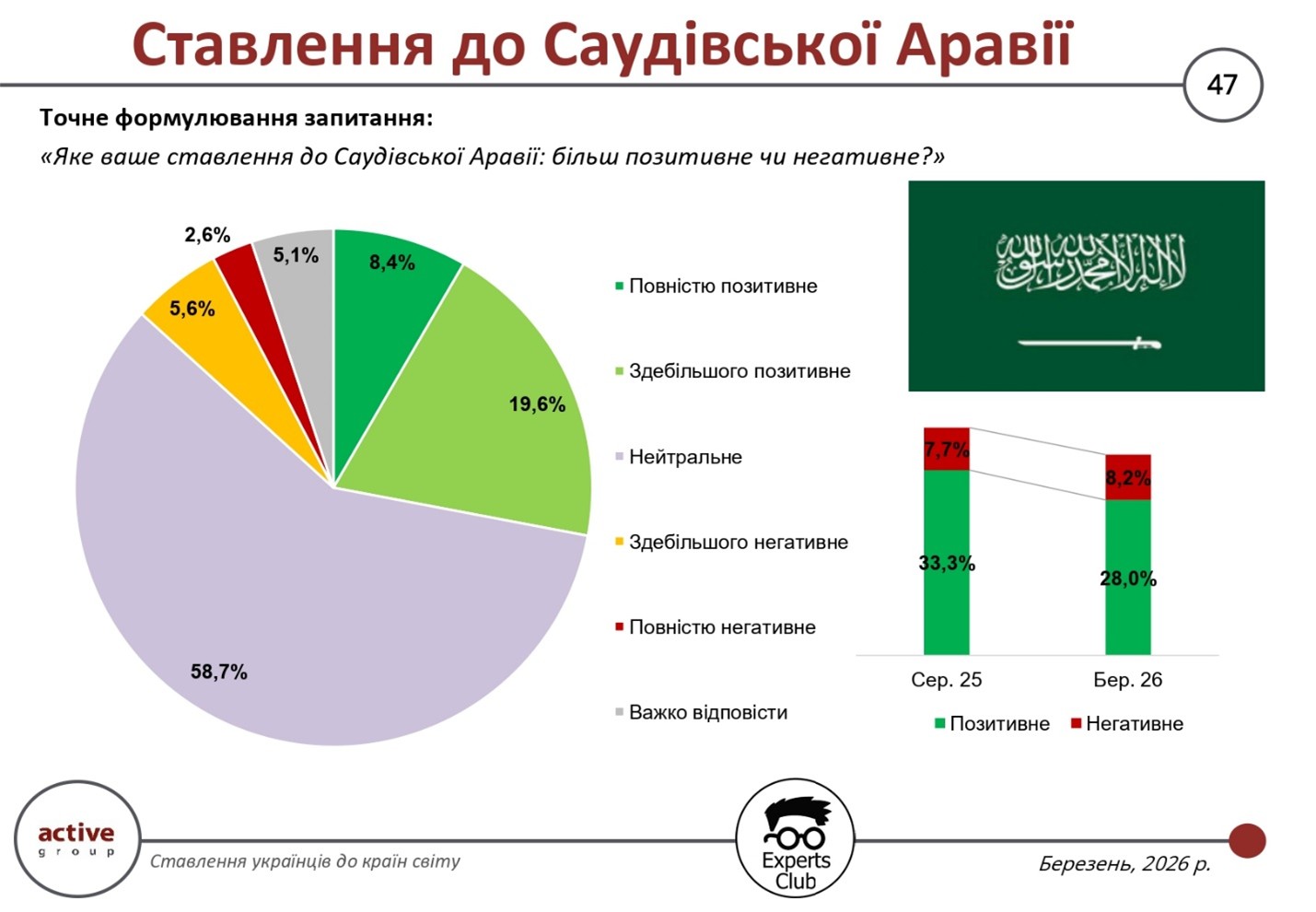
The overall level of positive attitudes toward Saudi Arabia stands at 28.0%. Of these, 8.4% of respondents view the country “entirely positively,” while another 19.6% view it “mostly positively.” At the same time, negative assessments reach 8.2% (5.6% — “mostly negative,” 2.6% — “completely negative”). As in previous waves of the survey, the largest share is held by neutral attitudes — 58.7%, while another 5.1% of respondents were unable to determine their position.
Compared to August 2025, positive attitudes decreased from 33.3% to 28.0%, while negative assessments rose slightly—from 7.7% to 8.2%. This trend indicates a gradual shift in the balance of assessments toward a more critical perception, although the changes remain moderate and do not go beyond the general neutral pattern.
The high proportion of neutral responses indicates that Saudi Arabia does not occupy a clearly defined place in the consciousness of Ukrainian society. Perceptions of the country are formed in a fragmented manner, without a systematic information presence or intensive contacts that could shift the balance toward more defined assessments. Under such conditions, even minor informational or political signals can influence the dynamics of public opinion.
“When we see that a country remains predominantly in the zone of neutral perception, it means that it effectively lacks sufficient ‘weight’ in the everyday information landscape of Ukrainians. In such a situation, even small changes in the information landscape can shift the balance of assessments in one direction or another. That is why, for such countries, it is crucial not only to increase their presence but also to shape a clear and positive image,” noted Maksym Urakin, founder of the Experts Club information and analytical center.
Thus, Saudi Arabia remains in the group of countries with a predominantly neutral image in Ukraine, where the level of positive perception is gradually declining, while the negative segment is slowly growing. The further evolution of this balance will depend on the intensity of economic, political, and informational contacts between the countries, as well as on how actively Saudi Arabia can shape its own image in the perception of Ukrainian society.
According to a study conducted by the Experts Club information and analytical center based on data from the State Customs Service, Saudi Arabia ranks 34th in total trade volume with Ukraine, amounting to $530.8 million. At the same time, Ukraine has a trade surplus with this country, as exports exceed imports by more than 1.6 times.
The study was presented at the Interfax-Ukraine press center; the video can be viewed on the agency’s YouTube channel. The full version of the study can be found at this link on the Experts Club analytical center’s website.
ACTIVE GROUP, EXPERTS CLUB, Pozniy, SAUDI ARABIA, SOCIOLOGY, SURVEY, UKRAINE, URAKIN

adidas stores in Ukraine have introduced an option for people with lower limb differences to purchase a single sneaker for 50% of the price of a pair, the retailer’s press service reported.
“The Single Shoe service was created for people with lower limb differences who do not need two sneakers at once. In this case, a single sneaker costs 50% of the price of a pair. In Ukraine, the service is available at official adidas stores, including outlet stores, and applies to all footwear in stock,” the company said.
When developing the service, adidas worked closely with Paralympic athletes, including communities from ParalympicsGB and Harder Than You Think.
This service is already available in 23 European countries.
adidas noted that to expand access to sports, the company has created an adaptive basketball uniform for wheelchair athletes and those who play while seated; has begun preparations to launch adaptive running shoes developed in collaboration with people with Down syndrome; and has introduced inclusive design in most of the uniforms for athletes at the 2024 Olympic and Paralympic Games in Paris
adidas is a global leader in the sporting goods industry. The company’s headquarters are located in Herzogenaurach, Germany. The company employs approximately 65,000 people worldwide, and its revenue in 2025 amounted to EUR 24.8 billion.
According to data from the YouControl analytics system, the net revenue of the subsidiary “Adidas-Ukraine” in 2025 grew by 28% to UAH 2.99 billion, while the net loss amounted to UAH 103.3 million, compared to a profit of UAH 43.3 million in the previous year.

According to customs statistics cited by the Ukrainian Poultry Farmers Union, Ukraine shipped 43,470 metric tons of poultry meat to foreign markets in March 2026, marking the highest volume since January 2022.
The industry association noted that physical export volumes increased by 5.3% compared to February, rising from 41,080 tons. However, despite the growth in shipments, the industry’s foreign exchange revenue in March fell by 3.8% to $85.05 million.
“The decline in foreign exchange earnings despite increased shipments is directly linked to the drop in global prices. In March, the average selling price of Ukrainian chicken fell to $1.96 per kg,” the association explained.
The main export destinations in the first quarter of 2026 were the Netherlands (18.9% of the total volume), the United Kingdom (12.4%), Slovakia (10.1%), and the UAE (7.9%).
According to the association, the EU’s share of total exports for January–March was 35.8% (42,400 tons). At the same time, the European market remains the most profitable: it accounted for 46.4% of all revenue generated by Ukrainian poultry producers in the first quarter of the year.
The results of a sociological survey conducted in March 2026 by the research company Active Group in collaboration with the Experts Club information and analytical center show that Lebanon remains one of the countries with a predominantly neutral perception among Ukrainians, though with a trend toward increasing negative assessments. The largest share of responses is a neutral attitude—62.5%, which indicates the country’s limited presence in Ukraine’s information space.
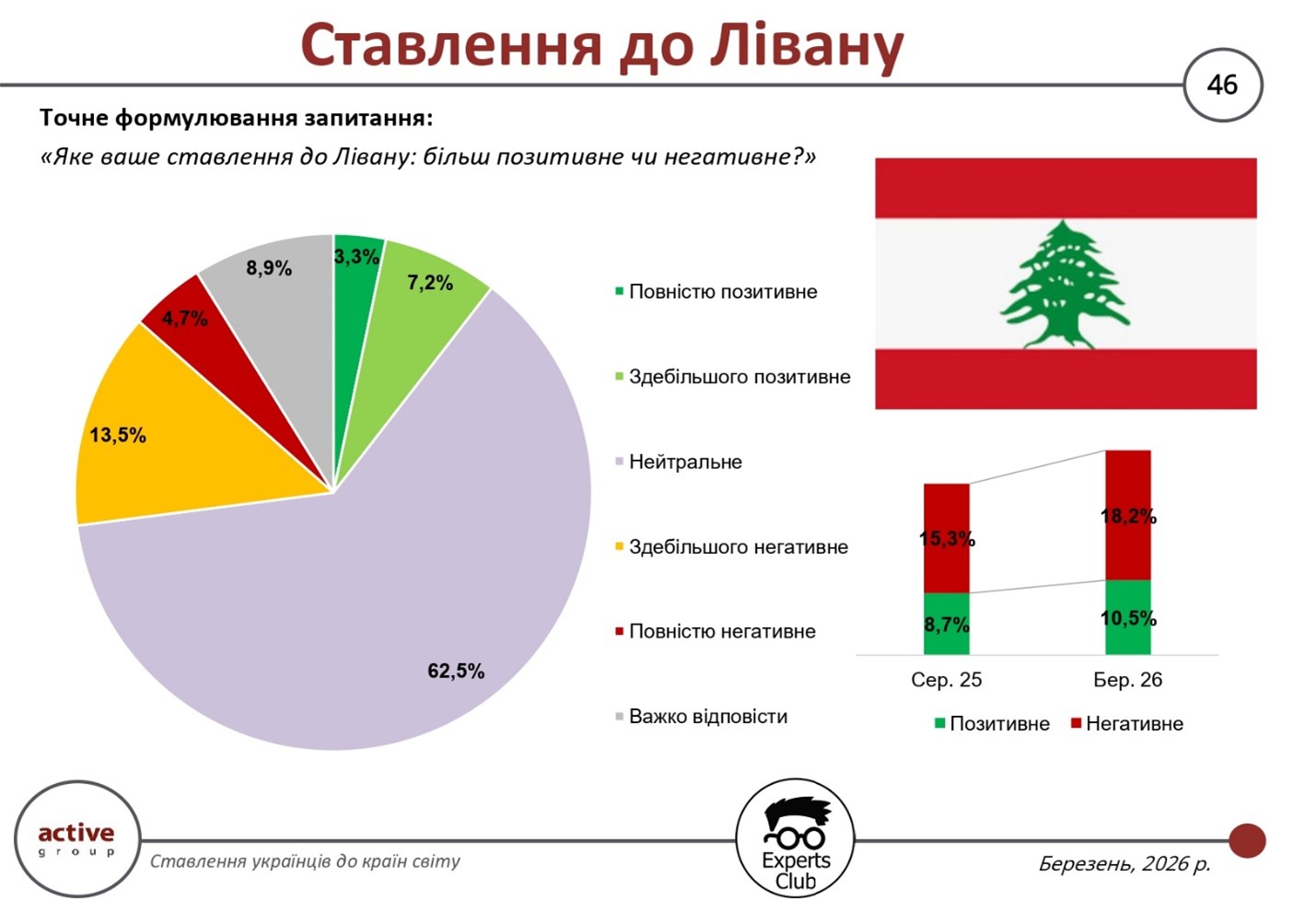
The share of positive attitudes toward Lebanon is relatively low—10.5%. Specifically, 3.3% of respondents indicated a “completely positive” attitude, and 7.2% — a “mostly positive” one. At the same time, negative assessments are significantly higher — 18.2% in total, of which 13.5% represent a “mostly negative” attitude and another 4.7% — a “completely negative” one. Additionally, 8.9% of respondents were unable to determine their position.
Compared to August 2025, there has been a simultaneous increase in both positive (from 8.7% to 10.5%) and negative (from 15.3% to 18.2%) attitudes. This trend indicates the gradual formation of a more defined image of Lebanon in Ukrainian society, although the neutral segment remains dominant.
A high level of neutrality combined with a rise in negative assessments may point to a fragmented perception of the country, shaped not through systematic interaction but through isolated information signals. Under such conditions, even a limited information background or media events can significantly influence the balance of assessments.
“When we see that, alongside neutrality, the share of negative assessments is also beginning to rise, it means that the country is gradually entering the information space, but this process is not accompanied by a sufficient number of positive signals. In such cases, an asymmetrical perception forms, where individual events or news stories have a disproportionately large impact. That is why it is important for countries with a similar profile to work not only on their presence but also on the content of that presence,” noted Maksym Urakin, founder of the Experts Club information and analytical center.
Thus, Lebanon is among the group of countries with a weak established image in Ukraine, where neutrality is gradually shifting toward a more polarized perception. The future trajectory of these assessments will largely depend on the intensity of contacts, media presence, and the nature of interaction between the countries.
According to a study conducted by the Experts Club Information and Analytical Center based on data from the State Customs Service, Lebanon ranks 33rd in total trade volume of goods with Ukraine, with a figure of $532.9 million. This is one of the most striking examples of a trade surplus for Ukraine, as Ukrainian exports far exceed imports from Lebanon.
The study was presented at the Interfax-Ukraine press center; the video can be viewed on the agency’s YouTube channel. The full version of the study can be found at this link on the Experts Club analytical center’s website.
ACTIVE GROUP, EXPERTS CLUB, LEBANON, Pozniy, SOCIOLOGY, SURVEY, UKRAINE, URAKIN
The results of a sociological survey conducted in March 2026 by the research company Active Group in collaboration with the Experts Club information and analytical center show that Indonesia remains one of the countries with the highest level of neutral perception among Ukrainians. According to the study, 71.6% of respondents chose a neutral assessment, indicating limited involvement of this country in Ukraine’s informational and economic space.
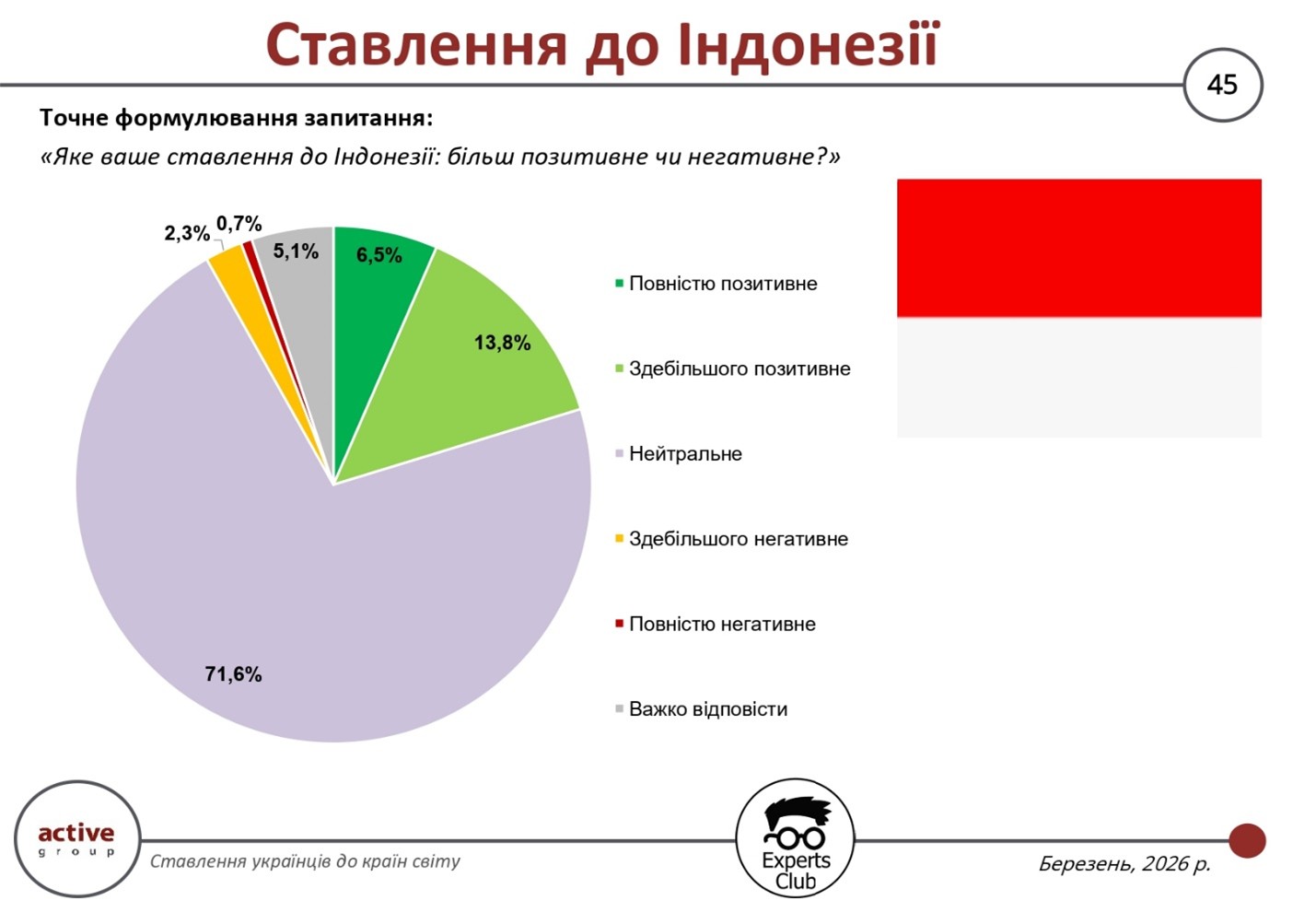
The share of positive attitudes toward Indonesia stands at 20.3%. Specifically, 6.5% of respondents indicated a “completely positive” attitude, and 13.8% — “mostly positive.” At the same time, negative assessments remain minimal — a total of 3.0%, of which 2.3% answered “mostly negative” and only 0.7% — “completely negative.” Another 5.1% of respondents were unable to determine their position.
This pattern of responses is typical for countries that do not have a significant influence on Ukraine’s domestic agenda or are not associated with key political, security, or economic processes. The high proportion of neutral assessments indicates not a negative perception, but rather the absence of a clearly formed image of the country in the public consciousness.
“When we see over 70% neutral responses, it means that the country is effectively outside the active information field of Ukrainians. In such cases, perceptions are formed not through experience or interaction, but through fragmented impressions. That is why even a slight increase in economic or humanitarian contacts can quite quickly shift the balance of assessments in a positive direction,” noted Maksym Urakin, founder of the Experts Club information and analytical center.
Thus, Indonesia remains a country with the potential to build a positive image among Ukrainians; however, this potential has not yet been realized due to low visibility and limited practical interaction. If bilateral contacts are intensified, particularly in the economic and educational spheres, the neutral segment could become the foundation for growing positive perceptions.
According to a study conducted by the Experts Club information and analytical center based on data from the State Customs Service, Indonesia ranks 32nd in terms of total trade in goods with Ukraine, amounting to $578.3 million. At the same time, Ukraine has a small trade surplus, as exports to Indonesia slightly exceed imports.
The study was presented at the Interfax-Ukraine press center; the video can be viewed on the agency’s YouTube channel. The full version of the study can be found at this link on the Experts Club analytical center’s website.
ACTIVE GROUP, EXPERTS CLUB, INDONESIA, Pozniy, SOCIOLOGY, SURVEY, UKRAINE, URAKIN
The results of a survey conducted in March 2026 by the research company Active Group in collaboration with the Experts Club information and analytical center indicate that Ukrainians’ attitudes toward Taiwan (referred to as “a province of China”) remain predominantly neutral, despite the presence of a moderately positive segment. The share of respondents who view Taiwan positively stands at 36.6%, which is lower than the August 2025 figure (41.0%). At the same time, negative assessments have decreased slightly—to 7.2% from 7.7%.
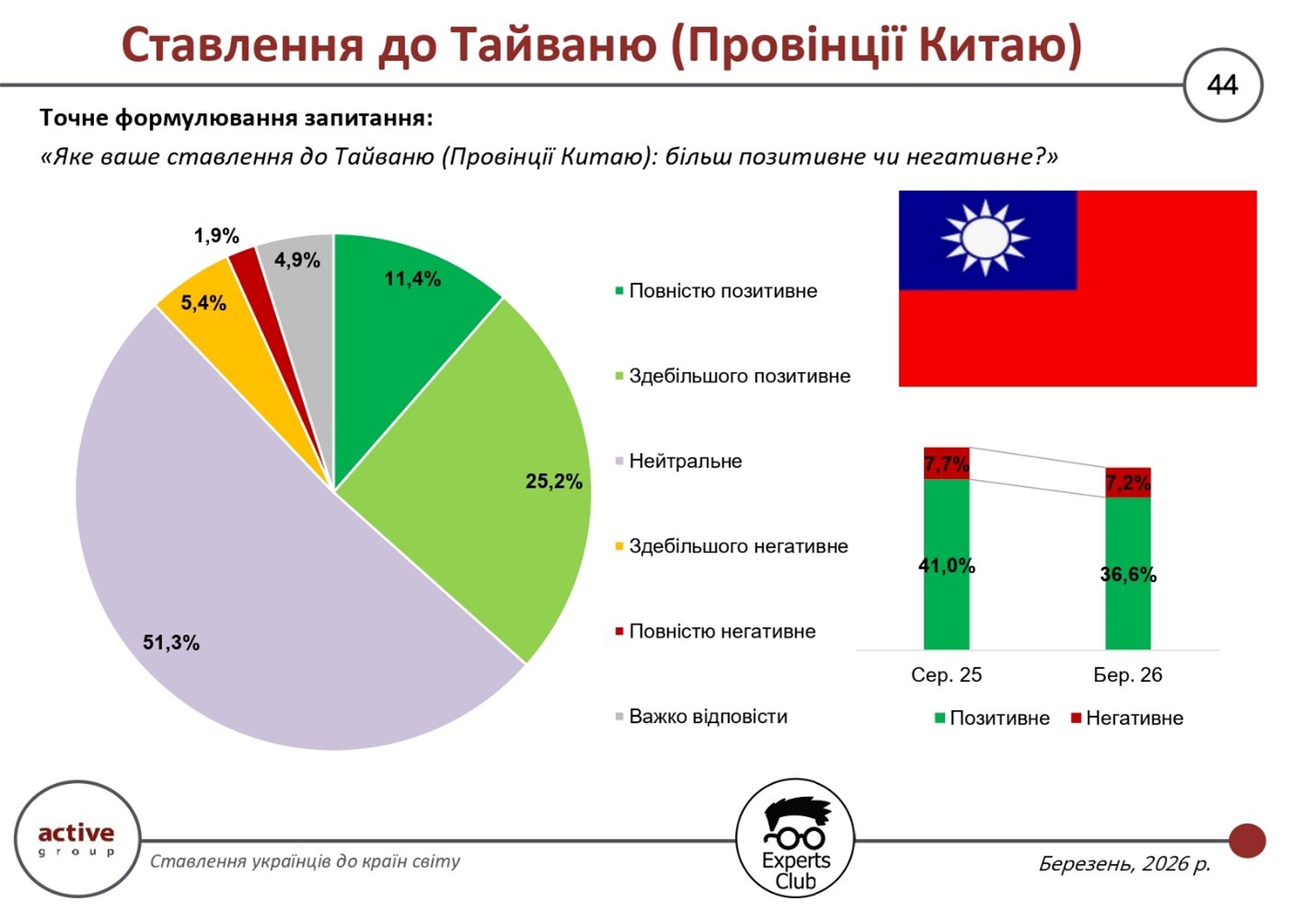
In the breakdown of responses, only 11.4% of respondents indicated a “completely positive” attitude, while another 25.2% said “mostly positive.” At the same time, neutral assessments constitute the absolute majority—51.3%, which is one of the highest figures among the countries surveyed.
The negative segment remains relatively limited: 5.4% of respondents answered “mostly negative,” and 1.9% — “completely negative.” Another 4.9% of respondents were unable to determine their attitude.
Comparative trends show that the decline in positive perceptions occurred without a significant increase in negative ones. This means that some respondents shifted to a neutral position, which is typical for countries that do not have a strong media presence or direct influence on the daily lives of Ukrainians.
“Ukrainians tend to assess countries about which they have limited experience or information with caution. In such cases, a neutral attitude dominates, which is not a sign of indifference but rather an indication of these countries’ insufficient involvement in Ukraine’s informational and social space. At the same time, even a moderate presence of positive sentiment indicates potential for building trust in the future,” noted Oleksandr Pozniy, director of the research firm Active Group.
Thus, for Ukrainian society, Taiwan remains a country with an undefined but not negative image. The high level of neutral assessments indicates significant potential for a shift in perception, which depends primarily on the intensity of contacts, information exchange, and political visibility.
According to a study conducted by the Experts Club information and analytical center based on data from the State Customs Service, Taiwan, a province of China, ranks 31st in total trade volume of goods with Ukraine, with a figure of $650.8 million. At the same time, imports from Taiwan almost entirely dominate the structure of bilateral trade, resulting in a significant trade deficit for Ukraine of over $607 million.
The study was presented at the Interfax-Ukraine press center; the video can be viewed on the agency’s YouTube channel. The full version of the study can be found at this link on the Experts Club analytical center’s website.
ACTIVE GROUP, EXPERTS CLUB, Pozniy, SOCIOLOGY, SURVEY, TAIWAN, UKRAINE, URAKIN



