
According to Fixygen, JSC “Ukrainian Energy Machines” intends to hold its annual general meeting of shareholders on April 23, 2026, remotely via a written ballot. The record date for shareholders entitled to participate in the meeting is set for April 20, 2026.
According to published materials, the agenda includes consideration of the supervisory board’s report for 2025, the conclusions of the audit report, the approval of the results of financial and economic activities and the distribution of profits, a review of the remuneration for members of the supervisory board, the determination of the main areas of activity for 2026, as well as the issue of approving agreements with JSC “TASCOMBANK.”
The meeting materials also propose approving the payment of dividends based on the results of 2025. The draft resolution provides for allocating 75% of net profit to dividend payments to shareholders and retaining 25% as retained earnings, with the total amount of annual dividends proposed at UAH 2.304 million.
In addition, shareholders are asked to approve the annual assessment of the achievement of operational goals set out in the owner’s letter of expectations for 2025, reflecting the state’s control over the company. According to SMIDA data for the fourth quarter of 2025, the Ukrainian state owns 75.2241% of the company’s shares, another 15.3416% is controlled by the closed-end non-diversified venture capital investment fund “Seventh” managed by LLC “Asset Management Company ‘Svarog Asset Management’,” and 5.5980% by non-resident individual Valandin V.V.
JSC “Ukrainian Energy Machines” is registered in Kharkiv; the company’s authorized capital is UAH 1.417 billion; the CEO is Viktor Subotin. The main activity is the production of engines and turbines, excluding those for aviation, motor vehicles, and motorcycles. According to Opendatabot, the company’s revenue in 2025 was UAH 1.061 billion, net profit was UAH 3.073 million, and assets at year-end were UAH 8.47 billion. On its corporate website, the company lists itself among the world’s largest manufacturers of steam and hydraulic turbines, as well as turbo and hydro generators.

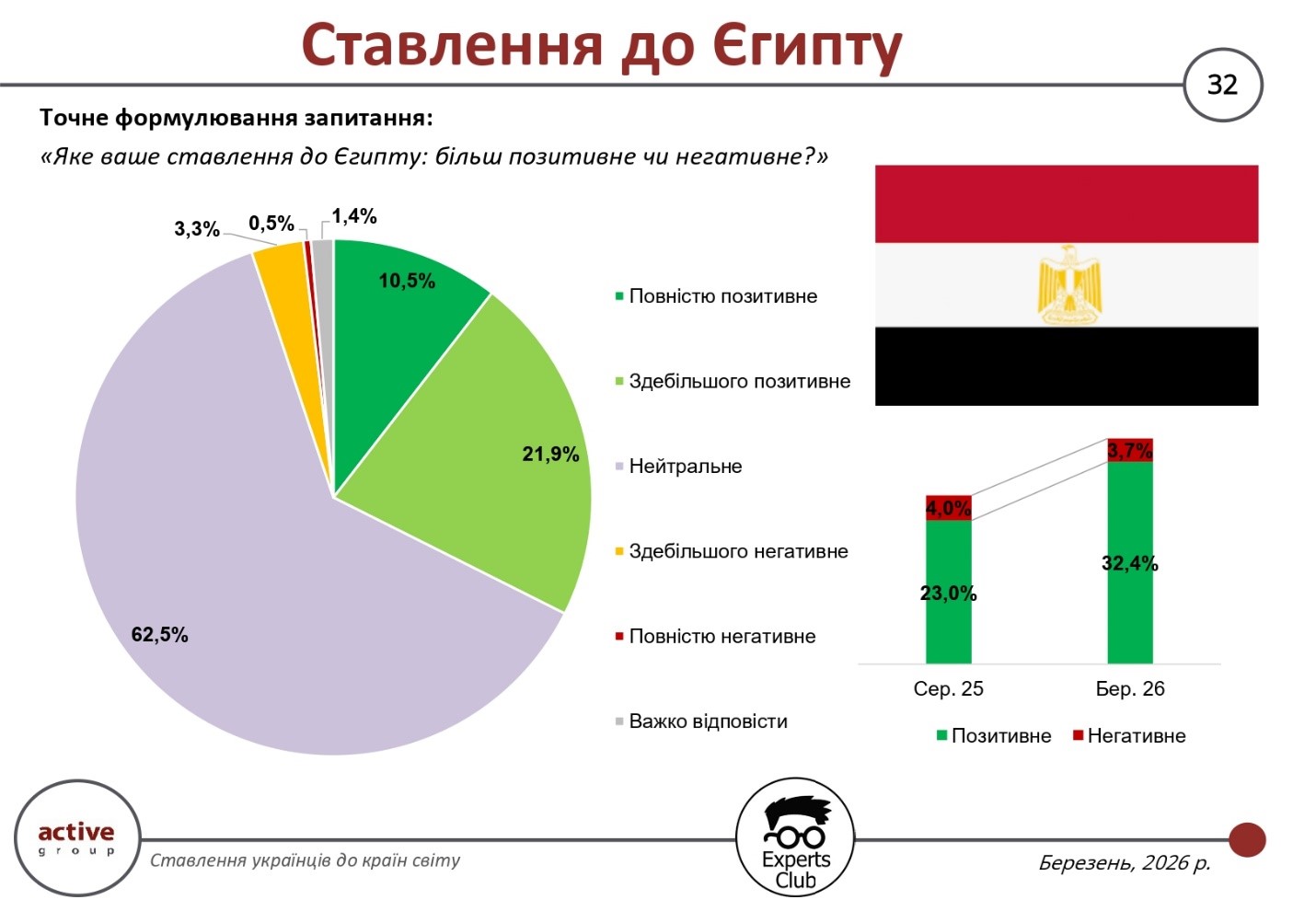
Ukrainians’ attitude toward Egypt remains largely neutral, but trends over the past few months indicate a noticeable improvement in perceptions of the country. According to the results of a sociological survey conducted in March 2026 by the research company Active Group in collaboration with the Experts Club information and analytical center, 32.4% of respondents view Egypt positively, whereas in August 2025 this figure stood at 23.0%. At the same time, the share of negative assessments has decreased slightly—from 4.0% to 3.7%.
The breakdown of responses shows that the largest group remains respondents with a neutral stance—62.5%. This means that for most Ukrainians, Egypt does not belong to the category of countries with a clearly defined emotional image. The positive attitude consists of 10.5% “completely positive” and 21.9% “mostly positive” assessments. The negative segment remains minimal: 3.3% of respondents chose “mostly negative,” 0.5% chose “completely negative,” and another 1.4% were undecided.
Thus, the main feature of attitudes toward Egypt is a combination of very high neutrality with a gradual increase in positive sentiment. This indicates that the country does not yet occupy a prominent place in the Ukrainian information space, yet its image is not negative and has the potential for further improvement. It is also important that the increase in positive assessments is occurring without a rise in critical perception.
“Egypt is a very interesting example of the gap between economic statistics and public perception. Egypt ranks first among Ukraine’s trading partners in terms of trade surplus—over $1.224 billion—meaning it is one of the most profitable markets for us. But in public opinion, we see a predominantly neutral attitude, which means: the country’s economic weight has not yet translated into an equally strong reputational presence,” noted Maksim Urakin, founder of the Experts Club information and analytical center.
From an analytical perspective, this means that Egypt is already an important economic partner for Ukraine, but has not yet become a country with a clearly established positive image in the public consciousness. Given such a significant positive trade balance, the potential for strengthening the bilateral image remains quite high. If economic cooperation is complemented by greater public visibility, humanitarian contacts, and an information presence, some of the current neutrality may eventually shift toward a more pronounced positive perception.
According to a study conducted by the Experts Club information and analytical center based on data from the State Customs Service, Egypt ranks 19th in total trade volume with Ukraine, with a figure of $1.82 billion. At the same time, Ukraine has a significant trade surplus with Egypt, as exports of Ukrainian goods exceed imports by more than five times.
The study was presented at the Interfax-Ukraine press center; the video can be viewed on the agency’s YouTube channel. The full version of the study can be found at this link on the Experts Club analytical center’s website.
ACTIVE GROUP, EGYPT, EXPERTS CLUB, Pozniy, SOCIOLOGY, SURVEY, UKRAINE, URAKIN

According to Fixygen, PJSC “Nikopol Plant of Technological Equipment” intends to hold an extraordinary general meeting of shareholders on May 5, 2026, in a remote format via a written ballot. The record date for shareholders entitled to participate in the meeting has been set for April 30, 2026.
According to the published announcement, the agenda includes five items, the key one being the dissolution of the company through its transformation from a private joint-stock company into a limited liability company. Shareholders are also invited to approve the procedure and terms of the transformation, the procedure for exchanging shares for equity interests in the successor LLC, and to appoint authorized representatives and the members of the transformation commission.
The meeting materials specifically state that the items regarding the procedure for the conversion, the conversion of shares, and the appointment of authorized persons are interrelated with the decision on the conversion itself. If the shareholders do not support the second item on the agenda, votes on the third, fourth, and fifth items will not be counted.
The company must make the ballots freely available on April 24, 2026, at 10:00 a.m., at which time they will also begin to be sent to depository institutions. Ballot acceptance will end on May 5 at 6:00 p.m.
Nikopol Plant of Technological Equipment PJSC was registered on November 1, 2001, in Nikopol, Dnipropetrovsk Oblast; its authorized capital is UAH 16.61 million; the director listed is Dmytro Sharf; and its primary activity is the manufacture of tools. According to Opendatabot, the company’s revenue in 2025 was UAH 1.081 billion, net profit was UAH 29.53 million, and assets at year-end were UAH 240.38 million. According to SMIDA data on major shareholders as of March 31, 2026, 25.01% of the shares are owned by Centravis Production Ukraine PJSC, another 25.01% by Interpipe Nico Tube LLC, 24.984% by PKP Yuvis LLC, and 24.99% by the Cypriot company Volbert Company Limited.
Nikopol Plant of Technological Equipment, shareholders' meeting

According to Fixygen, JSC “Zhytomyr Delicacies” intends to hold its annual general meeting of shareholders on April 30, 2026, remotely via a written ballot. Voting on agenda items will begin on April 20 at 11:00 a.m. and end on April 30 at 6:00 p.m., and the list of shareholders eligible to participate in the meeting will be compiled as of April 27.
According to the published notice, the agenda includes consideration of the supervisory board’s report for 2025, approval of the results of financial and operational activities and profit distribution, a decision on dividend payments, review of the audit report, as well as an increase in the number of members of the supervisory board, the election of new members, including independent directors, and the approval of a new version of the articles of association and the regulations on the supervisory board.
The draft resolutions propose to approve the company’s net profit for 2025 in the amount of UAH 32.871 million and to allocate it for the payment of dividends. It is proposed to approve the dividend amount for ordinary registered shares at UAH 0.87 per share, with the payment to be made within six months from the date of the resolution’s adoption by the general meeting. Shareholders are also proposed to increase the composition of the supervisory board from three to seven members, two of whom must be independent directors.
JSC “Zhytomyr Delicacies” was registered in Zhytomyr on September 23, 1993; the company’s primary activity is the wholesale trade of sugar, chocolate, and confectionery products; its authorized capital is UAH 18.22 million; and Lyudmila Sidenko is listed as the director. According to public registries, the largest shareholders are TIS-COMPANY LLC with a 65.8663% stake, Trading House “Zhytomyrski Lasoschi” LLC with a 16.4666% stake, and Delta Capital SA with a 13.9711% stake. The company’s revenue in 2025 amounted to 707.628 million UAH, its net loss was 31.813 million UAH, and its assets at year-end were 1.233 billion UAH.
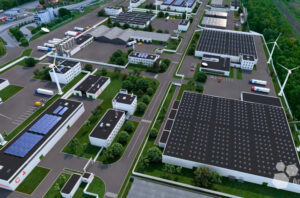
The Bila Tserkva Industrial Park (IP)—a project of entrepreneur Vasyl Khmelnytskyi’s holding company UFuture—is building an educational hub and plans to open it in 2026, Oleksiy Henzer, commercial director of the Bila Tserkva Industrial Park, told Interfax-Ukraine. According to him, the building, with a total area of 2,500 square meters, will house classrooms, training facilities with modern equipment, production laboratories, a conference hall, and office and social spaces.
“For us, the industrial park is a platform for shared infrastructure and collaborative solutions. Together, we create the engineering foundation, organize services, and must also jointly address systemic barriers that are difficult, expensive, and not always effective for an individual resident to overcome on their own. “One of the most pressing issues today is the availability of qualified specialists. For us, the training of specialists is part of the investment infrastructure,” he said.
Genzer emphasized the critical importance of supporting the community’s industrial development alongside the simultaneous development of education at all levels. “We are currently planning to involve a specialized educational institution to develop modern curricula. We also plan to involve residents in the program to give people the opportunity to train on modern equipment and obtain relevant qualifications directly within the park,” he said.
In addition, among the projects of the “Bila Tserkva” Industrial Park is support for secondary and vocational education. In particular, a memorandum has been signed with local authorities regarding the renovation of vocational training classrooms. Two classrooms have already been renovated, and by 2028, we plan to renovate classrooms in 13 more educational institutions.
“The community is handling the renovations, while we provide modern equipment. We hope that within the framework of this project, we will be able to cover almost all secondary schools in the city,” said Genzer.
UFuture, the investment holding company of Ukrainian entrepreneur Vasyl Khmelnytskyi, has a diversified portfolio of assets in real estate, infrastructure, industry, and pharmaceuticals. It is actively investing in the development of the UNIT.City innovation park and the Bila Tserkva Industrial Park.
The Bila Tserkva Industrial Park and Bila Tserkva 2 were included in the Register of Industrial Parks in 2018. There are over two dozen residents (including foreign companies) within the parks. Their total area is 70.3 hectares, of which 45 hectares have already been developed. Over 85,000 square meters of industrial and warehouse real estate have been commissioned.

The UK intends to tighten the rules for obtaining permanent residency for most migrants by extending the standard waiting period from five to ten years. The primary source of this initiative is the UK government’s immigration White Paper, “Restoring control over the immigration system.” These documents explicitly mention a transition from the current five-year baseline to a new standard threshold of ten years.
The new model implies that the right to permanent residence will no longer be granted automatically after a fixed period of stay. The authorities want to link it to criteria regarding behavior, integration, and contribution to British society and the economy. The official consultation states that when reviewing applications, the following will be taken into account: the legality and continuity of residence, knowledge of the English language, passing the Life in the UK test, no criminal offenses, and, likely, verified employment and tax contributions.
The consultation on the earned settlement reform ran from November 20, 2025, to February 12, 2026, and the government says it is currently analyzing the feedback received. At the same time, London has already begun to implement related changes: on March 5, 2026, the Home Office announced stricter English language requirements for obtaining settlement, with these changes set to take effect in March 2027.



