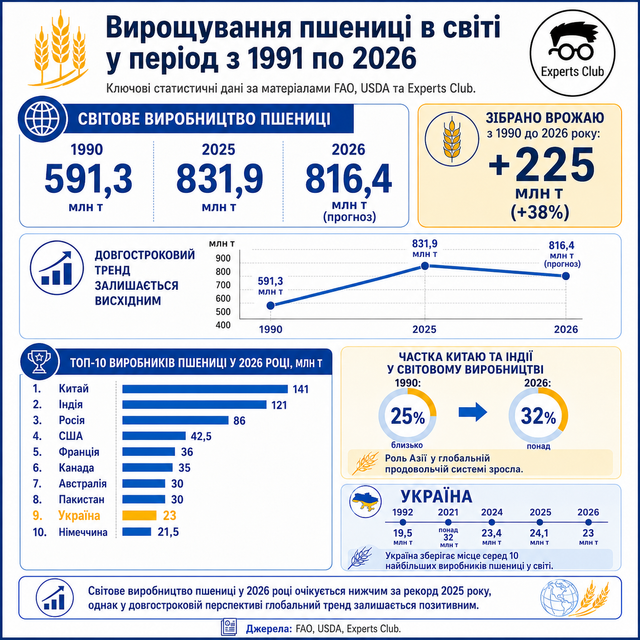
Global grain production in 2026 could reach one of the highest levels on record, but international trade is declining due to logistical restrictions, particularly shipping problems in the Black Sea. Ensuring global food security depends not only on the volume of production but also on the ability to transport products to consumers on time and at an affordable price, SEEDS reports, citing an analysis by international expert Kateryna Zvierieva.
According to the latest estimates by the Food and Agriculture Organization of the United Nations (FAO), global grain production in 2026 is forecast at 2.979 billion tonnes. This is the second-highest figure on record. At the same time, the volume of international grain trade is projected to decrease by 3.5% to 505.8 million tonnes.
Among the main factors behind the decline in trade, FAO identifies shipping difficulties in the Black Sea and insufficient capacity of alternative transport corridors. As a result, even with high production volumes, certain regions may face supply disruptions and rising costs of imported food.
As Kateryna Zvierieva, an international expert in strategic communications in the agri-food sector, sustainable development and food systems, notes in an article for the Italian publication Agricultura.it, risks to food security are not necessarily associated with a physical shortage of grain. The availability of transport routes, delivery speed and logistics costs play a significant role.
The situation in Ukraine is particularly illustrative in this context, as grain exports remain dependent on security conditions, the operation of port infrastructure and the capacity of alternative routes.
According to the State Customs Service of Ukraine, as of October 16, the country had exported 5.929 million tonnes of grain and leguminous crops since the beginning of the 2026/27 marketing year. This is 24.9% less than during the corresponding period of the previous season.
At the same time, export trends for individual crops differ significantly. In particular, wheat shipments decreased by 40.5%, while corn exports increased by approximately 80%. This difference indicates that logistical and market factors have varying effects on individual segments of the grain market.
The structure of transport routes has also changed. According to the European Commission, in September 2026, about 90% of Ukrainian exports of grain, oilseeds and related products were transported through the Solidarity Lanes between Ukraine and the EU. Meanwhile, approximately 10% of shipments passed through Black Sea ports.
Rail, road and river transport make it possible to maintain exports even under restrictions on maritime logistics. However, their capacity remains an important factor determining the volumes, delivery times and costs of agricultural product shipments.
Logistical difficulties also affect global food prices. According to FAO, the Food Price Index rose by 1.5% in September compared with August and by 5.8% year-on-year. Meanwhile, the cereal price sub-index increased by 5.1% over the month and by 17.2% compared with September 2025.
In particular, global wheat prices rose by 6.3% during the month. Among the reasons cited are restrictions on transport connections in the Black Sea region and dry weather conditions in certain areas of North America. Corn became 5.6% more expensive amid expectations regarding yields in the United States and a reduction in export supplies from Brazil.
According to Zvierieva, delays in transporting products create risks not only for international trade but also for the financial stability of agricultural enterprises. Longer delivery times and higher transport costs affect farmers’ working capital, their ability to finance current operations and investments in subsequent production cycles.
At the same time, high global harvests and declining trade do not automatically mean the emergence of a global food crisis. However, the current situation demonstrates the dependence of food markets on transport infrastructure and the stability of international supply chains.
Thus, ensuring global food security increasingly depends on countries’ ability to maintain stable logistics routes, diversify transport corridors and reduce food delivery costs.
Kateryna Zvierieva is an international expert in strategic communications in the agri-food sector, sustainable development and food systems. She has collaborated with FAO and the European Bank for Reconstruction and Development (EBRD). She is the founder of Sapienza.media.
Agricultural exports, FAO, FOOD SECURITY, GLOBAL MARKETS, GRAINS, KATERYNA ZVIERIEVA, LOGISTICS, UKRAINE

Ukraine has officially been granted sectoral partner status in the Pacific Islands Forum (PIF), which brings together 18 states and territories in the Pacific region. The decision was made by the organization’s leaders at the 55th summit in Palau, held from August 30 to September 4, 2026, the Ukrainian Embassy in Australia reported on October 25.
According to the diplomatic mission’s statement, the Forum Secretariat sent an official notification confirming Ukraine’s inclusion in the Sectoral Partnership Stream.
This decision was the result of more than three years of diplomatic efforts aimed at expanding Ukraine’s relations with the states of Oceania and regional international organizations.
The new status provides for the possibility of regular political dialogue with Forum member states, particularly within the framework of the organization’s annual meetings of foreign ministers with international partners (Forum Foreign Ministers–Forum Partners Dialogue).
In addition, Ukraine and the Forum will be able to develop a joint cooperation plan in areas of mutual interest.
Kyiv has identified food security, digital governance, education, and climate change adaptation as priority areas.
In particular, developing cooperation in the area of food security could create additional opportunities for Ukrainian agricultural and food producers. Countries in the Pacific region are interested in increasing the resilience of food supplies, as many island economies are heavily dependent on imports.
Another promising area is the exchange of Ukraine’s experience in the digitization of public services and the development of e-governance.
In the field of education, this new format of cooperation could facilitate academic exchanges, joint research programs, and the training of specialists.
However, the embassy’s statement did not announce any specific trade agreements, investment projects, or financial commitments. Ukrainian diplomacy attaches particular importance to cooperation with the states of Oceania on issues of international law, compliance with the UN Charter, and the protection of states’ sovereignty and territorial integrity.
The embassy emphasized Ukraine’s interest in strengthening international support for the principle that state borders cannot be altered by force.
Ukraine also expressed its gratitude to the leadership of the Forum Secretariat and to all 18 member states and territories of the organization for supporting the decision to grant the new status.
The Pacific Islands Forum was established in 1971 under the name South Pacific Forum. In 2000, the organization adopted its current name. Its headquarters are located in Suva, the capital of Fiji.
The Forum’s members include Australia, New Zealand, Fiji, Papua New Guinea, Samoa, Tonga, Vanuatu, the Solomon Islands, Kiribati, Nauru, Tuvalu, Palau, the Marshall Islands, the Federated States of Micronesia, the Cook Islands, Niue, as well as French Polynesia and New Caledonia.
The organization addresses issues of regional economic integration, trade, climate change, sustainable development, and security. One of its key strategic documents is the 2050 Strategy for the Blue Pacific Continent.
At the 2026 summit, member states approved an updated mechanism for engaging with international partners, which divides cooperation into strategic and sectoral areas.
Ukraine’s attainment of sectoral status creates an institutional framework for long-term cooperation with the nations of Oceania; however, it does not mean that the country has joined the Forum as a full member.
Source: Embassy of Ukraine in Australia, official statement dated October 25, 2026.
DIPLOMACY, FOOD SECURITY, international cooperation, Oceania, UKRAINE
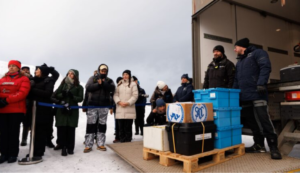
Ukraine has transferred 773 seed samples of ten agricultural crops from its national collection to the Global Seed Vault on the Svalbard archipelago in Norway.
The samples transferred to the Arctic seed vault include triticale, barley, buckwheat, millet, peas, white lupine, vetch, Sarepta mustard, alfalfa, and clover. These samples represent valuable genetic resources from Ukrainian plant breeding, which are essential for developing new varieties, adapting agriculture to climate change, and ensuring food security.
According to the National Academy of Agrarian Sciences of Ukraine (NAAS), the seeds were prepared by the V.Y. Yuryev Institute of Plant Growing and the Ustymiv Experimental Station of Plant Growing. Scientists selected the most valuable samples and ensured their testing, packaging, and documentation under wartime conditions.
“Preserving the national plant gene pool is a matter of our national security and ensuring food stability for future generations,” emphasized Taras Vysotsky, Minister of Agrarian Policy and Food of Ukraine, as quoted by SEEDS.
According to him, transferring the duplicate collection to an international repository will protect the unique achievements of Ukrainian plant breeders from risks associated with the war.
This transfer marks the second such event in Ukraine’s history. The previous deposit of Ukrainian seeds on Svalbard took place in 2012.
According to the Delegation of the European Union to Ukraine, these two transfers have ensured the backup storage of genetic material representing approximately 10% of the national seed collection.
Ukraine’s National Plant Genetic Bank contains over 154,300 samples of 2,002 plant species. Of these, approximately 56,900 samples are of Ukrainian origin. The collection includes genetic material from cereals, legumes, oilseeds, forage crops, and other agricultural crops.
Preserving this collection is of strategic importance for agricultural science. Genetic diversity enables breeders to develop new varieties that are resistant to drought, diseases, temperature fluctuations, and other adverse growing conditions.
Following the outbreak of full-scale war, Ukraine’s system for conserving genetic resources came under threat due to hostilities, damage to scientific infrastructure, and the risk of losing unique collections.
To protect the seeds, the Food and Agriculture Organization of the United Nations (FAO), with financial support from the European Union, implemented a program to establish backup storage facilities in collaboration with the National Academy of Agrarian Sciences of Ukraine (NAAS) and international partners.
As part of this initiative, 51,000 seed samples were evacuated to the western regions of Ukraine, and in November 2025, a permanent backup center was opened, equipped with modern laboratories and specialized infrastructure for the long-term storage of genetic material.
Storing part of the collection on Svalbard provided an additional layer of protection. In the event of damage to or loss of Ukraine’s primary collections, the backup samples can be used to restore genetic resources.
At the same time, the transferred seeds remain the property of Ukraine. The international repository ensures their storage without transferring ownership rights to the genetic material.
Ukraine has also acceded to the International Treaty on Plant Genetic Resources for Food and Agriculture, which entered into force for the country on August 12, 2026. This creates additional opportunities for international scientific cooperation and the protection of agricultural biodiversity.
The Svalbard Global Seed Vault is located on the Norwegian archipelago of Svalbard, above the Arctic Circle, and has been in operation since 2008. It was established for the long-term backup storage of genetic resources of agricultural plants from around the world.
According to the vault’s administration, as of 2026, it holds more than 1.4 million seed samples provided by gene banks and scientific institutions from various countries.
During the October 2026 ceremony, 21 research institutions from various regions of the world donated samples. In total, the repository received more than 16,000 new samples.
The project is supported by the Norwegian government, the Nordic Genetic Resource Center (NordGen), and the international organization Crop Trust. Its primary goal is to ensure the restoration of crop varieties in the event of wars, natural disasters, man-made disasters, or other threats to plant genetic diversity.
Sources: SEEDS, publication dated October 16, 2026; V. Ya. Yuryev Institute of Plant Growing, National Academy of Agrarian Sciences of Ukraine; Svalbard Global Seed Vault, announcement dated October 14, 2026.
agricultural sector, FOOD SECURITY, plant breeding, SEEDS, UKRAINE
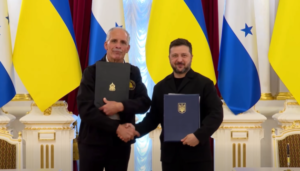
Ukraine can help Honduras with food security, according to Honduran President Nasri Asfura.
“Ukraine has extremely important ideas and technologies that could be useful to us in the agricultural sector and could also help us with food security,” Asfour said at a joint press conference with Ukrainian President Volodymyr Zelenskyy on Friday.
For his part, Zelenskyy noted that Ukraine is ready to assist Honduras in matters related to drone technology.
“We are ready to share our knowledge on digitalization. We have made significant strides forward, especially during the war… We are ready to help with drone technology,” Zelenskyy said.
He emphasized that drones are not just about weapons—they are about security, coastal defense, and intelligence.

Norway will allocate NOK 200 million (approximately EUR 17 million) to the World Food Program, including the Grain from Ukraine program, and NOK 50 million (approximately EUR 4 million) will be transferred to the World Bank’s Ukraine Fund, the Norwegian government said in a statement.
“Norway will continue to support the people of Ukraine. At the same time, we do not lose sight of other crises in the world. The Nansen Program (5-year support program for Ukraine – IF-U) is one example of how we manage to combine these efforts,” Norwegian Foreign Minister Espen Barth Eide said in a statement.
In addition, it is noted that another 150 million Norwegian kroner (about EUR 12 million) will be allocated to the World Food Program in response to its call for emergency assistance to Ukraine.
“In addition to providing food aid near the front line, these funds will be used to demine agricultural land, allowing farmers to return to food production as soon as possible,” the statement said.