
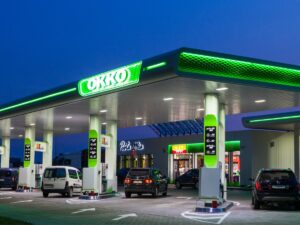
The OKKO network remains the largest importer of automotive gasoline into Ukraine: in August 2026, the company imported 46,100 metric tons of fuel, and 302,000 metric tons since the beginning of the year, according to data from the A-95 Consulting Group. OKKO accounts for about 27% of all Ukrainian gasoline imports since the beginning of the year.
The next group of largest suppliers consists of WOG, UPG, and “Ukrnafta.”
In August, WOG imported 20,200 metric tons of gasoline, UPG—20,000 metric tons, and “Ukrnafta” imported 19,400 metric tons.
Next are “BRSM-Nafta” with 7,000 metric tons, Amic with 3,400 metric tons, and “Avantage” with 3,100 metric tons.
Gaztrim and KLO each imported 2,400 metric tons, and Bars 2000 imported 2,200 metric tons.
Other market participants accounted for 26,100 metric tons.
In total, Ukraine imported 152,000 metric tons of motor gasoline in August.
The largest countries of origin for the fuel were Lithuania—51,800 metric tons—and Poland—40,100 metric tons. The ORLEN Group supplied more than half of August’s imports.
The Cabinet of Ministers of Ukraine has so far rejected the idea of mobile gas stations in order to protect consumers from low-quality fuel and avoid risks related to tax payments, but gas station operating schedules will be revised, according to Serhiy Kuyun, director of the consulting firm “A-95.”
“The idea of mobile gas stations has been put on hold to avoid facing the situation currently unfolding in Russia, where many people no longer drive anywhere due to the authorization to sell low-quality fuel. Moreover, the state’s need for fuel taxes hasn’t gone away, and in this chaos, it will be even harder to collect them,” Kuyun wrote on his Facebook page on Friday.
At the same time, as he noted, certain measures regarding gas station operations under shelling were discussed at a recent meeting with the prime minister.
“At the meeting, representatives of the gas station network assured that they would continue operating, as they have gradually adapted to the new realities. But operating hours will obviously be changed (shortened), and service operations in dangerous areas will be temporarily suspended… The less often and the less time you spend at a gas station, the better,” Kuyun noted.
He also noted that the issue of fuel delivery remains critical, as the enemy has begun targeting fuel tankers.
The director of “A-95” noted that, according to estimates, up to 200 gas stations and oil depots have already been damaged, including four oil depots and nine “OKKO” gas stations, 22 “WOG” facilities, and 12 “Ukrnafta” facilities.
As previously reported, on July 7, the Prime Minister of Ukraine held a meeting with oil traders to discuss the necessary measures to ensure continued fuel supplies to frontline regions amid ongoing Russian attacks on gas stations and fuel complexes.
At the time, Danylo Getmantsev, chairman of the Verkhovna Rada’s Tax Committee, noted following the meeting that the government and market representatives have a clear plan of action to ensure uninterrupted supplies and prevent losses. He also announced that the necessary decisions would be adopted in the near future.
Fuel prices in Ukraine continue to decline—this applies primarily to diesel, which has dropped by another 1–3 UAH per liter over the past five days, according to price monitoring at select gas station chains conducted by Energoreforma.
According to the report, natural gas prices have also fallen by up to 1 UAH per liter.
Gasoline prices remain stable, at the same level as on June 17.
According to calculations by Serhiy Kuyun, director of the consulting firm “A-95,” the price of diesel fuel has already dropped by more than 12 UAH per liter from its peak of over 90 UAH per liter.
He noted that at the start of the crisis, the price of diesel fuel was 62 UAH per liter.
The expert also pointed out that smaller retail chains, which do not have remaining stocks of fuel purchased at high prices, are lowering their prices more aggressively.
Regarding gasoline, Kuyun explained that there is no noticeable downward trend, since the difference between the purchase price (customs value) and the retail price during the “Iranian crisis” only returned to its pre-crisis February level in June.
“In other words, there are no excess profits that could explain the slowdown in price reductions. Gasoline margins have completely collapsed, which is why prices aren’t really falling. Gas stations’ finances are currently being propped up by diesel, though that doesn’t prevent diesel prices from falling sharply,” Kuyun wrote.
At the same time, the director of “A-95” emphasized that Russian attacks on gas station networks continue, and these losses are also putting pressure on their finances.
“Last week, one of the major chains lost an oil depot containing $1.5 million worth of fuel. Another chain reports that it suffers 15–20 ‘lightning strikes’ every week in frontline regions. WOG has already lost 6–7 gas stations, each worth $1 million. Gasoline and natural gas tankers are burning,” Kuyun described the situation.
He also noted that there had been an initiative to create a fund to compensate for these losses, but so far there are no sources of funding for it.
Kuyun pointed out that current global prices are not the only factor in pricing, but given the level of competition and the large number of gas stations, supply sources, and logistical capabilities in the Ukrainian market, in his opinion, there is no chance of operating under any rules other than market ones.
For his part, Volodymyr Omelchenko, director of energy and infrastructure programs at the Razumkov Center, noted that autogas is once again becoming more cost-effective than gasoline, having dropped by more than 5 UAH/liter in one month and more than 7 UAH/liter in two months.
Meanwhile, gasoline prices fell by only 1.1 UAH per liter over the same period. He noted that currently, a liter of LPG costs approximately 56% of the price of a liter of A-95.
Omelchenko attributed this, in particular, to a decline in the wholesale price of LPG, which fell by 3.46 UAH per liter over the past month.
According to him, propane and butane prices have fallen in Europe, and the import parity for LPG has also declined since its April peak. As of June 19, it stood at 34.43 UAH per liter, compared to 40.95 UAH per liter on April 16.
However, he also noted that the price cap at gas stations is determined not only by European quotations but also by the influence of wholesale prices, logistics, taxes, exchange rates, security risks, and the safety margins of the networks themselves.
“Therefore, a decrease in external prices does not always immediately translate into an equivalent decrease at the retail level,” Omelchenko said.
As previously reported, fuel prices in Ukraine began to decline around mid-June amid reports of a stabilizing situation in the Middle East and falling oil prices. On June 19, Pavlo Kyrylenko, head of the Antimonopoly Committee of Ukraine, convened fuel market participants to discuss the situation.
He drew their attention to the fact that over the past few weeks, global markets have seen a significant drop in prices for crude oil and petroleum products, but in Ukraine, the pace of decline in retail fuel prices remains significantly slower than the pace of their previous rise.
Market participants were asked to provide further explanations regarding the reasons for the slower decline in petroleum product prices compared to their previous rapid rise, as well as the factors influencing how quickly lower petroleum product costs are reflected in prices for end consumers.
On June 17, Natalia Nikeshina, marketing director of the national network of gas stations operating under the Parallel brand, predicted that the potential for price reductions ranges from 6 UAH to 12 UAH per liter. According to her, the largest drop can be expected if European prices do indeed fall to pre-crisis levels.

Total drug sales at gas stations accounted for less than 0.1% of the retail market; experts surveyed by Interfax-Ukraine believe this segment has a negligible impact on the retail pharmaceutical market.
“As of today, 260 licenses have been issued, with more than a third of them in Kyiv and the surrounding region. This accounts for 1% of the total number of pharmacies on the market. These are more like pharmacy kiosks than pharmacies at gas stations,” said Iryna Horlova, CEO of the analytical and consulting firm Support in Market Development (SMD).
She noted that the law permits these retail outlets to sell only a specific list of limited over-the-counter medications, primarily pain relievers, nasal drops, and cold remedies.
“Since this accounts for 1% of the total number of pharmacies and potentially about 0.05% of the pharmaceutical market’s turnover, the opening of these pharmacies has had no impact and will have no impact on the country’s pharmaceutical market,” she said.
At the same time, Gorlova noted that “prices are regulated by law.”
“Last year, the National Price Catalog was introduced, which sets a price cap for each registered drug item; pharmacies are not allowed to sell it for more than that. Therefore, prices at gas station pharmacies cannot be higher than at regular pharmacies and will not affect price changes in any way,” she said.
At the same time, according to Gorlova, despite the fact that “this initiative brings Ukraine closer to other developed countries where the sale of medicines at gas stations is permitted, unfortunately, these initiatives will not help make medicines more accessible to rural regions, as was intended, but will increase their accessibility and convenience for drivers and their passengers.”
For his part, Dr. Serhiy Sur, a pharmaceutical scientist, also noted that “the authorization to sell medicines at gas stations has not yet had any impact on the market.”
“According to results from April 2026, medicines were sold at only 260 gas stations, and the total volume of sales amounted to just 354,000 UAH. The average turnover per location was 4,700 UAH per month. For comparison, sales of over-the-counter medicines in the retail market (across 18,000 pharmacies) totaled 5.167 billion UAH as of April 2026. Accordingly, the average turnover for this category of drugs per pharmacy was approximately 283,000 UAH per month. In other words, sales of over-the-counter drugs at gas stations as of April 2026 accounted for less than 0.007% of their sales in pharmacies,” he said.
According to Sura’s estimates, the sale of medicines at gas stations also did not affect pharmaceutical manufacturers’ product ranges due to insignificant sales volumes. “Drug manufacturers have no need to change their product ranges for this sales channel,” he said.
At the same time, he noted that there is currently no available analytical data on price differences for the same drugs at gas stations and in pharmacies, but the cost of drugs at gas stations, just as in pharmacies, must not exceed the maximum retail prices listed in the National Price Catalog.
“Theoretically, expanding the channel for selling medicines at gas stations could create additional opportunities for patients to access over-the-counter drugs, especially in certain situations—while traveling or outside standard pharmacy hours. At the same time, from a practical standpoint, one should not expect this channel to drive significant sales growth compared to volumes sold through the pharmacy network. Gas stations will remain a niche channel with a limited product range and a specific consumption model. Thus, this can only be seen as a selective addition to the existing sales structure, rather than a significant transformation of it,” he concluded.
Sur also noted that “there is no uniform approach to the sale of medicines at gas stations across EU countries”: in some countries, their sale is permitted only through pharmacies, while others allow sales outside of pharmacies, specifically at gas stations. However, this applies exclusively to a limited list of over-the-counter medications, typically intended for treating mild conditions that do not require complex diagnosis and pose a low risk to the patient’s health. Furthermore, such activities are accompanied by regulatory safeguards: the establishment of special lists, requirements for storage conditions, as well as personnel standards.
International experience, particularly in EU countries such as France and Austria, shows that the range of permitted over-the-counter medications at gas stations is quite limited—approximately 30–50 items. These are medications in small packages (2–4–6 tablets or capsules) and in standard but low dosages, for example, ibuprofen 200 mg.
GAS STATIONS, MEDICINES, over-the-counter drugs, PHARMACEUTICAL MARKET, PHARMACIES
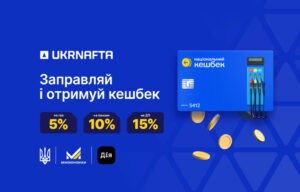
UKRNAFTA was the first to join the government’s fuel cashback support program.
Starting today, at all 660 gas stations in the network, customers will be able to receive:
15% cashback on diesel;
10% on gasoline;
5% on LPG.
Funds will be credited to a card registered in the state “National Cashback” program.
The maximum cashback amount for fuel is up to 1,000 UAH per person per month.
Accrued funds can be viewed in the Diya app. Payments are made by the end of the month following the purchase.
Fuel cashback is part of the government’s support for Ukrainians in response to rising oil prices due to hostilities in the Middle East.
The program will run until May 1.
JSC “Ukrnafta” is Ukraine’s largest oil producer and operates the country’s largest national network of gas stations—UKRNAFTA. In 2024, the company entered into an asset management agreement with Glusco. In 2025, it finalized a deal with Shell Overseas Investments BV to purchase the Shell network in Ukraine. In total, it operates 660 gas stations.
The company is implementing a comprehensive program to resume operations and modernize the format of gas stations in its network. Since February 2023, it has been issuing its own fuel vouchers and “NAFTACard” cards, which are sold to legal entities and individuals through Ukrnafta-Postach LLC.
The largest shareholder of Ukrnafta is Naftogaz of Ukraine with a stake of 50% plus one share.
In November 2022, the Supreme Commander-in-Chief of the Armed Forces of Ukraine decided to transfer to the state the share of corporate rights in the company that belonged to private owners, which is now managed by the Ministry of Defense.
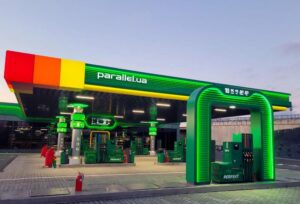
The Parallel gas station chain (AZK) Parallel reported a net profit of UAH 165,875,000 in 2025, which is 7.14 times higher than the corresponding figure for 2024 (UAH 23,212,000), according to a company statement provided to the Energoreformi online portal by the press service.
According to the report, net profit in 2023 was a loss of 978,000 UAH.
Meanwhile, the company’s revenue in 2025 was 11,179,677 thousand UAH, in 2024 – 8,750,387 thousand UAH, and in 2023 – 4,830,609 thousand UAH. The company forecasts revenue of nearly UAH 13,917,547 thousand for 2026.
Profitability increased from minus 0.02% in 2023 to 0.27% in 2024 and 1.48% in 2025.
At the same time, the company’s assets, as well as its liabilities, decreased. In 2024, assets amounted to nearly 6.8 billion UAH, and in 2025—4.08 billion UAH; liabilities, respectively, were 6.3 billion UAH and 3.5 billion UAH.
For 2025, the company reports more than double the growth in pre-tax wages compared to 2024—21,600 UAH versus 10,100 UAH. The lowest salary in the network was in 2022—approximately 5,000 UAH, which is nearly 2.5 times less than the previous year—11,680 UAH in 2021.
According to the company’s data, 454 people were employed in the network in 2025, and 432 in 2024. Revenue per employee amounted to 24.6 million UAH and 20.25 million UAH, respectively.
As reported, the Parallel gas station chain plans to expand its fuel business by 350 gas stations in 2026 and become one of the top five largest retailers of light petroleum products in Ukraine. According to the network’s owner, Oleksandr Dubinin, Parallel plans to invest approximately 2 billion UAH in the network’s development in 2026, time and market conditions permitting. Prior to this, starting in 2022, approximately 350 million UAH was invested in the network’s reconstruction and development.
In an interview with Forbes Ukraine, Dubinin noted that building new stations from scratch during wartime is impossible due to lengthy bureaucratic procedures, obtaining permits, and land allocation, so the company is considering the acquisition of regional networks.
Before the war, the Parallel network comprised 132 gas stations. As a result of the full-scale invasion, Parallel lost or suspended operations at a significant portion of its facilities. As of July 2025, 76 gas stations were reported to be operational across 8 regions.
Parallel is among the top 10 largest Ukrainian fuel importers.
Alexander Dubinin is listed as the sole owner of the network.



