
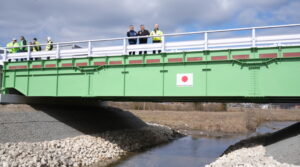
The possibility of establishing backup bridge crossings was discussed by Mykola Kalashnyk, Ukraine’s Minister of Recovery, Infrastructure, and Transport; Yo Osumi, the Japanese Ambassador; and Osamu Hattori, the head of the JICA office in Ukraine.
“The key issue is the possibility of establishing backup bridge crossings. Given the ongoing Russian attacks on transportation infrastructure, we must ensure alternative routes so that, even if the main bridges are damaged, we can maintain connections between the banks, the movement of critically important cargo, the operation of emergency services, and the ability to evacuate people,” Kalashnik wrote on Telegram on Wednesday evening following a meeting with Japanese representatives.
According to Kalashnik, Japan has already provided Ukraine with 720 meters of prefabricated bridge structures. “We are currently exploring the possibility of using the available equipment to construct backup crossings. We have agreed with JICA to continue working together to find effective engineering solutions,” Kalashnik wrote.
The minister also highlighted a second important area—the resilience of critical utility infrastructure ahead of winter. “We discussed the need for backup power supplies for water utilities, modular boiler rooms, and equipment to ensure the uninterrupted operation of heating and water supply systems. Priority lists of necessary equipment have already been submitted to JICA for the development of a new emergency assistance project,” Kalashnik reported.
“We also discussed the implementation of joint reconstruction projects. We recently signed the fifth phase of the Emergency Recovery Program, which allocates $15 million for infrastructure needs. We are also working on extending technical assistance for infrastructure recovery,” he added.
“I am grateful to the Government and people of Japan, the Embassy, and the JICA team for their consistent support of Ukraine and their willingness to address our urgent needs,” the minister concluded.

Ukraine needs to develop a comprehensive program for the protection and resilience of bridge infrastructure; the foundation for this approach was laid as early as 2022, according to the website of the Ukrainian Center for Steel Construction (UCSB).
As explained by the UCSB, Ukraine developed the “Fortress Country” concept for the comprehensive protection of critical infrastructure facilities at that time, which was subsequently approved at the national level. It provides, in particular, for standard solutions for the protection of road and rail bridges.
“Today, it is important to implement these solutions as part of a systematic program for the protection of bridge infrastructure. Critical bridges must be assessed, priorities identified, appropriate design solutions developed, reserves of materials and structural components for repairs established, and the responsible organizations and procedures for responding to damage defined. Otherwise, we will always be reacting: first, damage occurs, then an inspection, a search for design solutions, materials, and contractors—and only then does restoration begin,” notes military officer Artem Bilyk, a member of the Coordination Headquarters for the Engineering Protection of Critical Infrastructure and a leading co-author of the “Fortress Country” concept.
According to him, this model is far too slow for critical infrastructure. We must act proactively, anticipate what the enemy might target, and protect the infrastructure’s vulnerabilities.
A comprehensive program should include at least five areas, such as: surveying and ranking bridges by criticality and the potential consequences of their damage; engineering protection of the most critical structural elements and facilities; organizational and technical measures, including surveillance, security, and countermeasures against drone and missile threats; preparation of reserves for rapid restoration: design solutions, materials, steel structures, and equipment; and the creation of a network of Ukrainian manufacturers capable of producing the necessary structures as quickly as possible and ensuring their installation.
A large-scale program for the engineering protection of bridges could have the added benefit of supporting the Ukrainian steel industry and manufacturers of steel construction products,” notes Andriy Ozeychuk, director of the construction company Rauta.
According to Bilyk, the top priority for bridges should be to identify the most critical elements of a specific structure and reinforce them, taking into account possible damage scenarios.
Depending on the structural design and operating conditions, various solutions may be applied: protective structures, gabion structures, concrete and other barrier elements, steel protective structures, and so on.
Another approach involves creating pre-detonation screens, which increase the distance between the explosion source and the main structural elements. Such solutions must be designed individually for each structure and should not pose additional risks to the bridge’s operation, the expert notes.
Metal-based solutions are best suited for protecting bridges. These can include lattice steel structures, metal mesh, and cables, or a combination thereof, depending on the bridge’s design and the required distance to the pre-detonation screen,” Ozeychuk clarified. He noted that high strength combined with low weight, along with the modular approach to creating protection from various elements, makes it possible to adapt existing metal products to the specific geometry of bridges, as well as to easily replace or reinforce structures locally.
Equally important is protection against secondary damage factors: fires, fragment damage, and damage to auxiliary systems. It is advisable to protect vulnerable elements of the bridge infrastructure with appropriate non-combustible structures.
As for alternative crossings, according to the expert’s assessment, it is extremely difficult to fully replace the existing city bridges across the Dnipro River with temporary structures. A temporary crossing must be integrated with road and rail infrastructure, have the necessary capacity, and meet safety requirements, explains Bilyk.
In addition, it is noted that a modern bridge is far more than just a means of road traffic. Bridge crossings can accommodate railroad tracks, subway lines, utility lines, pipelines, cables, and other systems. Therefore, a pontoon bridge or other temporary crossing can serve as a backup solution but is not a full-fledged replacement for the developed bridge infrastructure of large cities, according to the website.
As noted in the press release, the strategy should not involve choosing between a bridge and a pontoon, but rather creating a multi-tiered resilience system where a protected main bridge is complemented by rapid restoration capabilities and backup transportation solutions.
BRIDGE, INFRASTRUCTURE, OZEYCHUK, PROTECTION, steel structure, UKRAINE

The volume of construction work completed in Ukraine from January through August 2026 decreased by 9.9% compared to January through August 2025, according to data from the State Statistics Service (Derzhstat).
According to the statistical agency, the volume of construction output in January–August totaled 156.5 billion hryvnias.
According to the State Statistics Service, over the eight-month period, the volume of residential construction decreased by 3.8% compared to January–August of last year, nonresidential construction by 6.3%, and civil engineering structures by 13.7%.
In August 2026, compared to August 2025, construction volumes decreased by 3.7%, including residential construction by 2.3% and civil engineering structures by 12.2%. At the same time, construction volumes for non-residential buildings increased by 9.8%.
In August 2026, compared with the previous month, construction volumes increased by 12.9%; specifically, in the residential category by 0.2%, in nonresidential buildings by 25.3%, and in civil engineering structures by 8.8%.
According to the agency’s seasonally adjusted data, construction output indices in August 2026 stood at 62% for residential construction, 155% for nonresidential construction, and in civil engineering at 112%; taking into account the calendar-day effect, the figures were 63.1%, 156.5%, and 115.4%, respectively.
The share of new construction in the total volume of construction work completed in July was 44.6%, repairs—30.3%, and reconstruction and other work—25.1%.
CONSTRUCTION, INFRASTRUCTURE, REAL ESTATE, State Statistics Service, UKRAINE

JSC “Ukrzaliznytsia,” in collaboration with the European Bank for Reconstruction and Development (EBRD), has approved amendments to the loan agreement for the “UZ Energy” project, which will allow EUR130 million from the previously approved EUR180 million loan to be allocated to support the company’s liquidity, specifically for infrastructure restoration and ensuring the transportation of passengers and cargo.
“Funds previously earmarked for the distributed generation project can now also be used for critical repairs, infrastructure restoration, and ensuring the transportation of people and cargo,” wrote Mykola Kalashnyk, Ukraine’s Minister of Recovery, Infrastructure, and Transport, on his Telegram channel on Wednesday following a meeting with EBRD President Odile Renaud-Basso.
According to him, the ministry is working to ensure that “Ukrzaliznytsia” gains access to the relevant funds as early as the first weeks of October.
Among other things, the project to build a 200-MW gas-fired power plant is continuing thanks to grant support from the EU and the United Kingdom, while “Ukrzaliznytsia” is carrying out the construction work on its own.
The minister also noted that the meeting included discussions on additional funding for the modernization of the locomotive fleet.
According to the ministry, since the start of Russia’s full-scale invasion, 550 locomotives have been damaged, with more than 335 of them damaged this year.
“Securing resources to replace and restore them is one of our top priorities,” Kalashnik emphasized.
Separately, the Ministry of Infrastructure discussed the development of international highway corridors and investments in roads—specifically, projects the ministry is implementing jointly with the Recovery Agency.
Other topics for discussion included the development of distributed thermal power generation, backup power supplies, and the protection of critical infrastructure.
Issues related to port concessions were also addressed, particularly the preparation of relevant projects; in this context, the ministry is counting on the EBRD’s expertise in drafting these projects and attracting international operators and investors.
“I would like to thank Odile Renaud-Basso and the EBRD team for their support of Ukraine and their willingness to tailor financing to our urgent needs,” added Ukraine’s Minister of Recovery, Infrastructure, and Transport.

Autostrada founder Maksym Shkil reported that the company continues to carry out all work at its sites in accordance with the approved schedules, he wrote on Facebook.
“… Autostrada is helping to restore damaged infrastructure and protect facilities amid intensifying Russian attacks. We are doing everything in our power to protect people and critical infrastructure. We understand the difficult situation with public finances. Autostrada continues to carry out work at all sites in accordance with the approved schedules. We assume that the government will fulfill its obligations to the industry for work already completed once international financial aid is received,” reads the post by the company’s founder on Facebook.
Earlier, the Autostrada Group of Companies announced that it was suspending work at all sites in Ukraine due to the government’s suspension of capital expenditures.

Ukraine and Romania, within the framework of the Carpathian Economic Forum (C8 Summit), signed a memorandum of understanding based on an updated Strategy for the Development of Border Infrastructure between the two countries, which takes into account the needs related to the transportation of cargo and passengers.
According to a statement from Ukraine’s Ministry of Recovery, Infrastructure, and Transport, the document was signed by Minister Mykola Kalashnyk and Ionel Scriostanu, State Secretary of Romania’s Ministry of Transport and Infrastructure.
Under the memorandum, the countries are expected to work on modernizing and developing road border crossing points (BCPs) and access roads, strengthening rail connections, as well as simplifying border control procedures and expanding opportunities for transshipment of Ukrainian cargo in Romanian ports.
Among other things, there are plans to increase the throughput capacity of existing border crossing points and develop new routes; specifically, the updated Strategy identifies 17 border crossing points, 10 of which are new proposals.
“The signed memorandum outlines specific directions for this work. It is important for us to increase the border’s throughput capacity and create stable and predictable routes for Ukrainian businesses to the European Union and Romanian ports,” the press release quotes Ukraine’s Minister of Recovery, Infrastructure, and Transport as saying.
The ministry emphasized that the next step will be to move toward implementing the relevant projects and securing funding for their execution.



