

According to “Serbian Economist”, on July 30, the Montenegrin government approved a proposal to establish a mechanism for screening foreign investments that could affect the country’s security and the functioning of critical infrastructure.
The new rules have not yet taken effect. A separate law must be passed for them to be implemented.
Prior approval will be required from investors from countries outside the EU who acquire control or at least 10% of the capital or voting rights in companies operating in strategic sectors.
The review may cover the energy sector, ports, airports, railways, banks, payment systems, telecommunications, media, digital infrastructure, technology, food production, and critical raw materials.
Real estate will be subject to review only if it is associated with strategic facilities or located near critical, military, or government infrastructure. This initiative does not directly apply to ordinary apartment purchases by foreigners.
The government will have the authority to approve a transaction, impose additional conditions, or prohibit it entirely. Potential requirements include restrictions on access to confidential data, disclosure of information about ultimate owners, and sources of funding.
The preliminary review is expected to take up to 45 days. Concluding a transaction without authorization may result in a fine, restrictions on voting rights, or the mandatory sale of the acquired stake.
The initiative is part of Montenegro’s efforts to align its legislation with EU rules. The final terms will be determined after the law is drafted and adopted.
Formally, specific countries are not named in the initiative. However, in practice, the mechanism will be particularly important for investors from Russia, Serbia, and China. All three countries are outside the EU, and their capital is significantly represented in Montenegro’s economy.
The possible adoption of this law will, in one way or another, also affect Ukrainian investors. Ukraine ranks high in terms of the number of companies in Montenegro. According to the latest data from MONSTAT, in 2024 there were 1,069 enterprises with Ukrainian owners operating in the country, accounting for 3.6% of all active companies with foreign capital. This places Ukraine fourth, behind Russia, Turkey, and Serbia.
At the same time, Ukrainian investments are concentrated primarily in real estate and small companies. In 2023, the inflow of such investments amounted to 19.1 million euros, of which 15.2 million euros went toward real estate purchases.
Therefore, the impact of the new rules on Ukrainian businesses is likely to be limited. Routine purchases of apartments and the establishment of small companies should not automatically be subject to review. Permission will be required for investments in strategic sectors or projects related to critical infrastructure.
Source: Government of Montenegro

The large-scale reconstruction of Ukraine could serve as the foundation for creating a modern basalt fiber and composite materials industry, which would integrate the extraction of domestic raw materials, the production of construction materials, and the manufacture of high-value-added products.
This was written by Volodymyr Khaustov, Scientific Secretary of the Institute of Economics and Forecasting of the National Academy of Sciences of Ukraine and Honored Economist of Ukraine, in a column for the Interfax-Ukraine news agency published on July 29, 2026.
According to him, future reconstruction efforts will require significant quantities of cement, metal, glass, thermal insulation, and other construction materials. At the same time, this could create a market for more durable, lightweight, and corrosion-resistant composite products.
According to the fifth joint assessment by the Ukrainian government, the World Bank, the European Commission, and the UN, the country’s reconstruction and rehabilitation needs as of the end of 2025 amount to nearly $588 billion over the next ten years. The greatest needs are in transportation, energy, and housing.
Basalt can be used in roads, bridges, and municipal infrastructure
Basalt fiber is produced by melting prepared rock and then forming it into fibers. It is used to manufacture thermal and acoustic insulation, technical fabrics, reinforcing mesh, concrete fiber, composite reinforcement, profiles, and pipes.
These products can be used in the construction of roads and bridges, the rehabilitation of utility networks, industrial flooring, energy facilities, and buildings. Their advantages include resistance to corrosion, high temperatures, and aggressive chemical environments, as well as relatively low weight.
In a study published in 2026 by the European Commission’s Joint Research Center, basalt fibers are identified as among the advanced and innovative construction materials capable of increasing the durability of structures and supporting the construction industry’s transition to more sustainable technologies. At the same time, European researchers point to the need for testing, standardization, and full life-cycle assessment of new materials.
Ukraine has deposits and scientific expertise
The most well-known basalt raw material deposits in Ukraine are located in the Rivne region. Specifically, these are the Berestovtse and Ivano-Dolynske deposits. Rock types promising for fiber production have also been studied in the Zakarpattia and other regions.
Ukrainian scientific institutions were involved in developing technologies for the production of basalt fibers as early as the second half of the 20th century. In the 1980s, dozens of enterprises involved in the production of basalt materials were operating in the country; however, following the collapse of the Soviet industrial system, most of these facilities ceased operations or significantly scaled back their activities.
Khaustov believes that the first step should be an audit of the Ukrainian basalt industry. This audit should cover the condition of deposits, enterprises, equipment, technologies, patents, and scientific developments.
In addition, Ukraine needs modern standards and testing of basalt materials for strength, durability, fire resistance, and resistance to moisture and chemicals. It would be advisable to harmonize national requirements with European standards.
The next step could be the launch of demonstration projects during the restoration of roads, bridges, utility networks, industrial facilities, and damaged public buildings. Support for the industry could include research grants, preferential financing for equipment, investment insurance, and the involvement of European technology partners.
However, the availability of raw materials alone does not guarantee the competitiveness of production. The industry’s development requires a stable energy supply, modern smelting furnaces, high-quality equipment, product certification, trained specialists, and a guaranteed market for the finished products.
The economic efficiency of each product type must be compared with steel, fiberglass, and other traditional materials, taking into account production costs, energy consumption, logistics, maintenance, and the entire service life.

According to “Serbian Economist”, the Hungarian government plans to allocate 3.55 trillion forints, or about 9.8 billion euros, by 2035 for the modernization of the national railway network.
Hungarian Prime Minister Péter Magyar and Minister of Transport and Investment Dávid Vitézi presented the program on July 22 at the Rakospalota-Újpest station in Budapest. Authorities are calling it one of the largest railway projects in the country’s history.
The program is designed to be implemented in several phases. Its main objectives will be to improve the reliability of transportation, reduce travel times, reconstruct tracks and stations, modernize the rolling stock, and develop international rail routes.
The government intends to ensure competitive rail service to all administrative centers in Hungary, modernize regional lines, and expand commuter service around Budapest and other major cities. Specific areas of focus will include the development of freight transport, the establishment of a rail link to Budapest Airport, and the integration of national and urban transportation systems.
It is planned to allocate 1.1 trillion forints from EU Cohesion Funds and 700 billion forints from the European Recovery and Resilience Facility (RRF) to implement the program. An additional 400 billion forints is planned to be raised through loans from the European Investment Bank, with a similar amount to be secured through concession projects. Approximately 950 billion forints will be allocated to projects under the next EU budget cycle for 2028–2034.
The government plans to purchase at least 35 new InterCity trains and 42 commuter electric trains, as well as begin renovating the country’s ten busiest train stations. The average age of MÁV trains and HÉV commuter trains is currently about 43 years, and 42% of the rail network is subject to significant speed restrictions.
On major routes, the government aims to increase the average speed to 100 km/h. Certain sections are planned to be upgraded to accommodate trains traveling at speeds of 160–200 km/h.

Romania, Bulgaria, and Turkey have agreed to expand the mission of the joint Black Sea Mine Countermeasures Task Group by adding the protection of critical infrastructure to its mandate.
The agreement was reached during the NATO summit in Ankara. This involves expanding the authority of the Mine Countermeasures Black Sea Task Group, which had previously focused primarily on locating and neutralizing mines in the Black Sea.
According to Reuters, the new mandate calls for the protection of energy and telecommunications facilities and undersea pipelines owned or operated by the three countries.
The Romanian Ministry of Defense stated that protecting critical infrastructure in the Black Sea requires a comprehensive, integrated, and long-term approach. The ministry also noted that a memorandum establishing the mine countermeasures security group was signed on January 11, 2024, by the defense ministers of Romania, Bulgaria, and Turkey.
The joint group became the first trilateral initiative of its kind among the three NATO countries with access to the Black Sea. Its initial task was to improve the safety of navigation following the appearance of drifting mines in the sea as a result of Russia’s war against Ukraine.
According to Reuters, the group has already neutralized more than 150 mines since its creation. The expansion of its mandate reflects growing concerns among countries in the region regarding the security of maritime infrastructure, particularly against the backdrop of developing gas projects in the Black Sea.
For Ukraine, this decision is of direct importance, as Black Sea security affects shipping, export routes, energy infrastructure, and the overall naval situation in the region. Stronger coordination between Romania, Bulgaria, and Turkey also signals greater NATO focus on the Black Sea region.
BLACK SEA, BULGARIA, DEFENSE, INFRASTRUCTURE, ROMANIA, TURKEY
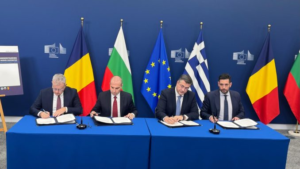
Greece, Bulgaria, and Romania are promoting the construction of the “Black Sea–Aegean Sea” multimodal transport corridor, which is intended to connect the ports, railways, highways, and logistics hubs of the three countries with access to the Ukrainian and Moldovan borders.
The project will become part of the EU’s Trans-European Transport Network (TEN-T). The European Commission notes that the broader “Baltic Sea–Black Sea–Aegean Sea” corridor spans 11 EU countries, as well as Ukraine and Moldova, connecting the Baltic, Black, and Aegean Seas.
The new section between Greece, Bulgaria, and Romania will consist of three main branches. The western branch is planned to run along the route Athens–Thessaloniki–Promachonas–Kulata–Sofia–Vidin/Calafat–Craiova–Bucharest. The central branch will connect Thessaloniki and Alexandroupolis with the Bulgarian cities of Svilengrad and Ruse, then continue through Giurgiu and Bucharest to
Siret on the Romanian border with Ukraine, as well as to Ungheni on the border with Moldova. The Eastern Branch will connect Alexandroupolis with the Bulgarian ports of Burgas and Varna, and then on to Constanța in Romania.
To coordinate the project, the three countries are establishing the Black Sea–Aegean Sea Corridor Platform (BACP). The European Commission reported that Greece, Bulgaria, and Romania signed a memorandum on the development of transport infrastructure on December 3, 2025, in Brussels. The document provides for coordination at the political and technical levels, the exchange of data on national investment plans, and the joint promotion of priority TEN-T projects.
European Commissioner for Transport Apostolos Tzitzikostas called the project a step toward strengthening the strategic north-south corridor in Southeast Europe. According to him, closer cooperation between Greece, Bulgaria, and Romania should strengthen ties for citizens and businesses, as well as enhance Europe’s security, competitiveness, and resilience in the Aegean, Black Sea, and Danube regions.
The project’s significance for the region goes beyond mere transportation modernization. The corridor could provide Ukraine with an additional southern logistics route to ports in the Aegean Sea, Bulgaria, and Romania, as well as strengthen the role of Constanța, Burgas, Varna, Alexandroupoli, and Thessaloniki as hubs for trade, agricultural exports, industrial cargo, and container transport.
For the Balkans, this also represents an opportunity to reduce dependence on overburdened or vulnerable routes. Since the outbreak of full-scale war against Ukraine, the importance of alternative routes via the Danube, the Black Sea, Romania, Bulgaria, and Greece has risen sharply. The central branch to Siret could effectively become an extension of Ukrainian logistics routes to southern Europe.
The project is also important for the military and crisis mobility of the EU and NATO, but its civilian economic value is no less significant. This involves faster transport between the three seas, better connections between ports and railways, reduced logistics costs, and the creation of a sustainable infrastructure for trade between Ukraine, Moldova, the Balkans, Central Europe, and the Mediterranean.
For Ukraine, this represents a potential new route to the Mediterranean; for Romania, Bulgaria, and Greece, it means strengthening their roles as transit countries; and for the entire region, it is a step toward more sustainable logistics between the Baltic Sea, the Black Sea, the Danube, and the Aegean Sea.
Aegean Sea, BACP, BLACK SEA, BULGARIA, GREECE, INFRASTRUCTURE, LOGISTICS, ROMANIA, TEN-T, UKRAINE

According to Experts.news, Ukraine’s construction industry has shown mixed trends based on preliminary results for the first half of 2026: following growth in 2023–2025, the sector has faced a slowdown in the volume of work, rising construction costs, a labor shortage, and a shift in demand toward housing and infrastructure reconstruction.
The State Statistics Service has not yet released final data for January–June, so a current assessment can be made based on statistics for the first four months, data on housing completions in the first quarter, the “eOselya” and “eVidnovlennia” programs, as well as construction companies’ expectations for the second quarter.
According to the State Statistics Service, the volume of construction work completed in Ukraine in January–April 2026 decreased by 2% compared to the same period in 2025 and amounted to 59.3 billion UAH. At the same time, in April compared to April 2025, construction had already shown a 2.8% increase; specifically, residential construction rose by 5.8%, civil engineering structures by 9.7%, while non-residential construction declined by 7.4%. New construction accounted for 47.8% of the total in April, repairs for 29%, and reconstruction and other work for 23.2%.
By comparison, in 2025, the volume of construction work completed in Ukraine rose by 11.3% to 258.2 billion UAH, but the growth rate was already slowing down at that time, following 17.8% growth in 2024 and 31.8% in 2023. In 2025, residential construction grew by 13.5%, nonresidential construction by 25.4%, and civil engineering by only 3.1%.
“In the first half of 2026, the construction sector effectively transitioned from a phase of rapid post-shock recovery to a phase of selective growth. Housing, renovations, engineering infrastructure, and reconstruction-related projects remain the most resilient. At the same time, commercial non-residential construction remains weaker due to war risks, more expensive financing, and uncertainty for investors,” noted Maksym Urakin, founder of the Experts Club analytical center and candidate of economic sciences.
The residential segment appears more stable than the overall industry trend. In the first quarter of 2026, housing completions in Ukraine decreased by only 0.1% year-over-year, to 2.289 million square meters. During this period, 29,600 apartments were completed, which is 4.3% more than in the first quarter of 2025. The largest volumes of housing completions were recorded in the Lviv, Odesa, Ivano-Frankivsk, Zakarpattia, and Ternopil regions, while in Kyiv, 289,000 square meters of housing—or 4,900 apartments—were completed.
Government programs remain one of the key sources of demand for housing. According to the Ministry of Economy, as of June 22, 2026, 4,104 Ukrainian families had taken advantage of the “eOselya” program since the beginning of the year, receiving preferential mortgage loans totaling nearly 7.7 billion UAH. In just one week in June, 157 loans totaling 313 million UAH were issued, with the majority of new loans going toward first-time home purchases.
The “eVidnovlennia” program plays an even more important role for the construction market. As of June 2026, 206,447 Ukrainian families had received assistance for repairing or purchasing new housing, totaling 103.9 billion UAH. More than 138,000 families received payments to repair damaged homes, nearly 65,000 families received housing certificates for destroyed property, and a separate program for rebuilding on private land is already being funded through tranches.
At the same time, the industry is facing significant price pressure. According to the summary table of price indices for construction and installation work, in April 2026, the construction price index stood at 103.1% compared to March, following 109.4% in March, 101.8% in February, and 101.1% in January. The cumulative figure for the first four months of 2026 was 116.1%, indicating a significant increase in the cost of labor and materials.
Business expectations among construction companies remain cautious. According to a State Statistics Service survey for the second quarter of 2026, the business confidence indicator in construction improved by 1.9 percentage points compared to the first quarter but remained deeply negative at minus 25.7%. The current order volume was estimated at minus 41.5%, and expectations regarding the number of employees stood at minus 9.9%. Companies cited labor shortages, financial constraints, and other factors as the main limiting factors, while their order backlog was estimated to cover an average of six months of work.
At the macro level, the country’s recovery remains the industry’s main long-term driver. According to estimates by the World Bank, the Ukrainian government, the European Commission, and the UN, Ukraine’s needs for recovery and reconstruction over the next ten years are already estimated at nearly $588 billion. Direct losses reached $195 billion, with the housing, transportation, and energy sectors hardest hit. Damages to the housing sector alone are estimated at approximately $61 billion, and about 14% of the housing stock has been damaged or destroyed.
According to Experts Club’s assessment, in the second half of 2026, Ukraine’s construction industry will remain dependent on three key factors: the security situation, access to financing, and the stability of government recovery programs. Residential projects in hinterland regions, the reconstruction of damaged housing, engineering infrastructure, the energy resilience of communities, social housing, and critical infrastructure facilities will have the greatest potential.
“The Ukrainian construction sector cannot be assessed solely based on the current index of completed work. It is no longer just an economic sector, but one of the key tools for survival, the return of people, the recovery of communities, and the country’s future investment attractiveness. But the transition from repairs to large-scale modernization requires long-term financing, insurance against war risks, transparent project pipelines, and skilled personnel,” emphasized Maksym Urakin.
Thus, the first half of 2026 for Ukraine’s construction industry can be preliminarily assessed as a period of stabilization following the rapid growth of previous years. The market is not showing a uniform upturn, but it has significant structural demand related to housing, reconstruction, infrastructure, and future post-war reconstruction. For businesses, this means a shift toward more selective competition—companies with access to financing, qualified personnel, a transparent cost estimation framework, and the ability to work with government and international reconstruction programs will come out on top.
CONSTRUCTION, EXPERTS CLUB, HOUSING, INFRASTRUCTURE, RECONSTRUCTION, URAKIN



