
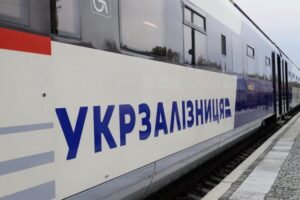
A number of Ukrzaliznytsia trains across the country are running with delays of 2 to 16 hours, according to train schedule information posted on the company’s website on Monday.
According to the latest updates as of 10:43 a.m., the train with the longest delay is train 121/122 Mykolaiv Pass. – Kyiv-Pass. – 16 hours 33 minutes, as well as train 109/110 Mykolaiv Pass. – Lviv – 12 hours 37 minutes, while trains 233/234 Kryvyi Rih-Holovnyi – Chernivtsi and 293/294 Kryvyi Rih-Holovnyi – Rakhiv are running with a delay of 11 hours 58 minutes.
As for other trains, the 3/4 Dnipro-Holovnyi–Uzhhorod is delayed by 10 hours 24 minutes, and the 285/286 Lviv–Dnipro-Holovnyi and 41/42 Truskavets–Dnipro-Holovnyi are running with a delay of 7 hours 36 minutes.
“Ukrzaliznytsia” notes that train delays are calculated automatically, so changes may occur. Among other things, it is noted that during emergencies, evacuations, and detours, train delays may increase, while they may decrease when a train accelerates.
The company’s website reports that, in total, approximately 50 trains are running with delays across Ukraine.

The Ukrainian Grain Association (UGA) is urging the Verkhovna Rada and the government to repeal the 10% export duty on soybeans and rapeseed, the association reported.
According to the association’s estimates, in the 2025/26 marketing year, Ukraine exported 2.7 million metric tons of soybeans, compared to 3.8 million metric tons in the previous season, and 1.82 million metric tons of rapeseed, compared to 3.2 million metric tons. The UGA considers the introduction of the export duty to be one of the key reasons for the decline in exports of these crops.
The association notes that the additional 10% export duty diverts a portion of revenue from the production chain and increases the financial burden on agricultural producers, especially small and medium-sized ones, for whom selling their harvest at a competitive export price is crucial for covering loan payments, land rent, fuel, fertilizers, plant protection products, and labor costs.
The UZA also notes that the government has streamlined the procedure for confirming farmers’ eligibility for duty exemptions on their own-grown produce through the State Agrarian Register. However, in the association’s view, this mechanism does not address the systemic problem, as a significant portion of Ukrainian soybeans and rapeseed passes through the commercial distribution chain.
According to the UZA, export restrictions create imbalances in the domestic market and limit producers’ ability to choose the most economically viable sales channel. The association considers it important to maintain the ability to export products to markets where there is demand and where producers can obtain competitive prices.

By the end of September 2026, Apple will expand the iCloud+ package in Ukraine to include access to the Apple TV streaming service and the Apple Arcade gaming platform at no additional charge with all paid plans.
Ukraine has officially joined the list of over 100 countries and territories where Apple is rolling out its new subscription model. At the same time, Apple TV is expanding into 59 new markets and, once the rollout is complete, will be available in approximately 170 countries worldwide.
According to the Ukrainian iCloud website, the cheapest iCloud+ plan—50 GB—costs $0.99 per month and will include Apple TV and Apple Arcade. The 200 GB plan costs $2.99, 2 TB costs $9.99, 6 TB costs $34.99, and 12 TB costs $69.99 per month.
Apple TV provides access to original series, movies, and documentaries from Apple Originals, while Apple Arcade features over 200 games without ads or in-app purchases.
An iCloud+ subscription can be shared with up to five family members via Family Sharing. Each user’s personal files, settings, and recommendations remain separate.
For users who already pay for iCloud+, Apple TV and Apple Arcade should be added automatically at no additional cost. If a user previously subscribed to Apple TV or Apple Arcade separately, Apple plans to transition that access into iCloud+, while progress and saves in Apple Arcade games will remain accessible.
On Apple’s official Ukrainian website, the new bundle is currently listed as coming “soon,” as the company is rolling it out gradually through the end of September.
In addition to Ukraine, the program includes Serbia, Montenegro, Moldova, Georgia, Armenia, Turkey, Kazakhstan, Azerbaijan, the Western Balkan countries, as well as India, Singapore, the UAE, Saudi Arabia, and dozens of countries in Africa, Asia, and the Middle East.

At the “Carpathian Eight” summit in Bukovel, JSC “Ukrzaliznytsia” proposed a project to establish, in partnership with investors, a low-cost passenger carrier on routes between Ukraine and the EU using European-standard tracks, with investments in share capital totaling approximately $441 million.
According to the project description posted on the summit’s website, the carrier’s routes will run from western Ukrainian railway hubs—including Uzhhorod, Lviv, and Kovel—to markets in Central and Eastern Europe, specifically Budapest, Bratislava, Warsaw, Vienna, and Berlin.
As part of the project, there are plans to purchase modern trains for European-standard tracks.
It is noted that the project is in the advanced planning stage, and its implementation is expected to take approximately four years.
Ukrzaliznytsia hopes that this project will attract interest from rail and road carriers in Poland, Slovakia, Hungary, and Romania.
As previously reported, in late 2018 and in June 2019, trains operated by the state-owned railway companies MÁV-START of Hungary and ZSSK of Slovakia began running on routes from Mukachevo—where the European gauge track ends—to Budapest and Košice, respectively.
On the same route, starting in March 2024, the Czech private carrier RegioJet has been operating services from Chop to Prague; it also cooperates with Ukrzaliznytsia on services to the Polish city of Przemyśl, which borders Ukraine.
In addition, in October 2023, the Polish company SKPL (Stowarzyszenie Kolejowych Przewozów Lokalnych) became the first to launch passenger service on the standard-gauge route between Warsaw and Rava-Ruska, where passengers transferred to Ukrzaliznytsia trains bound for Lviv or Kolomyia. Starting in December 2024, the state-owned operator PKP Intercity also began operating on this route, and SKPL withdrew from it in September 2025.
Ukrzaliznytsia also has plans to extend the European-gauge track to Chernivtsi and Lviv; prior to the full-scale Russian invasion, the possibility of building a new high-speed rail line between Warsaw and Kyiv was also being considered.
As reported, Ukrainian President Volodymyr Zelenskyy noted that agreements on $1 billion in investments had already been reached during the first Carpathian Economic Forum.
The C8 Summit website lists about 90 projects across eight sectors. The energy sector has the most—33—followed by transportation and logistics with 11, industry and manufacturing with 17, and infrastructure and real estate with 12.
In terms of regions, the largest number of projects is listed in Lviv Oblast—30—followed by 14 in Zakarpattia, 13 in Chernihiv Oblast, 11 in Poltava Oblast, and 3 in Bukovina.
The first inaugural summit of the “Carpathian 8” (Carpathian 8 Summit) is taking place at the Bukovel ski resort in Ivano-Frankivsk Oblast from September 18 to 20.
European gauge, INVESTMENT, TRANSPORTATION, UKRAINE, UKRZALIZNYTSIA
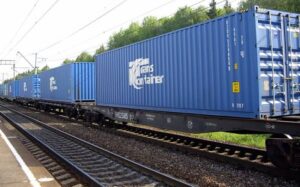
The volume of containerized freight transported by rail in January–August of this year totaled 202.73 thousand DFE (TEU), which is 33% higher than the figures for the same period in 2025, according to Valery Tkachov, deputy director of the Department of Transportation Technology and Commercial Operations at JSC “Ukrzaliznytsia,” on Facebook.
According to him, the business community considers the shortage of fitting platforms (FTPs) in Ukraine to be the main obstacle to further growth in container transportation volumes.
According to data provided by Tkachov, 27% of container traffic during the reporting period consisted of grain (26% for the first 8 months of 2025), 15% (21%) to ferrous metals, 12% (10%) to oilcake and meal, and 6% each to synthetic resins and oil (5% and 7%, respectively, last year).
The expert noted that, against the backdrop of an overall decline in shipments, the share of container traffic in the total cargo volume rose to a record high of 4.4% over the past year.
Tkachov added that the “Liski” branch of the Central Transport Service (CTS) presented a strategy for selling its own rolling stock, under which 60–80% of the FTL fleet is planned to be sold under long-term USTO contracts, and 20–40% through auctions or on general terms.
Currently, the operational fleet of the “Liski” branch of the Central Transport Service consists of 1,500 FTG units, of which 1,200 are 40-foot units, 265 are 60-foot units, and 48 are 80-foot units.
A representative of “Ukrzaliznytsia” noted that due to increased demand for fitting platforms, the branch has begun selling its scarce fleet through “Prozorro.Sales” auctions.
According to the post, business representatives raised concerns regarding the mechanisms for allocating the railcar fleet between long-term USTO contracts and auctions, suggesting that these mechanisms be revised to account for the specific nature of container transportation. To resolve the issue, meeting participants agreed to transition to long-term cooperation regarding the provision of container railcars under USTO contracts. Company representatives were asked to submit requests within a week detailing their FTT needs for 2026–2027, while “Ukrzaliznytsia” plans to conclude the relevant contracts with all interested companies as soon as possible.
“Having signed USTO contracts will allow us to plan the repair of Ukrzaliznytsia’s freight train fleet, taking into account existing repair capacities,” explained the director of Ukrzaliznytsia’s Department of Transportation Technology and Commercial Operations.
In addition, business representatives proposed considering the possibility of leasing FPTs from the non-operational fleet, assuming the costs of their repairs.
Among other issues, the business community cited incorrect preparation of accompanying documents and charges during export and import shipments at western border crossings, as well as congestion at the “Yagodin-Dorohusk” and “Mostyska-2-Medika” crossings, Tkachov reported.
CONTAINER, LOGISTICS, TRANSPORTATION, UKRAINE, UKRZALIZNYTSIA

In Ukraine, 4,621 enforcement proceedings were initiated between January and August 2026 to collect unpaid wages, which is 16% fewer than during the same period last year, when 5,470 such proceedings were registered, according to data from the Unified Register of Debtors, as analyzed by OpenDataBot.
Despite the decline in the number of new cases, the total volume of unresolved wage arrears remains significant. As of September, the Unified Register of Debtors listed 35,922 active cases related to unpaid wages.
Some of these debts have remained unresolved for many years. In particular, 1,957 active cases were opened as far back as 2017 and have still not been closed.
New cases were filed against 311 companies between January and August 2026. Of these, 144—or about 46%—are private enterprises, 117 are state-owned, and another 50 belong to local communities.
Thus, state-owned and municipal companies together account for more than half of the enterprises against which new enforcement proceedings regarding wage arrears were initiated this year.
OpenDataBot compiles statistics based on the Unified Register of Debtors, into which enforcement proceedings are entered after the relevant decisions on debt collection are issued.
Source: OpenDataBot, data for January–August 2026.



