

In July 2026, the state-owned company Ukrnafta increased its diesel fuel imports by 2.4 times compared to July of last year—to nearly 60,000 metric tons—ranking second among the country’s largest importers.
These figures were reported by the “A-95 Consulting Group.” A total of 134 companies imported diesel fuel in July.
The OKKO Group retained first place, importing more than 73,000 metric tons of diesel fuel. Its imports rose by 32% compared to July 2025.
Ukrnafta accounted for about 59,800 metric tons, or approximately 10.6% of the country’s total diesel fuel imports in July.
UPG took third place with 53,200 metric tons. Next came Energo Trade JSC with 50,700 metric tons and WOG with 42,900 metric tons.
Thus, the five largest importers together imported about 280,000 metric tons of diesel fuel—nearly half of the total volume of supplies to Ukraine in July.
Among the major market players, the Western Fuel and Energy Company (ZPEK) demonstrated the highest growth rate, increasing its imports by a factor of 5.3—to approximately 32,000 metric tons.
The sharp increase in Ukrnafta’s purchases comes amid its growing role in the Ukrainian petroleum products market following the expansion of its own network of gas stations and trading operations.
Overall, Ukraine imported 562,000 metric tons of diesel fuel in July—5% more than a year earlier.
However, despite the rise in imports, A-95 reported a fuel shortage in the market. Analysts cite several reasons for this, including increased demand following a rise in global prices, higher purchases by industrial and private consumers, and increased consumption due to the shift in agricultural exports toward road and rail transport.
In August, analysts expect the situation to gradually normalize thanks to a decline in global prices and an increase in fuel supply.
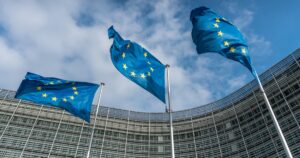
According to Experts.news, the European Commission is preparing proposals to reform the EU enlargement process, which are set to form the basis for a strategic discussion among EU leaders in October 2026. One of the key areas of discussion is the introduction of additional safeguards that would allow for the restriction of certain rights of new member states in the event they violate their obligations to the EU.
The European Commission has confirmed that it is preparing the reform. As early as July 6, an EC representative told Euronews that Brussels was working on its own proposals ahead of the October summit, as member states themselves are increasingly engaged in discussions regarding the new rules.
The European Council has officially confirmed that at its meeting on October 15–16, 2026, EU leaders will hold a strategic discussion on the Union’s enlargement and internal reforms. However, there is as yet no official confirmation that the European Commission will present the final package on October 15 specifically.
One of the most discussed options is a temporary restriction on certain voting rights of new member states.
Back in June, Germany, France, the Netherlands, Belgium, and Luxembourg proposed discussing the possibility of a transition period during which new EU members would be unable to block decisions in the most sensitive areas, where unanimity among all countries is currently required.
This primarily concerns foreign policy, the EU budget, and the Union’s further expansion.
In addition, the five countries propose including special safeguard mechanisms in future accession treaties. These would allow measures to be taken against a new member state in the event of a serious deviation from the principles of democracy, the rule of law, or media freedom.
These proposals are largely linked to Hungary’s experience under Viktor Orbán, when Budapest repeatedly used the unanimity requirement to block important EU decisions.
However, for now, the discussion centers on reform options rather than newly agreed-upon rules.
This discussion is of the greatest significance for Montenegro, which is currently the most advanced candidate for accession.
According to the European Commission, the country has opened all 33 negotiation chapters, 16 of which have already been provisionally closed. Podgorica intends to conclude negotiations and become the 28th member of the European Union in 2028.
European Commission President Ursula von der Leyen stated in June that Montenegro’s accession by 2028 is “achievable.” The EU has already begun drafting the future accession treaty.
Therefore, Montenegro’s accession treaty could potentially become the first document of a new generation, providing additional guarantees for the EU following the country’s admission.
However, the European Commission is concerned about a scenario in which new conditions would be developed exclusively for Montenegro. That is why Brussels wants to establish a universal approach that can also be applied to future candidate countries.
The reform will be of direct importance to both Ukraine and Moldova.
Negotiations with both countries accelerated significantly in the summer of 2026. In June, the EU opened the first negotiation cluster with Ukraine and Moldova, focusing on fundamental issues—the rule of law, democratic institutions, and public administration. In July, negotiations also made progress on foreign policy issues.
That said, Ukraine and Moldova are much further from concluding negotiations than Montenegro.
For Kyiv, the future model is particularly important: if the EU does indeed introduce transitional restrictions on the right of veto, Ukraine could potentially gain full membership but would initially have limited ability to block decisions in certain areas.
At the same time, such a system could facilitate political consensus on Ukraine’s membership within the current EU, as some member states fear that expanding from 27 to more than 30 members would significantly complicate decision-making.
The assertion that France, Germany, and the Netherlands are generally opposed to rapid EU enlargement requires clarification. These countries support further enlargement but belong to a group of states that demand prior strengthening of institutional safeguards and stricter oversight of future members’ compliance with the rule of law. Together with Belgium and Luxembourg, they have proposed developing a new template for accession treaties.
France, in particular, takes a cautious stance regarding Ukraine’s accelerated accession. Officials in Paris are concerned about the budgetary implications, the impact of Ukraine’s large agricultural sector on the single market, and the potential for the decision-making process to become more complicated in an expanded EU.
Germany, on the other hand, actively supports enlargement but at the same time insists on reforming the European Union itself and is considering options for the gradual integration of new member states.
Essentially, the debate boils down to an attempt to resolve the tension between two objectives.
On the one hand, the geopolitical situation is prompting the EU to accelerate the accession of Montenegro, Albania, Ukraine, and Moldova. Brussels views enlargement as a tool for strengthening European security and limiting the influence of Russia and China in the Western Balkans and Eastern Europe.
On the other hand, existing member states are reluctant to admit new members who, once admitted, could use their veto power to exert pressure on other EU countries.
Therefore, the future model may be based on the following principle: full membership is granted more quickly, but some of the new member state’s political tools remain limited during a transition period, and compliance with obligations continues to be monitored even after accession.
The final parameters of such a system have not yet been agreed upon. The main political discussion is set to take place at the European Council on October 15–16, 2026, after which it will become clearer which of the proposed mechanisms may be included in the future accession treaties for Montenegro, Ukraine, Moldova, and other candidates.
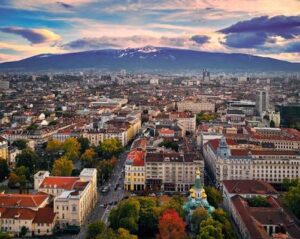
The British newspaper Metro has named Sofia the most underrated capital in Europe, highlighting the city’s combination of relatively affordable prices, historical heritage, modern cultural life, and proximity to natural attractions.
According to the British publication, the Bulgarian capital remains significantly less popular among mass tourists than traditional destinations in Western and Southern Europe, despite its potential for short city breaks.
Metro cites the British market as one example. In 2025, approximately 343,000 travelers from the United Kingdom visited Bulgaria, whereas Spain welcomes around 18 million British tourists annually. Thus, even with growing interest, the gap between Bulgaria and one of Europe’s largest tourist destinations remains vast.
At the same time, tourism in Sofia itself is growing. According to the city’s tourism authorities, the capital welcomed more than 1 million tourists from January through September 2025, and the number of arrivals increased by approximately 10% year-over-year. Foreigners accounted for about 63% of visitors.
Metro highlights Sofia’s historic center as one of its main attractions, where monuments from different eras are concentrated within a small area.
St. Alexander Nevsky Cathedral remains one of the city’s main attractions. The British publication also draws attention to the archaeological complex of ancient Serdica, a significant portion of which can be seen right in the center of modern Sofia.
The city’s proximity to Vitosha Mountain is cited as a distinct advantage. As a result, a trip to Sofia allows visitors to combine exploring the capital with hiking trails and outdoor recreation without having to travel long distances to another region of the country.
British journalists also highlight the capital’s burgeoning cultural scene. Among the events mentioned is the A to JazZ music festival, and among the cultural venues are the Sofia City Art Gallery and other museums in the city.
Another factor contributing to the city’s appeal is the relatively low cost of food, public transportation, and entertainment compared to other European capitals. Metro considers Sofia’s affordability to be one of its advantages amid rising travel costs to the most-visited cities in Western Europe.
Overall, Bulgaria welcomed approximately 13.6 million foreign visitors in 2025, a 2.7% increase from the previous year, according to data from the country’s National Statistical Institute. More than 9.5 million tourists were registered at lodging facilities, a 5.8% increase over the year.
Thus, the British Metro’s focus on Sofia aligns with a broader trend of growing interest in Bulgaria as a destination in its own right for city tourism, rather than merely as a country of summer resorts and winter getaways.

Prices for construction and installation work in Ukraine’s non-residential and civil engineering sectors rose sharply in the second quarter of 2026: compared to the first quarter, the cost of work increased by 12% and 12.4%, respectively. At the same time, quarterly growth in residential construction was significantly more moderate—at 0.4%, according to data from the State Statistics Service of Ukraine.
On an annual basis, the trend is even more pronounced. In the second quarter, prices for construction and installation work were generally 21.6% higher than in April–June 2025. Nonresidential and civil engineering construction rose by 22.4%, while residential construction rose by 18.2%.
The increase continued through June. Compared to June of last year, the cost of civil engineering construction had already risen by 24.3%, nonresidential construction by 23.8%, and residential construction by 19.2%. The average rate of increase in the construction sector reached 23.1%.
Thus, the sharpest price increases are currently being observed not in residential development, but in non-residential buildings and engineering infrastructure.
This may be particularly noticeable in the construction of industrial facilities, warehouses, retail and office properties, as well as infrastructure projects, where rising construction costs directly impact investment budgets and the need for additional financing.
In the first half of the year, prices for construction and installation work in Ukraine rose by 15.8% year-over-year. By comparison, the increase for all of 2025 was 5.8%, for 2024—7.9%, and for 2023—15.8%.
The statistics indicate a noticeable acceleration in price pressures in the construction industry specifically in the second quarter of 2026, primarily in segments that are directly relevant to business investment and infrastructure restoration.
Prices for construction and installation work in Ukraine rose by 23.1% in June 2026 compared to June of last year, according to data from the State Statistics Service of Ukraine. Growth was recorded in all major segments of construction. Residential construction rose by 19.2% year-over-year, nonresidential construction by 23.8%, and civil engineering structures by 24.3%.
In June alone, compared to May, the cost of construction and installation work increased by 0.8% in residential construction, by 1.3% in non-residential construction, and by 1.8% in civil engineering. Thus, work related to infrastructure projects is currently rising in price the fastest.
In January–June 2026, prices for construction and installation work were, on average, 15.8% higher than during the same period last year. In the residential segment, the increase was 13.7%; in the non-residential segment, 16.5%; and in civil engineering, 16.1%.
The current growth rate is significantly higher than last year’s. For the full year 2025, construction and installation work prices rose by 5.8%; in 2024, by 7.9%; and in 2023, by 15.8%.
Thus, the annual rate of price growth in June is approximately four times higher than the growth rate of construction and installation costs for the full year of 2025, although a direct comparison of the monthly annual rate with the full-year result should be viewed as an indicator of acceleration rather than as identical statistical values.
The acceleration in construction cost growth is significant not only for the real estate development market but also for Ukraine’s recovery. If this trend continues, previously established budgets for the construction, repair, and reconstruction of facilities may need to be revised upward.
The State Statistics Service updated the “Changes in Construction Prices” dataset on August 10, 2026.
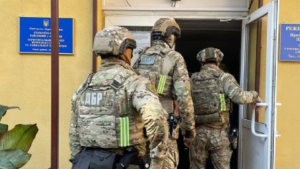
A total of 76.7% of Ukrainians consider the system of territorial recruitment and social support centres to be the most affected by corruption.
This is evidenced by the results of a sociological survey conducted by the Politarena publication jointly with the Active Group company on 1 August 2026.
According to the survey, 82.6% of respondents believe that the level of corruption in Ukraine has increased since 2022. A decline was reported by 6.6% of respondents, while 10.8% were unable to decide on an answer.
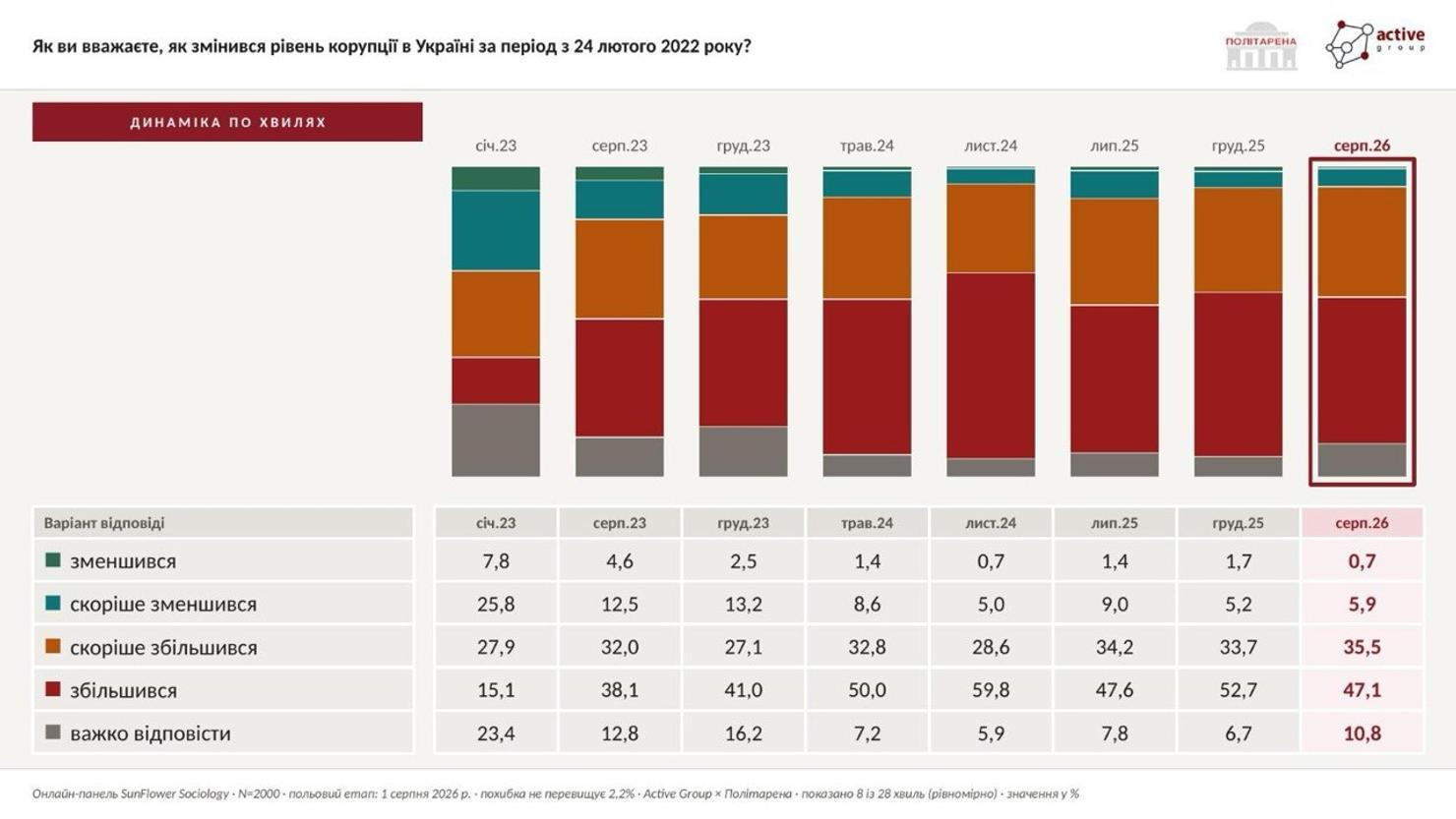
Compared with January 2023, Ukrainians’ assessments have deteriorated significantly. At that time, 43% of respondents spoke of an increase in the level of corruption, while 33.6% spoke of its decrease.
Territorial recruitment and social support centres ranked first among the structures that Ukrainians consider the most corrupt, with a figure of 76.7%. In October 2024, 71.3% of respondents expressed this opinion.
The judicial system ranked second, with 62.2% of respondents calling it corrupt, compared with 71.2% in 2024. Law enforcement agencies ranked third with 59.1%, compared with 67.7% in 2024.
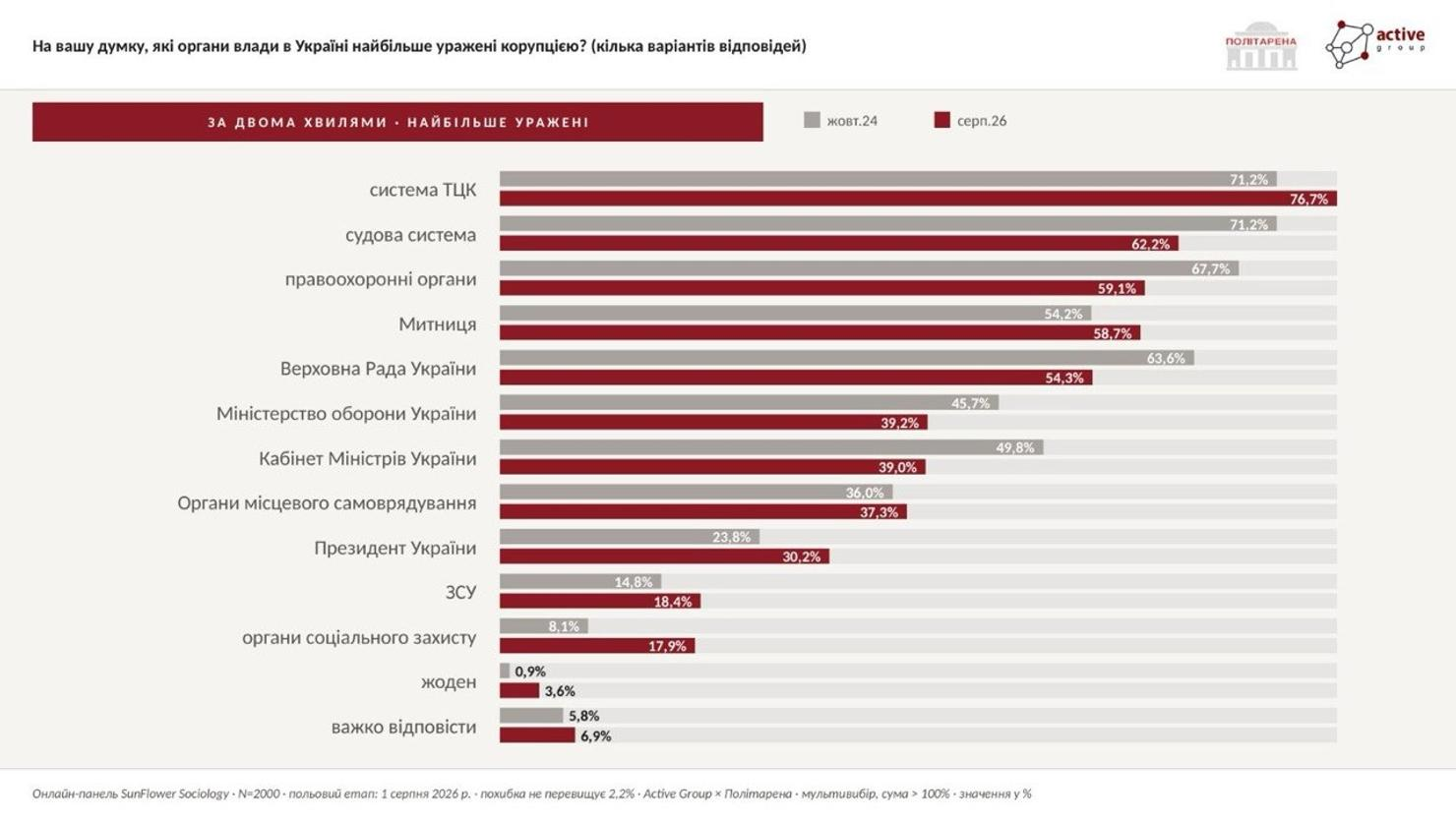
The Ministry of Defence of Ukraine is considered corrupt by 39.2% of survey participants, the Cabinet of Ministers by 39%, and local self-government bodies by 37.3%.
A total of 30.2% of respondents included President of Ukraine Volodymyr Zelenskyy among corrupt institutions and officials. The Armed Forces of Ukraine were described as corrupt by 18.4% of respondents, while social protection bodies were named by 17.9%.
Research methodology: the study was conducted using the SunFlower Sociology online panel. Method: self-completion of questionnaires by Ukrainian citizens aged 18 and over. Sample: 2,000 questionnaires (representative by age, gender and region of Ukraine). The theoretical margin of error at a confidence probability of 0.95 does not exceed 2.2%. Data collection period: 1 August 2026. Median salary values were calculated among those who provided a substantive response, using linear interpolation within the intervals; the extreme categories were taken as UAH 5,000 (“up to UAH 10,000”) and UAH 150,000 (“over UAH 150,000”).



