
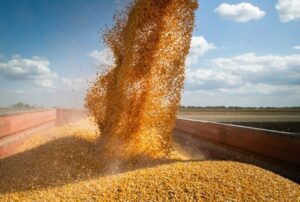
Rail shipments of grain to Danube ports in August 2026 nearly tripled compared to July—reaching 248.8 thousand metric tons, while shipments to the ports of Greater Odesa fell by 94.9%—to 68.5 thousand metric tons, according to a weekly review by the brokerage firm Spike Brokers.
Overall, rail grain shipments to seaports, including domestic shipments to Izmail, totaled approximately 317,300 metric tons in August, compared to 1.440 million metric tons in July. According to the brokerage firm, there was a sharp shift in cargo flows from the Greater Odessa region to the Danube.
In August, 1.297 million metric tons of grain were transported by rail—34.7% less than in July and 53.9% less than in August 2025. The average daily load amounted to 39.2 thousand metric tons, which is 22.5% lower than in July and 55% lower than in August 2025.
Exports of grain and milled products totaled 672.2 thousand metric tons, down 58.5% month-over-month and approximately 74% year-over-year. A total of 113,000 metric tons of vegetable oil were transported—15.4% more than in July and 54.7% more than in August 2025. Transportation of oilcake and meal totaled 167.1 thousand metric tons, down 9.3% month-over-month and 7.4% year-over-year.
In August, 501.8 thousand metric tons were transported via land crossings, compared to 208.8 thousand metric tons in July—a 2.4-fold increase.
The average daily throughput of grain cars through the main western border crossings in August was 192.8 cars, compared to 71.3 cars in July. The highest average daily figure was on the Polish route—56.6 cars. Through Hungary, 49.4 cars were transported per day; through Romania, 45.5; and through Slovakia, 41.4 cars.
Unlike in July, the August flow was distributed much more evenly among the four corridors.
As of September 3, there were 8,221 railcars en route to border crossings, of which 1,346 were loaded with grain, compared to 9,273 and 1,414 railcars, respectively, at the end of August. During the first days of the month, the total backlog decreased by approximately 11%, while the grain backlog decreased by 5%.
In August, 325,000 metric tons of agricultural products were exported via road border crossings, compared to 289,200 metric tons in July—an increase of 12.4%. Compared to August 2025, the volume was 23.7% higher.
Nearly half of August’s road freight traffic was destined for Poland—150,100 metric tons, or 46.2%. Among the largest categories in August were poultry meat—30,200 metric tons, sunflower oil—24,800 metric tons, ethyl alcohol—23,100 metric tons, sugar—18,600 metric tons, fruits and nuts—16.9 thousand metric tons, and soybean meal—15 thousand metric tons.
During the first three days of September, 33 thousand metric tons were exported by road, or about 11 thousand metric tons per day, compared to an average of 10.5 thousand metric tons per day in August.
In August, Ukraine exported 2.146 million metric tons of agricultural products in UKT ZED groups 01–24, worth $1.280 billion. The grain segment accounted for 987,100 metric tons, or 46% of the total volume, in the final August statistics: 612,700 metric tons of wheat, 305,700 metric tons of corn, and 68,700 metric tons of barley were shipped. Rapeseed accounted for another 292,600 metric tons, or 13.6% of exports. The three main vegetable oils totaled 279,100 metric tons, while sunflower and soybean meal totaled 187,200 metric tons.
The largest physical volumes went to Germany—227.1 thousand metric tons, Turkey—203.8 thousand metric tons, Italy—188.1 thousand metric tons, Poland—179.3 thousand metric tons, and the Netherlands—171.7 thousand metric tons. Together, these five countries accounted for about 45% of August’s exports.
From September 1–3, Ukraine exported 331.4 thousand metric tons of agricultural products worth $167.7 million, or about 110.5 thousand metric tons per day.

From August 1 to 26, Ukraine exported 1.423 million metric tons of grains, oilseeds, and their processed products via alternative routes, which accounts for one-third of the volume required for this period, Minister of Agrarian Policy and Food Taras Vysotsky said at a briefing on Friday.
“From August 1 to 26, 1,423 thousand metric tons of grains, oilseeds, and products derived from them were exported. This accounts for 33% of the demand for this period. Grains accounted for the smallest share—822 thousand metric tons. For grains, we exported only 21% of the potential demand. The rest consists of oil, oilseeds, and meal. In principle, export volumes in these categories meet current demand,” he said.
Vysotsky noted that exports by rail and via the Danube each amounted to approximately 600,000 metric tons, while road transport remains the smallest in volume—about 80,000 metric tons. Of this volume, about 40,000 metric tons are oilseeds, which is due to the high cost of road transport.
According to him, if the current pace is maintained, Ukraine could export about 1.5 million metric tons of agricultural products via alternative routes by the end of August.
By the end of September, up to 2 million metric tons could be exported via alternative routes, as previously forecast by the Ministry of Agrarian Policy.
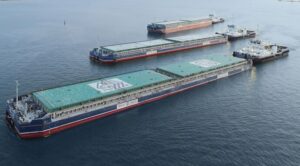
Nibulon Joint Venture LLC proposes introducing a transitional mechanism for assigning and confirming the qualifications of river fleet specialists, which, according to its estimates, will make it possible to increase shipments through the Danube export corridor by 100,000 metric tons per month, the company’s press service reported, citing Logistics Director Serhiy Kalkutin.
“Nibulon” could deploy an additional 12 tugboats on the Danube, but this would require resolving the issue of retraining and processing the necessary paperwork for approximately 30 specialists. And we are not the only ones facing this limitation. “If a workable mechanism is created to attract qualified specialists on an industry-wide scale, the Danube corridor will be able to transport up to an additional 100,000 metric tons of cargo per month,” the press service quoted Kalkutin as saying.
He explained that shipowners have a technically ready fleet but are unable to fully staff their crews or put additional vessels into service due to a shortage of qualified crew members.
As noted in the statement, “Nibulon” proposes introducing a temporary transitional mechanism for certifying and confirming the qualifications of inland waterway fleet specialists and for them to obtain the necessary documents until the full transition to European regulations is complete. This, in particular, will allow specialists with the necessary training and experience to complete the paperwork required to work on the Danube more quickly.
Kalkutin emphasized that additional shipments via the Danube corridor will make it possible to support purchases from agricultural producers, ensure the inflow of foreign exchange earnings, and increase the resilience of Ukraine’s export system.
“Nibulon” proposed that the relevant government agencies, together with industry representatives, develop a transitional solution that would allow for the recruitment of the necessary number of qualified specialists to work on inland waterways while complying with requirements for professional competence and navigation safety.
As reported, according to the Ministry of Agrarian Policy, from August 1 to 18, Ukraine exported 900,000 metric tons of agricultural products, of which about 45% were exported via the Danube region.

From August 1 to 18, Ukraine exported 900,000 metric tons of agricultural products, which accounts for 31% of the volume that could have been exported had there been unimpeded access to logistics, said Minister of Agrarian Policy and Food Taras Vysotsky at a briefing in Kyiv on Thursday.
“The biggest drop was in grains. A total of 522,000 metric tons of grain were exported, which is only 20% of the required volume. Exports of oilseeds during this period totaled 163,000 metric tons, vegetable oil—128,000 metric tons, and meal—86,000 metric tons. In these sectors, export rates are in line with balance sheet figures,” Vysotsky noted.
According to him, alternative logistics routes can, in terms of volume, support the export of oilseeds and their processed products. As for grains, alternative routes can primarily be used to export products from border regions.
He added that due to changes in logistics, transportation costs have increased by approximately $50 per metric ton.
According to Vysotsky, exports of oilseeds and their processed products remain profitable, whereas for grains—with the exception of border regions—they are unprofitable.
Overall, via alternative routes from August 1 to 18, about 45% of agricultural products were exported via the Danube, 45% by rail, and another 7–8% by road.
As previously reported, according to data from the Ministry of Agrarian Policy, Ukraine exported 590,000 metric tons, or 30% of its needs, from August 1 to 12.
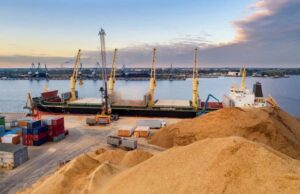
The suspension of the maritime corridor since late July has led to a drop in grain exports from Ukraine: from August 1 to 12, exports totaled 590,000 metric tons, or 30% of demand, Agriculture Minister Taras Vysotsky said at a briefing in Kyiv on Friday.
“From August 1 to 12, we exported 590,000 metric tons. That’s about 30% of the required volume. We expect to be able to reach 50% going forward… taking into account all the relevant impacts on international trade balances,” the minister said.
He clarified that of these 590,000 metric tons, about 40% were exported by rail, about 40% via the Danube region, about 10% by road, and the remaining 10% consisted of several ships that were still able to leave Ukrainian ports in early August.
“If we subtract those, we can say that as of today, 45% is exported by rail, 45% via the Danube region, and about 10% by road,” the minister stated.
At the same time, he emphasized that there is potential to partially increase exports, but even so, without the resumption of operations at the Black Sea ports, exports will amount to no more than 50% of demand.
According to Vysotsky, due to the drought, the Danube route is currently unable to operate at full capacity; reaching its full potential—about 1.5 million metric tons per month—will be possible closer to the end of the year.
The minister also reported that Ukraine currently has sufficient permanent storage facilities for grain, but in November, after the corn harvest, there may be a storage capacity shortfall of 8 to 11 million metric tons, which they hope to cover using temporary storage facilities and silo bags.
According to Vysotsky, a request for $10 million in funding for the temporary storage of 2–2.5 million metric tons has already been sent to international partners. In addition, a similar request to the World Bank for $25 million—covering more than 6 million metric tons of grain—is being finalized.
He noted that it is currently difficult to predict how quickly maritime exports can be resumed.
“We see that every day there are various rumors… gossip about different proposals (regarding a maritime ceasefire)… As always, we must rely first and foremost on ourselves. By ‘ourselves,’ I mean the military… As of today, the only way to enable exports is through military security… This is a very important area; the military is working on it, but so far, they cannot report any progress on their end. Therefore, as of today, exports from the ports of Greater Odesa are suspended. We are focusing on alternative logistics channels,” stated the head of the Ministry of Agrarian Policy.
Regarding the U.S. Department of Agriculture’s downward revision this week of its forecast for grain exports from Ukraine this marketing year by 2.21 million metric tons—to 37.77 million metric tons—Vysotsky noted that, overall, the figures remain within the range of the typical annual balance.
“We do not rule out that this could be the case. We are still only a month and a half into the marketing year. We understand that, provided there is some recovery during a certain period, we can make up the shortfall. Therefore, from our point of view, this balance is currently based on the annual cycle—no more, no less—rather than on an assessment of the current situation,” the minister said.
He noted that this year’s total harvest of grains and oilseeds is expected to exceed 80 million metric tons, of which domestic consumption and adequate carryover stocks will account for up to 20 million metric tons.
“The baseline volume of exports of grains, oilseeds, and processed products could reach up to 60 million metric tons. However, given how logistics are currently developing, we understand that there is a possibility this trend will continue throughout the year, and exports will amount to no more than 30 million metric tons,” Vysotsky said, outlining the worst-case scenario.
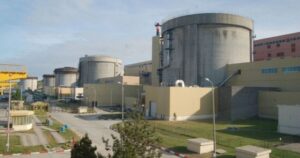
On August 13, the Romanian state-owned company Nuclearelectrica began a controlled shutdown of the second power unit at the Cernavodă Nuclear Power Plant due to a prolonged drop in the water level of the Danube, leaving the country’s only nuclear power plant temporarily without any operating reactors.
Nuclearelectrica’s official announcement was sent to the Bucharest Stock Exchange on August 13. The company notes that the decision was made due to a “significant and prolonged drop in water levels in the Danube,” based on forecasts from Romania’s National Institute of Hydrology and Water Management (INHGA).
The procedure for the controlled reduction of Unit 2’s output began this morning. Nuclearelectrica Director Romeo Urian previously reported that output is expected to drop to zero around noon, after which the unit will be disconnected from the national power grid.
Chernavoda’s Unit 1 was shut down for the same reason on July 28. At that time, Nuclearelectrica also attributed this decision to the unprecedentedly low water level in the Danube caused by a severe drought.
Each of the two operating CANDU-type reactors has a capacity of about 706 MW. Together, under normal operating conditions, they account for approximately 20% of Romania’s electricity production.
The water situation remains extremely challenging. According to INHGA data as of the morning of August 13, the Danube’s flow rate at its entry into Romania near Băziaș was only 1,350,000 cubic meters per second.
The long-term average for August is about 3,900 cubic meters per second. Thus, the current flow rate corresponds to only about 35% of the typical August level.
Most importantly, the official hydrological forecast does not yet predict a significant recovery.
This means that even if the Danube’s level stabilizes at current levels, there is still insufficient basis for a rapid return of the nuclear units to operation.
Prior to the shutdown of Unit 2, Romanian authorities took extraordinary engineering measures to divert more water toward Cernavodă.
In one section, controlled blasting was carried out on a rocky obstacle, the riverbed was deepened, and four barges loaded with rocks were deliberately sunk to partially redirect water from the Bala branch into the main channel of the Danube.
These measures yielded temporary results. After the barges were sunk, the water level in the Cernavodă area was approximately 8 cm higher than the projected trajectory, which allowed the second reactor to remain operational for several more days.
However, in the long term, it was not possible to compensate for the lack of water through engineering measures.
For the recovery of Cernavoda, what matters is not so much local precipitation directly near the plant as it is rainfall across a large area of the upper and middle Danube basin—primarily in Germany, Austria, Slovakia, Hungary, and further downstream.
The current 10-day forecast shows the first noticeable change in weather in the upper part of the basin on August 18. Thunderstorms are forecast for Vienna on August 17, and rain on August 21. Heavy rain is expected in Bratislava on August 17, followed by localized thunderstorms on August 18.
However, further downstream, the situation is less favorable. No significant precipitation is currently forecast for Budapest through August 22. Belgrade is also expected to experience mostly dry and hot weather.
In Černavoda itself, the forecast through August 22 is almost entirely dry, and after August 17, temperatures may rise above 30 degrees again.
Based on a combination of hydrological and meteorological forecasts, no significant improvement is expected by August 20.
Optimistic scenario: Heavy rainfall will occur in Austria and Slovakia on August 17–18, a new weather front will arrive around August 21, after which the Danube’s water level will begin to rise noticeably. In that case, the technical conditions for preparing the restart may be met around August 23–26.
The baseline scenario is that precipitation will be moderate and will only halt the further decline in water levels. In that case, a restart is more likely in the last week of August, around August 26–31.
The negative scenario is that rains will be localized, and the heat will persist in the middle and lower reaches. In that case, both units may remain offline into early September.
To compensate for the lost generation, the authorities will utilize several sources.
The Ministry of Energy is counting on an increase in wind power generation: in the coming days, average capacity is estimated at approximately 525 MW, and during certain periods it may reach 1.56 GW.
In addition, the 330-MW Rovinari 4 coal-fired power unit has been placed on standby, and Hidroelectrica is expected to provide at least about 300 MW of available additional capacity within the limits of existing hydropower resources. Romania has also begun purchasing electricity from Ukraine.
The total cross-border transmission capacity of the Romanian power grid for imports is approximately 4 GW. The authorities are considering, in particular, electricity supplies from southern Europe via Bulgaria.
At the same time, the shutdown of “Cernavodă” increases price risks.



