

At the “Carpathian Eight” summit in Bukovel, JSC “Ukrzaliznytsia” proposed a project to establish, in partnership with investors, a low-cost passenger carrier on routes between Ukraine and the EU using European-standard tracks, with investments in share capital totaling approximately $441 million.
According to the project description posted on the summit’s website, the carrier’s routes will run from western Ukrainian railway hubs—including Uzhhorod, Lviv, and Kovel—to markets in Central and Eastern Europe, specifically Budapest, Bratislava, Warsaw, Vienna, and Berlin.
As part of the project, there are plans to purchase modern trains for European-standard tracks.
It is noted that the project is in the advanced planning stage, and its implementation is expected to take approximately four years.
Ukrzaliznytsia hopes that this project will attract interest from rail and road carriers in Poland, Slovakia, Hungary, and Romania.
As previously reported, in late 2018 and in June 2019, trains operated by the state-owned railway companies MÁV-START of Hungary and ZSSK of Slovakia began running on routes from Mukachevo—where the European gauge track ends—to Budapest and Košice, respectively.
On the same route, starting in March 2024, the Czech private carrier RegioJet has been operating services from Chop to Prague; it also cooperates with Ukrzaliznytsia on services to the Polish city of Przemyśl, which borders Ukraine.
In addition, in October 2023, the Polish company SKPL (Stowarzyszenie Kolejowych Przewozów Lokalnych) became the first to launch passenger service on the standard-gauge route between Warsaw and Rava-Ruska, where passengers transferred to Ukrzaliznytsia trains bound for Lviv or Kolomyia. Starting in December 2024, the state-owned operator PKP Intercity also began operating on this route, and SKPL withdrew from it in September 2025.
Ukrzaliznytsia also has plans to extend the European-gauge track to Chernivtsi and Lviv; prior to the full-scale Russian invasion, the possibility of building a new high-speed rail line between Warsaw and Kyiv was also being considered.
As reported, Ukrainian President Volodymyr Zelenskyy noted that agreements on $1 billion in investments had already been reached during the first Carpathian Economic Forum.
The C8 Summit website lists about 90 projects across eight sectors. The energy sector has the most—33—followed by transportation and logistics with 11, industry and manufacturing with 17, and infrastructure and real estate with 12.
In terms of regions, the largest number of projects is listed in Lviv Oblast—30—followed by 14 in Zakarpattia, 13 in Chernihiv Oblast, 11 in Poltava Oblast, and 3 in Bukovina.
The first inaugural summit of the “Carpathian 8” (Carpathian 8 Summit) is taking place at the Bukovel ski resort in Ivano-Frankivsk Oblast from September 18 to 20.
European gauge, INVESTMENT, TRANSPORTATION, UKRAINE, UKRZALIZNYTSIA
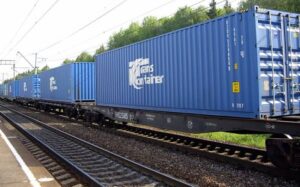
The volume of containerized freight transported by rail in January–August of this year totaled 202.73 thousand DFE (TEU), which is 33% higher than the figures for the same period in 2025, according to Valery Tkachov, deputy director of the Department of Transportation Technology and Commercial Operations at JSC “Ukrzaliznytsia,” on Facebook.
According to him, the business community considers the shortage of fitting platforms (FTPs) in Ukraine to be the main obstacle to further growth in container transportation volumes.
According to data provided by Tkachov, 27% of container traffic during the reporting period consisted of grain (26% for the first 8 months of 2025), 15% (21%) to ferrous metals, 12% (10%) to oilcake and meal, and 6% each to synthetic resins and oil (5% and 7%, respectively, last year).
The expert noted that, against the backdrop of an overall decline in shipments, the share of container traffic in the total cargo volume rose to a record high of 4.4% over the past year.
Tkachov added that the “Liski” branch of the Central Transport Service (CTS) presented a strategy for selling its own rolling stock, under which 60–80% of the FTL fleet is planned to be sold under long-term USTO contracts, and 20–40% through auctions or on general terms.
Currently, the operational fleet of the “Liski” branch of the Central Transport Service consists of 1,500 FTG units, of which 1,200 are 40-foot units, 265 are 60-foot units, and 48 are 80-foot units.
A representative of “Ukrzaliznytsia” noted that due to increased demand for fitting platforms, the branch has begun selling its scarce fleet through “Prozorro.Sales” auctions.
According to the post, business representatives raised concerns regarding the mechanisms for allocating the railcar fleet between long-term USTO contracts and auctions, suggesting that these mechanisms be revised to account for the specific nature of container transportation. To resolve the issue, meeting participants agreed to transition to long-term cooperation regarding the provision of container railcars under USTO contracts. Company representatives were asked to submit requests within a week detailing their FTT needs for 2026–2027, while “Ukrzaliznytsia” plans to conclude the relevant contracts with all interested companies as soon as possible.
“Having signed USTO contracts will allow us to plan the repair of Ukrzaliznytsia’s freight train fleet, taking into account existing repair capacities,” explained the director of Ukrzaliznytsia’s Department of Transportation Technology and Commercial Operations.
In addition, business representatives proposed considering the possibility of leasing FPTs from the non-operational fleet, assuming the costs of their repairs.
Among other issues, the business community cited incorrect preparation of accompanying documents and charges during export and import shipments at western border crossings, as well as congestion at the “Yagodin-Dorohusk” and “Mostyska-2-Medika” crossings, Tkachov reported.
CONTAINER, LOGISTICS, TRANSPORTATION, UKRAINE, UKRZALIZNYTSIA

The IDS Ukraine Group of Companies has restructured its logistics, reorganized distributor territories, and increased the number of transportation partners by 30% by incorporating small carriers and sole proprietors, said Marco Tkachuk, CEO of IDS Ukraine.
“Shelling poses additional challenges, as it destroys our partners’ logistics centers and warehouses. We have to constantly change routes and deliver water directly to stores more often. We’ve increased the number of partners by 30% by bringing in small carriers and sole proprietors who own several vehicles,” he said in an interview with the “Interfax-Ukraine” news agency.
When asked about the main challenges facing the company, aside from logistics and rising fuel prices, Tkachuk cited migration and, as a result, a decline in consumption. Declining household incomes and migration trends have forced the company to seek new business channels, which is why it was decided to launch the B2B platform e-Morshynska, which accounts for 10% of sales in traditional retail through direct ordering without the involvement of sales agents.
In addition, staffing remains a challenge. According to Tkachuk, because the reservation system covers only half of the employees, there is an acute shortage of drivers.
To improve planning amid uncertainty, IDS Ukraine is in the final stages of implementing an ERP system for inventory management, he added.
IDS Ukraine is a Ukrainian group of companies founded in 1996. It owns the “Morshynska,” “Myrhorodska,” “Alaska,” and “Aqua Life” brands. The group includes the Morshyn “Oscar” Mineral Water Plant, the Mirgorod Mineral Water Plant, the distribution company “IDS,” and the water delivery operator “IDS Aqua Service.”

The Kyiv Oblast State Administration has delivered five more passenger buses to Bucha as part of aid from its French partners—the Île-de-France region—according to the administration’s press service.
“Four buses had previously been added to the community’s fleet, and now five more have been added. The vehicles are adapted for people with disabilities and parents with strollers. The barrier-free design makes the buses more comfortable for all passengers,” the statement on the Telegram channel reads.
It is emphasized that this is an important step toward strengthening the local transportation system, as people’s daily mobility directly affects their quality of life.
In total, as part of the partnership with the Île-de-France region, Kyiv Oblast has already received 60 buses, which are being transferred to local communities.

JSC “Ukrzaliznytsia” (UZ) transported 8.14 million passengers over the three summer months, compared to 8.07 million during the same period last year and 7.94 million in the summer of 2024, according to a company announcement on its Telegram channel on Thursday.
According to UZ, 628,400 children and 90,000 military personnel visiting their families traveled by train between June and August this year. A total of 22,000 people with disabilities, including veterans, traveled in accessible railcars. A total of 357,000 passengers purchased tickets through the auto-renewal system.
“This result once again demonstrates a more efficient use of the rolling stock: additional ‘rotational’ trains and minimal downtime for cars, especially in frontline regions,” Ukrzaliznytsia noted.
It is noted that over the summer, “UZ” put 20 new railcars into service, while losing seven during this period.
According to Ukrzaliznytsia, there were four and a half passenger requests per seat in June–August. The top five most popular routes based on the number of ticket searches in the company’s app were Lviv–Kyiv, Przemyśl–Kyiv, Kyiv–Kharkiv, Kholm–Kyiv, and Kyiv–Dnipro.
Among other things, passengers exchanged more than 300 million “hugs” for discounts in the “Rail Friends” loyalty program during the summer and also earned about 500,000 rewards.
For its part, the Ministry of Recovery, Transport, and Infrastructure reported that the railway is entering the fall season with a schedule that has been updated and adapted to the current needs of Ukrainians, while also taking the security situation into account.
“This year’s summer season has been yet another challenge for the Ukrainian railway. Russia is attempting to disrupt domestic logistics. At the same time, railway workers continue to optimize operations in accordance with the security situation, quickly adjust logistics, and make the most of the available rolling stock,” the ministry emphasized.
As reported, citing data from “Ukrzaliznytsia,” since the start of the war, the enemy has carried out 6,100 attacks on its infrastructure, more than 1,500 of which occurred between January 1 and August 20, 2026.
PASSENGER TRAFFIC, railcar, RAILROAD, TRANSPORTATION, UKRZALIZNYTSIA
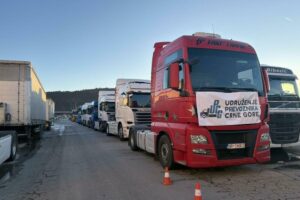
According to The Serbian Economist, Serbian truckers, together with their colleagues from Montenegro, Bosnia and Herzegovina, and North Macedonia have announced their intention to begin blocking freight border crossings into the European Union starting September 14, 2026, if a solution to the issue of professional drivers’ stay in the Schengen Area has not been found by that time.
This was reported by the Serbian association of international carriers, “Međunarodni transport.” According to the association, drivers from the Western Balkan countries continue to be detained, deported, and turned back at the borders for exceeding the permitted length of stay in the Schengen Area. The association claims that several dozen Serbian drivers are turned back at the borders every day, and there have been more than 50 such cases in the past week alone.
Before the blockade begins, the carriers intend to make one more attempt to reach an agreement with European authorities. On August 31, from 12:00 p.m. to 2:00 p.m., a peaceful protest will take place in Belgrade in front of the EU delegation at 40/V Vladimira Popovića Street. Similar protests are planned in front of the EU delegations in Montenegro, Bosnia and Herzegovina, and North Macedonia.
In addition, another meeting between representatives of the transport companies and the European Commission is scheduled for September 1. If it does not lead to a concrete decision, starting September 14, transport companies from the four countries intend to begin protests at border crossings.
The cause of the conflict is the 90/180 rule in effect in the Schengen Area, under which a third-country national may stay in the Schengen Area for no more than 90 days within any 180-day period. This is sufficient for the average tourist, but international carriers argue that professional drivers are physically unable to make regular trips to the EU under such a restriction.
The rule itself existed previously, but with the introduction of the Electronic Entry/Exit System (EES), enforcement has become significantly stricter. The system automatically records the entries and exits of third-country nationals and, as of April 10, 2026, is fully operational at the external borders of the Schengen Area, with the exception of Ireland and Cyprus. The possibility of “losing” some days between passport stamps has effectively disappeared.
At the same time, the European Commission officially acknowledges the existence of the problem. The EU Visa Policy Strategy, adopted on January 29, 2026, states that a number of mobile professions, particularly truck drivers serving European businesses, may need to stay in several Schengen countries for more than 90 days within a 180-day period.
The European Commission has stated that it will seek a solution, including the possibility of introducing special EU-wide rules regarding extended short-term stays. However, a specific mechanism has not yet been approved.
For Serbia, this issue is particularly acute due to the significant dependence of its exports on road transport to the EU. Carriers warn that some drivers are already refusing to make trips to EU countries.
This will be the second major regional protest by carriers in 2026. Starting on January 26, drivers from Serbia, Montenegro, Bosnia and Herzegovina, and North Macedonia simultaneously blocked freight terminals at the borders with the EU. In Serbia, the protest lasted five days and was called off on January 30 after the European Commission included the issue of professional drivers in its new visa strategy.
The economic impact of the previous blockade was significant. According to estimates by the Serbian Chamber of Commerce and Industry, the restrictions affected about 93% of exports from the four Western Balkan countries, and potential business losses were estimated at up to 92 million euros per day.
For Ukraine, a potential blockade is also significant, although its impact will be considerably less than for Serbia and other Western Balkan countries. The main truck traffic between Ukraine and the EU passes directly through Poland, Slovakia, Hungary, and Romania, so a blockade of the Serbian borders will not halt Ukrainian-European trade.
However, the issue could directly affect Ukrainian trucks traveling to Serbia, Bosnia and Herzegovina, Montenegro, North Macedonia, Albania, and Greece, as well as carriers that use Serbia as a transit country. If the protest follows the January scenario and the Batrovci freight terminal on the border with Croatia, the Horgos terminal on the border with Hungary, the border crossings with Romania, and the Gradina terminal on the border with Bulgaria are blocked, Ukrainian carriers will find themselves in the same lines as other international trucks.
The most vulnerable routes may be those from Ukraine through Hungary or Romania to Serbia and onward to Montenegro, Bosnia, and North Macedonia, as well as transit toward the Adriatic and the southern Balkans. Rerouting cargo through Romania and Bulgaria or other border crossings is not always possible and entails additional mileage, fuel costs, and longer delivery times.
This is a particularly sensitive issue for Ukrainian logistics due to the economy’s heavy reliance on land transport corridors. According to the European Commission, in July 2026, the “Solidarity Lanes”—established after the start of the full-scale war—accounted for approximately 90% of Ukraine’s imports and 95% of its non-agricultural exports, although only a portion of these shipments is related to the Balkan route. Therefore, a strike in the Western Balkans alone is not capable of paralyzing Ukrainian foreign trade, but for companies that work specifically with the Balkans, it could significantly increase logistics costs.
A separate issue concerns Ukrainian professional drivers themselves. Ukraine has a special agreement with the EU on road transport, which has been extended until March 31, 2027. It liberalizes bilateral and transit freight transport and allows Ukrainian carriers to operate within the EU without some of the former licensing restrictions.
However, this agreement primarily regulates carriers’ access to the market, not the length of stay of a specific driver in the Schengen Area. Therefore, a Ukrainian driver entering the Schengen Area as a third-country national on a short-term stay and who does not hold a long-term visa, residence permit, or other relevant status must generally also comply with the 90-day limit within a 180-day period. The European Commission notes that holders of long-term visas and residence permits are not subject to this restriction.
https://t.me/relocationrs/3545



