

Ukrainian President Volodymyr Zelenskyy has signed a decree relieving Olga Stefanishyna of her duties as Ukraine’s Ambassador Extraordinary and Plenipotentiary to the United States.
The corresponding decree, No. 696/2026, has been published on the president’s website.
In a Facebook post, Stefanishyna announced that she had decided to step down as Ukraine’s ambassador to the United States due to personal circumstances.
“This is my own decision, dictated by personal circumstances that I have mentioned previously,” she noted.
According to Stefanyishyna, representing Ukraine in Washington during a full-scale war was the greatest honor of her life.
At the same time, the diplomat emphasized that the main tasks she came to Washington to accomplish have been fulfilled. In particular, she said, she succeeded in increasing U.S. arms supplies and maintaining support for Ukraine amid changes in the U.S. political landscape, enshrining that support in law, and shifting Ukraine’s role “from a country that receives aid to a country in which investments are made and whose technologies are purchased.”
Stefanyishyna also stated that she would comment separately and publicly on issues that have recently been raised in the media, and assured that she would continue to work for the benefit of Ukraine “wherever she can be of use.”
Olga Stefanyishyna was born on October 29, 1985, in Odesa. In 2008, she graduated from Taras Shevchenko National University of Kyiv with a degree in international law and as an English translator; in 2016, she received a specialist degree in finance and credit from Odesa National Economic University.
From 2006 to 2007, she worked in private legal practice. Since 2007, she has worked at the Ministry of Justice of Ukraine, where she held positions in departments responsible for European integration and international law. From 2017 to 2019, she headed the Office for European and Euro-Atlantic Integration at the Secretariat of the Cabinet of Ministers of Ukraine.
In June 2020, the Verkhovna Rada appointed Stefanyishyna as Deputy Prime Minister for European and Euro-Atlantic Integration of Ukraine and included her in the National Security and Defense Council.
In 2021, Stefanyishyna was appointed to the Political Council of the “Servant of the People” party.
In 2024, the Verkhovna Rada appointed Stefanyishyna as Minister of Justice of Ukraine following the dismissal of Denys Malyuska. She retained her position as Deputy Prime Minister for European and Euro-Atlantic Integration.
In July 2025, Stefanyishyna lost her positions as Minister of Justice and Deputy Prime Minister following the resignation of Denys Shmyhal’s government. Subsequently, President Volodymyr Zelenskyy appointed her as the President of Ukraine’s Representative for the Development of Cooperation with the United States, and in August 2025, as Ambassador Extraordinary and
Ambassador Extraordinary and Plenipotentiary of Ukraine to the United States.
On July 23, 2026, Zelenskyy announced that he had offered Yulia Svyrydenko the position of U.S. Ambassador to Ukraine.
AMBASSADOR, DIPLOMACY, Stefanyishyna, UKRAINE, UNITED STATES

According to Open4business, the United States retained its status as the largest supplier of imported passenger cars to Ukraine in the first half of 2026, accounting for 43% of the total number of imported cars. According to data from the State Customs Service published on July 28, 73,200 passenger cars were imported from the U.S. to Ukraine between January and June.
Germany ranked second among supplier countries, accounting for 17,300 cars, or 10% of total imports. Poland ranked third with 14,600 cars, or 9%.
Collectively, the United States, Germany, and Poland supplied 105,100 passenger cars to Ukraine. These three countries accounted for about 62% of total imports.
Overall, in the first half of the year, cars were imported from more than 50 countries. The total volume of imports exceeded 169,000 vehicles, and their declared value amounted to nearly 96.6 billion UAH.
Customs revenues from passenger car imports reached 32.1 billion UAH.
According to estimates by the Experts Club analytical center, gasoline-powered cars led in terms of customs revenue. They contributed 14.6 billion UAH to the budget, or 45.5% of the total.
Diesel cars generated 8.4 billion UAH, hybrids—7.1 billion UAH, and electric cars—about 2 billion UAH.
Used cars accounted for over 70% of the total number of imported vehicles and generated 17.7 billion UAH in customs duties. New cars accounted for less than 30% of imports and 14.4 billion UAH in revenue.

In 2024, nearly 31.6 million jobs in European Union countries were supported by final demand for European goods and services from non-EU countries, Eurostat reported on July 20, 2026.
This figure represents 14.4% of total employment in the European Union. In 2010, external demand supported 22.6 million jobs, or 11.5% of employment. Thus, over the course of 14 years, the number of jobs linked to foreign consumers increased by approximately 9 million.
Gross value added generated in the EU as a result of final consumption and investment outside its borders rose from EUR1.3 trillion in 2010 to EUR2.788 trillion in 2024. Its share of the EU economy’s total value added rose from 13.3% to 17.2%.
The United States remains the largest external market for the European economy. U.S. demand supported approximately 6 million jobs in the EU, or 19.1% of all employment linked to final demand outside the bloc. The United States also accounted for EUR585.8 billion in value added—21% of the total.
The United Kingdom generated demand that supported 3.4 million jobs in the European Union, or 10.6% of the corresponding employment. China ranked third with 3.1 million jobs and a 9.8% share. However, in terms of value added generated, China, at EUR289.8 billion, outpaced the United Kingdom, which stood at EUR276 billion.
Swiss demand supported approximately 1.5 million jobs in the EU and generated EUR126.6 billion in value added.
Eurostat’s calculations are based on the FIGARO cross-country tables and take into account not only employees of companies that directly export products but also employment across the entire production chain—including suppliers of raw materials, components, and services. External final demand refers to goods and services purchased outside the EU for consumption or investment.
Eurostat also provides a broader measure of the impact of exports, which includes intermediate goods and services: in 2024, exports to countries outside the EU supported 32.9 million jobs, or 15% of total employment, and generated EUR2.905 trillion in value added.
The growing dependence of European employment on external markets highlights the importance of the EU’s trade relations with the United States, the United Kingdom, and China. Potential tariffs, trade restrictions, or a decline in demand in these countries could affect not only European exporters but also companies operating within their associated supply chains.
EMPLOYMENT, EUROPEAN UNION, Eurostat, EXPORTS, UNITED STATES
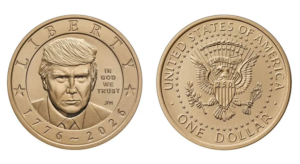
The U.S. Mint plans to begin minting a dollar coin featuring the country’s current president, Donald Trump.
Treasury Secretary Scott Bessent unveiled sketches of the new “gold coin” on Wednesday, one side of which features a profile of Trump alongside the phrase “In God We Trust.”
“To commemorate the 250th anniversary of American independence, the U.S. Mint will begin minting this new $1 gold coin to honor the enduring legacy of freedom and the enduring symbol of patriotism,” Bessent wrote on social media.
The Treasury Department and the Mint did not respond to inquiries from The Wall Street Journal regarding the mintage and release date of these coins, as well as the material from which they will be made and where they will be available.
The publication notes that it is rare for a sitting president to be depicted on U.S. commemorative coins. In the U.S., coins bearing the image of the head of state are usually issued posthumously. The only exception was a 50-cent coin issued in 1926 to mark the 150th anniversary of U.S. independence. Its obverse features the profiles of the first U.S. president, George Washington, and the then-sitting president, Calvin Coolidge, while the reverse depicts the Liberty Bell.

The U.S. Supreme Court ruled that children born on U.S. soil to parents who are in the United States illegally or on a temporary basis are U.S. citizens from the moment of birth. The decision effectively blocks President Donald Trump’s attempt to restrict the automatic granting of citizenship by birthright.
The case was heard in connection with Executive Order 14160, “Protecting the Meaning and Value of American Citizenship,” which Trump signed on January 20, 2025. The order proposed that children born in the U.S. to parents without permanent immigration status should not automatically be considered U.S. citizens.
The court concluded that such children are protected under the Fourteenth Amendment to the U.S. Constitution, which states that all persons born or naturalized in the United States and subject to its jurisdiction are citizens of the United States and of the state in which they reside.
The ruling is significant not only for immigration policy but also for the market for services related to childbirth in the United States. In practice, it means that U.S. passports obtained by virtue of birth on U.S. soil remain valid, and the right to citizenship by birth itself cannot be revoked by presidential decree.
However, the debate surrounding so-called “birth tourism” is not over. Following the court’s decision, the Trump administration may tighten controls over visa applications, travel by pregnant women, and cases of potential fraud upon entry into the United States. But this is a different legal matter: combating visa violations is not the same as revoking the citizenship of a child born on U.S. soil.
For foreigners who view the U.S. as a destination for childbirth, the main takeaway is this: the fundamental constitutional principle has been upheld, but immigration and visa risks may increase. U.S. authorities may scrutinize the purpose of travel, financial documents, medical plans, and any potential concealment of true intentions more closely when issuing visas or at the border.
For the international market for immigration and medical services, the Supreme Court’s decision means the preservation of one of the most well-known mechanisms of jus soli—citizenship by place of birth. The United States remains one of the key countries where the mere fact of being born on U.S. soil grants a child citizenship, regardless of the parents’ citizenship, with the exception of a few specific cases.
Thus, Trump’s executive order has not altered the fundamental principle of U.S. citizenship. Children born in the United States are still entitled to U.S. citizenship, but there will likely be more scrutiny, legal disputes, and political pressure surrounding travel for the purpose of giving birth.
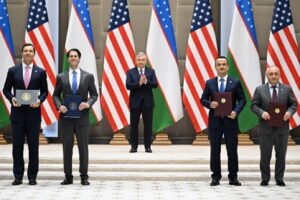
Uzbekistan and the United States of America have launched the “U.S.–Uzbekistan” Joint Investment Platform, designed to expand bilateral cooperation in the areas of investment and export financing, as well as to attract additional resources for the implementation of strategically important projects.
The new platform is being created to identify, support, and promote strategic investment projects of mutual interest to Uzbekistan, the U.S., and their partners. The mechanism also provides for the development of cooperation in the field of export financing and the attraction of international capital to priority sectors of the economy.
The platform’s key areas of focus include energy, infrastructure, transportation and logistics, information and communication technologies, the pharmaceutical industry, as well as the exploration and development of critical mineral resources.
Particular attention will be paid to projects capable of strengthening production and logistics supply chains, ensuring a sustainable energy supply, and promoting the development of modern high-tech manufacturing.
The new mechanism is expected to serve as a tool for mobilizing private capital and to enable sovereign wealth funds, international financial institutions, multilateral development banks, and other major investment organizations to participate in financing promising projects.
According to DFC estimates, Uzbekistan and Central Asia have significant economic potential due to growing global demand for critical minerals, an increasing need for reliable energy supplies, and expanding trade flows along the Trans-Caspian Transport Corridor.
DFC CEO Ben Black noted that the launch of the platform is the first step toward implementing investments that align with the strategic interests of both countries. According to him, the new mechanism will help strengthen supply chains and create additional opportunities for economic growth in the United States and Uzbekistan.
At the same time, the parties are discussing moving toward the practical implementation of a number of major joint projects. Promising areas include the construction of a new airport in Tashkent, the creation of a modern medical complex in the Fergana region, and the launch of a digital bank.



