

The Varus supermarket chain will open its first store in Vinnytsia on July 3, according to the company’s press office.
The new store is located in the PetroCenter shopping mall (70 Kotsyubynskoho Ave.). It offers everything needed for daily and family shopping: fresh meat and fish, fruits and vegetables, dairy products, baked goods, ready-to-eat meals, and delicacies. The store will feature a VARUS CAFE serving coffee and pizza, a bakery section, a WOK station, self-checkout lanes, and Scan&Go for quick purchases. Customers can also order items on VARUS.UA for pickup at this store at a convenient time.
According to the Ukrainian Council of Shopping Centers, this store is opening on the site of the former “EKO Market” supermarket, which was the chain’s last location in the city.
Varus is a national supermarket chain represented in Ukraine’s grocery retail market by the company “Omega.” The first store opened in 2003 in Dnipro. In 2025, seven new stores were opened. Currently, the total number stands at 119 supermarkets in various cities across Ukraine.
The chain operates in several formats: traditional supermarkets, To Go stores, and the Varus.ua online store.
According to the company, its network’s turnover in 2025 increased by 19.5% to 28.8 billion UAH. Tax payments to budgets at all levels totaled 1.99 billion UAH, which is 13.45% more than in 2024.
According to Opendatabot data, the owner of Omega LLC is the Cypriot company “Viant Enterprises Limited.” Valeria Kiptika and Ruslan Shostak are listed as the ultimate beneficiaries.

Ukrainian local and craft wineries can expand their presence in national retail chains, but to do so, producers must meet retailers’ requirements regarding quality, safety, documentation, and supply stability.
This was discussed during the National Roundtable “Local Grape Varieties: Heritage, Sustainability, and Rural Development,” organized by the Public Association “UKRSADVINPROM” to mark the 10th anniversary of the Association’s activities.
Olena Gordon, a representative of the “Ukraine Food Retail Alliance” (UFRA)—which includes leading Ukrainian food retail chains such as ATB-Market, Silpo, VARUS, NOVUS, and KOLO—noted that local producers can enter retail chains provided they meet standards and are ready to scale up production.
For Ukrainian winemakers, this means that having a high-quality product is no longer the only requirement for increasing sales through retail channels. Retail chains expect suppliers to provide stable shipments, a clear quality control system, production traceability, the necessary certifications, regulatory approvals, and a willingness to work within a long-term partnership framework.
Roundtable participants noted that retailers’ interest in craft wineries and local producers is growing amid rising demand for Ukrainian products. In the context of the war, supporting domestic producers is viewed not only as a consumer choice but also as a key element of the country’s economic resilience.
For the producers themselves, collaboration with retail chains can be a crucial step in scaling their businesses. A presence on the shelves of national retailers boosts brand recognition, expands access to consumers, and helps foster a culture of Ukrainian wine consumption.
At the same time, participants in the discussion emphasized that craft winemaking requires a distinct approach. Small producers cannot always operate according to the logic of mass industrial production; therefore, flexible collaboration models, professional support, assistance with certification, and clear rules for market entry are essential for the segment’s development.
The HoReCa sector and wine tourism could serve as additional channels for promoting Ukrainian wine. Restaurants, tasting events, festivals, and wine tours provide opportunities to introduce consumers to local grape varieties, create an emotional connection with producers, and gradually build demand that can subsequently support retail sales.
The roundtable also noted that the development of local grape varieties could become part of a broader strategy for promoting Ukrainian wine. Volodymyr Pechko, Chairman of the “UKRSADVINPROM” Public Association, emphasized that Ukraine needs to more actively showcase its own varieties and build a wine identity around them. In particular, “Odesa Black” and “Sukholimansky” were cited as flagship varieties of Ukrainian breeding.
For retailers, local varieties could become a distinct competitive niche, as they allow retailers to offer customers not just Ukrainian wine, but a product with provenance, history, and regional identity. This approach could boost interest in Ukrainian wines both in the domestic market and, in the long term, in export markets.
Participants in the event also emphasized the need to create a Vineyard Register and conduct a comprehensive inventory of vineyards in accordance with EU approaches. This is important for the sector’s transparency, the development of geographical indications, Ukraine’s integration into the European system of support for viticulture, and the future use of EU financial instruments.
The “UKRSADVINPROM” General Association is an industry association operating in the fields of horticulture, viticulture, and winemaking. The organization brings together market participants, takes part in industry discussions, promotes the interests of Ukrainian producers, and supports the development of high-value-added products. In 2026, the Association celebrated its 10th anniversary.
craft wine, local producer, RETAIL, UKRSADVINPROM, WINEMAKING, ПЕЧКО
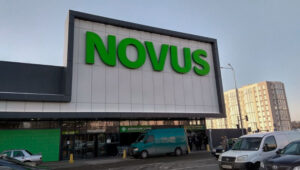
The Novus supermarket chain has received permission from the Antimonopoly Committee of Ukraine (AMCU) to lease assets from the Eurotek Group, which recently announced the closure of its supermarket chains, and plans to open its first stores in Lviv and Ivano-Frankivsk in their place, the grocery retailer’s press service told the “Interfax-Ukraine” news agency.
It is specified that at a meeting on Thursday, the AMCU granted Novus Ukraine LLC permission to lease three assets from JSC “ZNVKIF Eurotek Invest,” which has closed its grocery chains.
For Novus, this marks its first entry into the Lviv and Ivano-Frankivsk markets, as well as a new stage in the chain’s expansion across Ukraine’s western regions. In Lviv, Novus plans to open stores in August (147 Zelena St. and 60 Chervonoyi Kaliny Ave.), and in Ivano-Frankivsk in September (2 Mykolaychuk St.).
“The western region, particularly Lviv and Ivano-Frankivsk, is a strategically important area for us. Today, Lviv is one of the country’s key consumer hubs and most competitive markets, while Ivano-Frankivsk is experiencing rapid growth and high demand for quality retail. We want residents of both cities to get to know Novus not just as a new supermarket, but as a place for a comfortable shopping experience that combines European-style service, a wide product range, and a modern customer experience,” the company notes.
To maximize convenience and speed of service, the checkout areas in the new stores have been optimized to match the scale of the facilities. For example, the supermarket at 147 Zelena St. (total area: over 3,000 sq. m; retail area: 1,761 sq. m) will feature six linear checkout lanes, eight self-checkout stations (SCS), and one information desk with two workstations. At the store at 60 Chervonoyi Kaliny Ave. (total area: 2,376 square meters; sales area: 1,500 square meters), five regular checkout lanes, eight self-checkout stations, and one information counter—which also combines two checkout stations—will ensure quick checkout.
In Ivano-Frankivsk, at 2 Mykolaychuk St. (total area: 3,106 sq. m, retail area – 1,971 sq. m), service speed will be ensured by eight linear checkout lanes, one information counter (with two workstations), and eight self-service checkout stations, which have been divided by payment type for convenience: two for cash payments and six for non-cash payments.
As previously reported, the Eurotek Group of Companies closed its grocery chains “Fresh,” “Arsen,” “Soyuz,” and “Kvartal.” Specifically, the “Arsen” chain operated in Lviv, Ivano-Frankivsk, and Rivne regions, with a total of eight supermarkets. In May, the Antimonopoly Committee of Ukraine (AMCU) authorized Silpo-Food LLC—which operates the Silpo chain and is part of the Fozzy Group—to acquire five of these stores; opening dates have not yet been announced.
Novus is a supermarket chain with 100% Lithuanian capital that has been operating since 2008 and is developed by BT Invest (Lithuania). As of the end of June 2026, the company has 173 locations and is represented in Kyiv, the Kyiv region, and a number of other regions of Ukraine. The founder and beneficial owner of the group is Lithuanian entrepreneur Raimondas Tumenas. The company operates a supermarket chain as well as “neighborhood” stores under the Mi Market brand.
As of the end of 2025, the chain ranks among Ukraine’s largest food retailers. Its annual revenue totaled 34.69 billion UAH, an increase of 19.55% compared to 2024.
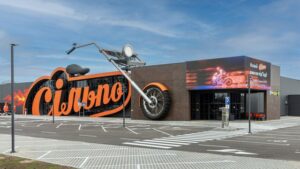
On June 6, the Silpo chain opened a new supermarket in the Kyiv region (village of Myrotske, 4 Shlyakhova St.) in a biker loft style; MOTO FEST by Silpo is scheduled to take place in the store’s parking lot on June 13, the chain’s press service told Interfax-Ukraine.
The new supermarket covers an area of 1,639 square meters and is open from 8:00 a.m. to 11:00 p.m. The “Silpo” sign mimics the outline of a motorcycle: a seat, a wheel with a stand, handlebars, and a headlight that glows at night, with graffiti featuring flames behind it. Interior details include a horse made of metal wire, a motorcycle with wheels made of pineapple rings and a headlight made of a pumpkin, and more. A special place here is occupied by a panel made of leather jackets painted with bikers’ creeds. The sketches and paintings for them were created by artist Oleksii Bondarenko, co-author of the mural “VOLIA.” At the entrance stands a column of rock posters, and the checkout lightboxes are designed in the shape of spiked wheels.
The “Silpo” team announced a motorcycle festival with an extreme riding show for June 13.
Silpo-Food LLC, which operates the Silpo chain, was established in early August 2016. According to information on the website, the chain operates 311 supermarkets in 60 cities across Ukraine and four Le Silpo delicatessens: in Kyiv, Dnipro, Kharkiv, and Odesa.
The founder of the LLC is PJSC “Retail Capital” (100%, Kyiv), a closed-end, non-diversified venture corporate investment fund. The ultimate beneficiary is Volodymyr Kostelman.
Silpo-Food’s revenue for 2025 increased by 13.97% compared to 2024, reaching UAH 106.013 billion, while net profit amounted to UAH 1.205 billion, compared to UAH 154.1 million for the same period the previous year.
It is part of the Fozzy Group, a commercial and industrial group with more than 825 retail outlets throughout the country. The company operates retail chains of various formats: Silpo supermarkets, Fozzy wholesale hypermarkets, Fora neighborhood stores, Thrash! discounters, Bila Romashka pharmacy supermarkets, and others.
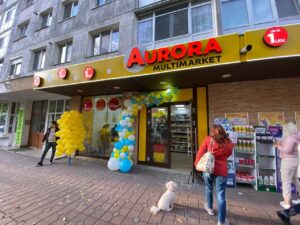
The “Aurora” supermarket chain has invested 13 million hryvnias in strengthening product quality control; the consumer product testing laboratory began operations in Poltava on June 2, according to the company’s press office.
“Our laboratory is about transparent quality control and trust. We want both manufacturers and shoppers to see how the quality of products that end up on Aurora’s shelves is determined. Moreover, anyone can bring a product in for testing—even if it wasn’t purchased in our stores. This helps foster a new culture of consumption based on openness, objectivity, and trust,“ emphasized Natalia Izyumets, Quality Director of the ‘Aurora’ supermarket chain.
The laboratory is located next to the ”Aurora” Support Office in Poltava and has a separate entrance for visitors. Large panoramic windows allow visitors to observe the product testing process in real time.
A distinctive feature of the consumer testing laboratory is its openness to visitors. Anyone can submit a request to have a product tested, specifying the testing criteria themselves. After the tests are conducted, the results can be received via email or discussed with specialists in person.
The lab team consists of six specialists in quality control and product testing. The lab’s specialists work with over 25,000 product SKUs across various categories—from electronics, children’s products, and tableware to cosmetics, household chemicals, and food products. Here, they verify safety, reliability, and compliance with declared specifications and current legislation. The data obtained is shared with suppliers and the chain’s commercial department, enabling the rapid improvement of the product range and enhancement of product quality.
“For example, when inspecting a cleaning product, in addition to weight and volume, we check the consistency—that is, whether there is any separation, whether there is sediment—because cleaning products should not normally contain sediment or lumps. If there is any, that’s not good. We record this, include it in the inspection results, and submit a request to the suppliers,” notes Anna Tokach, an incoming quality control specialist at the “Aurora” chain.
Professional equipment is used for testing, which allows for simulating real-world conditions for product use. Specifically, in the lab, they check product shelf life using a climate chamber, test wooden products for moisture content, USB cables for compliance with the stated power rating, cosmetics for acidity level using a pH meter, and electrical goods for compliance with technical specifications and safety of use.
Special attention is given to high-risk products. For example, products involving open flames are tested in a special combustion chamber equipped in accordance with all fire safety requirements.
The opening of the consumer testing laboratory is part of Aurora’s long-term strategy to raise quality standards and promote responsible consumption.
“Aurora” was founded in 2011 by Lev Zhydenko, Taras Panasenko, and Lesya Klymenko. As of the end of 2025, the chain has over 1,800 stores in Ukraine and more than 60 in Romania. The retail chain’s headquarters are located in Poltava.
According to Opendatabot, the owner of Vygidna Pokupka LLC, which operates the chain, is the Cypriot company “Aurorail Investments Limited”; its beneficial owner is Lev Zhydenko, and among the owners are funds managed by Horizon Capital.

In September, the Chinese economy showed higher-than-expected growth rates in industry and retail trade, indicating a gradual recovery in domestic demand and business activity.
According to the National Bureau of Statistics of China, industrial production grew by 6.5% year-on-year, the highest rate since June. In August, growth was 5.2%, and analysts had expected a slowdown to 5%.
The largest contributors were:
manufacturing — +7.3%,
mining — +6.4%,
oil and gas — +8.9%,
automobile production — +16%,
computers and telecommunications equipment — +11.3%.
Growth was recorded in 36 of 41 sectors of the economy. Overall, industrial production increased by 6.2% in the first nine months of 2025 compared to the same period last year.
Retail sales in September grew by 3% year-on-year. This is slightly less than in August (3.4%), but still better than analysts’ forecasts (2.9%).
The largest increases were in sales of food products (+6.3%), jewelry (+9.7%), and clothing (+4.7%). Car sales rose by 1.6%, while petroleum product sales fell by 7.1%.
Since the beginning of the year, retail turnover has reached 36.6 trillion yuan (about $5.1 trillion), which is 4.5% more than a year earlier.
Investments in fixed assets as a whole declined slightly, by 0.5%, mainly due to a decline in the construction sector (-13.9%). At the same time, investments in infrastructure and manufacturing grew by 1.1% and 4%, respectively.
The unemployment rate in September fell to 5.2% from 5.3% a month earlier.
Experts from the Experts Club analytical center note that the Chinese economy remains stable despite the slowdown in global demand and difficulties in the real estate sector.
Reference: Experts Club.
For several years now, China has ranked first in the world in terms of economic size, calculated in terms of purchasing power parity (PPP), ahead of the US and the EU. This confirms its status as the largest industrial and consumer center on the planet.



