Ukrzaliznytsia’s international passenger traffic has increased 50–60-fold since the start of Russian aggression and the closure of Ukrainian airspace, and is generating significant profits, according to Ukrzaliznytsia CEO Oleksandr Pertsovskyi.
“This is a profitable segment; pricing is fairly flexible there and is determined by bilateral agreements. We expect to generate up to 5 billion hryvnias in revenue and somewhere around 2 billion hryvnias in profit in this segment,” he said on the “What’s Up with the Economy” podcast produced by the Center for Economic Strategy (CES).
At the same time, Pertsovskyi noted that this result was achieved by repairing a “huge number” of RIC railcars and reaching agreements with all the railways of neighboring countries.
“From an economic standpoint, everything is fine here; the key task is to scale up these operations. We really wanted to launch a train to Bulgaria—another popular route—but politics got in the way because governments changed in Romania and in Bulgaria itself, so there are some complications,” added the chairman of the board of Ukrzaliznytsia.
According to him, they have not yet managed to convince Poland to allow wider Ukrainian railcars to run on European-gauge tracks, even though a pilot run demonstrated that this is possible and such railcars regularly run on European-gauge tracks toward Budapest.
Among the latest successful projects, he cited the transition of the train to Chisinau to a daily schedule instead of every other day, as well as the synchronization of service with Germany.
Regarding domestic long-distance trains, Pertsovskyi emphasized that the government’s introduction this year of an experimental Public Service Obligation (PSO) compensation model—which covers part of the company’s costs for such services—allowed this segment to break even for the first time.
However, the head of Ukrzaliznytsia clarified that there is still a need for capital expenditures to purchase new passenger cars, since renewing the fleet of 1,600 cars with an average cost of $1.5 million would require over $2 billion; therefore, it is positive that the state budget has allocated funds for the purchase of such cars starting in 2021.
As for the “Intercity” trains, according to Pertsovskyi, one was lost due to an enemy attack, and another due to a traffic accident.
“We are currently working on a more systematic, long-term solution for their repair. It’s not cheap, and since the trains aren’t new, manufacturers aren’t really prepared for this, but at the same time, we’re turning them into ‘transformers’: using fewer cars but getting them back into service,” said the chairman of the board.
Finally, he emphasized, the most unprofitable and problematic segment of passenger transportation remains—commuter rail.
“There is no solution here yet, because it’s stuck between the state budget and local budgets, but there is a willingness and unity within the government—and on our part—to pass a law this year on state procurement, the so-called public PSO, including for commuter (transportation). We would greatly appreciate your support and advocacy; this will make it possible to balance this segment as well, and then we will be in a stable economic situation,” Pertsovskyi concluded.
In 2025, Ukrzaliznytsia reduced its revenue from sales to external customers by 12.4% compared to 2024—to 91.24 billion—and increased its operating loss by 5.5 times—to 17.03 billion hryvnias.
Revenue from intercity passenger transportation on domestic and international routes increased by 11.8%—to 11.94 billion hryvnias—while the loss from these services rose by 9.1%, to 9.62 billion hryvnias.
Suburban transportation generated only 0.51 billion UAH in revenue and 9.996 billion UAH in losses for the company, which is 2.8% less and 7% more, respectively, than in 2024.
Finally, freight transportation declined by 17.1% to 67.87 billion UAH, while profit from this segment fell 3.5-fold to 5.82 billion UAH.

In the 2025/2026 marketing year, Ukraine exported 2.7 million metric tons of soybeans, compared to 3.8 million metric tons in the previous season, according to the Ukrainian Grain Association.
Turkey was the largest buyer of Ukrainian soybeans, purchasing 923,000 metric tons. The top five importers also included the Netherlands (382,000 metric tons), Germany (298,000 metric tons), France (159,000 metric tons), and Egypt (151,000 metric tons).
According to the UGA, the decline in soybean exports was due to a lower harvest and the introduction of an export duty on this crop.

“Nibulon” Joint Venture LLC is preparing to begin work on its second humanitarian demining contract in Kharkiv Oblast, which involves clearing 64 hectares of agricultural land in the Izyum District, the company’s press service reported.
“The terrain is challenging, but we make timely decisions tailored to each specific challenge—to ensure effective work and achieve our main goal: that farmers in the Kharkiv region harvest grain, not the remnants of explosive ordnance,” the press service quoted Vsevolod Petrovsky, head of the “Demining” division, as saying.
According to the report, the work will be carried out under a subcontract on land owned by Landex-Agro LLC.
At the same time, Nibulon is completing its first government contract in the Kharkiv region, which it is carrying out jointly with Ukrainian Demining Services LLC. As part of this project, the company’s specialists have already surveyed more than 30 hectares of land across seven cadastral numbers on the territory of “Agrofirma Yug-M” LLC.
The work has passed an internal inspection and is currently undergoing an external audit conducted by the Mine Action Center of the Ministry of Defense of Ukraine, the statement said.
In addition, the company has completed a non-technical survey of 24 hectares of land in the Dnipropetrovsk region. The results have been validated by the Center for Mine Action in the IMSMA system.
The company noted that the development of its humanitarian demining operations is supported by DEG Impulse gGmbH, which has enabled it to strengthen its technical capabilities, particularly through the use of modern clearance equipment.
The statement noted that “Nibulon” has already completed its first commercial humanitarian demining contract in the Mykolaiv region. Since the start of operations, the company has returned more than 7,500 hectares of agricultural land to productive use and confirmed the certification of five mine action processes. Certification of three additional processes is currently underway.
As previously reported, in May 2025, Nibulon confirmed its certification in demining and expanded the list of mine action processes to eight areas.
Before the war, Nibulon LLC cultivated 82,000 hectares of land across 12 regions of Ukraine and exported agricultural products to more than 70 countries worldwide. In 2021, the grain trader exported 5.64 million metric tons of agricultural products—the highest volume in its history. After the war began, the company was forced to relocate its headquarters from Mykolaiv to Kyiv. In addition to 23 grain elevator complexes, “Nibulon” has its own trucking and rail transport capabilities, as well as a fleet built at its own shipyard. During wartime, this fleet continues to provide river transport services.
The company is also actively developing its own humanitarian demining division to restore safety on leased lands and assist Ukraine’s agricultural sector. Nibulon is a certified mine action operator.
DEG Impulse gGmbH is a nonprofit subsidiary of the German financial institution DEG that implements private-sector support programs funded by the German Federal Ministry for Economic Cooperation and Development (BMZ).
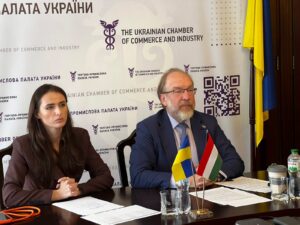
On July 6, the Chambers of Commerce and Industry of Ukraine and Kuwait held an online conference with the support of the Embassy of Ukraine in the State of Kuwait, attended by approximately 50 business representatives from both countries.
The event was co-chaired by Gennadiy Chizhikov, President of the Ukrainian Chamber of Commerce and Industry, and Firas Al-Oda, Acting Director General of the Kuwaiti Chamber of Commerce and Industry. The meeting marked the first practical event of this kind between the chambers after a hiatus of more than six years.
The main goal of the event was to establish direct contacts between Ukrainian and Kuwaiti entrepreneurs. The parties presented current trade and investment opportunities and identified promising areas for cooperation.
In his remarks, Maxim Subkh, Ukraine’s Ambassador to Kuwait, emphasized the importance of revitalizing the business component of bilateral relations, particularly in the context of involving Kuwaiti businesses in Ukraine’s post-war reconstruction projects.
Gennadiy Chizhikov, President of the Ukrainian Chamber of Commerce and Industry, urged Kuwaiti businesses to view Ukraine not only through the lens of the war, but first and foremost as a country of opportunities and a future member of the European Union.
Conference participants discussed the possibility of systematic cooperation through working groups in priority sectors, including agriculture, the food industry, construction, energy, IT, and logistics. The parties also exchanged contact information, presentations, and commercial proposals.
According to the data provided, trade between Ukraine and Kuwait amounted to $336.6 million in 2024 and $90.8 million in 2025. In the first five months of 2026, bilateral trade had already reached $102 million, exceeding the figure for the entire year of 2025.
BUSINESS, INTERNATIONAL TRADE, INVESTMENTS, KUWAIT, UCCI, ЧИЖИКОВ

According to Fixygen, the American company Strategy Inc. sold $216 million worth of Bitcoin, marking the company’s largest cryptocurrency sale since it began building its Bitcoin portfolio in 2020.
This is an important psychological signal for the crypto market. Strategy has long been viewed as one of Bitcoin’s leading corporate supporters and a role model for companies considering BTC as a reserve asset. Therefore, even a partial sale could heighten investors’ doubts about the sustainability of corporate demand for cryptocurrency.
According to the company, this is only its third Bitcoin sale since 2020. However, the scale of the transaction significantly exceeds previous ones, and the timing was chosen amid a weak market: on Monday, Bitcoin fell by 1.9% to $61,532, and has lost 30% of its value since the start of the year.
An additional negative factor was Strategy’s $8.32 billion loss on digital assets for April–June. This illustrates just how sensitive the company’s business model has become to Bitcoin’s revaluation and the crypto market’s decline.
Strategy’s stock fell 4.5% in pre-market trading on Monday. Since the beginning of the year, the company’s market capitalization has shrunk by nearly 34%—to $35.3 billion—while the Nasdaq Composite Index rose by more than 11% over the same period. This means that investors no longer view Strategy as a typical technology company, but rather as a high-risk proxy for Bitcoin.
For the crypto world, the main issue is not the amount of the sale itself, but the shift in perception. If a company that has spent years building an image as the largest corporate holder of BTC begins to sell the asset in significant volumes, the market may see this as a signal: even long-term institutional holders are forced to lock in liquidity or reduce risk.
In the short term, this could intensify pressure on Bitcoin and related stocks, especially if investors begin to anticipate further sales. More broadly, the Strategy case shows that corporate Bitcoin holdings remain not only an investment story but also a source of volatility for balance sheets, financial reporting, and the stock market.
The crypto market will now be watching not only the Bitcoin price and ETF flows but also whether Strategy continues its sales. If these turn out to be a one-time transaction, the impact may be limited. However, if the company begins to systematically reduce its position, it will be one of the most significant bearish signals for the market since 2020.