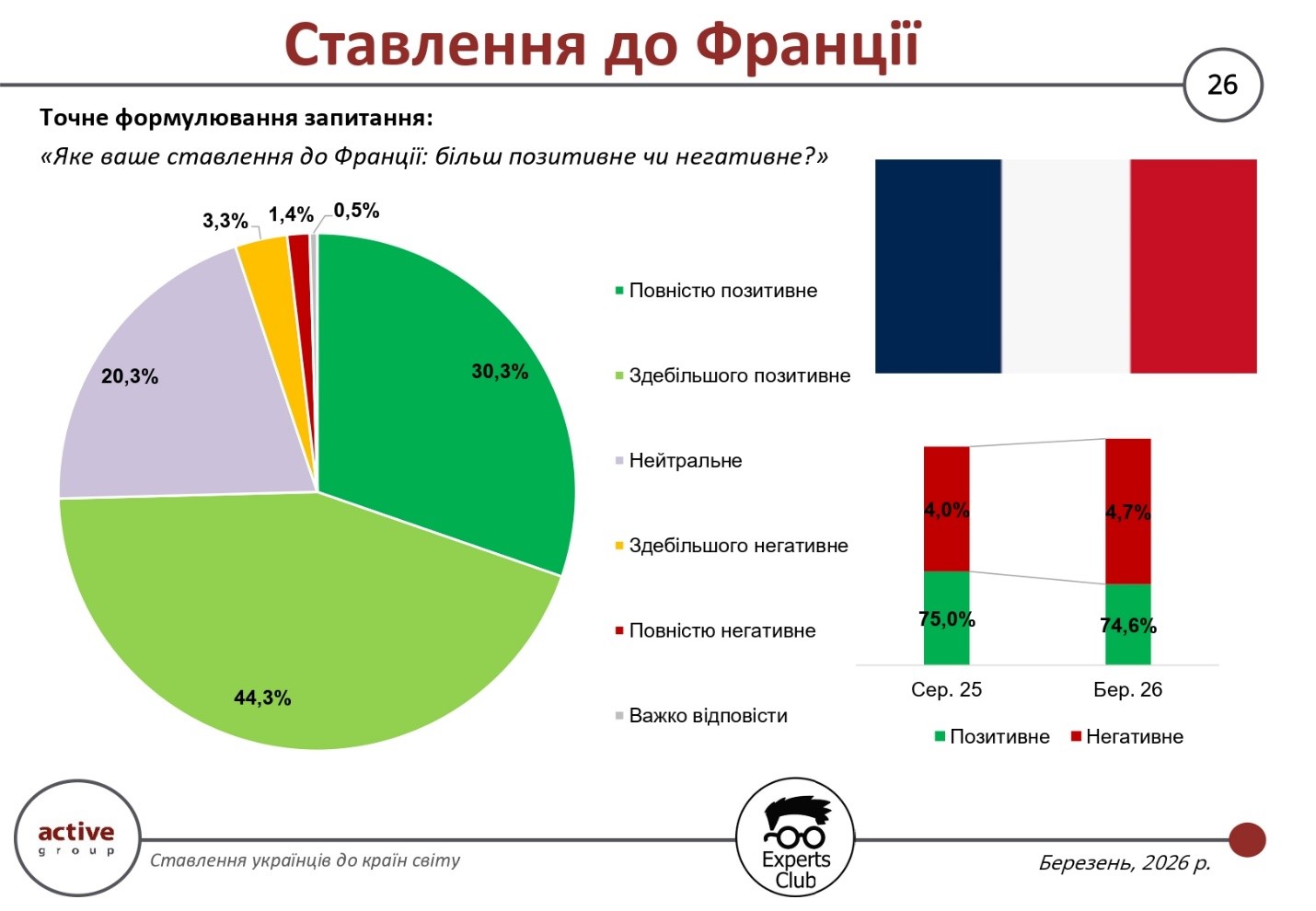
Ukrainians’ attitude toward France in March 2026 remains one of the highest among the countries surveyed. According to the results of a sociological survey conducted in March 2026 by the research company Active Group in collaboration with the Experts Club information and analytical center, 74.6% of respondents rate their attitude toward France as positive, which is only slightly lower than the 75.0% recorded in August 2025. At the same time, the share of negative assessments rose from 4.0% to 4.7%, indicating minimal but noticeable shifts in the balance of public opinion.
In the breakdown of responses, 30.3% of respondents indicated a “completely positive” attitude toward France, while another 44.3% described it as “mostly positive.” A neutral position was taken by 20.3% of respondents. Negative assessments remain low: 3.3% answered “mostly negative,” 1.4% — “completely negative,” while 0.5% were undecided.
Despite the overall stability of the indicators, a slight decrease in the share of positive assessments and a simultaneous increase in negative responses may indicate a gradual shift in perception. This does not signify a radical change in attitude, but demonstrates that public opinion is becoming more sensitive to the foreign policy context and the information landscape.
France traditionally remains an important partner for Ukrainians in the political and security spheres, which largely explains the high level of positive perception. At the same time, even minor fluctuations in the figures indicate that Ukrainians’ assessments are not static and may change depending on current events and signals in international politics.
It is also significant that the share of neutral responses remains relatively small compared to other countries. This means that most respondents have formed a clear perception of France, which is typically a sign of the country’s deeper presence in Ukraine’s information and public sphere.
“Attitudes toward France demonstrate an established and stable perception of partnership. Even with minor fluctuations, the overall level of trust remains high, indicating the stability of political and humanitarian ties. It is important for Ukraine to maintain this momentum through practical cooperation projects that reinforce the sense of mutual benefit,” noted Maksym Urakin, founder of the Experts Club information and analytical center.
Thus, the survey results confirm that France remains among the countries with the highest level of positive perception in Ukraine. Minor changes in the indicators do not affect the overall trend but point to the need for constant maintenance of active dialogue and interaction between the countries.
According to a study conducted by the Experts Club Information and Analytical Center based on data from the State Customs Service, France ranks thirteenth in terms of total trade in goods with Ukraine, which amounts to $2.93 billion. Imports from France significantly exceed the volume of Ukrainian exports, resulting in a substantial trade deficit.
The study was presented at the Interfax-Ukraine press center; the video can be viewed on the agency’s YouTube channel. The full version of the study can be found at this link on the Experts Club analytical center’s website.
ACTIVE GROUP, EXPERTS CLUB, FRANCE, Pozniy, SOCIOLOGY, SURVEY, UKRAINE, URAKIN
Ukrainians’ attitudes toward Bulgaria in March 2026 show a clear trend toward improvement. According to the results of a sociological survey conducted in March 2026 by the research company Active Group in collaboration with the Experts Club information and analytical center, 53.8% of respondents rate their attitude toward this country as positive, which is significantly higher compared to 44.3% in August 2025. At the same time, the share of negative assessments decreased from 3.7% to 2.3%, indicating a gradual strengthening of the country’s positive image.
In the breakdown of responses, 14.2% of respondents indicated a “completely positive” attitude toward Bulgaria, while another 39.6% described it as “mostly positive.” The share of neutral assessments remains significant at 42.4%, indicating a moderate or insufficiently formed perception among a significant portion of respondents. Negative assessments are limited in scope: 2.1% answered “mostly negative,” only 0.2% — “completely negative,” while 1.4% of respondents were undecided.
The trend is telling: the increase in positive assessments by more than 9 percentage points is accompanied by a simultaneous decline in the negative segment. This means that some respondents who previously held a reserved or critical stance are gradually shifting toward a positive perception.
At the same time, the high proportion of neutral responses indicates that Bulgaria’s image remains less distinct for a significant portion of Ukrainians compared to countries that have a more active presence in the public sphere or are associated with key political processes. In such cases, public opinion forms gradually and depends largely on the informational context and personal experience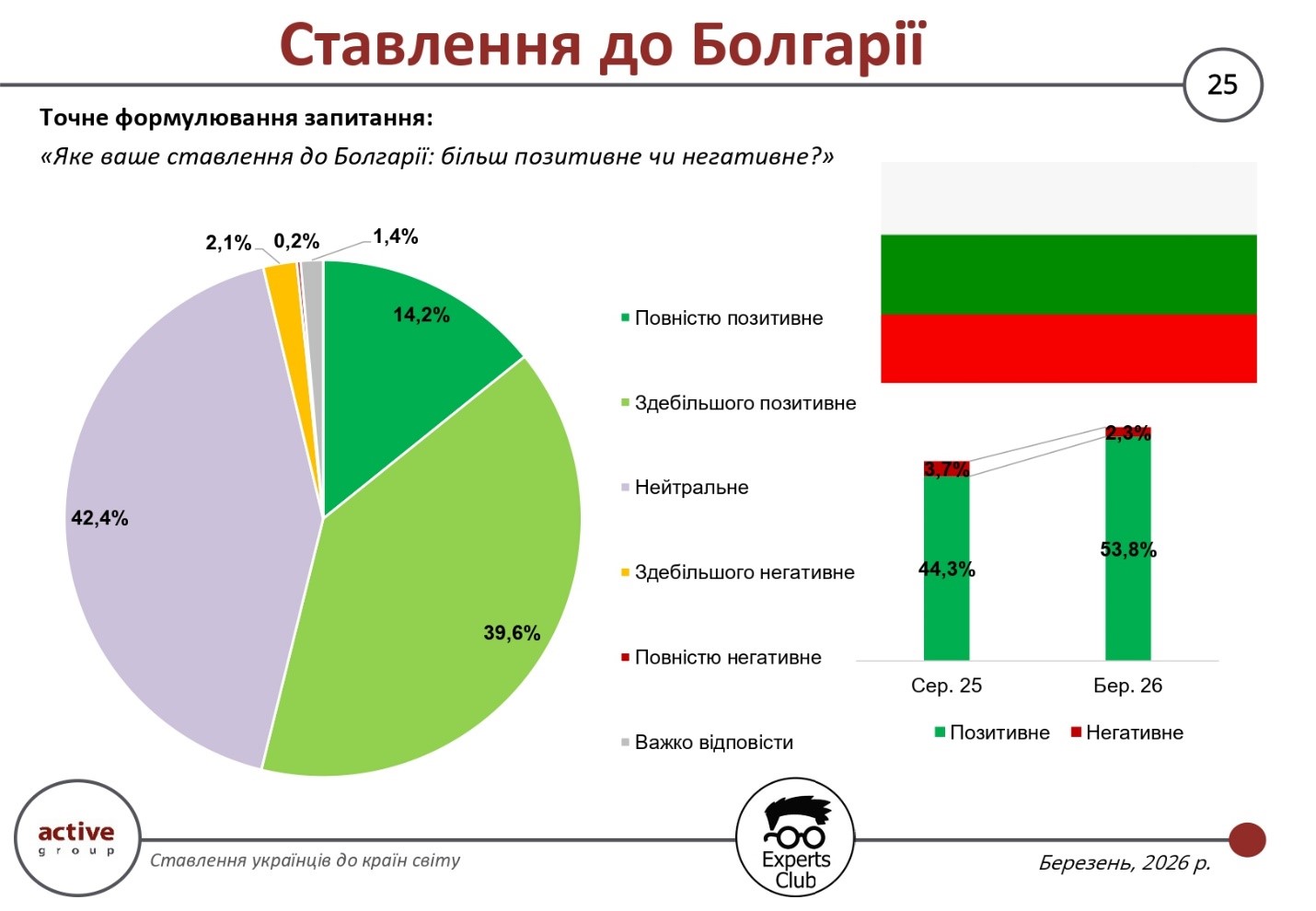
An important feature is that even with a large neutral group, negative attitudes toward Bulgaria remain minimal. This creates a favorable foundation for further strengthening the country’s positive image in Ukrainian society.
“Ukrainians do not form their assessments in isolation—they react to the informational context and their own experience of interacting with countries. Where there are more signals and clear actions, we see an increase in positive assessments. Bulgaria is gradually moving into the group of countries with a consistently positive perception,” noted Oleksandr Pozniy, director of the research company Active Group.
Thus, the survey results indicate that Bulgaria is strengthening its position in the public opinion of Ukrainians. The growth of positive attitudes against a backdrop of low negative sentiment creates potential for the further development of bilateral relations at both the social and economic levels.
According to a study conducted by the Experts Club information and analytical center based on data from the State Customs Service, Bulgaria ranks twelfth in total trade volume of goods with Ukraine, with a figure of $2.99 billion. At the same time, imports of Bulgarian products exceed Ukrainian exports, resulting in a negative trade balance.
The study was presented at the Interfax-Ukraine press center; the video can be viewed on the agency’s YouTube channel. The full version of the study can be found at this link on the Experts Club analytical center’s website.
ACTIVE GROUP, BULGARIA, EXPERTS CLUB, Pozniy, SOCIOLOGY, SURVEY, UKRAINE, URAKIN

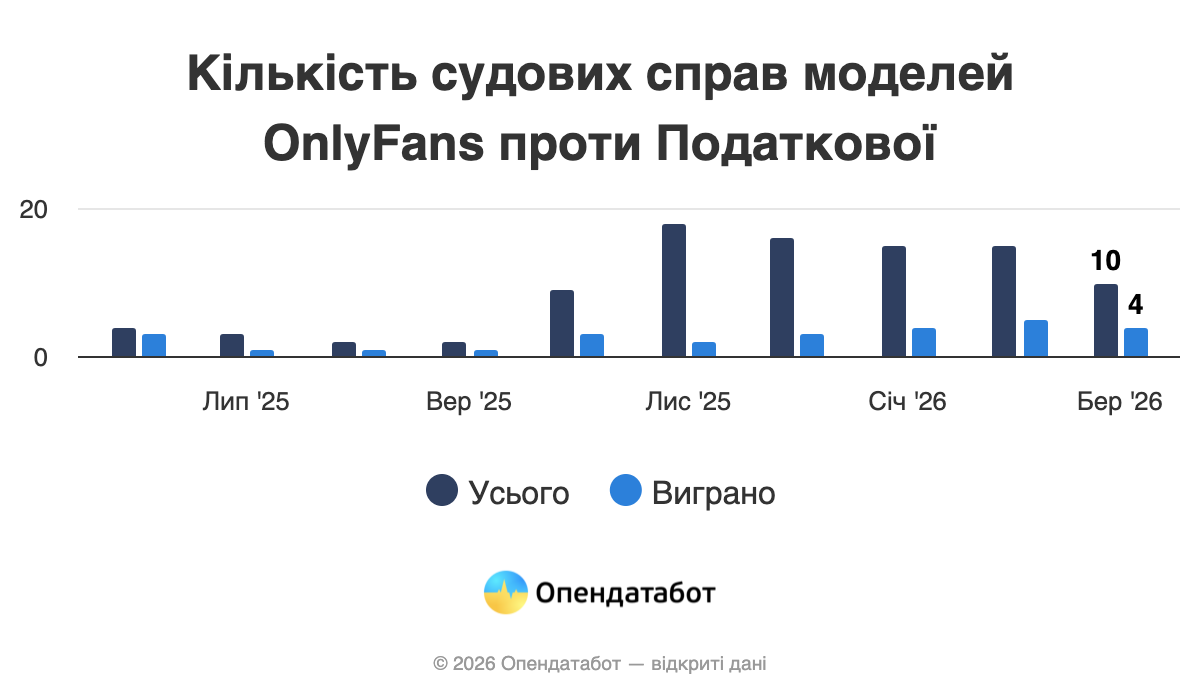
At least 27 court rulings in which OnlyFans content creators successfully challenged and partially or fully overturned fines imposed by the State Tax Service are currently listed in the Unified State Register of Court Decisions. In total, OnlyFans models have attempted to challenge the Tax Service’s actions in 94 cases. They have won nearly a third of them. In 92% of cases, procedural errors were the reason for the Tax Service’s defeats.
The number of court rulings in favor of OnlyFans content creators challenging fines and additional tax assessments from the Tax Service is rapidly increasing, according to the “Babusia” court decision search engine. At least 27 cases have been resolved fully or partially in favor of the plaintiffs. This is nearly a third of the 94 cases where models sought to defend their rights.
This year, courts have already issued 13 rulings in favor of content creators. February set a record with 5 rulings.
In 92% of cases, the courts sided with the plaintiffs due to procedural violations by the State Tax Service. Most often, the Tax Service sent documents to outdated addresses. The letters were returned, but the audits were conducted anyway. As a result, the courts ruled such audits unlawful, and along with them—all the assessments.
At the same time, the Tax Service often relied on letters from British tax authorities regarding payments from Fenix International Ltd, which operates OnlyFans. But the courts consistently emphasize: such letters are merely a pretext for an audit, not proof of income. Without bank statements, contracts, or other primary documents, the additional assessments are deemed unfounded.
One in three won cases was recorded in the Odesa region—8 court rulings. Dnipropetrovsk region follows with 5 cases. However, in some regions, particularly in the Zhytomyr and Rivne regions, despite ongoing proceedings, no cases have been won yet.
The largest fine that was successfully overturned was recorded in Kyiv—over 3 million UAH in taxes assessed on allegedly nearly 400,000 dollars in income. The plaintiff provided her own bank statements, which did not confirm these amounts—and the court ruled in her favor.
In Cherkasy Oblast, the court canceled over 1.3 million hryvnias in taxes and fines due to the complete absence of source documents. And in Odesa Oblast, the reason for canceling a fine of over half a million was a simple mistake with the address: the tax authority failed to properly notify the person of the audit, which the court deemed unlawful.
In Ivano-Frankivsk Oblast, the plaintiff independently contacted the British tax authority and received an official response: no information about her had been sent there. In fact, the State Tax Service was relying on data that did not exist. Accordingly, the court canceled all charges.
https://opendatabot.ua/analytics/onlyfance-courts
According to the Ukrainian Agribusiness Club (UAC), Ukraine exported 19,600 tons of beef in 2025, which is 1.5% less than the previous year and 15% below the average for the past five years.
The business association noted that total beef production last year amounted to 222,000 tons. Despite war-related risks, producers continue to actively respond to high international demand due to low activity in the domestic market. The key export destinations were European countries outside the EU (44.7% of the total volume) and Asia (40.5%).
The association’s analysts noted that the industry continues to face a decline in the cattle herd. As of 2025, the cattle herd stands at 2.0 million head, which is 10% less than in 2024 and 24% below the five-year average. The largest decline was recorded in private households and the eastern regions of the country.
“Since the domestic market is less active, producers are optimizing sales by focusing on more profitable foreign markets. Global demand for meat is encouraging Ukrainian farmers and enterprises to increase exports, making foreign trade a strategic factor in supporting the industry,” experts explained.
According to UCAB data, cattle currently account for 45% (0.9 million head) of the total herd at enterprises, while 55% (1.1 million head) are concentrated in private households.
Beef imports in 2025 amounted to 2,000 tons, which is 35% less than in 2024 and 4.5 times lower than the average over the past five years.

According to Serbian Economist, FAS/USDA forecasts corn production in Serbia for the 2025/2026 marketing year (beginning in October 2025) at 7.1 million tons, with a harvested area of 950,000 hectares.
Corn exports in the 2025/26 marketing year are estimated at 2.5 million tons, domestic consumption at 4.25 million tons, and ending stocks at 827,000 tons. The report notes that demand for Serbian corn on FOB terms from Danube ports is being held back by strong competition from Ukraine and Russia.
https://t.me/relocationrs/2622