
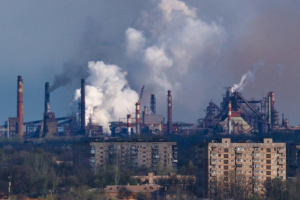
At the end of 2025, Ukraine ranked 95th out of 143 countries and territories in the global air pollution ranking published by the Swiss company IQAir. According to IQAir’s global press release, in 2025 only 14% of the world’s cities met the World Health Organization’s recommendation for an annual average PM2.5 concentration of no more than 5 micrograms per cubic meter, while 130 out of 143 countries and territories exceeded this benchmark.
The IQAir global release also notes that the five most polluted countries in the world in 2025 were Pakistan, Bangladesh, Tajikistan, Chad, and the Democratic Republic of the Congo. The most polluted city in the world was Lonhi in India, while the cleanest was New Woodville in South Africa.

“Kyivstar,” Ukraine’s largest telecommunications operator, which acquired a 12.947 MW solar power plant operator in the Zhytomyr region for $3 million late last year, plans to acquire six more solar power plant operators in the Lviv region: EnergoPostach-Plus LLC, Lightful, Sunlight Generation, Ternovitsa Solar, Energy Space, and Ternovitsa Solar Plus.
According to a statement from the Antimonopoly Committee of Ukraine, it granted Kyivstar PJSC the relevant approval on Thursday.
As previously reported by the Interfax-Ukraine agency, the AMCU had already granted permission to purchase these solar power plants in July 2021, but at that time the potential buyer was the French company Total Eren S.A. (a subsidiary of Total).
At that time, the project involved more than 100 MW of installed capacity: “Energy Space” (5.94 GW and 5.797 GW), “Ternovitsa Solar” (13.023 GW and 15.537 GW), “Ternovitsa Solar Plus” (12.382 GW and 15.537 GW), “Sunlight Generation” (5.94 GWp and 5.797 GWp), “EnergoPostach-Plus” (5.94 GWp and 5.797 GWp), and “Lightful” (5.94 GWp and 5.79 GWp).
According to data from YouControl, the main beneficiary of “Energy Space” and “Ternovitsa Solar Plus” is Vsevolod Trofimenko, a member of the family that owns the Multiplex cinema chain, “Ternovitsa Solar,” “Sunlight Generation,” “Energopostach-Plus,” and ‘Lightful’—Ivan Torsky, who was the CEO of the development holding “TKS.”
On March 13, during the presentation of the group’s annual report, Kyivstar CEO and President Oleksandr Komarov noted that the first solar power plant acquired at the end of last year generates electricity equivalent to 4% of Kyivstar’s annual electricity consumption.
According to him, such investments serve as a hedge against energy costs, which represent one of the company’s largest recurring expenses. They align with the strategy to support Ukraine’s recovery and energy independence, while also meeting the needs of digital services.
“Expanding our presence in the energy sector is a natural hedge against rising prices in the coming periods,” CFO Boris Dolgushin added at the time.
In 2025, Kyivstar Group increased its EBITDA by 30% to UAH 27 billion, with revenue growing by 30.3% to UAH 48.2 billion; including a 23.1% increase in EBITDA to UAH 7.2 billion in the fourth quarter of last year, with revenue growing by 30.1% to UAH 13.5 billion.
Swedish company H&M Hennes & Mauritz AB has published its 2025 annual sustainability report, in which it reported a further reduction in greenhouse gas emissions, an increase in the share of recycled and more sustainable materials, as well as investments in decarbonization and innovation.
As noted in the report, in 2025, 91% of the materials used by the company were recycled or more sustainable alternatives, with the share of recycled materials reaching 32%, exceeding the target of 30%.
According to the report, Scope 1 and 2 greenhouse gas emissions decreased by 41% compared to 2019, and Scope 3 emissions by 34.6%. Total investments in decarbonization and innovation amounted to 2.8 billion Swedish kronor.
H&M also reported that since 2022, the number of Category 1, 2, and 3 clothing suppliers using coal-fired boilers has decreased by 108. The company confirmed its goal of completely phasing out such equipment by 2026.
Freshwater use in 2025 was reduced by 22.8%, more than doubling the target. Meanwhile, the resale service via Sellpy and the group’s brands is already operating in 26 markets and accounts for 0.8% of revenue, having increased by 31% year-over-year.
H&M Group CEO Daniel Erver noted that the company continues to strengthen its customer offering while demonstrating that growth, profitability, and emissions reduction can go hand in hand. Leila Ertur, Director of Sustainability, in turn, stated that the group intends to continue decoupling business growth from resource consumption while supporting people and communities.
In addition, the H&M Group announced the 10th anniversary of its global framework agreement with IndustriALL and IF Metall, which, according to the company, protects the rights of over 1 million workers.
The full 2025 Annual and Sustainability Report is available on the H&M Group website.

According to The Serbian Economist, Serbia has aligned itself with two European Union resolutions that extend existing restrictive measures related to the war in Ukraine.
The first EU resolution concerns measures against Russia’s actions regarding the occupied regions of Ukraine that are not under Kyiv’s control. Essentially, this is an extension of the special sanctions regime for another year—until February 24, 2027. Serbia supported this extension along with a number of other EU candidate countries and partners.
The second decision concerns sanctions against specific individuals, companies, and organizations in connection with the situation in Ukraine. These are not “general sanctions against Russia as a whole,” but rather an extension of the list of targeted restrictions on specific individuals until March 6, 2027.
The wording stating that Serbia “will ensure the alignment of its national policy” with this decision means the following: Belgrade has declared that it will act in line with EU policy on these two specific issues. The European Union separately noted and welcomed Serbia’s alignment in official statements.
This does not mean that Serbia has fully aligned itself with the entire EU sanctions package against Moscow. It concerns specifically these two separate decisions, not full alignment with Brussels on sanctions.
For Serbia, this is yet another example of partial foreign policy alignment with Brussels on issues related to Ukraine and Russia.
Serbia is a candidate country for EU membership and is regularly under close scrutiny by Brussels regarding the alignment of its foreign and sanctions policies with European decisions. Against this backdrop, such steps by Belgrade are usually seen as a signal of its willingness to maintain working-level coordination with the EU on specific international issues, primarily those related to the Ukrainian agenda.
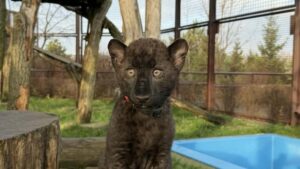
A Far Eastern leopard cub with melanism—a rare black coat color atypical for this subspecies—was born at the “XII Months” Zoo near Kyiv. The female, named Hera, was born on August 20, 2025, but the public was only informed about her now—after the animal had passed the most dangerous period of its first months of life. Mikhail Pinchuk, the zoo’s director and founder, shared this in an exclusive comment to the “Interfax-Ukraine” agency.
“This is a very rare occurrence. Hera’s parents are ordinary Far Eastern leopards, yellow with black spots. The black coloration is a recessive gene that may not manifest for generations. Only if both the mother and father carry it can such a black cub be born,” said Pinchuk.
According to him, the very appearance of a black leopard cub in the Far Eastern subspecies came as a real surprise to the park. The director explained that black Far Eastern leopards have rarely been recorded in the wild, which is particularly due to the characteristics of their habitat. While dark coloring may be an advantage in the jungle, in open snowy areas it, on the contrary, makes the predator too conspicuous.
Park officials say they didn’t immediately grasp the significance of the event at first, as no one expected such a birth from this particular pair of animals. At the same time, they decided not to publicly announce Gera’s arrival right away. The reason was the difficult start to her life.
As Pinchuk explained, a bacterial infection was detected in the cub during the first weeks after birth. Because of this, the leopard cub had to be taken away from its mother and treated. Additionally, it later turned out that the animal had swallowed straw in its mother’s den, and small straw fibers had entered its nasopharynx, complicating its condition.
According to the director, the name Gera was given by the park’s veterinarians. Today, she is already active, developing well, climbing trees, playing, and demonstrating quite distinct hunting instincts. Her diet already includes meat, specifically beef and quail, and the animal herself, despite her playfulness, is already showing the character of a true predator.
Pinchuk says with a smile that as she has grown older, Gera has become so energetic that all her play increasingly resembles training for future hunts.
“The difference between walking a dog and walking Gera (the leopard) is that you don’t lead her—she leads you. Wherever she wants to go, that’s where you have to follow her. If she decides we’re going to the woods today—then we’re going to the woods. If she wants to walk on rocks—we walk on rocks,” said zoo founder Mykhailo Pinchuk.
In the first few months, Gera was walked only in enclosed and safe areas. In the winter, she was let out into the large orangutan enclosure, and later they began taking her on a leash through the zoo grounds early in the morning or late at night, when there were no visitors yet. According to the director, the leopard cub grew up very quickly: while just recently she was a tiny kitten, now she is a serious young predator with sharp teeth, claws, and the habits of a hunter. That is why, after her play sessions, park staff have to replace damaged clothing and sometimes even repair the surrounding area.
At the same time, Hera’s story has become not only good news for the zoo but also a symbol of how the park is trying to hold on during a full-scale war. Pinchuk emphasized that today the main task of “XII Months” is not development or expansion, but simply survival until the end of the war.
“We are currently operating under the premise that we need to survive until the war ends. Nothing else matters. The number of people is about five times smaller compared to pre-war years,” he said.
According to the director, following the occupation of the Kyiv region, the park has completely rethought its security and support systems. Whereas a gas boiler room was previously the main source of power, the zoo has now established a multi-tiered backup system: alternative heat sources, a large backup generator for the entire park, and individual generators for each building where the animals live. All of this is necessary for one purpose—to prevent the temperature in the enclosures from dropping at a critical moment.
Pinchuk explained that some animals, especially primates and heat-loving species, cannot be kept in the cold even for a short time. For example, primates need to be kept at around 20 degrees Celsius; otherwise, they start to get sick. That is why the park begins preparing for the next winter as early as spring—purchasing pellets, branches, and feed, and checking heated floors, generators, and the entire infrastructure.
In fact, according to the director, the zoo’s current operating model is one of constant preparation for a new crisis. And while such measures might have seemed like overkill in peacetime, after 2022 they became a basic condition for survival.
Pinchuk also touched on the financial situation. He emphasized that the park’s only stable source of income remains ticket sales—that is, visitor admission fees. According to him, the zoo receives no systematic state support or significant international aid.
“Our visitors help us. Anyone who comes to us and buys a ticket has already helped automatically. We don’t so much ask for donations as we ask people to come visit us,” he said.
According to the park’s founder, help from caring people does exist, but in much smaller amounts than at the start of the full-scale invasion, when the zoo’s story under occupation particularly struck a chord with many Ukrainians. Today, he says, this is understandable, as the country has far more critical needs, and the army and the front lines remain the priority for people.
At the same time, the park is forced to reconsider ticket prices. Currently, an adult ticket costs 500 UAH, and a child’s ticket costs 350 UAH; however, prices will likely have to be raised, as the costs of maintaining a large number of animals, heating, feed, and backup systems are only increasing.
Pinchuk also noted that the park is currently trying to avoid focusing on active animal breeding. Whereas previously there were open borders and the possibility of full-scale exchanges with other zoos around the world, bringing in new animals under wartime conditions now seems too risky. That is why new additions to the park are currently the exception rather than the rule.
At the same time, “XII Months” remains a place where you can see not only Gera but also many other iconic and rare animals. During the conversation, the director specifically mentions primates, orangutans, large predators, as well as the entire infrastructure created specifically to house complex and valuable species. That is why every birth here is not just news for visitors, but the result of the complex daily work of a large team of veterinarians, paramedics, and keepers.
The behavior of animals during the war was also a separate topic of conversation. According to Pinchuk, while the reaction was dramatic in the early days of the full-scale invasion, most of the park’s residents have now largely adapted to the constant threats. They often react to the sounds of explosions more like they would to thunder, although nearby explosions, of course, frighten both animals and people.
Visitors will be able to see Hera starting in early April. The zoo hopes that the story of the black leopard cub will not only be good news for the Kyiv region but also an additional reason for people to visit the park and support it during these difficult times.
The “XII Months” Park in the Kyiv region was under occupation in 2022 and has since been operating amid constant security and financial challenges. The birth of a female Far Eastern leopard with melanism in August 2025 was a unique event for the park, which was only publicly announced after the animal had passed the critical survival period. Starting in early April 2026, Geru is scheduled to be shown to visitors for the first time.
Author: Olga Levkun

The Sukha Balka mine (Kryvyi Rih, Dnipropetrovsk Oblast), part of Alexander Yaroslavsky’s DCH Group, has commissioned two new iron ore mining sections, which are scheduled to be developed throughout the spring.
According to information in the DCH Steel corporate newsletter on Thursday, for each production unit, the company’s specialists take into account the specific characteristics of the ore deposit and the mining-geological conditions. After analyzing the data, they apply technological solutions that ensure the most efficient extraction possible.
It is noted that on March 13, at the Yuvileina Mine, block 110-116 in the “Glavny” deposit was put into production on the seventh sub-level of the “minus” 1,420 m horizon. Given the characteristics of the ore body, the classic mining method using scraper winches was employed here. The block’s reserves are estimated at 37,200 tons, with an average iron content of 59.25%. The block’s reserves are expected to last for two months of operation.
In addition, it is reported that at the Frunze Mine, technological processes—from preparation to loading—are carried out using self-propelled machines. On March 19, Block 51-57 was commissioned here, located in the “Druzhba” deposit at a depth of “minus” 1,227 m. The block’s reserves amount to 48,200 tons of high-quality raw material (62.83%), which will be sufficient for three months of stable operation.
“A differentiated approach to technology selection—from the scraper method to the use of self-propelled equipment—allows for flexible operation in various mining conditions and maintains stable raw material quality,” the corporate publication notes.
Since the beginning of 2026, four new production units with a total reserve of 258,900 tons have been put into operation at the Sukha Balka mine. In particular, in March, Block 67-71 was commissioned at the Yuvileina Mine on the seventh sub-level of the “Shurfa” deposit at the “minus” 1,420 m level.
The Sukha Balka Mine is one of the leading enterprises in the mining industry in Ukraine. It extracts iron ore using underground mining methods. The mine complex includes the Yuvileina and Frunze mines.
In May 2017, the DCH Group acquired the mine from the Evraz Group.



