

Potato production in Ukraine in 2026 is expected to reach about 12.5 million metric tons, which will be sufficient to meet domestic food needs, according to the press service of the Ministry of Agrarian Policy and Food, citing Minister Taras Vysotsky.
“Potato production this year is expected to total about 12.5 million metric tons. The available volume is more than enough for the domestic market. The population consumes a maximum of 2–2.5 million metric tons per year. The rest of the harvest is traditionally used as seed potatoes and animal feed,” Vysotsky noted.
According to Vysotsky, potatoes are grown as a cash crop in Ukraine by about 400 specialized enterprises on a total area of approximately 60,000 hectares. A significant portion of the harvest is traditionally grown by households for their own consumption.
According to the State Statistics Service, the average selling price of potatoes currently stands at about 14 UAH per kilogram. Over the past week, it has fallen by 5%, and over the past month—by 15%; in some places, purchase prices have dropped to 12 UAH per kilogram.
Final figures on potato production will be available after the harvest campaign is complete, the ministry noted.
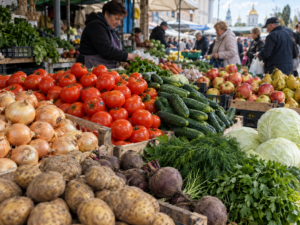
On the Ukrainian fruit and vegetable market, prices for a number of key vegetables continued to rise last week, while apples and pears began to fall in price, according to EastFruit’s review of trading platforms for the 37th week of 2026, published on September 14.
According to analysts, bulb onions became more expensive in Ukraine, while a reduction in the supply of table beets also led to higher prices. Tomatoes and cucumbers continued to rise in price. At the same time, prices for Chinese cabbage and cauliflower, zucchini and eggplants declined, while broccoli became more expensive. In the greens segment, prices for dill and parsley increased, while green onions became cheaper, EastFruit reports.
In the fruit and berry segment in Ukraine, apples and pears began to fall in price. At the same time, the cost of blueberries and garden strawberries rose noticeably, while raspberries became more expensive. Plums became cheaper, while prices for peaches and nectarines went up. Watermelons continued to become more expensive, and the price range for melons and grapes widened. Among imported fruits, lemon prices declined, EastFruit notes.
Tomatoes became the leader on the EastFruit trading platform by the number of sale listings. Market participants also increased the supply of bulb onions and white cabbage. At the same time, the number of sellers of potatoes, carrots and table beets declined. Pumpkins and eggplants once again entered the weekly top list of the most actively offered vegetables, with the increase in their sales provided, in particular, by participants from Ukraine, according to EastFruit’s review.
Among fruits, apples were sold most actively, although the number of listings for them decreased compared with the previous week. Participants from Ukraine increased the supply of pears. At the same time, the number of sellers of watermelons, plums and nectarines decreased, while the supply of melons increased, EastFruit reports.
Potatoes were in the greatest demand among buyers on the trading platform. Other vegetables from the so-called borscht set were also actively purchased.
In total, sellers from eight countries offered fruit and vegetable products on the EastFruit Trade Platform last week. Ukraine retained first place in terms of the number of listings posted, followed by Uzbekistan, Turkey, China and Iran. At the same time, the number of offers from Ukraine decreased over the week, while those from Uzbekistan, Turkey and China increased.

The volume of processing of major oilseeds in Ukraine during the 2026/27 marketing year could reach 16.9 million metric tons, which is 14% higher than the previous season’s figure, according to a forecast by the U.S. Department of Agriculture.
In the 2025/26 marketing year, processing is estimated at 14.8 million metric tons, while in the 2024/25 marketing year it stood at about 15.7 million metric tons. Thus, the new forecast exceeds even the relatively high pre-war levels of previous seasons.
At the same time, exports of oilseeds from Ukraine are projected at 4.95 million metric tons, compared with 4.12 million metric tons in the 2025/26 marketing year. The increase could be about 20%.
However, seed exports will still be significantly lower than the 2024/25 marketing year figure—7.39 million metric tons. Compared to that figure, the projected volume is about one-third lower.
This trend indicates a continued shift toward increasing domestic processing of raw materials rather than exporting them in their unprocessed form.
According to the April report by the USDA agricultural attaché in Kyiv, the growth of processing is also driven by excess capacity at Ukrainian oilseed and fat processing plants, a shortage of sunflower seeds in the previous season, and changes in the trade regime for rapeseed and soybeans. The USDA office expected this trend to continue into the 2026/27 marketing year.
Ukraine primarily processes sunflower seeds, as well as soybeans and rapeseed. A recovery in the sunflower seed harvest to 13 million metric tons will allow plants to increase their production of oil and meal while simultaneously boosting exports of higher-value-added products.
Source: USDA Foreign Agricultural Service, September report Oilseeds: World Markets and Trade dated September 11, 2026.

Despite a sharp recovery in 2025 and growth in indicators in the second quarter of 2026, Ukraine’s new housing construction market remains significantly below the pre-war level.
According to the Experts Club information and analytical center, based on data from the State Statistics Service, the total area of new housing construction in 2025 amounted to 5.8 million sq. m, increasing by 49.4% compared with 2024.
However, compared with 2021, when the figure reached 12.7 million sq. m, the volume remained approximately 54% lower, that is, more than twice as low.
In 2022, the area of new construction amounted to 6.6 million sq. m, in 2023 — 4.2 million sq. m, and in 2024 — 3.9 million sq. m.
Thus, the lowest figure for the period under review was recorded in 2024, after which the market began to recover noticeably in 2025.
In the second quarter of 2026, this process continued: the area of residential buildings declared for the start of construction increased by 6.1% year on year — to 1.65 million sq. m.
At the same time, the sustainability of the recovery remains ambiguous. For the entire first half of the year, the area of new apartment building construction was 2.3% lower than a year earlier, while the number of declared apartments decreased by 6%.
At the same time, construction costs continue to rise rapidly. In July 2026, construction prices were 23.7% higher than in July of the previous year.
Housing prices themselves are also rising: in the second quarter of 2026, they increased by 19.6% year on year and by 3.8% compared with the first quarter.
Thus, the Ukrainian market is simultaneously facing a recovery in construction activity, high inflation in construction costs, and a significant lag behind the supply volumes typical of the period before the full-scale war.

Western Fuel and Energy Company (ZTEK) plans to unveil its own network of FENIX energy gas stations by the end of 2026, which is expected to consist of approximately 20 locations in the initial phase.
Oleg Chykida, CEO and co-owner of ZTEK, announced this in an exclusive interview with the news agency “Interfax-Ukraine.”
“Our initial target is up to 20 gas stations by the end of 2026. Of course, we have to take military realities into account—a shortage of contractors and personnel, as well as disruptions in the supply of materials (…) Therefore, our plan is for up to 20 stations, but the timeline also depends on external factors,” he said.
According to Chikida, less than a year ago, FENIX energy practically didn’t exist, and he, along with his business partner and ZTEK co-owner Kostyantyn Gavrilenko, worked independently on the concept, name, color scheme, and positioning of the network.
“I’m cautious about chasing quantity. We’re entering a highly competitive and long-established market, so first we need to offer a high-quality product (…), build a strong team, refine the model, and only then scale it up,” the CEO noted.
The network’s primary geographic focus will be western and central Ukraine. ZPEK does not plan to operate in Kyiv during the initial phase.
FENIX energy will be financed from several sources: its own funds, profits from the group’s operations, and bank loans.
“Our key banking partner is Ukrgasbank. Over the past three years, we’ve gone from an initial financing round of approximately $110,000 to a credit line of about $17 million. At the same time, we’re in talks with other banks regarding the FENIX energy project,” Chikida said.
As he explained, ZTEK distinguishes three main formats for gas stations. The estimated budget, depending on the facility, can range from $700,000 to $2.5 million, while certain flagship complexes will require even greater investments.
For the urban format, the company is targeting approximately $1–1.2 million. There will also be regional highway stations and complexes along major national highways.
“We don’t want to build a network that differs only in the color of the ceiling. The foundation of FENIX energy is fuel quality control from import to the pump, a uniform standard for all facilities, and comprehensive roadside service,” added the CEO.
ZTEK plans to present some of its solutions, particularly those related to self-service, separately.

Ethereum is becoming the second-largest digital asset after Bitcoin that public companies are using to build corporate cryptocurrency reserves, according to Fixygen.
According to The Block’s Ethereum Treasury Tracker as of September 9–10, 2026, the nine publicly traded companies being monitored hold a total of approximately 7.63 million ETH on their balance sheets. The value of these reserves is estimated at approximately $19 billion.
BitMine Immersion Technologies emerged as the clear leader. The company announced on September 8 that it had increased its portfolio to 5.929 million ETH. In addition, BitMine holds 211 BTC, cash, and marketable securities totaling $593 million, as well as a number of other investments. The company estimates the total value of its cryptocurrency, cash, and marketable securities at $15.7 billion.
According to BitMine’s own estimates, the 5.93 million ETH it owns account for approximately 4.9% of the total Ethereum supply.
At the same time, the company has already staked approximately 5.067 million ETH. At the time of the announcement, BitMine valued these holdings at approximately $12.6 billion.
SharpLink ranks second among public corporate holders of Ethereum with 868,700 ETH worth approximately $2.15 billion, while Dynamix Corporation ranks third with 496,700 ETH worth approximately $1.24 billion.
Next are Bit Digital with 158,500 ETH, BTCS with 70,100 ETH, and Forum Markets with 69,800 ETH.
Thus, BitMine alone controls about 78% of all ETH held in specialized corporate Ethereum reserves tracked by The Block.
The emerging model resembles the strategy Strategy began implementing with Bitcoin several years ago, but there is a significant difference with Ethereum. A company can not only hold the digital asset in anticipation of its value increasing but also stake it to earn additional returns.
At the same time, this model carries additional risks—ranging from ETH volatility to fluctuations in staking yields and a potential discount on the company’s stock relative to the value of its Ethereum holdings.
As of September 10, ETH is trading at $2,470.



