

Exports of Ukrainian IT services in January–August 2026 increased by 4% compared to the same period last year—to $4.46 billion, according to data from the National Bank of Ukraine analyzed by Experts Club.
In terms of foreign exchange revenue, the sector has effectively returned to the levels seen in the corresponding period of 2023, though it has not yet reached the peak figures of 2022.
In January–August 2022, the volume of IT exports was approximately 9% higher than the current figure.
Thus, the trend of recent years can be divided into two periods: after a record-breaking 2022, Ukrainian IT exports began to decline, and in 2026, they are once again showing growth.
The importance of IT for the entire Ukrainian services sector remains particularly significant. In the first eight months of 2026, Ukraine exported services worth $10.9 billion, which is approximately 6% higher than the figure for the same period last year.
IT accounted for 41% of this total—that is, more than $4 out of every $10 Ukraine earned from service exports.
The sector’s share of total foreign trade also remains significant. Total exports of goods and services for January–August amounted to $35.8 billion, of which $4.46 billion came from IT companies and specialists.
As a result, the IT sector accounts for about 12% of the country’s total exports—roughly one in every eight dollars of export revenue.
If current growth rates continue, the sector could end 2026 with its best performance in several years; however, growth rates will need to accelerate to return to the record levels seen in 2022.
Data source: National Bank of Ukraine.

Starting October 16, 2026, Ukraine will temporarily suspend the acceptance of applications for government grants to establish and develop orchards, berry farms, vineyards, and greenhouse operations.
According to EastFruit, agricultural producers planning to take advantage of government support this year may submit an application through October 15.
The acceptance of applications is scheduled to resume in the first quarter of 2027. Funding to continue the program has been allocated in next year’s state budget.
According to data provided by EastFruit, 61 decisions have already been made in 2026 to award such grants totaling 300 million UAH.
Specifically, 40 decisions totaling 170 million UAH relate to the establishment and development of orchards, berry farms, and vineyards. Another 21 decisions totaling 130 million UAH were approved for the development of greenhouse farming.
To date, 34 grants for projects in the fields of fruit growing, berry farming, and viticulture have been fully funded, totaling 137 million UAH. Another 19 grants totaling 123 million UAH have been funded for the development of greenhouse operations.
The state-supported projects call for the creation of 428.4 hectares of new perennial plantings and 31.5 hectares of modular greenhouses.
Their implementation is also expected to create 282 permanent and 5,518 seasonal jobs.
Farmers who do not manage to submit their applications by October 15 (inclusive) will be able to apply for a grant once the application period reopens in 2027.
The 2026 state support program for horticulture and greenhouse farming provides grants of up to 7 million UAH per project, but not exceeding 70% of the project’s cost. For enterprises in de-occupied and frontline territories, the share of state funding may reach 80%. Applications are submitted through the “Diya” portal.
agricultural sector, GRANT, greenhouse, HORTICULTURE, UKRAINE

Ukraine earned $4.46 billion from IT services exports in January–August 2026, with the technology sector accounting for about 12% of the country’s total exports of goods and services, according to data from the National Bank of Ukraine analyzed by the Experts Club research and analysis center.
Thus, approximately one in every eight dollars of Ukraine’s export revenue comes from IT services.
Ukraine’s total exports of goods and services for the first eight months of 2026 amounted to $35.8 billion and remained virtually unchanged compared to the same period last year.
The bulk of foreign exchange earnings continues to come from goods exports—$24.9 billion, or about 70% of the total. Exports of services totaled $10.9 billion, of which $4.46 billion came from IT.
Thus, with services accounting for about 30% of the country’s total exports, the IT sector alone accounts for approximately 12% of Ukraine’s total export revenue.
As noted by analysts at Experts Club, these figures demonstrate the special role of IT in Ukraine’s foreign trade. Unlike goods exports, technology services are virtually independent of maritime logistics, border capacity, and the physical transportation of products.
Furthermore, IT remains the largest component of Ukraine’s service exports. Computer services account for about 41% of the service sector’s total export revenue.
From January through August, Ukraine’s service exports reached $10.9 billion, an increase of approximately 6% compared to the same period in 2025. IT exports grew by 4% to $4.46 billion.
Despite this recovery, the IT sector has not yet returned to its 2022 all-time high. IT service exports for the first eight months of 2026 remain approximately 9% below the figure for the corresponding period in 2022.
Thus, Ukrainian IT exports are simultaneously demonstrating a recovery from the decline of previous years and maintaining an exceptionally significant role in generating the country’s foreign exchange revenue.
Data source: National Bank of Ukraine. Calculations of the export structure are based on NBU data published by Opendatabot.

More than two-thirds of Ukrainians planning to buy an apartment pay attention to the availability of a backup power supply and independent heating, according to the results of a survey by “OLX Real Estate.”
According to the study, 68% of potential buyers consider a backup power supply in case of power outages to be important, compared to 49% in 2025. Thus, over the course of a year, the share of buyers paying attention to a home’s energy independence has risen by 19 percentage points. The availability of autonomous heating is also important to 68% of respondents.
“Energy sustainability has effectively become on par with many ‘traditional’ characteristics of an apartment or house,” notes the OLX report.
At the same time, the main criterion when buying an apartment remains its cost—82% of respondents cited price as important. In second place is the total area of the home—79%.
The number of rooms and the city neighborhood are considered by 77% of potential buyers each. A good floor plan or renovation, as well as the property’s stage of completion, are important to 76% of respondents; infrastructure and the building’s exterior are important to 73%; and the floor level is important to 72%.
At the same time, the war has significantly changed Ukrainians’ security requirements for real estate. 67% of potential buyers consider the distance from strategic facilities, and the presence of a shelter directly in the building is important to 60%.
At the same time, traditional advantages of a property’s location are less important. Proximity to the metro was cited as important by 46% of respondents, and a location near the city center by 45%.
The main reason for purchasing real estate remains the desire to improve current living conditions—47% of respondents cited this as their motivation. Another 42% want to acquire their own private space, 23% plan to move into a more spacious home, 20% view the purchase as a way to improve their standard of living, and 11% want to change the neighborhood where they live.
The investment component remains significant, though it takes a back seat to purchasing a home for personal use. Twenty-eight percent of potential buyers view real estate as an investment. Specifically, 19% expect to generate income in the future by renting out the property or reselling it.
Thus, the survey results indicate a shift in Ukrainian buyers’ priorities: alongside price, square footage, and location, a property’s ability to function during power outages and its level of security are becoming increasingly important.
According to OLX, attitudes toward backup power have changed particularly noticeably: while in 2025 approximately one in two potential buyers considered this factor, by 2026 the figure had risen to more than two-thirds.
Source: “OLX Real Estate” study.

According to Experts.news, gasoline imports to Ukraine in September 2026 totaled 145,000 metric tons, which is 5% less than in August but 3% higher than in September of last year, the A-95 Consulting Group reported based on the results of a special study.
From January through September, Ukraine imported 1.26 million metric tons of gasoline—15% more than during the same period in 2025.
“The decline in gasoline supplies in September occurred against the backdrop of a seasonal drop in consumption. Demand was also weighed down by this year’s record-high retail prices, which prompted car owners to conserve fuel,” the A-95 Consulting Group reported.
Lithuania remained the largest source of gasoline supplies in September, accounting for 46,400 metric tons, or 32% of the total volume. Compared to August, supplies fell by 10.4%.
Poland ranked second with 36,800 metric tons, or 25% of Ukraine’s imports. A month earlier, 40,100 metric tons were supplied from that country.
Thus, the combined share of Lithuania and Poland in September fell from 60% to 57%. Supplies from the largest supplier—the ORLEN Group—from these two countries decreased from 78,800 to 67,800 metric tons. Despite the decline, ORLEN accounted for about 47% of all Ukrainian gasoline imports.
At the same time, the geography of supplies changed. Imports from Germany fell by 25% compared to August—to 13,600 metric tons. Of this volume, 8,300 metric tons, or 61%, were imported by the UPG network.
At the same time, the share of southern supplies increased. Gasoline shipments from Romania rose by 29%—from 23.4 thousand to 30.1 thousand metric tons. As a result, Romania moved into third place among supplier countries and accounted for over 20% of September’s imports.
Supplies from Greece, on the other hand, fell by 28%—from 15,000 to 10,800 metric tons. Imports from Moldova more than doubled—from 1,900 to 4,100 metric tons.
Thus, despite the decline in total imports in September, shipments remain higher than last year’s level, and in the first nine months of 2026, Ukraine imported 15% more gasoline than in the same period a year earlier.
Source: A-95 Consulting Group.
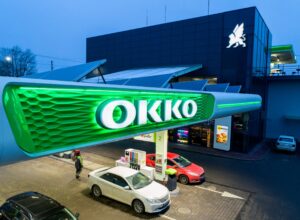
OKKO maintained its leadership among the largest importers of automotive gasoline into Ukraine, importing 51,000 metric tons of fuel in September 2026, according to data from a special study by the A-95 Consulting Group and calculations by the Experts Club analytical center.
Thus, OKKO accounted for about 35% of total gasoline imports in September, which amounted to 145,000 metric tons.
From January through September, the company imported 375,000 metric tons of gasoline—about 30% of the total volume of shipments to Ukraine since the beginning of the year, which reached 1.26 million metric tons.
Ukrnafta took second place among importers in September with a volume of 19,500 metric tons. WOG recorded virtually the same figure—19,000 metric tons.
UPG imported 15,900 metric tons of gasoline. Thus, the four largest companies—OKKO, Ukrnafta, WOG, and UPG—accounted for a total of 105,400 metric tons, or nearly 73% of all gasoline imports into the country for the month.
Next came BRSM-Nafta with 5,300 metric tons, Avantage with 3,400 metric tons, BVS and SOCAR with 2,600 metric tons each, KLO with 2,300 metric tons, and VST with 1,900 metric tons. Other companies collectively imported 21,300 metric tons.
In September, gasoline imports into Ukraine fell by 5% compared to August—to 145,000 metric tons. The A-95 Consulting Group attributes the decline in supplies to a seasonal drop in consumption and this year’s record-high retail gasoline prices, which encouraged drivers to conserve fuel.
At the same time, compared to September 2025, imports rose by 3%, and over the first nine months of this year—by 15%, to 1.26 million metric tons.
Source: “A-95” Consulting Group.



