

In July 2026, prices for clothing and footwear in Ukraine fell by 4.8% compared to June and by 5.6% compared to July of last year, according to data from the State Statistics Service. Clothing prices fell by 5.8% over the month and by 5.4% year-over-year. Footwear prices fell by 3.5% and 6.1%, respectively.
Compared to December 2025, the entire “clothing and footwear” category fell in price by 4.5%, including clothing by 6.5% and footwear by 2%.
In January–July 2026, prices for clothing and footwear were, on average, 5.5% lower than during the same period in 2025. At the same time, the overall consumer price index rose by 7.8% over these two periods.
Clothing and footwear thus remain one of the largest categories in the consumer basket where the State Statistics Service has recorded price declines amid overall inflation.
CLOTHING, footwear, INFLATION, PRICE, State Statistics Service

Transportation prices in Ukraine in July 2026 were 18.6% higher than a year earlier, according to data from the State Statistics Service. In just one month, transportation prices rose by 1.3%. The most significant increase was recorded in passenger road transportation—up 6% in July and 30.8% compared to July 2025.
Overall, transportation services rose in price by 28.9% over the year and by 25.7% since the beginning of 2026. Passenger rail transportation became 2.7% more expensive over the month and 15.5% more expensive over the year.
Another significant factor remains the cost of fuel. In July, fuel and lubricants became 0.1% cheaper compared to June; however, compared to July of last year, they were 28% more expensive, and since the beginning of the year—26.5% more expensive.
Thus, transportation costs are rising significantly faster than the overall consumer market: annual inflation in Ukraine stood at 7.7% in July, while transportation inflation was 18.6% and transportation services inflation was 28.9%.

According to Fixygen, the cryptocurrency market ended last week mostly on an uptrend: Bitcoin rebounded from its early August decline and once again tested the $65,000 mark, while Ethereum and most of the major altcoins also gained ground. The exception among the leading cryptocurrencies was XRP, which lost about 5% over the week.
As of the morning of August 10, Bitcoin was trading at around $65,200 and had risen by approximately 3.7% over the past seven days, according to CoinDesk data. On Monday, the price fell back below $65,000—to around $64,500–$64,700. As of August 7, BTC was up 3.1% for the week, heading toward its first weekly gain in three weeks.
Ethereum was trading around $1,900 at the start of the new week and also ended the week with gains. BNB and Solana were in positive territory, while XRP lagged behind the broader market recovery and lost about 5%.
One of the main supporting factors was the return of institutional demand. U.S. spot Bitcoin ETFs saw $853.54 million in net inflows last week, marking the strongest weekly result since mid-April. A significant portion of the funds went to BlackRock’s IBIT fund.
The combined net inflow into U.S. spot Bitcoin and Ethereum ETFs for the week is estimated at approximately $1.1 billion. Back in early August, the situation was the opposite: Bitcoin ETFs had ended the previous week with a small net outflow, so the return of major buyers became one of the key shifts in the market landscape.
U.S. macroeconomic data provided additional support for cryptocurrencies. Weak U.S. labor market data eased concerns about a possible further increase in the Fed’s interest rates and bolstered demand for risky assets. Following the release of the data, Bitcoin rose to $65,000, while U.S. stock indices finished the week on a strong note.
However, it is still too early to speak of a full-fledged return to a sustained bullish trend. Bitcoin remains near the $62,000–$65,000 range, where it has spent much of the past few weeks. Analysts note that a sustained market recovery would require a break above the $65,000 level.
Another sign of caution is the extremely low realized volatility. Last Saturday, BTC’s trading range was only about $350—the narrowest Saturday range since November 2023. At the same time, the options market continues to see elevated demand for downside protection around the $62,000–$63,000 range, indicating ongoing concerns among market participants.
News of the sale of bitcoins by Strategy, the largest corporate holder, also acted as a restraining factor. The company reported on August 10 that it had sold 1,690 BTC for approximately $108.6 million the previous week, using the proceeds, in part, to repurchase preferred shares. Its holdings have decreased to 840,447 BTC.
Regulatory factors, on the other hand, are likely to take a back seat by the end of August. The U.S. Senate failed to pass the CLARITY Act before Congress’s August recess began. Lawmakers are not expected to resume consideration of comprehensive regulations for the digital asset market until at least mid-September.
What Will Drive the Market Through the End of August
The first major test will be U.S. inflation data. The U.S. Consumer Price Index for July is scheduled for release on August 12, the Producer Price Index on August 13, and retail sales data on August 14. Following weak employment data, inflation figures could shape expectations regarding the Fed’s future policy and, consequently, the direction of Bitcoin and other risky assets.
The next key date will be August 19, when the Federal Reserve releases the minutes of the July 28–29 FOMC meeting. Investors will be looking for additional signals in the minutes regarding the extent to which the central bank is concerned about the combination of rising inflation and a softening labor market.
The last week of August will be even more eventful. On August 26, the U.S. will simultaneously release the second estimate of second-quarter GDP and July statistics on personal income and spending, including the PCE price index—one of the Fed’s key inflation benchmarks.
From August 27 to 29, the Kansas City Federal Reserve Bank will hold its annual symposium in Jackson Hole. In 2026, the symposium’s theme is directly related to financial markets: “Financial Innovation: Implications for Payments and Policy.” Therefore, statements by central bank leaders may be of particular significance for the cryptocurrency sector as well.
Two main scenarios can be identified for the market through the end of August. Assuming continued capital inflows into ETFs, more moderate inflation in the U.S., and sustained expectations of a neutral or more dovish Fed policy, Bitcoin will have the opportunity to consolidate above $65,000 and attempt to return to July’s levels above $66,000. This is a conclusion based on the current market structure, not a guaranteed price forecast.
The negative scenario is primarily linked to an unexpected acceleration of inflation in the U.S., rising bond yields, and a renewed escalation of geopolitical risks surrounding the Middle East and the Strait of Hormuz. In that case, market attention will shift back to the $62,000–$63,000 range, where options traders are currently actively hedging against a decline.
Thus, the crypto market is entering the second half of August in a stronger position than at the beginning of the month: institutional inflows have resumed, Bitcoin has recouped a significant portion of its recent losses, and most of the largest altcoins have turned bullish. However, low volatility and the concentration of several key macroeconomic events in the second half of the month set the stage for a noticeable increase in price fluctuations by the end of August.

Consumer prices in Ukraine rose by 0.3% in July 2026 compared with June, while annual inflation accelerated to 7.7% from 7.2% a month earlier, according to data from the State Statistics Service of Ukraine. Since the beginning of the year, consumer prices have risen by 6%. In January–July 2026, they were 7.8% higher than in January–July 2025.
The acceleration in annual inflation is partly due to the base effect: in July 2025, prices fell by 0.2%. However, the current rate of 7.7% remains lower than the 8.2% recorded in May.
Core inflation slowed to 0.3% in July from 0.5% in June and 0.7% in May. On an annual basis, it remained at 8.1%.
The trends in individual components of the consumer basket varied significantly. Food and non-alcoholic beverages fell in price by 0.2% over the month, while clothing and footwear fell by 4.8%. At the same time, housing and utilities rose by 1.6%, and transportation by 1.3%.
At the end of July, the NBU raised its inflation forecast for the end of 2026 from 9.4% to 10%, and its core inflation forecast from 7.2% to 9.2%. The regulator attributes the increase in underlying price pressures to rising business costs for logistics, labor, and energy resources.
Data from the State Statistics Service excludes territories temporarily occupied by Russia and parts of the country where hostilities are ongoing or have taken place.

According to Interfax-Ukraine, this article presents key macroeconomic indicators for Ukraine and the global economy as of the end of April 2026. The analysis is based on data from the State Statistics Service of Ukraine, the National Bank of Ukraine, the Ministry of Finance, the State Customs Service, the International Monetary Fund, Eurostat, BEA, BLS, NBS, ONS, TurkStat, IBGE, and other official institutions. Monthly and quarterly statistical data published after the end of the reporting period were used for April indicators.
Maksim Urakin, Ph.D. in Economics and founder of the information and analytical center Experts Club, presented an overview of the key trends that shaped the state of the Ukrainian and global economies in April and early May 2026.
Ukraine’s Macroeconomic Indicators
As of the end of April, the Ukrainian economy remained macro-financially stable, although inflationary, currency, and foreign trade risks had intensified. Compared to March, consumer inflation accelerated, international reserves declined for the third consecutive month, and the trade deficit continued to widen. At the same time, the government ensured funding for defense, social benefits, and critical budgetary needs, while the National Bank of Ukraine (NBU) maintained control over the foreign exchange market.
According to a preliminary estimate by the State Statistics Service, Ukraine’s real GDP in the first quarter of 2026 decreased by 0.6% compared to the first quarter of 2025. On a seasonally adjusted basis, the decline was 0.7% compared to the previous quarter.
Nominal GDP amounted to 2,047.2 billion UAH. This negative trend was attributed to electricity shortages, infrastructure damage, delays in external financing, weak investment activity, and adverse weather conditions at the beginning of the year. At the same time, private consumption remained relatively stable, while the manufacturing sector, trade, and certain service sectors showed growth.
In its April forecast, the National Bank revised downward its estimate for Ukraine’s real GDP growth in 2026 to 1.3%. The main reasons were further damage to energy and logistics infrastructure, a larger electricity shortage, high energy prices, and weaker first-quarter results. The NBU expected economic growth to be supported by consumer demand and investments in reconstruction and the defense-industrial complex, but did not forecast a rapid transition to a sustainable recovery.
“The first-quarter results confirmed that the Ukrainian economy remains extremely sensitive to energy, military, and fiscal shocks. Positive domestic demand and business resilience can no longer fully offset the losses from infrastructure destruction, electricity shortages, and weak exports. The 1.3% growth forecast implies actual stagnation on a per-capita basis. “Therefore, the main priority should be not only to maintain financial stability but also to restore production capacity,” Urakin noted.
The inflation situation worsened in April. Consumer inflation accelerated to 8.6% year-over-year, up from 7.9% in March. Prices rose by 1.4% over the month and by 4.9% since the beginning of the year. Core inflation rose to 7.6% year-over-year, inflation for services reached 13.3%, and the increase in fuel prices hit 36.1% year-over-year.
The main source of inflationary pressure was the rise in energy and fuel prices, which increased business costs for logistics, electricity, and production. Additional factors included wage increases, the pass-through of the hryvnia’s earlier depreciation to consumer prices, and rising costs of certain food products and transportation services. Bread, grains, sunflower oil, fish, restaurant services, and household services saw the fastest price increases.
The NBU’s April forecast projected that inflation would accelerate to 9.4% by the end of 2026. A return to a steady decline was expected in 2027, when inflation was projected to slow to 6.5%, and to reach the 5% target in 2028.
On April 30, the National Bank’s Board kept the policy rate at 15% per annum. The regulator explained the decision by the need to maintain the attractiveness of hryvnia-denominated assets, keep inflation expectations under control, and ensure the stability of the foreign exchange market. The NBU’s forecast called for keeping the rate at 15% at least until the second quarter of 2027. In the event of further intensification of price pressures, the regulator did not rule out the use of additional measures, including a rate hike.
“The acceleration of inflation to 8.6% and the sharp rise in fuel prices left the National Bank no room to continue its policy easing cycle. Under current conditions, the 15% rate is not so much a tool for curbing lending as it is a mechanism for safeguarding confidence in the hryvnia. The risk of a premature rate cut now significantly outweighs the potential short-term effect on economic activity,” Urakin emphasized.
The foreign exchange sector remained under control but required significant support from the regulator. As of May 1, 2026, Ukraine’s international reserves stood at $48.215 billion, having declined by 7.3% in April. This marked the third consecutive monthly decline in reserves.
In April, the NBU sold $3.577 billion on the foreign exchange market, while inflows into the government’s foreign currency accounts totaled only $377.9 million. $716.6 million was allocated to service and repay foreign-currency government debt, and Ukraine paid another $255.3 million to the IMF. The losses were partially offset by a positive revaluation of financial instruments amounting to $378 million. Despite the decline, the reserves were sufficient to finance 4.9 months of future imports.
“The decline in reserves from nearly $52 billion to $48.2 billion in a single month is significant, but not yet critical. Far more important is the underlying cause: the private foreign exchange market remains structurally in deficit, and international inflows do not always coincide with the timing of intervention needs and debt payments. Therefore, the stability of the hryvnia will continue to depend on the regularity of external financing and Ukraine’s ability to narrow the trade gap,” Urakin believes.
According to the State Customs Service, Ukraine’s trade turnover in January–April 2026 amounted to $46.1 billion. Imports reached $32.2 billion, while exports totaled $13.9 billion. Thus, the trade deficit for the four-month period was approximately $18.3 billion, with imports exceeding exports by a factor of 2.3.
Ukraine imported the most goods from China—$8.7 billion—followed by Poland—$3.1 billion—and Turkey—$2.2 billion. The main destinations for Ukrainian exports were Poland—$1.5 billion—Turkey—$1.2 billion—and Italy—$857 million.
In the import structure, machinery, equipment, and transportation accounted for $13.3 billion; fuel and energy products—$5.3 billion; and chemical industry products—$4.6 billion. Exports were primarily driven by food products at $8.5 billion, metals and metal products at $1.3 billion, and machinery, equipment, and transportation at $1.2 billion.
“The increase in the trade deficit to $18.3 billion in just four months is one of the main macroeconomic challenges. A significant portion of imports is objectively necessary—these include energy resources, equipment, transportation, and defense products. However, the export base remains too narrow and reliant on raw materials. Without the development of processing, machine building, the defense industry, and service exports, Ukraine will continue to offset the trade deficit with international aid and reserves,” Urakin emphasized.
The budgetary situation remained tense but under control. From January through April, the general fund of the state budget received 1.04 trillion UAH. Total cash expenditures from the general fund amounted to 1.35 trillion UAH, which is 13.8% more than during the same period in 2025. In April alone, General Fund revenues totaled 302.6 billion hryvnias, while expenditures amounted to 433.1 billion hryvnias.
Expenditures on security and defense over the four-month period reached 854.1 billion hryvnias, or 63.3% of all General Fund expenditures. In April, 283.1 billion hryvnias were allocated for these purposes. UAH 555.5 billion was spent on public sector wages and related benefits, UAH 235 billion on social security, UAH 205.4 billion on subsidies and transfers to enterprises, UAH 151.4 billion on goods and services, and UAH 103.2 billion on servicing the national debt.
International grants for January–April totaled 228.2 billion hryvnias, with 55.1 billion hryvnias received in April alone. In total, 1.43 trillion hryvnias flowed into the general and special funds of the state budget over the four-month period, while state budget cash expenditures amounted to 1.7 trillion hryvnias.
“The budget remains functional, but its structure is entirely dictated by the war. When nearly two-thirds of the general fund’s expenditures are directed toward defense and security, the capacity to finance long-term development remains limited. Under these conditions, it is particularly important that international aid cover the budget’s civilian needs, while domestic resources are directed as effectively as possible toward defense, energy, and industrial recovery,” Urakin noted.
The Global Economy
As of the end of April 2026, the global economy remained resilient, but the geopolitical and inflationary environment had deteriorated significantly. The war in the Middle East caused energy prices to rise, heightened inflationary expectations, and forced major central banks to postpone further monetary easing.
In its April World Economic Outlook, the International Monetary Fund projected global economic growth of 3.1% in 2026 and 3.2% in 2027, assuming the conflict would be limited in duration and scope. The IMF warned that a longer war, deepening geopolitical fragmentation, new trade disputes, and high public debt could significantly worsen the outlook.
The U.S. economy maintained positive momentum. According to the BEA’s revised estimate, real GDP in the first quarter of 2026 grew by 2.1% on an annualized basis compared with the previous quarter. Growth was driven by investment, exports, and government and consumer spending.
At the same time, inflation in the U.S. continued to accelerate. In April, the CPI rose by 3.8% year-over-year, following a 3.3% increase in March. Core inflation stood at 2.8%, while energy inflation reached 17.9%. In just one month, energy prices rose by 3.8%, and gasoline prices by 5.4%.
On April 29, the Federal Reserve kept the federal funds rate target range at 3.5–3.75%. The Fed cited elevated inflation, rising global energy prices, and high uncertainty surrounding events in the Middle East.
The eurozone showed significantly weaker economic momentum. According to a preliminary Eurostat estimate released on April 30, eurozone GDP in the first quarter grew by only 0.1% compared to the previous quarter and by 0.8% year-over-year. This indicated that the region’s economy was effectively stagnating.
Annual inflation in the eurozone accelerated to 3.0% in April, up from 2.6% in March. In the European Union, it rose to 3.2%. Services, energy, and food made the largest contributions to the rise in prices.
On April 30, the European Central Bank kept its deposit rate at 2.0%, its main refinancing rate at 2.15%, and its marginal lending rate at 2.40%. The ECB emphasized that risks of rising inflation and a slowdown in economic growth had intensified due to the energy shock.
In the United Kingdom, by contrast, inflation slowed to 2.8% year-over-year in April, down from 3.3% in March. Core CPI fell to 2.5%, and services inflation to 3.2%. At the same time, motor fuel prices rose significantly due to the external energy shock.
On April 30, the Bank of England kept its base rate at 3.75%. Eight members of the Monetary Policy Committee supported this decision, while one voted to raise the rate to 4%.
“April showed that the global cycle of rapid interest rate cuts has effectively been put on hold. The U.S. faced accelerating inflation to 3.8%, the eurozone to 3%, and central banks were once again forced to focus on energy risks. For Ukraine, this means more expensive global capital, more challenging conditions for exports, and additional pressure due to fuel prices,” Urakin noted.
China’s economy grew by 5.0% year-over-year in the first quarter of 2026. Nominal GDP reached 33.419 trillion yuan. Industrial production increased by 6.1%, the services sector by 5.2%, and foreign trade in goods by 15%. At the same time, real estate investment fell by 11.2%, indicating that structural problems persist. In April, China’s CPI rose by 1.2% year-over-year and by 0.3% month-over-month. Average inflation for January–April stood at 0.9%. Meanwhile, retail sales in April grew by only 0.2% year-over-year, indicating weakness in domestic consumer demand.
India maintained the highest growth rates among major economies. Following the transition to a new statistical base, the official estimate for real GDP growth in fiscal year 2025/26 was raised to 7.6%, and nominal GDP growth to 8.6%. The main drivers remained the services sector, domestic consumption, construction, and government investment.
Turkey again faced a sharp spike in inflation in April. Consumer prices rose by 4.18% month-over-month and by 32.37% year-over-year. Year-to-date inflation stood at 14.64%. The figure exceeded March’s level of 30.87%, indicating the instability of the disinflation process. At the same time, Turkey’s GDP grew by approximately 3.6% in 2025, confirming the economy’s ability to sustain business activity even amid high price pressures.
Brazil showed more balanced dynamics, although inflation also accelerated. The country’s GDP grew by 2.3% in 2025, reaching 12.7 trillion reais at current prices. In April 2026, the IPCA index rose by 0.67% month-over-month, and annual inflation reached 4.39%, up from 4.14% in March. The largest contributions came from food, medical goods, and services.
“China, India, Turkey, and Brazil demonstrate four distinct development models. China maintains high growth rates thanks to industry and exports, but still faces challenges with domestic demand and real estate. India relies on demographics, services, and investment. Turkey sustains growth at the cost of very high inflation. Brazil is moving more slowly but is trying to strike a balance between economic activity and price stability. “For Ukraine, the main conclusion is that long-term growth is impossible without its own manufacturing, technological, and export base,” Urakin believes.
Conclusions
As of the end of April 2026, Ukraine maintained macrofinancial stability, but key indicators pointed to increasing risks. Real GDP contracted by 0.6% year-over-year in the first quarter; inflation accelerated to 8.6% in April, with core inflation rising to 7.6%, while the policy rate remained at 15%.
International reserves fell to $48.2 billion, a decrease of 7.3% over the month. The trade deficit for January–April reached $18.3 billion. Revenues to the general fund of the state budget totaled 1.04 trillion UAH, while expenditures amounted to 1.35 trillion UAH. UAH 854.1 billion, or 63.3% of all general fund expenditures, was allocated to security and defense.
Positive factors included substantial reserves, a controlled exchange rate policy, international financing, steady consumer demand, business adaptability, and the development of defense production. The main risks were the continuation of the war, the destruction of energy infrastructure, rising fuel prices, labor shortages, weak exports, and the budget’s dependence on foreign aid.
The global economy also entered a more challenging period. The IMF projected global growth of 3.1% in 2026 but warned that downside risks predominated. Inflation in the U.S. accelerated to 3.8%, and in the eurozone to 3.0%, while the central banks of the U.S., the eurozone, and the United Kingdom kept interest rates unchanged. China grew by 5% in the first quarter, India maintained a growth rate of over 7%, while Turkey once again faced inflation exceeding 32%.
“April 2026 showed that Ukraine’s stabilization model remains viable, but its financial buffer is shrinking. The simultaneous acceleration of inflation, depletion of reserves, and widening of the trade deficit signal that external aid cannot be the sole foundation of economic stability. Ukraine needs to transition from financing its immediate survival to creating a new production model. This model should be based on energy self-sufficiency, the defense-industrial complex, agricultural processing, machine building, logistics, digital technologies, and exports of high-value-added products. “Only such a transition can transform macrofinancial stability from a temporary safety net into the foundation for long-term development,” concluded Maksym Urakin.

Turkey’s residential real estate market continues to show nominal price growth, but taking inflation into account, housing is in fact continuing to become cheaper, according to market data.
According to analysts, the average price per square meter of housing across the country has reached 40.486 thousand Turkish lira, or about $872. The average cost of a residential real estate property is estimated at approximately 5.02 million lira, or about $108.1 thousand.
In nominal terms, housing prices increased by 23.8% year-on-year. However, after adjustment for inflation, the real dynamics moved into negative territory and amounted to about 6.5%.
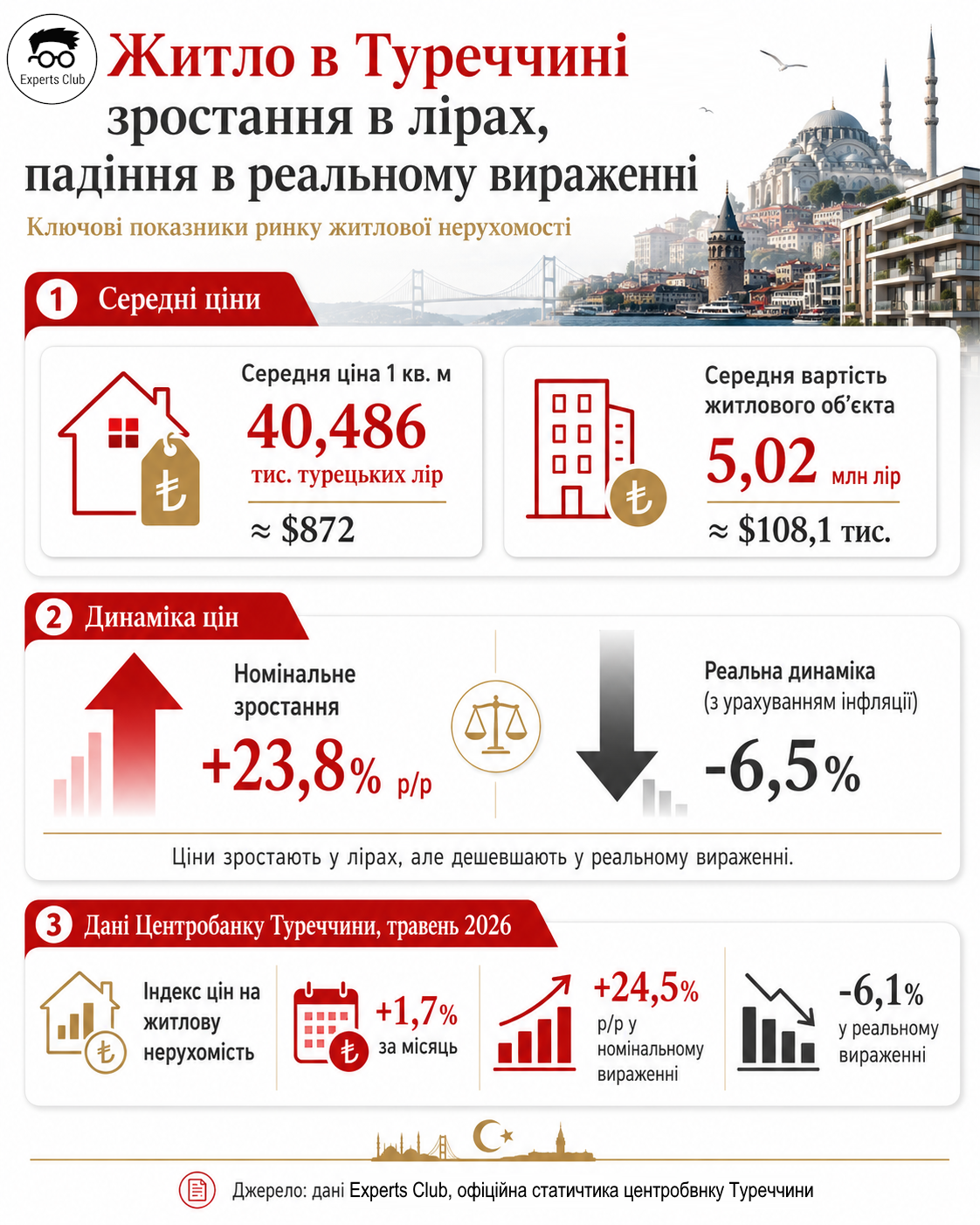
Official statistics from the Central Bank of Turkey confirm this trend. In May 2026, the residential real estate price index increased by 1.7% month-on-month and by 24.5% year-on-year in nominal terms, but declined by 6.1% in real terms.
This means that, for buyers and investors, price growth in lira is not the same as growth in the value of the asset. Against the background of high inflation, real estate may look more expensive in the national currency, but lose purchasing value in real terms.
The average payback period for housing through rental income in Turkey is currently estimated at approximately 13 years. However, the situation differs significantly by region. In large cities and resort locations, housing prices have often grown faster than rental rates, so the yield of such properties is becoming lower.
This gap is especially noticeable in popular tourist regions, including Muğla and parts of the coast, where the cost of land and housing remains high, while rent does not always keep pace with sale prices. In such locations, buying real estate increasingly requires not only calculating potential income, but also assessing the liquidity of the property, maintenance costs and currency risks.
For foreign buyers, the situation has become less clear-cut. After the boom of 2021-2023, the Turkish market no longer looks like a market of guaranteed rapid growth. High interest rates, inflation, the weakening of the lira, changes in residence permit rules and cooling demand from foreigners are making investment decisions more complex.
At the same time, Turkey remains one of the largest real estate markets in the region. Demand is supported by domestic buyers, tenants in large cities, tourist regions, as well as interest in housing as a way to protect savings from inflation. However, the market is becoming more selective: liquidity is being maintained primarily by quality properties in strong locations.
For investors, the main conclusion is that Turkish real estate can no longer be assessed only by nominal growth in lira. It is more important to look at dynamics in foreign currency, real yield adjusted for inflation, maintenance costs, rental demand and resale prospects.



