
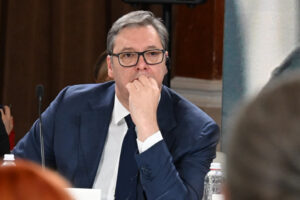
According to The Serbian Economist, Serbian President Aleksandar Vucic stated that the country’s upcoming parliamentary and presidential elections will be held separately.
According to Vučić, parliamentary elections will most likely take place first, followed by presidential elections. He noted that the decision to schedule the elections could be made in August or September, and the actual voting could take place in October or November.
The president explained that he supports holding the elections separately because, as he put it, opposition parties and other participants in the political process had previously pushed for this. He added that this format would give voters more opportunities to make separate decisions regarding the parliamentary and presidential campaigns.
During his address, Vučić also announced that a package of aid measures for citizens is likely to take effect in mid-September. He had previously noted that these measures could include one-time assistance for pensioners and reduced costs for medications. According to him, the government is also considering additional support for adult citizens, though details have not yet been disclosed.
In addition, Vučić announced the launch of the “Ko si bre ti” portal, through which citizens will be able to anonymously report unscrupulous officials and suspected corruption. He stated that he would personally read a portion of the reports every day, and that reports concerning corruption would be forwarded to the prosecutor’s office.
Separately, the president commented on Serbia’s European integration, noting that the country has made no significant progress toward EU membership for nearly five years, despite its economic development. He also said that, in his assessment, neither Serbia nor Ukraine will become members of the European Union in the near future.
Vucic’s statements came amid Serbia’s preparations for a new election cycle and ongoing political tensions in the country. Holding parliamentary and presidential elections separately could change the dynamics of the campaign, as parties and candidates will be forced to conduct two separate political mobilizations.
https://t.me/relocationrs/3191
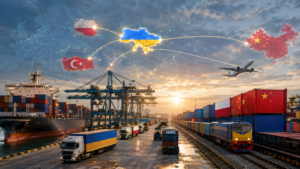
China, Poland and Turkey topped the list of Ukraine’s largest trading partners based on the results of January-May 2026, according to foreign trade in goods data as of May 31, 2026.
According to calculations by the Experts Club analytical center based on the presented statistics, Ukraine’s total trade turnover with all countries of the world in the first five months of 2026 amounted to about $58.1 billion. Imports reached $40.5 billion, exports — $17.6 billion, while the negative balance of trade in goods amounted to about $22.9 billion.
The top 10 trading partners accounted for about $36.1 billion in trade turnover, or approximately 62% of Ukraine’s total trade in goods. At the same time, they accounted for about $27.1 billion in imports and $9.0 billion in exports. This shows that Ukraine’s foreign trade in 2026 remains highly concentrated around several key directions, while the overall balance is formed primarily by imports from the largest economies of Europe, Asia and the United States.
China ranked first by a wide margin. Ukraine’s trade turnover with China in January-May amounted to $11.75 billion. At the same time, imports from China reached $11.09 billion, while Ukrainian exports amounted to only $663.8 million. The negative trade balance with China amounted to $10.43 billion, making the PRC the main source of Ukraine’s trade deficit.
Poland ranks second with trade turnover of $5.85 billion. Ukraine imported $3.88 billion worth of goods from Poland and exported $1.97 billion worth of goods. The balance remained negative and amounted to $1.91 billion. Poland retains its importance as one of Ukraine’s main trade and logistics channels to the EU, especially amid the reorientation of Ukrainian trade following the start of the full-scale war.
Turkey ranked third with trade turnover of $4.21 billion. Imports from Turkey amounted to $2.66 billion, Ukraine’s exports — $1.55 billion, and the negative balance — $1.11 billion. Turkey remains an important trade destination for Ukraine in the Black Sea region, combining the role of a supplier of industrial goods and a market for Ukrainian products.
Germany and the United States also entered the top five. Trade with Germany amounted to $3.68 billion, and with the United States — $2.49 billion. In both cases, Ukraine has a significant deficit: $1.56 billion with Germany and $1.53 billion with the United States. This reflects dependence on imports of equipment, machinery, transport, pharmaceuticals, energy-related and defense-related goods.
Italy ranked sixth, but the structure of its trade differs noticeably from that of other major partners. Trade turnover amounted to $2.17 billion, while imports and exports were almost equal: $1.09 billion and $1.08 billion, respectively. The negative balance with Italy amounted to only $9.5 million, making it one of Ukraine’s most balanced major trading partners.
Hungary, the Czech Republic, the Netherlands and Slovakia ranked seventh through tenth. Trade turnover with Hungary amounted to $1.62 billion, with the Czech Republic — $1.45 billion, with the Netherlands — $1.45 billion, and with Slovakia — $1.42 billion. Among them, the Netherlands stands out: it is the only country in the top 10 with which Ukraine has a positive balance — $213.9 million. This is associated with a higher volume of Ukrainian exports compared with imports.
“The structure of the top ten shows that Ukrainian foreign trade in 2026 remains both European and Asian. The EU is the key space for trade, logistics and exports, but China remains the main supplier of imported goods. The main challenge for Ukraine is not only to increase exports, but also to reduce the asymmetry of trade with its largest partners, especially through products with higher added value,” said Maksym Urakin, founder of the Experts Club analytical center.
It is also important that seven EU countries entered the top 10: Poland, Germany, Italy, Hungary, the Czech Republic, the Netherlands and Slovakia. Their combined role confirms that the European Union remains Ukraine’s basic trade framework. However, even within the EU, the structure is heterogeneous: Poland and Germany generate a large deficit for Ukraine, Italy is almost balanced, while the Netherlands provides a positive balance.
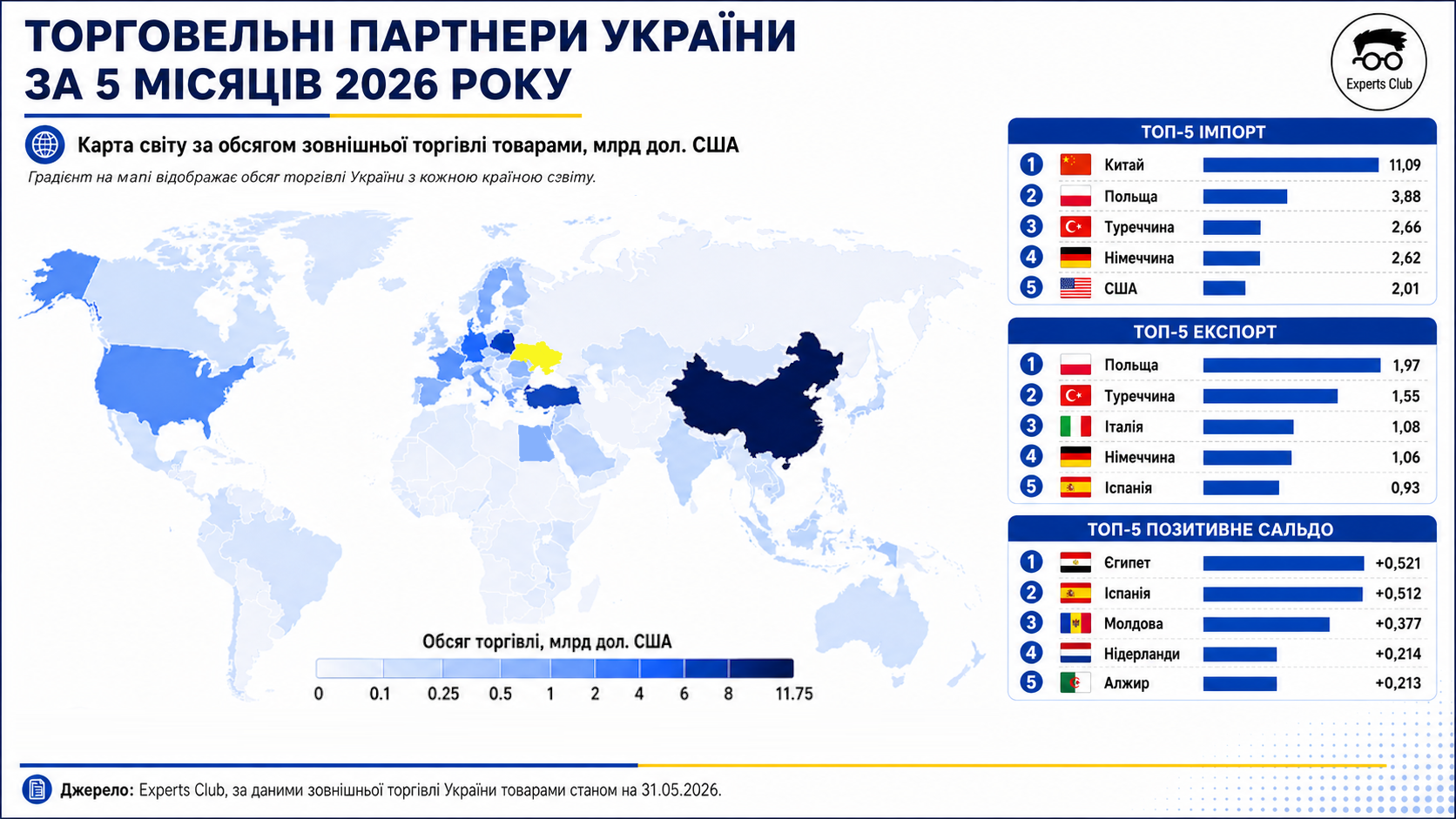
China remains a separate problem for the trade balance. Its share of Ukrainian imports in the first five months of 2026 exceeds a quarter of total imports of goods, while Ukrainian exports to China remain limited. As a result, almost half of Ukraine’s total trade deficit is generated solely in the Chinese direction.
For Ukraine, this means that restoring the foreign trade balance will require not only growth in exports of agricultural and metallurgical products, but also the development of new export niches — mechanical engineering, processing, food products, IT-related goods and industrial cooperation with the EU.
For reference: the Experts Club analytical center used data on Ukraine’s foreign trade in goods by countries of the world as of May 31, 2026. All indicators in the source table are given in thousands of US dollars.
EXPERTS CLUB, FOREIGN TRADE, TRADE BALANCE, TRADING PARTNERS, МАКСИМ УРАКІН
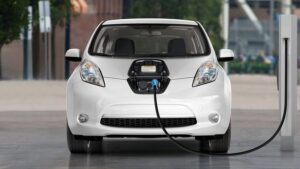
In the first half of this year, 15,221 thousand electric vehicles (new and used) were added to Ukraine’s vehicle fleet, which is half the number registered during the same period last year, according to a report by “Ukravtoprom” on its Telegram channel.
As usual, passenger cars accounted for the majority of registered electric vehicles—14,404 thousand—but their registrations fell by 53%, while demand for commercial electric vehicles dropped by 17% to 817 units.
New vehicles accounted for 19% of BEV registrations, compared to 18% last year.
The most popular new electric vehicles in January–June were the BYD Leopard 3 (421 units), the BYD Sea Lion 06 (359 units), the Zeekr 7X (229 units), the Volkswagen ID.Unyx (203 units), and the Zeekr 7X (172 units).
Among used vehicles, the most frequently registered for the first time were the Nissan Leaf (1,592 units), the Tesla Model Y (1,468 units), the Tesla Model 3 (1,355 units), the Chevrolet Bolt (613 units), and the Renault Zoe (553 units).
As previously reported, Ukraine’s vehicle fleet grew by 110,200 electric vehicles in 2025—twice as many as the previous year. New vehicles accounted for 20% of the total, compared to 24% in 2024.
In particular, in December—the last month during which electric vehicles could be cleared through customs without VAT—demand for them increased 8.6-fold compared to December 2024, reaching 32,800 units.
BEV, Electric vehicle, REGISTRATION, UKRAVTOPROM, vehicle fleet
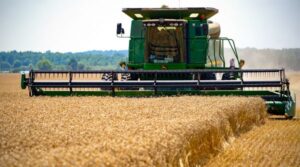
The Astarta agricultural holding has begun the harvest at its farms in Poltava Oblast and plans to harvest winter wheat from 38,000 hectares and winter rapeseed from 14,000 hectares, the company’s press service reported.
“Despite a delayed start to spring fieldwork due to unfavorable weather conditions, the harvest of early-maturing grains began at the optimal time,” the press service quoted Andriy Zagorulko, director of the holding’s Department of Crop Production, Logistics, and Mechanization, as saying.
He noted that production teams had completed all necessary preparatory work, and that the key priorities during the harvest remain harvest quality, minimizing losses, worker safety, and seamless coordination among all involved teams.
In the third ten-day period of July, enterprises in the Western region will join the harvest campaign.
“Astarta” is a vertically integrated agro-industrial holding operating in seven regions of Ukraine and is the country’s largest sugar producer. The company’s portfolio includes five sugar refineries, agricultural enterprises with a land bank of 214,000 hectares (including 129,000 hectares in Poltava Oblast, 42,000 hectares in Khmelnytskyi Oblast, and 16,000 hectares in Vinnytsia Oblast), and dairy farms with 30,000 head of cattle. The holding company also operates a soybean processing plant and a bioenergy complex in the Poltava region, as well as a network of six grain elevators. Astarta’s shares are listed on the Warsaw Stock Exchange.
Astarta’s net profit for 2025 fell 4.2-fold to $19.94 million, while consolidated revenue declined by 23% to $472 million.
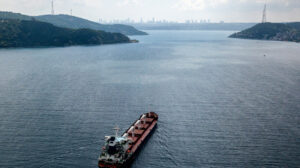
Romania, Bulgaria, and Turkey have agreed to expand the mission of the joint Black Sea Mine Countermeasures Task Group by adding the protection of critical infrastructure to its mandate.
The agreement was reached during the NATO summit in Ankara. This involves expanding the authority of the Mine Countermeasures Black Sea Task Group, which had previously focused primarily on locating and neutralizing mines in the Black Sea.
According to Reuters, the new mandate calls for the protection of energy and telecommunications facilities and undersea pipelines owned or operated by the three countries.
The Romanian Ministry of Defense stated that protecting critical infrastructure in the Black Sea requires a comprehensive, integrated, and long-term approach. The ministry also noted that a memorandum establishing the mine countermeasures security group was signed on January 11, 2024, by the defense ministers of Romania, Bulgaria, and Turkey.
The joint group became the first trilateral initiative of its kind among the three NATO countries with access to the Black Sea. Its initial task was to improve the safety of navigation following the appearance of drifting mines in the sea as a result of Russia’s war against Ukraine.
According to Reuters, the group has already neutralized more than 150 mines since its creation. The expansion of its mandate reflects growing concerns among countries in the region regarding the security of maritime infrastructure, particularly against the backdrop of developing gas projects in the Black Sea.
For Ukraine, this decision is of direct importance, as Black Sea security affects shipping, export routes, energy infrastructure, and the overall naval situation in the region. Stronger coordination between Romania, Bulgaria, and Turkey also signals greater NATO focus on the Black Sea region.
BLACK SEA, BULGARIA, DEFENSE, INFRASTRUCTURE, ROMANIA, TURKEY
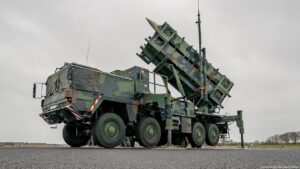
Norway has announced the allocation of 3 billion kroner (268 million euros) to strengthen Ukraine’s air defense, specifically as part of the PURL program and to purchase Patriot missiles from countries that already have them, the Norwegian government’s press service reported.
“Norway is now providing an additional 3 billion Norwegian kroner to strengthen Ukraine’s air defense systems,” the government press service stated on its website.
It is reported that Norway, together with Denmark, Germany, and Canada, will order new Patriot air defense missiles directly from the manufacturer in the U.S. as part of the PURL program.
“Given the long delivery times for some of these missiles, Norway also plans to purchase Patriot missiles from countries that already have them in order to deliver them to Ukraine as quickly as possible,” the Norwegian government emphasized.
Norway is also allocating funds to join Ukraine’s initiative to jointly develop anti-ballistic systems with European partners. “Ukraine has invited European partners to participate in the development of a specialized missile defense system. This could also be significant for the defense of Norway and other NATO member states. Norway is allocating funding to be able to contribute to this initiative,” the statement said.
“In the future, ballistic missiles may also pose a serious threat to Norway and its allies. Therefore, the Ukrainian initiative is of interest from the perspective of strengthening Norway’s defense capabilities,” said Defense Minister Tore O. Sandvik.
During the NATO summit in Ankara, Ukrainian President Volodymyr Zelenskyy stated that a key topic of discussion with partners would be the supply of interceptor missiles for the Patriot air defense system, which are critical to Ukraine’s ability to shoot down Russian ballistic missiles—and noted that these missiles are not exclusive to the United States.
As previously reported, the Netherlands, Germany, Finland, Sweden, Lithuania, Estonia, Latvia, Denmark, and Poland have appealed to the European Commission to grant authorization as soon as possible for the purchase of missiles for U.S.-made air defense systems as part of the 90 billion euro “defense” component that the EU is providing to Ukraine in 2026–27.



