
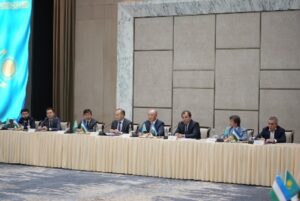
Kazakhstan and Uzbekistan plan to jointly enter new export markets in the Middle East. The agreement was reached during the Kazakhstan-Uzbekistan Business Forum, which took place on August 5 in Tashkent.
As part of the initiative, business delegations from both countries intend to visit Aleppo in late September and Erbil in early October. A trilateral business forum involving companies from Uzbekistan, Kazakhstan, and Syria is planned to be held in Syria. The Uzbek side may be represented by 20–30 companies.
The Syrian market is of particular interest, as demand for construction materials, food products, sunflower oil, and meat products is growing amid the country’s reconstruction.
In Iraq, the supply of confectionery products, porcelain tiles, household chemicals, and polyethylene pellets has been identified as promising areas.
Joint entry into third-country markets will make it possible to:
· expand the export reach of Kazakhstan and Uzbekistan;
· combine the production and export capabilities of the two countries;
· develop cooperation between enterprises;
· utilize shared logistics routes;
· find new foreign partners.
The initiative reflects a new approach to economic partnership between the two countries—shifting from the development of mutual trade to the joint development of third-country markets. Uzbekistan and Kazakhstan also maintain their goal of increasing bilateral trade to $10 billion.
Iraq is forming a new package of cooperation with American energy companies that is expected to increase oil and gas production, accelerate the processing of associated gas, and attract private capital to modernize the country’s oil and gas infrastructure.
Iraq’s Oil Minister Basim Mohammed estimated the total value of agreements between the Iraqi oil ministry and U.S. companies at approximately $200 billion. According to him, the projects should significantly expand production capacity and increase investment in the use of associated gas. Iraq’s current oil production capacity is estimated at about 4.8 million barrels per day.
At the same time, the declared $200 billion should not be viewed exclusively as the volume of already financed projects. The package includes contracts, preliminary agreements, memorandums, technical studies, and potential investment programs, the final parameters of which will be determined following negotiations.
During the visit of Iraqi Prime Minister Ali Faleh al-Zaidi to the United States, the Iraqi delegation held talks with representatives of Halliburton, Shell, Honeywell, Weatherford, and Baker Hughes. The parties discussed the development of oil and gas fields, the introduction of modern technologies, and increasing the efficiency of the energy sector.
Separate talks were held with Chevron. Iraq proposed that the company expand its activities in the southern fields and participate in oil refining, petrochemical, and gas infrastructure projects.
Chevron, for its part, expressed interest in developing the southern fields, laying pipelines to regional ports, and creating oil storage facilities. Iraqi authorities stated their readiness to speed up the allocation of land plots, the issuance of permits, and the creation of the necessary infrastructure.
Halliburton received a contract from Basra Oil Company to provide integrated management services for the Bin Omar and Sindbad fields in southern Iraq. The agreement provides for integrated asset development management, as well as support for the design, procurement, and construction of infrastructure.
In fact, Iraq is seeking to move from separate service contracts to a long-term presence of American companies in production, processing, oilfield services, digital field management, and the construction of export infrastructure.
For Baghdad, American capital is important not only as a source of financing. Large U.S. companies can provide access to enhanced oil recovery technologies, modern drilling and compressor equipment, automation of production processes, and international project management standards.
An additional task is the diversification of export routes. Iraq is interested in developing pipelines, oil storage facilities, and new outlets to regional ports in order to reduce dependence on a limited number of supply routes.
What opportunities are opening up for Ukraine
The scale of Iraqi projects creates opportunities not only for American operators. A significant part of the work will be carried out by international EPC contractors, oilfield service companies, and equipment suppliers that form their own global procurement chains.
For Ukrainian companies, the most realistic path is not the independent development of oil fields, but participation in the projects as suppliers, engineering partners, and subcontractors of American operators.
One of the main areas could be pipe and metallurgical products. Field development and export infrastructure construction projects will require casing, tubing, and trunk pipelines, sheet metal products, tanks, metal structures, and elements of industrial buildings.
Ukrainian manufacturers could also supply pumping and compressor equipment, shut-off valves, electric motors, transformers, cable products, switchgear, and modular substations.
A separate niche is connected with the processing of associated gas. Iraq needs gas gathering networks, compressor stations, gas purification and treatment units, small power plants, and electricity transmission equipment. American agreements provide for increased investment specifically in gas projects.
Ukrainian engineering companies can participate in the design of pipelines, tank farms, compressor and pumping stations, industrial facilities, and power supply systems.
There are also prospects for the IT sector. This concerns the implementation of SCADA systems, automated oil and gas metering, digital field modeling, equipment condition monitoring, and industrial cybersecurity.
Another area could be the technical diagnostics of pipelines, protection of metal from corrosion, inspection of existing infrastructure, and preparation of projects for its modernization.
The development of the oil and gas sector will also create demand in related industries. The construction of industrial facilities will require cement, road materials, specialized machinery, mobile buildings, warehouse equipment, water supply systems, and transport logistics.
Additional opportunities may arise for Ukrainian food producers. Large projects are accompanied by the creation of workers’ settlements, logistics centers, and new service enterprises, which increases demand for flour, vegetable oil, poultry meat, cereals, and ready-made food products.
A trilateral model could be optimal, in which an American company acts as the operator or general contractor, a Ukrainian enterprise supplies equipment, materials, or engineering solutions, and an Iraqi partner provides registration, local logistics, and interaction with government agencies.
Working through American operators and international EPC contractors allows Ukrainian enterprises to obtain more transparent technical requirements, safety standards, and quality control procedures.
At the same time, Ukrainian companies will need to undergo supplier prequalification, confirm that their products comply with API, ASTM, or the requirements of a specific customer, prepare English-language technical documentation, and provide after-sales service for the equipment.
For a systematic entry into the market, it would be advisable to form a separate catalog of Ukrainian manufacturers of oil and gas and energy equipment. It should specify production capacities, international certificates, experience in export deliveries, and readiness to work through American general contractors.
The next stage could be a trilateral business mission Ukraine–USA–Iraq with the participation of manufacturers of pipes, energy equipment, engineering, and digital companies.
The most logical venues for such events are Baghdad, Basra, and Houston, where Iraqi customers, oilfield service companies, and the main decision-making centers of the American energy industry are concentrated.
Maxim Urakin, founder of the Experts Club information and analytical center, commenting on the structure of Ukraine’s foreign trade, noted the need to move to a more complex export model.
“Ukraine needs to increase not only the physical volume of supplies, but also the share of products with high added value,” Urakin emphasized.
In his opinion, in order to reduce the trade deficit, Ukraine needs to develop processing industries, machine-building, the food industry, and technological exports.
Applied to Iraq, such a strategy means a transition from predominantly traditional commodity supplies to the export of pipes, metal structures, equipment, software solutions, and engineering services.
Iraq is already a profitable market for Ukraine with a large positive trade balance. However, participation in energy and infrastructure projects would make the relationship more long-term and increase the share of industrial products in Ukrainian exports.
According to the Experts Club information and analytical center, in January–June 2026 Iraq ranked 53rd among Ukraine’s largest trading partners.
Trade turnover between the countries amounted to $151.123 million. Ukraine exported goods to Iraq worth $151.051 million, while imports of Iraqi products amounted to only $72 thousand.
The positive trade balance for Ukraine reached $150.979 million. Thus, virtually the entire bilateral trade turnover was formed by Ukrainian exports. The data are presented in the table accompanying the Experts Club analysis published on July 16, 2026.
For comparison, at the end of 2025, Ukraine’s trade turnover with Iraq was estimated at $392.836 million. Ukrainian exports amounted to $392.513 million, imports to $323 thousand, and the positive balance reached $392.190 million.
The trade figures confirm that Iraq remains a profitable sales market for Ukrainian companies. At the same time, the almost one-sided trade structure indicates a low level of mutual investment and industrial cooperation.
Iraq’s new agreements with the United States may become an opportunity to change this model. Even limited participation of Ukrainian enterprises in energy projects with a total declared value of up to $200 billion can significantly increase exports of high value-added products.
With the proper organization of trilateral cooperation, Iraq can gradually turn from a predominantly commodity market into a long-term industrial, energy, and infrastructure partner of Ukraine.
Iraq has estimated the total value of contracts and agreements concluded with American energy companies during Prime Minister Ali al-Zaidi’s July visit to the United States at approximately $200 billion.
Iraqi Oil Minister Basim Mohammed Khudair announced this on July 21. According to him, the projects are expected to increase the country’s production capacity, expand associated gas processing and bring American technologies into the oil and gas industry. The minister estimated Iraq’s current production capacity at 4.8 million barrels of oil per day.
The announced package includes seven key arrangements related to field development, oil and gas asset management, energy infrastructure modernisation and the search for new export routes.
At the same time, the $200 billion estimate does not yet mean that the entire amount has already been formalised as binding capital investment. The package includes contracts, framework agreements, memoranda and preliminary arrangements. The final volume of investment will depend on the results of technical studies, commercial negotiations, the agreement of financing terms and the receipt of regulatory approvals.
Chevron expands its presence in Iraq
The American company Chevron has become one of the central participants in the new energy cooperation.
The company is negotiating its participation in the operation of the West Qurna-2 field, one of Iraq’s largest oil assets, as well as the development of the Nasiriyah field. The parties previously signed preliminary documents concerning Nasiriyah, the Balad field and several exploration blocks in Dhi Qar Province.
During a meeting with Chevron’s management, the Iraqi prime minister called on the company to accelerate investment in oil and gas production and the construction of oil refineries, petrochemical plants, pipelines and storage facilities.
The Iraqi side stated that it was prepared to allocate land plots and expedite administrative approvals for major energy projects. Chevron, in turn, expressed interest in fields in the south of the country and in developing infrastructure for the storage and export of raw materials.
The agreements concerning West Qurna-2 and Nasiriyah remain predominantly preliminary. Before final contracts are concluded, Chevron must examine the projects’ geological, technical and commercial data.
Halliburton to manage the Bin Umar and Sindbad fields
The American oilfield services company Halliburton has received a contract from the state-owned Basra Oil Company for the comprehensive management of the development of the Bin Umar and Sindbad oil and gas fields in southern Iraq.
The contract provides for integrated field management services, as well as support for the design, procurement and construction of the necessary infrastructure.
The involvement of Halliburton is expected to help Iraq increase oil and gas recovery from existing assets, introduce modern reservoir management methods and reduce technological losses.
Another agreement has been concluded with the American company HKN Energy for the development of the Himrin field in the north of the country. The Iraqi government approved the project as part of a broader programme to attract American companies to the oil and gas and electric power sectors.
Iraq seeks alternative oil export routes
One of Baghdad’s strategic objectives is to reduce its dependence on routes through the Persian Gulf and the Strait of Hormuz.
Recent regional crises have demonstrated the vulnerability of Iraq, most of whose oil exports pass through southern terminals. Shipping restrictions and export disruptions have a direct impact on production, budget revenues and the state’s ability to finance infrastructure projects.
Iraq is considering expanding supplies through the Turkish port of Ceyhan and creating a route to the Mediterranean Sea through Syria. The Iraqi and Syrian sides previously discussed transporting oil to the port of Baniyas, including the possibility of restoring existing infrastructure or constructing a new pipeline system.
Chevron is also exploring the possibility of participating in export pipeline and storage projects. If implemented, they would connect the oil fields of southern and northern Iraq with alternative maritime terminals and reduce the country’s dependence on the Strait of Hormuz.
However, such projects will require interstate agreements, large-scale investment and security guarantees. The restoration of pipelines through Syria is complicated by the condition of the infrastructure and the need to ensure the protection of the route along its entire length.
Baghdad turns towards American capital
The current arrangements reflect a broader shift in Iraq’s energy policy towards the United States.
In recent years, Chinese companies have secured a significant share of the country’s new oil and gas projects. Major assets have also been managed by Russian and European operators.
Ali al-Zaidi’s government has announced its intention to give priority to reputable American companies in the energy, telecommunications and technology sectors. To facilitate their entry into the market, the authorities have begun reviewing certain administrative requirements and strengthening the security of oil facilities.
For Iraq, such cooperation is expected to provide access to investment, technologies, oilfield services equipment and political support from Washington. For American companies, the country is attractive because of its large oil reserves, underdeveloped gas sector and need to modernise its infrastructure.
Production growth constrained by OPEC+ agreements
Iraq intends to increase its oil production capacity, but actual production volumes depend on more than investment alone.
The country participates in OPEC+ agreements and is required to comply with the established restrictions. In July, the group’s countries again reaffirmed their commitment to the current arrangements, including the need to compensate for previously exceeding production quotas.
The Iraqi Ministry of Oil previously announced plans to increase production capacity to more than 6 million barrels per day by 2028–2029. Achieving this goal will require the development of new fields, the rehabilitation of existing assets, the expansion of export infrastructure and agreement on a higher quota within OPEC+.
The development of the gas industry remains a separate priority. Iraq is seeking to expand the processing of associated gas, which continues to be flared at fields, and reduce the electric power sector’s dependence on imported fuel.
The authorities plan to increase the utilisation of produced gas to the highest possible level and virtually eliminate its flaring by the end of the decade.
Implementation of agreements will take several years
The package of projects with American companies could become one of the largest investment shifts in the history of Iraq’s oil and gas industry.
However, a significant share of the arrangements remains at a preliminary stage. To proceed to full implementation, the parties must determine the commercial terms, allocation of risks, investment payback periods and security guarantees.
OPEC+ quotas, bureaucratic procedures, the condition of pipeline infrastructure and regional instability remain additional constraints.
If even part of the announced projects is implemented, Iraq will be able to increase oil and gas production, expand processing, reduce its dependence on a single export route and strengthen its position as one of the largest energy producers in the Middle East.
ENERGY, INVESTMENT, IRAQ, OIL, USA
According to a survey conducted in March 2026 by the research company Active Group in collaboration with the Experts Club information and analytical center, Ukrainians’ attitudes toward Iraq are characterized by a significant proportion of neutral and negative assessments, which collectively form a generally reserved and distant image of the country. According to the survey results, positive attitudes account for only 8.4%, while negative ones account for 35.2%, indicating a significant imbalance in perception. At the same time, more than half of the respondents (50.6%) hold a neutral position, indicating a limited level of formed perceptions about Iraq.
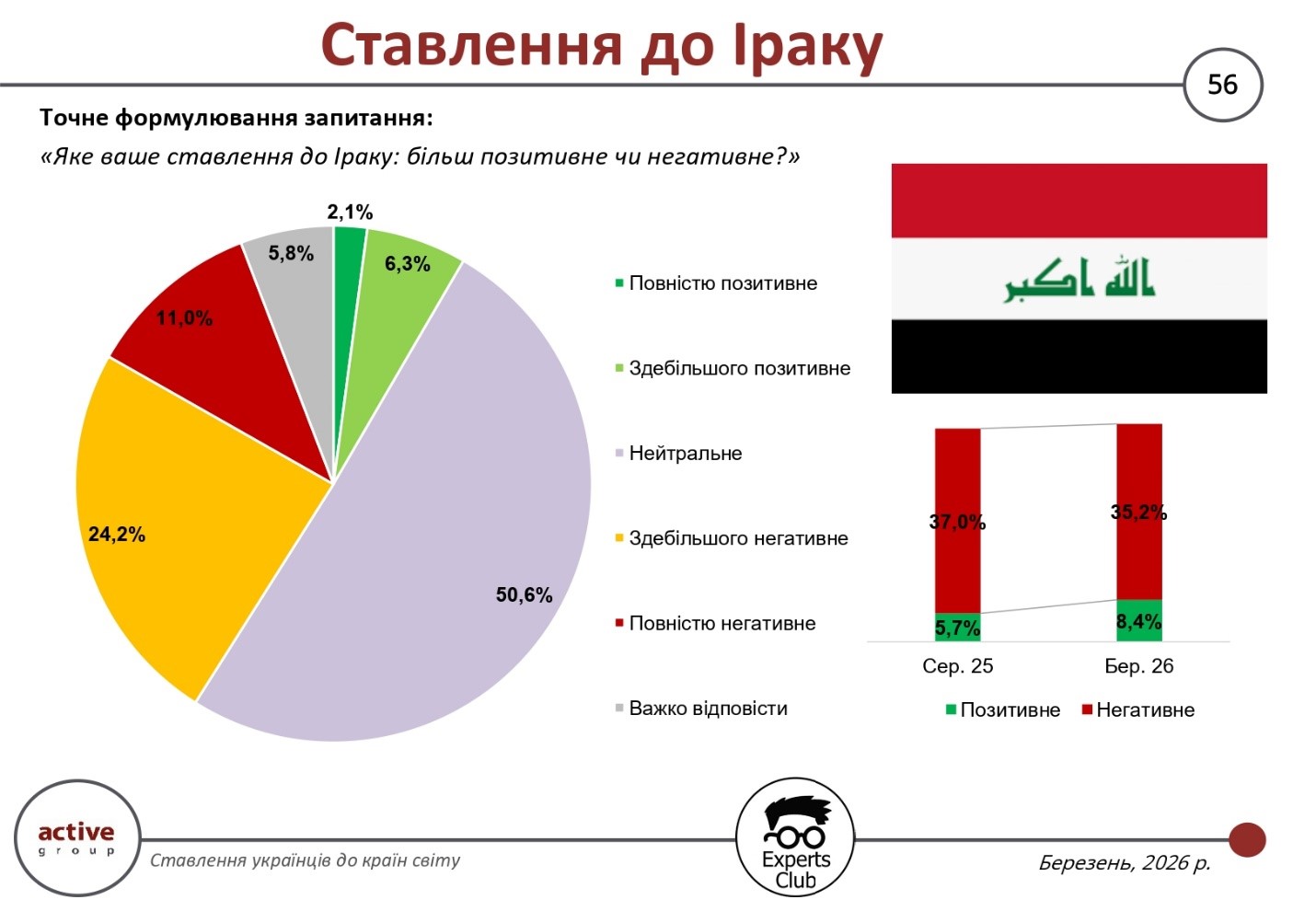
The structure of positive assessments is quite weak: only 2.1% of respondents expressed a “completely positive” attitude, and another 6.3% said it was “mostly positive.” This is one of the lowest figures among the countries included in the study. In contrast, negative perceptions are significantly more pronounced: 24.2% of respondents chose “mostly negative,” and 11.0% selected “completely negative.”
Despite this, a certain positive trend is observed compared to August 2025. The share of positive assessments rose from 5.7% to 8.4%, while negative ones decreased slightly—from 37.0% to 35.2%. This may indicate a gradual softening of perceptions, although the overall balance remains negative.
The high proportion of neutral responses, combined with a significant level of negativity, indicates the specific nature of perceptions of Iraq in Ukraine. On the one hand, a significant portion of the population lacks sufficient information or personal experience to form a clear position. On the other hand, existing perceptions are likely linked to the global information context, which tends to foster a cautious or critical attitude.
“If we see a high proportion of neutral assessments alongside significant negativity, it means the country is present in the information space, but this presence does not create a positive image. In such cases, it is important to work not only on economic cooperation but also on communication and reputation. Without this, neutrality can gradually transform into a persistent negative perception,” noted Maksym Urakin, founder of the Experts Club information and analytical center.
Thus, Iraq remains a country with a limited level of trust and weak positive identification for Ukrainians. The future dynamics of perception will depend on whether this country can strengthen its presence in Ukraine’s positive informational and economic context.
According to a study conducted by the Experts Club Information and Analytical Center based on data from the State Customs Service, Iraq ranks 44th in terms of total trade in goods with Ukraine, amounting to $392.8 million. This is one of the most striking examples of a positive trade balance for Ukraine, as nearly the entire volume of bilateral trade consists of Ukrainian exports, and the positive balance amounts to $392.2 million.
The study was presented at the Interfax-Ukraine press center; the video can be viewed on the agency’s YouTube channel. The full version of the study can be found at this link on the Experts Club analytical center’s website.
ACTIVE GROUP, EXPERTS CLUB, IRAQ, Pozniy, SOCIOLOGY, SURVEY, UKRAINE, URAKIN

France’s TotalEnergies has announced that it has halted or is in the process of halting production in Qatar, Iraq, and offshore assets in the UAE. According to the company’s estimates, these assets account for about 15% of its total production. This is stated in TotalEnergies’ statement on its investor page.
The company clarified that onshore production in the UAE is not affected by the conflict. Its volume is about 210,000 barrels of oil equivalent per day in TotalEnergies’ share. At the same time, 15% of the volume in the Middle East accounts for about 10% of the upstream segment’s cash flow, as local assets are subject to higher taxes and generate less cash flow per barrel than the group’s portfolio average.
The company also said that rising oil prices could compensate for the decline in volumes. According to TotalEnergies’ estimates, an $8 per barrel increase in the price of Brent is enough to offset the expected 2026 cash flow from assets in Iraq, Qatar, and offshore UAE at a price of $60 per barrel. At the same time, operations at the SATORP oil refinery in Saudi Arabia continue as usual and supply the kingdom’s domestic market.
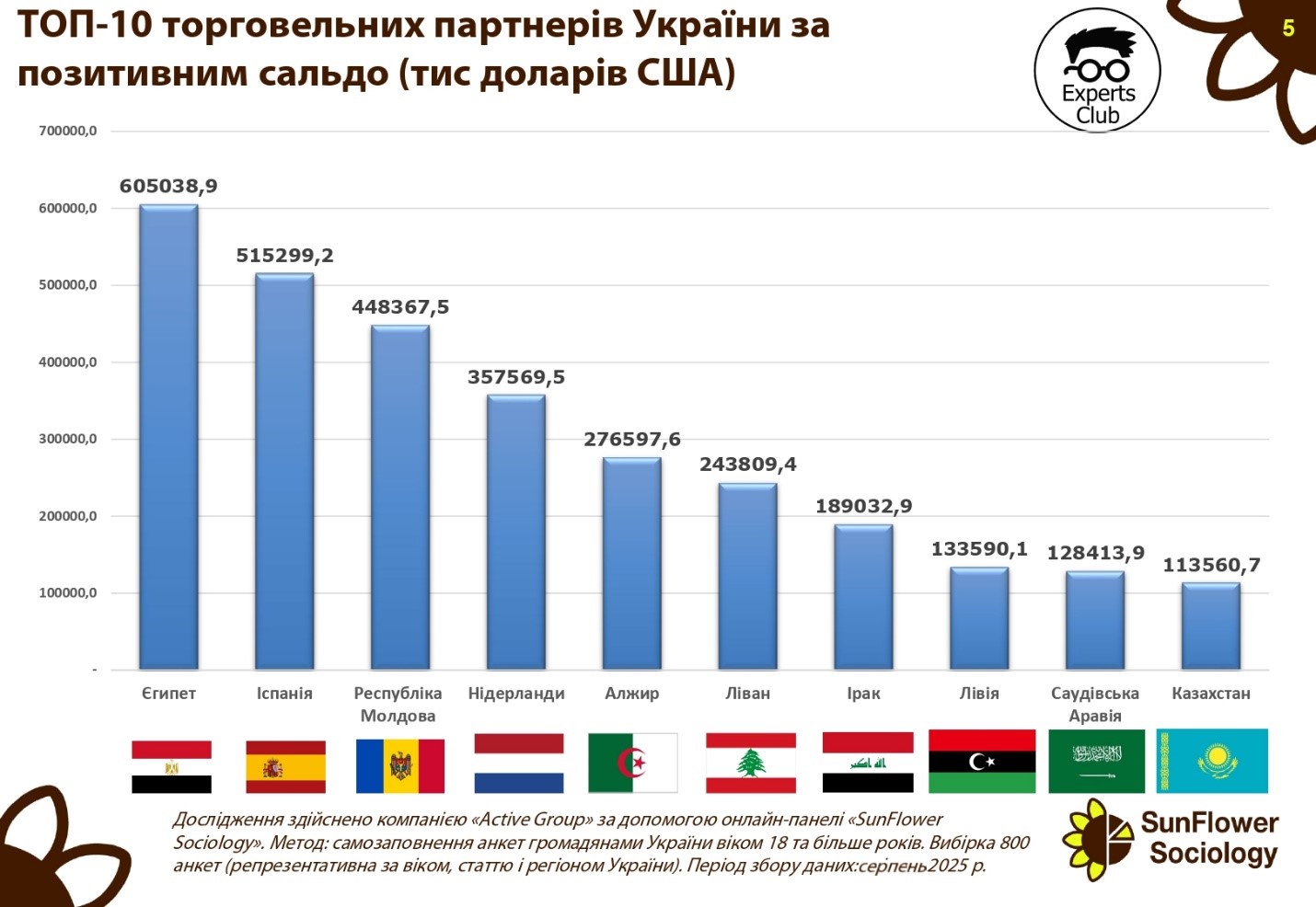
Ukraine maintains a significant positive trade balance with a number of key partners, which partially offsets the deficit in relations with China and EU countries.
The largest surplus in the first half of 2025 was recorded in trade with Egypt — $605.0 million. Spain ranks second with a balance of $515.3 million, followed by the Republic of Moldova — $448.4 million. Positive dynamics are also observed in relations with the Netherlands ($357.6 million), Algeria ($276.6 million), and Lebanon ($243.8 million).
Ukraine also has a high trade surplus with Iraq ($189.0 million), Libya ($133.6 million), Saudi Arabia ($128.4 million), and Kazakhstan ($113.6 million).
“The positive trade balance indicates that Ukraine is capable of competing effectively in international markets, especially in the agricultural sector and metallurgy. At the same time, it should be borne in mind that these markets are vulnerable to changes in the global economic situation, price fluctuations, and political factors,” emphasized Maksim Urakin, founder of Experts Club and economist.
According to him, maintaining a positive balance in relations with the countries of the Middle East and North Africa is a key element of Ukraine’s foreign trade strategy.
“Egypt, Spain, and the countries of the Arab world are stable importers of Ukrainian agricultural products. This is a strategic direction that needs to be developed further, as it creates a safety cushion for the economy against the backdrop of significant import costs,” Urakyn emphasized.
Analysts note that consolidating positions in the African and Middle Eastern markets could become a long-term factor in strengthening Ukraine’s foreign economic balance.
Agricultural exports, ALGERIA, ECONOMY, EGYPT, EXPERTS CLUB, FOREIGN TRADE, IRAQ, KAZAKHSTAN, LEBANON, LIBYA, MOLDOVA, NETHERLANDS, positive balance, SAUDI ARABIA, SPAIN, UKRAINE, МАКСИМ УРАКИН



